Forta (FORT) is a decentralized threat detection platform delivering real-time security monitoring across DeFi, NFT, governance, and Web3 systems since June 2022. Trading at $0.02053 with a $12.92 million market capitalization and moderate 5,289 holders on 11 exchanges including Gate, FORT addresses critical blockchain infrastructure security needs. This comprehensive analysis examines FORT's investment viability through historical price trends (79.83% decline over one year), core technological value propositions, and tokenomics featuring a fixed 1 billion token supply with 62.93% circulation. Short-term forecasts range from $0.0199-$0.0293, while long-term scenarios project $0.024-$0.046 based on adoption catalysts and ecosystem expansion. The article provides tailored investment strategies for beginners through institutional investors, risk management frameworks including asset allocation ratios and secure storage solutions, and detailed risk assessments covering market volatility, regulatory uncertainty, a
Introduction: Forta (FORT) Investment Position and Market Outlook
Forta (FORT) represents a significant asset in the cryptocurrency sector, focusing on real-time detection and security monitoring for blockchain activities. As a decentralized monitoring network, Forta detects threats and anomalies across DeFi, NFT, governance, bridges, and other Web3 systems in real time. Since its launch in June 2022, FORT has established its presence in the blockchain security monitoring space.
As of January 25, 2026, FORT is trading at approximately $0.02053, with a market capitalization of around $12.92 million and a circulating supply of approximately 629.29 million tokens out of a maximum supply of 1 billion tokens. The token holds a market ranking of 1088 and maintains a market dominance of 0.00065%. With its positioning as a security-focused monitoring solution for Web3 infrastructure, FORT has gradually become a subject of interest when investors discuss "Is Forta (FORT) a good investment?"
Recent price trends show mixed performance: a 2.49% increase over 24 hours and a 3.69% gain over 30 days, while experiencing a 4.25% decline over 7 days and a significant 79.83% decrease over the past year. The token is available on 11 exchanges and has approximately 5,289 holders. This article provides a comprehensive analysis of FORT's investment value, historical trends, future price predictions, and associated investment risks to serve as a reference for investors.
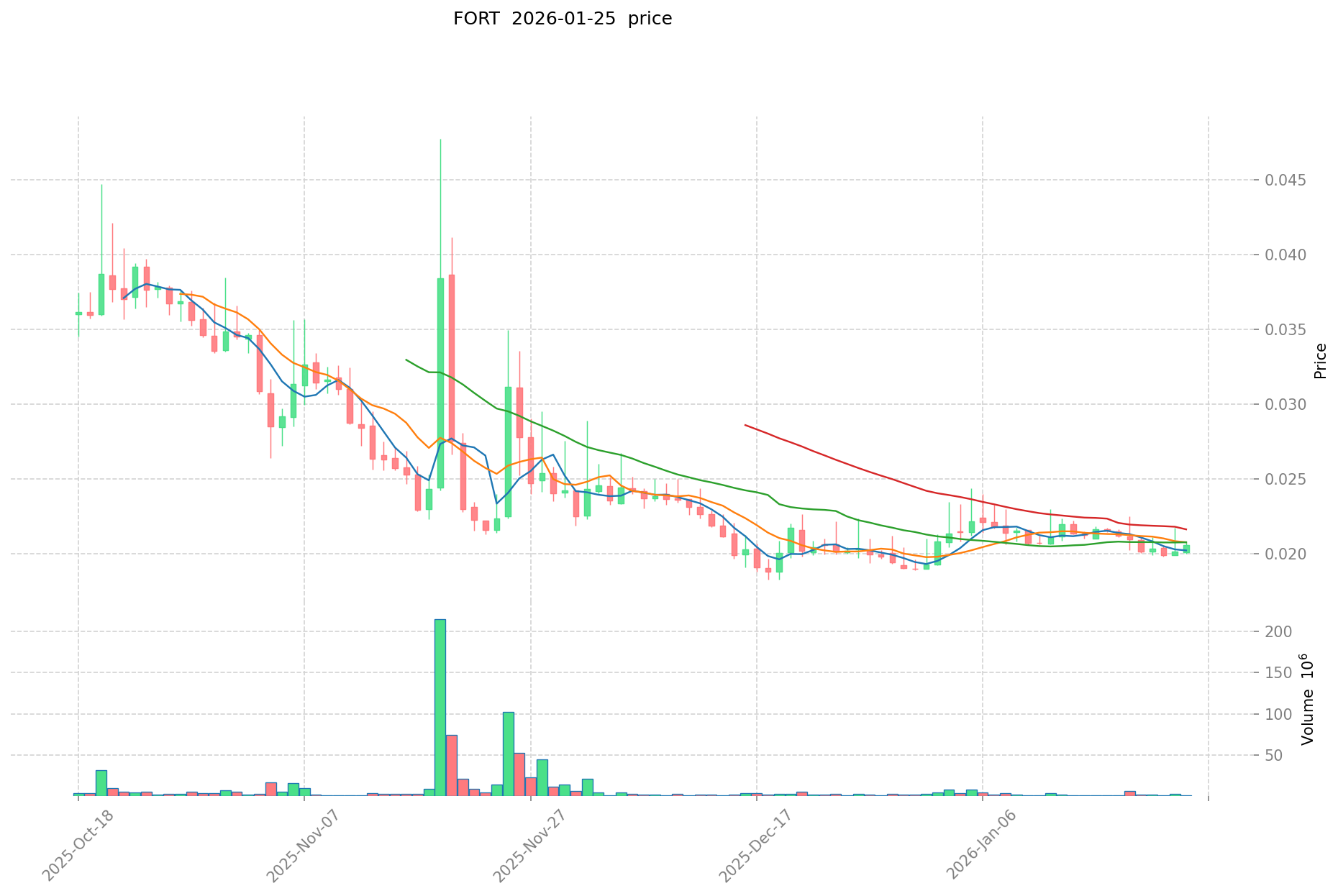
I. Historical Price Review and Current Investment Value Status of FORT
- 2022: Token launch at $0.25 and subsequent price discovery phase → Price declined from initial offering levels
- 2022: Market cycle impact → Price decreased from peak levels of $0.964645 in June 2022
- 2025: Market volatility period → Price reached lower trading ranges around $0.01832485 in December 2025
Current FORT Investment Market Status (January 2026)
- Current FORT price: $0.02053
- 24-hour trading volume: $23,460.66
- 24-hour price change: +2.49%
- Circulating supply: 629,287,639.63 FORT (62.93% of total supply)
- Market capitalization: $12,919,275.24
- Total supply: 1,000,000,000 FORT
Click to view real-time FORT market price
II. Core Factors Affecting Whether FORT is a Good Investment (Is Forta(FORT) a Good Investment)
Supply Mechanism and Scarcity (FORT investment scarcity)
- Fixed maximum supply of 1,000,000,000 FORT tokens → Affects price and investment value
- Current circulating supply of 629,287,639.63 FORT (62.93% of total supply) → Indicates gradual token release
- Historical data shows price fluctuations from $0.01832485 to $0.964645 → Reflects market volatility and supply-demand dynamics
- Investment significance: Token scarcity mechanism with capped supply provides potential long-term value support
Institutional Investment and Mainstream Adoption (Institutional investment in FORT)
- Current holder count: 5,289 addresses → Indicates moderate level of decentralized ownership
- FORT is listed on 11 cryptocurrency exchanges including Gate.com → Provides accessibility for institutional and retail investors
- Market capitalization of approximately $12.92 million with 0.00065% market dominance → Represents relatively small market presence in the broader cryptocurrency landscape
Macroeconomic Environment's Impact on FORT Investment
- As a blockchain security and monitoring protocol token, FORT's investment appeal may be influenced by broader cryptocurrency market sentiment and regulatory developments
- Price performance shows -79.83% decline over one year (as of January 25, 2026) → Reflects challenging market conditions
- 30-day price increase of 3.69% → Indicates potential short-term recovery momentum
Technology and Ecosystem Development (Technology & Ecosystem for FORT investment)
- Real-time detection network for blockchain security monitoring → Core technological value proposition
- Decentralized monitoring capabilities for DeFi, NFT, governance, bridges and Web3 systems → Addresses critical security infrastructure needs
- Multi-chain deployment: ERC-20 token on Ethereum mainnet with additional presence on Polygon network → Expands accessibility and utility
- Focus on threat detection and anomaly identification → Provides essential security services that support long-term ecosystem value
III. FORT Future Investment Forecast and Price Outlook (Is Forta (FORT) worth investing in 2026-2031)
Short-term Investment Forecast (2026, short-term FORT investment outlook)
- Conservative forecast: $0.0199 - $0.0205
- Neutral forecast: $0.0205 - $0.0248
- Optimistic forecast: $0.0248 - $0.0293
Mid-term Investment Outlook (2027-2029, mid-term Forta (FORT) investment forecast)
-
Market stage expectation: During the 2027-2029 period, FORT may experience gradual growth as the decentralized monitoring network continues to expand its capabilities in detecting threats across DeFi, NFT, governance, and bridge systems. The token's utility within the Forta ecosystem could drive moderate adoption.
-
Investment return forecast:
- 2027: $0.0224 - $0.0301
- 2028: $0.0261 - $0.0283
- 2029: $0.0190 - $0.0360
-
Key catalysts: Enhanced security monitoring features, expanded partnerships with Web3 projects, increased adoption of real-time threat detection services, and broader integration within the blockchain security ecosystem.
Long-term Investment Outlook (Is FORT a good long-term investment?)
- Base scenario: $0.0242 - $0.0360 (assuming steady development of the Forta network and consistent adoption of decentralized monitoring solutions)
- Optimistic scenario: $0.0319 - $0.0459 (assuming accelerated adoption of blockchain security services and favorable market conditions supporting Web3 infrastructure tokens)
- Risk scenario: $0.0190 - $0.0265 (under conditions of reduced demand for security monitoring services or increased competition in the decentralized security space)
Click to view FORT long-term investment and price forecast: Price Prediction
2026-01-25 - 2031 Long-term Outlook
- Base scenario: $0.024 - $0.036 (corresponding to steady progress and gradual mainstream application enhancement)
- Optimistic scenario: $0.032 - $0.046 (corresponding to large-scale adoption and favorable market environment)
- Transformative scenario: Above $0.046 (such as breakthrough progress in the ecosystem and mainstream popularization)
- 2031-12-31 predicted high: $0.0459 (based on optimistic development assumptions)
Disclaimer: This forecast is for informational purposes only and does not constitute investment advice. Cryptocurrency markets are highly volatile, and actual prices may differ significantly from predictions. Investors should conduct their own research and consider their risk tolerance before making investment decisions.
| Year |
Predicted High Price |
Predicted Average Price |
Predicted Low Price |
Price Change |
| 2026 |
0.0292864 |
0.02048 |
0.0198656 |
0 |
| 2027 |
0.030108672 |
0.0248832 |
0.02239488 |
21 |
| 2028 |
0.02832081408 |
0.027495936 |
0.0261211392 |
33 |
| 2029 |
0.0360018038016 |
0.02790837504 |
0.0189776950272 |
35 |
| 2030 |
0.036109251045504 |
0.0319550894208 |
0.026522724219264 |
55 |
| 2031 |
0.045943429814755 |
0.034032170233152 |
0.024162840865537 |
65 |
IV. FORT Investment Strategy and Risk Management (How to invest in Forta)
Investment Methodology (FORT investment strategy)
-
Long-term Holding (HODL FORT): Suitable for conservative investors who believe in the long-term value proposition of decentralized blockchain security monitoring infrastructure. This approach involves purchasing FORT tokens and holding them through market cycles, focusing on the protocol's fundamental development rather than short-term price movements.
-
Active Trading: Relies on technical analysis and swing trading strategies. Traders may monitor price movements within the identified 24-hour range ($0.01997 - $0.02074) and utilize momentum indicators to capture short-term volatility. Given FORT's historical price fluctuation from its all-time low of $0.01832485 to current levels, swing trading opportunities may emerge during market sentiment shifts.
Risk Management (Risk management for FORT investment)
-
Asset Allocation Ratios:
- Conservative investors: Allocate 1-3% of crypto portfolio to FORT
- Moderate investors: Allocate 3-7% with regular rebalancing
- Experienced investors: May allocate 7-15% with active management strategies
-
Risk Hedging Solutions: Implement multi-asset portfolio construction combining FORT with established cryptocurrencies and stablecoins. Consider utilizing stop-loss orders and position sizing strategies to manage downside exposure. Diversification across different Web3 security and infrastructure projects may reduce protocol-specific risks.
-
Secure Storage: Utilize cold wallets for long-term holdings and hot wallets only for active trading purposes. Hardware wallet solutions such as Ledger or Trezor are recommended for storing ERC-20 tokens. Given FORT's deployment on Ethereum mainnet (contract: 0x41545f8b9472D758bB669ed8EaEEEcD7a9C4Ec29) and Polygon network, ensure wallet compatibility with both chains.
V. FORT Investment Risks and Challenges (Risks of investing in Forta)
-
Market Risk: FORT exhibits substantial price volatility, with a 1-year decline of 79.83% from peak levels. The token's 24-hour trading volume of approximately $23,461 indicates moderate liquidity, which may expose investors to potential price slippage during large transactions. The current market capitalization of approximately $12.92 million represents 0.00065% market dominance, suggesting susceptibility to broader crypto market movements and potential low-volume manipulation risks.
-
Regulatory Risk: As a decentralized monitoring network operating across blockchain ecosystems, FORT faces evolving regulatory frameworks in different jurisdictions. Policy uncertainty regarding Web3 infrastructure protocols, token classification, and cross-border blockchain monitoring services may impact project operations and token utility. Changes in securities regulations or blockchain compliance requirements could affect FORT's market accessibility and adoption trajectory.
-
Technical Risk: The protocol's dependency on accurate real-time threat detection across multiple blockchain networks introduces technical complexity. Potential network security vulnerabilities in the monitoring infrastructure, smart contract exploits affecting the ERC-20 token contracts on Ethereum or Polygon, or failures in protocol upgrades could compromise system integrity. Additionally, the effectiveness of Forta's decentralized detection network relies on continuous node participation and monitoring quality, which may face operational challenges.
VI. Conclusion: Is Forta a Good Investment?
-
Investment Value Summary: FORT presents investment opportunities within the blockchain security infrastructure sector, addressing the growing need for real-time threat detection across DeFi, NFT, and Web3 systems. However, the token has experienced significant price depreciation over the past year, and the market demonstrates considerable short-term volatility.
-
Investor Recommendations:
✅ Beginners: Consider dollar-cost averaging (DCA) strategies with small, regular purchases rather than lump-sum investments. Prioritize secure storage using hardware wallets compatible with Ethereum and Polygon networks. Limit initial exposure to 1-2% of total portfolio allocation.
✅ Experienced Investors: Implement swing trading strategies around established support and resistance levels while maintaining a core long-term position. Utilize multi-asset portfolio construction combining FORT with complementary Web3 infrastructure tokens. Monitor protocol development milestones and ecosystem adoption metrics for rebalancing decisions.
✅ Institutional Investors: Evaluate strategic long-term allocation within blockchain security infrastructure thesis. Consider FORT as part of diversified exposure to decentralized monitoring solutions serving enterprise and protocol clients. Conduct thorough due diligence on tokenomics, with circulating supply at 62.93% of maximum supply (629,287,639 / 1,000,000,000 tokens).
⚠️ Disclaimer: Cryptocurrency investments carry high risk, including potential complete loss of capital. This analysis is provided for informational purposes only and does not constitute financial, investment, or legal advice. Investors should conduct independent research and consult qualified financial advisors before making investment decisions.
VII. FAQ
Q1: What is Forta (FORT) and what makes it unique in the cryptocurrency market?
Forta (FORT) is a decentralized monitoring network that provides real-time threat detection and security monitoring for blockchain activities across DeFi, NFT, governance, bridges, and Web3 systems. What distinguishes FORT from other cryptocurrency projects is its specialized focus on blockchain security infrastructure—it operates as a monitoring protocol rather than a traditional financial asset. Launched in June 2022, the network enables continuous detection of anomalies and threats through decentralized nodes, addressing critical security needs within the rapidly expanding Web3 ecosystem. The FORT token serves as the utility and governance mechanism for this security infrastructure, with deployment on both Ethereum mainnet and Polygon network.
Q2: How has FORT's price performed historically, and what is its current market position?
FORT has experienced significant price volatility since its launch. The token reached an all-time high of approximately $0.964645 in June 2022 shortly after launch, but declined substantially over subsequent periods, reaching a low of $0.01832485 in December 2025. As of January 25, 2026, FORT trades at approximately $0.02053 with a market capitalization of $12.92 million and holds a market ranking of 1088. The token has shown a 79.83% decline over the past year, though recent short-term performance indicates a 2.49% gain over 24 hours and 3.69% increase over 30 days. With approximately 5,289 holders and trading availability on 11 exchanges, FORT represents a relatively small-cap asset in the cryptocurrency market.
Q3: What investment strategies are recommended for different types of FORT investors?
Investment strategies should align with investor experience levels and risk tolerance. Beginners are recommended to employ dollar-cost averaging (DCA) with small, regular purchases limiting exposure to 1-2% of total portfolio, prioritizing secure hardware wallet storage compatible with Ethereum and Polygon networks. Experienced investors may implement swing trading strategies around identified support levels ($0.01997) and resistance levels ($0.02074) while maintaining a core long-term position, allocating 3-7% with regular rebalancing and monitoring protocol development milestones. Institutional investors should consider strategic long-term allocation within blockchain security infrastructure thesis as part of diversified Web3 exposure, conducting thorough due diligence on tokenomics with current circulating supply at 62.93% (629.29 million of 1 billion maximum tokens).
Q4: What are the primary risks associated with investing in Forta (FORT)?
FORT investment carries multiple risk categories. Market risk includes substantial price volatility demonstrated by 79.83% annual decline, moderate liquidity with $23,461 daily trading volume creating potential slippage concerns, and small market capitalization ($12.92 million) making the token susceptible to broader crypto market movements. Regulatory risk involves evolving frameworks for Web3 infrastructure protocols, potential token classification changes, and compliance requirements that may affect operations and adoption. Technical risk encompasses protocol dependency on accurate real-time threat detection across multiple blockchains, potential smart contract vulnerabilities in ERC-20 token contracts, and reliance on continuous node participation for effective decentralized monitoring. Investors should assess these risks carefully against their risk tolerance and investment objectives.
Q5: What are the price predictions for FORT in the short-term and long-term?
Price forecasts vary significantly based on adoption scenarios and market conditions. Short-term (2026) predictions range from conservative estimates of $0.0199-$0.0205 to optimistic scenarios of $0.0248-$0.0293. Mid-term (2027-2029) forecasts project gradual growth with 2027 at $0.0224-$0.0301, 2028 at $0.0261-$0.0283, and 2029 at $0.0190-$0.0360, driven by enhanced security monitoring features and expanded Web3 partnerships. Long-term (2030-2031) outlook suggests base scenario of $0.024-$0.036 assuming steady network development, optimistic scenario of $0.032-$0.046 with accelerated adoption, and 2031 predicted high of $0.0459 under breakthrough ecosystem progress. However, these forecasts are informational only—cryptocurrency markets exhibit high volatility and actual prices may differ significantly from predictions.
Q6: How does FORT's tokenomics structure affect its investment potential?
FORT's tokenomics features a fixed maximum supply of 1 billion tokens with current circulating supply of 629.29 million (62.93%), establishing a scarcity mechanism that provides potential long-term value support through capped supply. The gradual token release schedule indicates approximately 37% of total supply remains to enter circulation, which may create selling pressure but also allows for ecosystem growth incentives. With approximately 5,289 current holders and market capitalization of $12.92 million, the token demonstrates moderate decentralized ownership while maintaining relatively concentrated holdings. The distribution mechanism supports network operations, with tokens serving utility functions within the Forta monitoring ecosystem rather than purely speculative purposes. Investors should consider this supply dynamic when evaluating price appreciation potential and dilution risks.
Q7: What factors could drive FORT's adoption and price appreciation in the future?
Several catalysts may influence FORT's growth trajectory. Technology development factors include enhanced security monitoring capabilities, expanded real-time threat detection across additional blockchain networks, and protocol upgrades improving monitoring accuracy and efficiency. Ecosystem adoption drivers encompass partnerships with DeFi protocols, NFT platforms, and bridge infrastructure requiring security monitoring, increased demand from Web3 projects seeking threat detection services, and integration with enterprise blockchain security frameworks. Market dynamics supporting appreciation include growing awareness of blockchain security infrastructure importance, institutional recognition of decentralized monitoring solutions, favorable regulatory developments for Web3 infrastructure tokens, and broader cryptocurrency market recovery benefiting security-focused projects. However, these catalysts face competitive pressures from alternative security protocols and execution risks in protocol development.
Q8: How should investors approach secure storage and management of FORT tokens?
Proper storage practices are essential for FORT investment security. Hardware wallet solutions such as Ledger or Trezor are recommended for long-term holdings, supporting FORT as an ERC-20 token on Ethereum mainnet (contract: 0x41545f8b9472D758bB669ed8EaEEEcD7a9C4Ec29) and Polygon network deployment. Hot wallets should be reserved exclusively for active trading purposes with minimal balances to reduce exposure to online security vulnerabilities. Multi-chain considerations require wallet compatibility verification for both Ethereum and Polygon networks, ensuring proper network selection when conducting transactions. Security best practices include enabling two-factor authentication, maintaining offline backup of recovery phrases in secure physical locations, verifying contract addresses before transactions, and implementing regular security audits of wallet configurations. Investors should never share private keys or recovery phrases and should be cautious of phishing attempts targeting cryptocurrency holders.
* The information is not intended to be and does not constitute financial advice or any other recommendation of any sort offered or endorsed by Gate.