This comprehensive analysis examines whether Fuel (FUEL) represents a viable investment opportunity in 2026 and beyond. As an Ethereum Layer 2 scaling solution launched in December 2024, Fuel offers parallelized transaction execution exceeding 600 TPS with ultra-low fees below $0.0002. The article evaluates Fuel's technical infrastructure, current market position ($0.001566 price, $11.05 million market cap), and historical performance while providing detailed price predictions ranging from $0.00147-$0.00215 for 2026. It addresses key investment considerations including ecosystem development, supply mechanisms, and competitive positioning, alongside comprehensive risk analysis covering volatility, regulatory uncertainty, and technical vulnerabilities. Tailored investment strategies and risk management approaches for beginners through institutional investors are provided, complemented by practical guidance on secure storage via Gate exchange and hardware wallets.
Introduction: Fuel (FUEL) Investment Position and Market Outlook
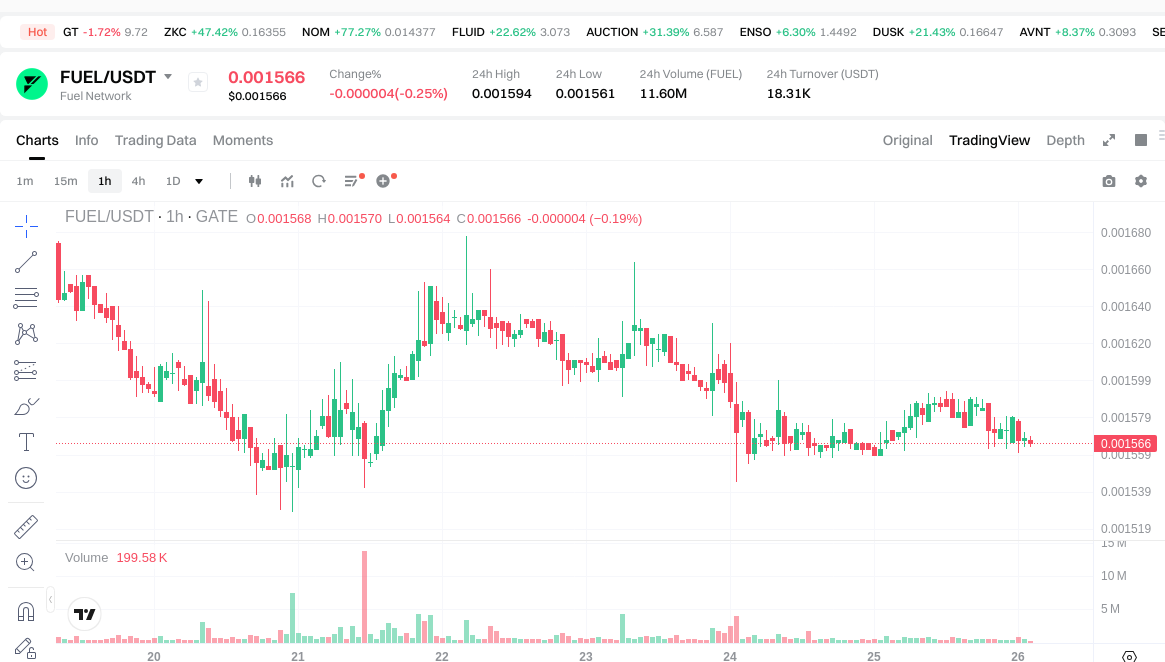
Fuel (FUEL) represents a notable asset in the cryptocurrency space, having launched in December 2024. As of January 26, 2026, Fuel holds a market capitalization of approximately $11.05 million, with a circulating supply of around 7.06 billion tokens, and a current price hovering near $0.001566. With its positioning as an innovative rollup solution for the Ethereum ecosystem, Fuel has become a focal point for investors considering "Is Fuel (FUEL) a good investment?" This article provides a comprehensive analysis of Fuel's investment value, historical price movements, future price projections, and associated investment risks to serve as a reference for market participants.
Fuel combines several technical innovations designed to enhance Ethereum's scalability and functionality. The Fuel Ignition rollup reports transaction throughput exceeding 600 TPS with transaction costs below $0.0002, while the platform's total value locked (TVL) has reportedly surpassed $380 million since launch. The project utilizes purpose-built components including FuelVM, the Rust-based Sway programming language, and the Forc toolchain. Currently ranked #1149 by market capitalization with a market dominance of 0.00051%, Fuel is listed on 13 exchanges and maintains a holder base of approximately 7,190 addresses. The circulating supply represents 69.04% of the total supply of 10.22 billion tokens, with no maximum supply cap defined.
I. Fuel (FUEL) Price History Review and Investment Value Status
- 2024: Token launch in December → Initial offering price at $0.01694
- 2025: Market expansion phase → Price reached $0.021383 in April, reflecting early trading activity
- 2026: Market adjustment period → Price declined to trading range around $0.001566 as of January
Current FUEL Investment Market Status (January 2026)
- FUEL current price: $0.001566
- Market sentiment (Fear & Greed Index): Data not available in provided materials
- 24-hour trading volume: $18,272.90
- Institutional investor holdings: Data not available in provided materials
Click to view real-time FUEL market price
II. Core Factors Affecting Whether FUEL is a Good Investment (Is Fuel(FUEL) a Good Investment)
Supply Mechanism and Scarcity (FUEL investment scarcity)
- Unlimited maximum supply → May impact long-term scarcity dynamics
- Current circulating supply: 7.056 billion FUEL (69.04% of total supply)
- Total supply: 10.220 billion FUEL with ongoing issuance potential
- Market cap to fully diluted valuation ratio stands at 69.04%, indicating substantial token allocation remaining for circulation
- Investment implication: The absence of a hard supply cap may influence scarcity-based valuation models compared to fixed-supply assets
Institutional Investment and Mainstream Adoption (Institutional investment in FUEL)
- Total value locked (TVL) reached over $380 million since Fuel Ignition launch
- Listed on 13 exchanges, indicating growing market accessibility
- Holder base: 7,190 addresses, reflecting early-stage adoption metrics
- Native account abstraction and wallet compatibility across networks may facilitate institutional integration
- Investment consideration: Ecosystem adoption and institutional participation remain in developmental phases
Macroeconomic Environment's Impact on FUEL Investment
- As an Ethereum Layer 2 solution, FUEL's investment dynamics correlate with broader crypto market conditions
- Monetary policy shifts affecting risk asset allocation may influence FUEL's investment appeal
- Market positioning as infrastructure technology rather than store-of-value asset distinguishes its economic sensitivity profile
Technology and Ecosystem Development (Technology & Ecosystem for FUEL investment)
- Parallelized Transaction Execution: Delivers over 600 TPS processing capacity → Enhances network efficiency and scalability potential
- FuelVM Architecture: Purpose-built virtual machine with Sway programming language and Forc toolchain → Supports developer ecosystem expansion
- Cost Efficiency: Transaction costs below $0.0002 per transaction → Competitive advantage in Ethereum rollup landscape
- Optimistic Rollup Design: Balances security inheritance from Ethereum with performance optimization
- Technology readiness: Fuel Ignition represents operational deployment, with ecosystem applications in early development stages
- Investment perspective: Technical infrastructure established, with long-term value dependent on ecosystem adoption velocity and competitive positioning
III. FUEL Future Investment Prediction and Price Outlook (Is Fuel(FUEL) worth investing in 2026-2031)
Short-term Investment Prediction (2026, short-term FUEL investment outlook)
- Conservative forecast: $0.00147 - $0.00157
- Neutral forecast: $0.00157 - $0.00185
- Optimistic forecast: $0.00185 - $0.00215
Mid-term Investment Outlook (2027-2029, mid-term Fuel(FUEL) investment forecast)
- Market stage expectation: The project may continue developing its Layer 2 ecosystem while navigating evolving market conditions and potential adoption trends within the Ethereum scaling landscape.
- Investment return prediction:
- 2027: $0.00128 - $0.00226
- 2028: $0.00117 - $0.00295
- 2029: $0.00195 - $0.00325
- Key catalysts: Technology development progress, ecosystem expansion, broader Layer 2 market dynamics, and potential integration with decentralized applications.
Long-term Investment Outlook (Is Fuel a good long-term investment?)
- Base scenario: $0.00178 - $0.00288 (assuming steady technological improvements and moderate adoption growth)
- Optimistic scenario: $0.00325 - $0.00414 (assuming enhanced ecosystem participation and favorable market environment)
- Risk scenario: Below $0.00147 (under challenging market conditions or delayed development milestones)
For more details on FUEL long-term investment and price predictions: Price Prediction
2026-01-26 - 2031 Long-term Outlook
- Base scenario: $0.00178 - $0.00288 (corresponding to steady progress and gradual mainstream application enhancement)
- Optimistic scenario: $0.00325 - $0.00414 (corresponding to large-scale adoption and favorable market environment)
- Transformative scenario: Above $0.00414 (if the ecosystem achieves breakthrough development and mainstream popularization)
- 2031-12-31 predicted high: $0.00383 (based on optimistic development assumptions)
Disclaimer: These predictions are based on historical data patterns and current market information. Cryptocurrency markets involve substantial risks, and actual prices may vary significantly from projections. This content does not constitute investment advice.
| Year |
Predicted High Price |
Predicted Average Price |
Predicted Low Price |
Price Change |
| 2026 |
0.00214542 |
0.001566 |
0.00147204 |
0 |
| 2027 |
0.0022639662 |
0.00185571 |
0.0012804399 |
18 |
| 2028 |
0.002945568483 |
0.0020598381 |
0.001174107717 |
31 |
| 2029 |
0.00325351427895 |
0.0025027032915 |
0.00195210856737 |
59 |
| 2030 |
0.004144476650724 |
0.002878108785225 |
0.001784427446839 |
83 |
| 2031 |
0.003827309062592 |
0.003511292717974 |
0.002106775630784 |
124 |
IV. Fuel Investment Strategy and Risk Management (How to invest in Fuel)
Investment Methodology (Fuel investment strategy)
Long-term Holding (HODL Fuel)
For conservative investors seeking long-term exposure to Ethereum Layer 2 scaling solutions, holding FUEL tokens may be considered as part of a diversified portfolio strategy. This approach typically involves:
- Accumulating positions during market corrections when prices trend toward lower ranges
- Focusing on the project's technological development progress, including FuelVM enhancements and ecosystem expansion
- Monitoring adoption metrics such as transaction volume and total value locked (TVL)
Active Trading
Active traders may utilize technical analysis and market timing strategies, including:
- Analyzing price movements within the observed range between $0.001469 and $0.021383
- Implementing stop-loss mechanisms to manage downside risk
- Monitoring trading volume patterns across the 13 exchanges where FUEL is listed
- Utilizing on-chain metrics and holder distribution data (currently 7,190 holders) for sentiment analysis
Risk Management (Risk management for Fuel investment)
Asset Allocation Ratios
Conservative Investors:
- Limit FUEL exposure to 1-3% of total crypto portfolio
- Focus on established assets with FUEL as a speculative position
- Prioritize capital preservation over aggressive growth
Moderate Investors:
- Allocate 3-7% to Layer 2 and scaling solutions including FUEL
- Balance exposure across multiple blockchain infrastructure projects
- Regularly rebalance based on performance metrics
Experienced Investors:
- May allocate 7-15% to emerging Layer 2 ecosystems
- Implement dynamic position sizing based on technical indicators
- Utilize advanced risk metrics including Value at Risk (VaR) calculations
Risk Hedging Approaches
- Diversify across multiple Layer 2 solutions and blockchain infrastructure projects
- Maintain positions in both established cryptocurrencies and emerging protocols
- Consider correlation analysis with Ethereum (ETH) given Fuel's rollup architecture
- Implement portfolio insurance strategies during periods of elevated volatility
Secure Storage Solutions
Hot Wallet Options:
- MetaMask or other ERC-20 compatible wallets for active trading
- Enable two-factor authentication and use strong passwords
- Only maintain amounts needed for immediate transactions
Cold Storage Recommendations:
- Hardware wallets (Ledger, Trezor) for long-term holdings
- Multi-signature wallets for institutional or large individual positions
- Regular backup of wallet recovery phrases in secure, offline locations
- Consider splitting large holdings across multiple storage solutions
V. Fuel Investment Risks and Challenges (Risks of investing in Fuel)
Market Risks
High Volatility:
FUEL has demonstrated significant price fluctuations, with movements ranging from $0.001469 to $0.021383 in its trading history. The 24-hour trading volume of approximately $18,272.90 relative to its market capitalization indicates liquidity considerations that investors should evaluate.
Price Sensitivity:
- Recent performance shows a decline of 5.08% over 7 days and 7.16% over 30 days
- The circulating supply represents 69.04% of the total supply, with potential supply expansion implications
- Market capitalization of approximately $11.05 million positions FUEL as a smaller-cap project with corresponding volatility characteristics
Regulatory Risks
Jurisdictional Uncertainty:
Cryptocurrency regulations vary significantly across different jurisdictions, creating potential compliance challenges:
- Evolving regulatory frameworks for Layer 2 solutions and rollup technologies
- Potential classification changes that could affect token status
- Cross-border transaction monitoring and reporting requirements
- Varying tax treatment across different countries
Compliance Considerations:
- Investors should monitor regulatory developments in their respective jurisdictions
- Layer 2 solutions may face specific scrutiny regarding their relationship with base layer protocols
- Changes in securities laws could impact token classification and trading availability
Technical Risks
Network Security:
- Smart contract vulnerabilities in the FuelVM implementation
- Potential exploits in the optimistic rollup mechanism
- Bridge security risks when transferring assets between Ethereum and Fuel networks
- Dependency on Ethereum's security model for final settlement
Development and Upgrade Risks:
- Potential technical issues during protocol upgrades
- Compatibility challenges with the Sway programming language and Forc toolchain
- Competition from other Layer 2 solutions with established ecosystems
- Risk of delayed feature implementations or performance targets not being met
Operational Risks:
- Reliance on validator and sequencer infrastructure
- Potential network congestion during high-demand periods
- Integration challenges with existing DeFi protocols and applications
VI. Conclusion: Is Fuel a Good Investment?
Investment Value Summary
Fuel presents a unique proposition within the Ethereum Layer 2 ecosystem, featuring parallelized transaction execution, native account abstraction, and specialized infrastructure including FuelVM, Sway programming language, and Forc toolchain. The project's technical approach aims to address scalability challenges while maintaining compatibility with the broader Ethereum ecosystem.
However, investors should consider several factors:
- The project operates in a highly competitive Layer 2 landscape with numerous established alternatives
- Recent price performance shows notable declines across multiple timeframes
- Market capitalization of approximately $11.05 million indicates early-stage positioning
- Trading availability across 13 exchanges provides some liquidity but remains limited compared to larger projects
Investor Recommendations
✅ Beginners:
- Consider small, fixed-amount periodic purchases (dollar-cost averaging) if interested in Layer 2 infrastructure exposure
- Prioritize secure storage using hardware wallets for any holdings
- Thoroughly research the technology and competitive landscape before committing capital
- Start with educational resources to understand optimistic rollups and Ethereum scaling solutions
✅ Experienced Investors:
- Evaluate FUEL as part of a diversified Layer 2 portfolio allocation
- Monitor key metrics including TVL growth, transaction volumes, and ecosystem development
- Implement technical analysis strategies appropriate to the token's volatility profile
- Consider correlation with Ethereum and other Layer 2 protocols for portfolio optimization
✅ Institutional Investors:
- Conduct comprehensive due diligence on technical architecture and development team
- Assess competitive positioning relative to established Layer 2 solutions
- Evaluate regulatory implications across relevant jurisdictions
- Consider strategic allocation sizing based on risk tolerance and portfolio objectives
- Monitor governance developments and token utility evolution
⚠️ Important Notice: Cryptocurrency investments carry substantial risk, including potential complete loss of capital. This analysis is provided for informational purposes only and does not constitute financial advice, investment recommendations, or solicitation to buy or sell any assets. Investors should conduct independent research, consult with qualified financial advisors, and carefully consider their risk tolerance and financial situation before making any investment decisions. Past performance does not indicate future results.
VII. FAQ
Q1: What is Fuel (FUEL) and how does it differ from other Ethereum Layer 2 solutions?
Fuel is an optimistic rollup solution for Ethereum that features parallelized transaction execution, delivering over 600 TPS with transaction costs below $0.0002. It distinguishes itself through its purpose-built infrastructure: FuelVM (a specialized virtual machine), Sway (a Rust-based programming language), and the Forc toolchain. Unlike many Layer 2 solutions that adapt existing frameworks, Fuel's architecture is designed specifically for parallel execution and native account abstraction, enabling enhanced scalability while maintaining security inheritance from Ethereum's base layer.
Q2: Is Fuel (FUEL) a good investment for beginners in 2026?
For beginners, Fuel represents a high-risk, speculative position that should constitute only 1-3% of a total crypto portfolio if considered at all. With a current price of approximately $0.001566 and recent declines of 5.08% over 7 days, FUEL exhibits significant volatility. Beginners should prioritize established cryptocurrencies and only explore emerging Layer 2 projects like Fuel after gaining experience with less volatile assets. Dollar-cost averaging and secure cold storage (hardware wallets) are essential if proceeding with any FUEL investment.
Q3: What are the main risks associated with investing in Fuel (FUEL)?
The primary risks include: (1) High price volatility, with historical fluctuations between $0.001469 and $0.021383; (2) Limited liquidity, evidenced by 24-hour trading volume of only $18,272.90; (3) Intense competition from established Layer 2 solutions with larger ecosystems; (4) Technical risks related to smart contract vulnerabilities, bridge security, and optimistic rollup mechanisms; (5) Regulatory uncertainty surrounding Layer 2 classifications and compliance requirements; (6) Early-stage adoption with only 7,190 holders and a market cap of $11.05 million positioning it as a smaller-cap project with corresponding risk factors.
Q4: What is the price prediction for Fuel (FUEL) in 2026-2031?
Based on current market analysis, conservative forecasts for 2026 range from $0.00147 to $0.00215. Mid-term predictions show: 2027 ($0.00128 - $0.00226), 2028 ($0.00117 - $0.00295), and 2029 ($0.00195 - $0.00325). Long-term outlook for 2031 estimates a potential high of $0.00383 under optimistic scenarios. However, these projections depend heavily on ecosystem adoption, technological development progress, and broader market conditions. The base scenario for 2031 ranges between $0.00178 - $0.00288, while risk scenarios could see prices remain below $0.00147. Note: These are speculative predictions and actual prices may vary significantly.
Q5: How should I store my Fuel (FUEL) tokens securely?
For active trading, use hot wallets like MetaMask or other ERC-20 compatible wallets with two-factor authentication enabled and strong passwords. Only keep amounts needed for immediate transactions in hot wallets. For long-term holdings, hardware wallets (Ledger or Trezor) are recommended to minimize security risks. Large holders should consider multi-signature wallets and splitting holdings across multiple storage solutions. Always backup wallet recovery phrases in secure, offline locations and never share them digitally. Regularly verify wallet addresses before transactions to prevent phishing attacks.
Q6: What factors could drive Fuel's price higher in the future?
Key positive catalysts include: (1) Growth in Total Value Locked (TVL) beyond the current $380 million; (2) Successful ecosystem expansion with increased developer adoption of Sway and FuelVM; (3) Significant DeFi protocol integrations leveraging Fuel's parallelized execution capabilities; (4) Exchange listings beyond the current 13 platforms, improving liquidity; (5) Favorable Ethereum scaling narrative as gas fees remain elevated; (6) Technological breakthroughs demonstrating superior performance versus competing Layer 2 solutions; (7) Increased holder base and network effect expansion beyond current 7,190 addresses; (8) Strategic partnerships with major blockchain projects or enterprises.
Q7: How does Fuel's unlimited supply affect its investment potential?
Fuel's lack of a maximum supply cap may impact long-term scarcity-based valuation compared to fixed-supply cryptocurrencies like Bitcoin. Currently, 69.04% (7.056 billion) of the 10.220 billion total supply is in circulation, with potential for additional token issuance. This unlimited supply structure could create ongoing selling pressure and dilute existing holder value if new tokens are released without corresponding demand growth. Investors should monitor emission schedules and token distribution plans. Unlike scarcity-driven assets, Fuel's value proposition relies more heavily on utility, adoption metrics, and ecosystem growth rather than supply constraints.
Q8: What are the recommended asset allocation strategies for different investor types?
Conservative investors should limit FUEL exposure to 1-3% of their total crypto portfolio, focusing primarily on established assets with FUEL as a minor speculative position prioritizing capital preservation. Moderate investors may allocate 3-7% to Layer 2 solutions including FUEL, balancing exposure across multiple blockchain infrastructure projects with regular rebalancing. Experienced investors might allocate 7-15% to emerging Layer 2 ecosystems, implementing dynamic position sizing based on technical indicators and advanced risk metrics. All investor types should diversify across multiple Layer 2 solutions and maintain positions in established cryptocurrencies to manage correlation risks with Ethereum's performance.
* The information is not intended to be and does not constitute financial advice or any other recommendation of any sort offered or endorsed by Gate.