Fusionist (ACE) is a Web3 gaming token launched in November 2023, currently trading at $0.2482 with a $21.6 million market cap and 87 million circulating supply across 28 exchanges. This comprehensive analysis evaluates ACE's investment characteristics through multiple dimensions: historical price performance showing significant volatility from $15.659 peak to current levels, tokenomics revealing 59.21% circulating supply ratio, and technological differentiation via AAA-grade Unity and HDRP integration with cross-platform WebGL compatibility. The article examines core investment factors including supply mechanisms, institutional adoption trends, and ecosystem development, while presenting detailed price scenarios for 2026-2031 ranging from conservative to optimistic outlooks based on market conditions. Investment strategy sections cover long-term holding and active trading approaches with tailored allocation recommendations for different investor profiles. Critical risk analysis addresses market volatility, r
Introduction: Fusionist (ACE) Investment Position and Market Outlook
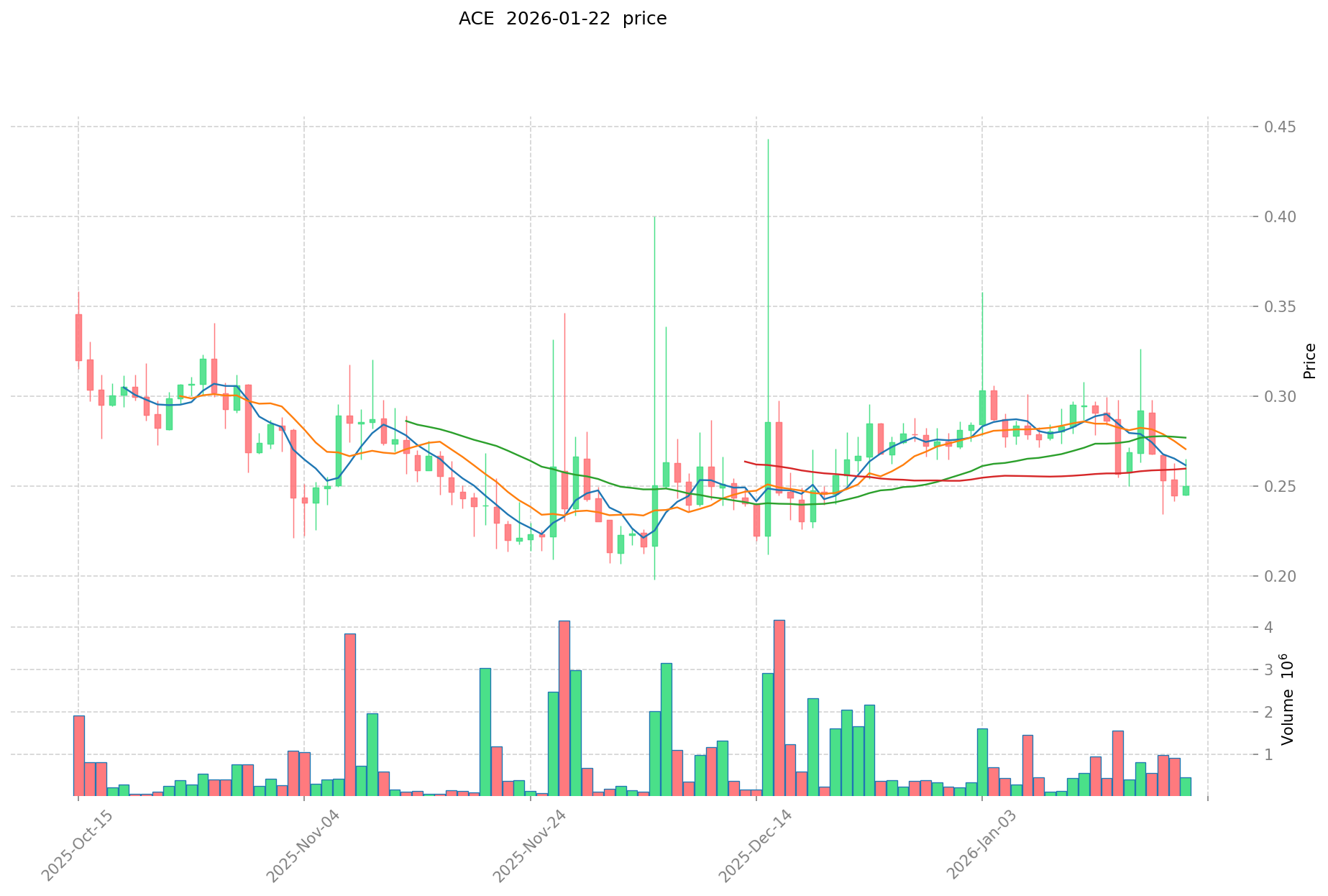
Fusionist (ACE) is a notable digital asset in the cryptocurrency sector, having been launched in November 2023. As a token associated with an independent WEB3 gaming ecosystem, it has established its presence in the blockchain gaming and entertainment domain. As of January 23, 2026, ACE holds a market capitalization of approximately $21.6 million, with a circulating supply of around 87 million tokens. The current price stands at approximately $0.25. Trading on 28 exchanges with over 17,000 holders, ACE has garnered attention within the Web3 gaming community. The token's positioning within the emerging GameFi sector has led investors to evaluate whether Fusionist (ACE) represents a viable investment opportunity. This article provides a comprehensive analysis of ACE's investment characteristics, historical price performance, future price considerations, and associated risks to assist investors in their research and evaluation process.
I. ACE Price History Review and Current Investment Value Status
- 2023: Token launched in November → Price experienced significant volatility in early trading period
- December 2023: Reached a notable price level of 15.659 → ACE price demonstrated substantial upward momentum during this phase
- 2025: Market adjustment cycle → Price declined from elevated levels to 0.1045 in October
Current ACE Investment Market Status (January 2026)
- ACE current price: 0.2482 USD
- 24-hour trading volume: 89,286.26 USD
- Market cap rank: 840
- Circulating supply ratio: 59.21%
Click to view real-time ACE market price
II. Core Factors Affecting Whether ACE is a Good Investment (Is Fusionist(ACE) a Good Investment)
Supply Mechanism and Scarcity (ACE investment scarcity)
- Token supply structure → influences price and investment value
- Fusionist (ACE) has a maximum supply of 147,000,000 tokens, with a circulating supply of 87,045,238 tokens, representing approximately 59.21% of the total supply. The controlled token release mechanism may create supply-side pressure management that could impact price dynamics.
- Investment significance: the relationship between circulating supply and maximum supply is a factor that some investors consider when evaluating long-term holding strategies
Institutional Investment and Mainstream Adoption (Institutional investment in ACE)
- Current holder data shows 17,239 addresses holding ACE tokens, indicating a certain level of community participation
- The token is listed on 28 exchanges, suggesting a degree of market accessibility and liquidity options for investors
- Mainstream adoption metrics and institutional holding trends remain areas for further market development
Macroeconomic Environment's Impact on ACE Investment
- As a gaming and Web3-focused asset, ACE's investment appeal may be influenced by broader cryptocurrency market conditions and gaming industry trends
- Market capitalization stands at approximately $21.6 million with a fully diluted valuation of $36.3 million, positioning it in the mid-to-small cap segment of the crypto gaming sector
- Market dominance of 0.0011% indicates ACE operates in a competitive landscape where macroeconomic shifts affecting risk appetite could impact investment flows
Technology and Ecosystem Development (Technology & Ecosystem for ACE investment)
- Unity and HDRP technology integration: Fusionist utilizes AAA-quality game development technologies including Unity and HDRP, which may support user experience and engagement metrics
- Backend architecture: the platform employs KCP and Flatbuffer protocols for backend-driven computation, designed to address fair gameplay concerns
- Cross-platform accessibility: Unity WebGL client compatibility with both PC and mobile devices expands potential user reach across different device ecosystems
- The interconnection of three game modes within the platform represents an ecosystem design approach that may influence long-term user retention and platform utility
III. ACE Future Investment Prediction and Price Outlook (Is Fusionist(ACE) worth investing in 2026-2031)
Short-term Investment Prediction (2026, short-term ACE investment outlook)
- Conservative Forecast: 0.146379 - 0.2481 USD
- Neutral Forecast: 0.2481 - 0.2915 USD
- Optimistic Forecast: 0.2915 - 0.334935 USD
Mid-term Investment Outlook (2027-2028, mid-term Fusionist(ACE) investment forecast)
- Market Stage Expectation: The token may enter a gradual recovery phase, with potential price increases driven by broader crypto market conditions and project development progress.
- Investment Return Prediction:
- 2027: 0.1982319 - 0.3848031 USD
- 2028: 0.223185798 - 0.375357933 USD
- Key Catalysts: Expansion of the WEB3 gaming ecosystem, adoption of Unity WebGL technology across platforms, and broader user base growth.
Long-term Investment Outlook (Is ACE a good long-term investment?)
- Base Scenario: 0.26824717969635 - 0.43727964909405 USD (assuming steady development and moderate market conditions)
- Optimistic Scenario: 0.354086277199182 - 0.599532446621342 USD (assuming enhanced adoption and favorable market environment)
- Risk Scenario: Below 0.146379 USD (under adverse market conditions or project setbacks)
Check ACE long-term investment and price prediction: Price Prediction
2026-01-23 - 2031 Long-term Outlook
- Base Scenario: 0.26824717969635 - 0.43727964909405 USD (corresponding to steady progress and gradual mainstream application enhancement)
- Optimistic Scenario: 0.354086277199182 - 0.599532446621342 USD (corresponding to large-scale adoption and favorable market conditions)
- Transformative Scenario: Above 0.599532446621342 USD (if ecosystem achieves breakthrough progress and mainstream popularization)
- 2031-12-31 Predicted High: 0.599532446621342 USD (based on optimistic development assumptions)
Disclaimer
| Year |
Predicted High Price |
Predicted Average Price |
Predicted Low Price |
Price Change |
| 2026 |
0.334935 |
0.2481 |
0.146379 |
0 |
| 2027 |
0.3848031 |
0.2915175 |
0.1982319 |
17 |
| 2028 |
0.375357933 |
0.3381603 |
0.223185798 |
36 |
| 2029 |
0.37816466349 |
0.3567591165 |
0.324650796015 |
43 |
| 2030 |
0.43727964909405 |
0.367461889995 |
0.26824717969635 |
48 |
| 2031 |
0.599532446621342 |
0.402370769544525 |
0.354086277199182 |
62 |
IV. ACE Investment Strategy and Risk Management (How to invest in Fusionist)
Investment Strategy (ACE investment strategy)
Long-term Holding (HODL ACE): This approach may suit conservative investors seeking exposure to the Web3 gaming sector. Fusionist's integration of Unity and HDRP technologies, combined with its multi-platform compatibility (PC and mobile via Unity WebGL), positions it within the emerging blockchain gaming ecosystem. Long-term holders typically focus on fundamental developments and ecosystem growth rather than short-term price movements.
Active Trading: For traders employing technical analysis and swing trading strategies, ACE's price history shows notable volatility. The token has experienced significant price fluctuations, with 24-hour trading volume recorded at approximately $89,286 as of January 23, 2026. Price change percentages indicate movement across different timeframes: -0.08% (1H), 0% (24H), -6.02% (7D), -6.41% (30D), and -85.11% (1Y). The 24-hour price range between $0.2421 and $0.2618 reflects intraday trading opportunities, though such volatility requires careful risk assessment.
Risk Management (Risk management for ACE investment)
Asset Allocation Ratio: Investment positioning should align with individual risk tolerance and portfolio objectives:
- Conservative investors: Limited allocation (1-3% of crypto portfolio) focusing on established projects with proven fundamentals
- Moderate investors: Balanced allocation (3-7% of crypto portfolio) combining gaming tokens with broader market exposure
- Aggressive investors: Higher allocation (7-15% of crypto portfolio) accepting elevated risk for potential gaming sector growth
Risk Hedging Solutions: Diversification remains essential for crypto portfolio management. Combining ACE with other asset classes and sectors can help mitigate concentration risk. Consideration of stablecoin positions or derivative instruments may provide additional portfolio balance, though availability varies by jurisdiction and platform.
Secure Storage: Proper custody solutions are fundamental to crypto asset protection:
- Cold Wallets: Offline storage solutions that minimize exposure to online threats, suitable for long-term holdings
- Hot Wallets: Internet-connected wallets for active trading, requiring strong security practices
- Hardware Wallets: Physical devices offering enhanced security through offline private key storage, recommended for significant holdings
The contract address for ACE on BSC (0xc27A719105A987b4c34116223CAE8bd8F4B5def4) should be verified through official channels before any transaction.
V. ACE Investment Risks and Challenges (Risks of investing in Fusionist)
Market Risks: The cryptocurrency market exhibits substantial price volatility. ACE's price performance demonstrates this characteristic, with the current price of $0.2482 representing a considerable decline from previous levels. The relatively limited 24-hour trading volume of approximately $89,286 may contribute to price sensitivity and potential liquidity constraints during market stress. Market capitalization of approximately $21.6 million (with circulating supply of 87,045,238 tokens) indicates a smaller market presence compared to major cryptocurrencies, which can amplify price movements.
Regulatory Risks: The regulatory landscape for cryptocurrency and blockchain gaming continues to evolve across different jurisdictions. Policy uncertainty may affect project operations, token accessibility, and market participation. As regulatory frameworks develop, gaming tokens and NFT-related projects may face varying degrees of scrutiny depending on regional authorities' approaches to digital asset classification.
Technical Risks: Blockchain gaming projects face technical challenges including:
- Network security considerations: Smart contract vulnerabilities could potentially affect token security or platform functionality
- Development execution: The success of technology implementations and gaming feature rollouts depends on ongoing development efforts
- Platform dependencies: Integration with blockchain networks and gaming infrastructure requires continuous technical maintenance
- Anti-cheat measures: While Fusionist employs backend-driven computation with KCP and Flatbuffer protocols to minimize cheating, maintaining fairness in competitive gaming environments presents ongoing challenges
VI. Conclusion: Is Fusionist a Good Investment?
Investment Value Summary: ACE represents exposure to the Web3 gaming sector, combining blockchain technology with AAA-quality gaming experiences through Unity and HDRP implementation. The project's multi-platform approach and interconnected game modes address diverse player preferences. However, the token has experienced substantial price volatility, with significant drawdowns from previous price levels. The circulating supply represents approximately 59.21% of maximum supply (147,000,000 tokens), indicating ongoing token distribution dynamics.
Investor Recommendations:
✅ Beginners: Consider dollar-cost averaging (DCA) strategies to reduce timing risk, combined with secure wallet storage practices. Prioritize understanding project fundamentals and gaming ecosystem development before committing capital.
✅ Experienced Investors: Technical analysis and portfolio diversification may help navigate price volatility. Monitoring gaming industry trends, project development milestones, and community engagement metrics can inform position sizing decisions.
✅ Institutional Investors: Strategic allocation decisions should evaluate Web3 gaming sector positioning, token economics, liquidity profiles, and regulatory considerations within broader portfolio context.
⚠️ Disclaimer: Cryptocurrency investments carry substantial risk, including potential loss of principal. Price volatility, regulatory uncertainty, and project-specific risks require careful consideration. This analysis provides informational content only and does not constitute investment advice. Individuals should conduct independent research and consult qualified financial advisors before making investment decisions.
VII. FAQ
Q1: What is ACE's current market position and how does it compare to other GameFi tokens?
ACE currently holds a market capitalization of approximately $21.6 million with a market rank of 840 as of January 23, 2026. The token represents a mid-to-small cap asset in the Web3 gaming sector with a market dominance of 0.0011%. With 17,239 holders and listings on 28 exchanges, ACE demonstrates moderate community adoption compared to larger GameFi projects. The circulating supply of 87,045,238 tokens represents 59.21% of the maximum supply of 147,000,000 tokens, indicating ongoing distribution dynamics. The relatively limited 24-hour trading volume of $89,286 suggests lower liquidity compared to major gaming tokens, which can amplify price movements during market volatility.
Q2: What are the primary technological features that differentiate Fusionist's gaming ecosystem?
Fusionist distinguishes itself through AAA-quality development technologies including Unity and HDRP integration, enabling high-fidelity gaming experiences across multiple platforms. The backend architecture utilizes KCP and Flatbuffer protocols for backend-driven computation, designed to minimize cheating and maintain competitive fairness. Unity WebGL client compatibility provides cross-platform accessibility on both PC and mobile devices, expanding potential user reach. The ecosystem incorporates three interconnected game modes designed to enhance user engagement and retention, representing a comprehensive approach to blockchain gaming integration rather than single-game functionality.
Q3: How has ACE's price performed historically and what factors contributed to major price movements?
ACE was launched in November 2023 and reached a notable price level of 15.659 USD in December 2023, demonstrating substantial initial momentum. However, the token entered a market adjustment cycle through 2025, declining to 0.1045 USD by October. As of January 2026, ACE trades at approximately $0.2482, representing an 85.11% decline over the one-year period. Price performance indicates: -0.08% (1H), 0% (24H), -6.02% (7D), -6.41% (30D). The significant drawdown reflects broader cryptocurrency market conditions, gaming sector dynamics, and token distribution patterns as circulating supply increased from initial launch levels.
Q4: What are the key risks investors should consider before investing in ACE?
Market risk represents the primary concern, as ACE exhibits substantial price volatility with limited liquidity evidenced by the $89,286 daily trading volume. The relatively small market capitalization of $21.6 million increases sensitivity to large transactions and market sentiment shifts. Regulatory risk remains significant as cryptocurrency and blockchain gaming regulations continue evolving across jurisdictions, potentially affecting token accessibility and project operations. Technical risks include smart contract vulnerabilities, development execution challenges, and platform dependencies on blockchain infrastructure. The competitive GameFi landscape presents adoption risks, as user engagement depends on gaming quality, ecosystem development, and sustained community interest.
Q5: What investment strategies are suitable for different types of ACE investors?
Long-term holding (HODL) suits conservative investors seeking Web3 gaming exposure, focusing on fundamental developments rather than short-term volatility. Recommended allocation ranges from 1-3% of crypto portfolios for conservative investors, 3-7% for moderate investors, and 7-15% for aggressive investors willing to accept elevated risk. Active traders may employ technical analysis strategies, though the 24-hour price range between $0.2421 and $0.2618 requires careful risk management. Dollar-cost averaging (DCA) helps beginners reduce timing risk while building positions gradually. Secure storage through cold wallets or hardware wallets is essential for all holding periods, with the BSC contract address (0xc27A719105A987b4c34116223CAE8bd8F4B5def4) requiring verification through official channels before transactions.
Q6: What are the realistic price predictions for ACE in the short, medium, and long term?
Short-term 2026 predictions range from a conservative forecast of 0.146379 - 0.2481 USD to an optimistic scenario of 0.2915 - 0.334935 USD. Medium-term outlooks for 2027-2028 project potential recovery with ranges of 0.1982319 - 0.3848031 USD (2027) and 0.223185798 - 0.375357933 USD (2028), contingent on ecosystem expansion and broader market conditions. Long-term projections through 2031 present a base scenario of 0.26824717969635 - 0.43727964909405 USD assuming steady development, while optimistic scenarios reach 0.354086277199182 - 0.599532446621342 USD with enhanced adoption. These predictions depend on multiple variables including gaming ecosystem growth, technology adoption, market conditions, and regulatory developments.
Q7: How does ACE's token supply mechanism affect long-term investment value?
ACE's maximum supply of 147,000,000 tokens with current circulating supply of 87,045,238 tokens (59.21%) creates ongoing distribution dynamics that may influence price performance. The controlled token release mechanism affects supply-side pressure management, as additional tokens entering circulation could impact scarcity dynamics over time. Fully diluted valuation stands at approximately $36.3 million compared to current market capitalization of $21.6 million, indicating potential dilution effects as remaining tokens enter circulation. Long-term investors should monitor token unlock schedules and distribution patterns, as supply expansion relative to demand growth will significantly influence price trajectories and investment returns through 2031.
Q8: What role does institutional adoption play in ACE's investment potential?
Current holder data shows 17,239 addresses, indicating community-level participation rather than significant institutional presence. Listing on 28 exchanges provides market accessibility and liquidity options, though institutional holding trends remain underdeveloped compared to major cryptocurrencies. Mainstream adoption metrics and institutional investment flows represent critical factors for future growth potential, as larger capital allocations could enhance liquidity, reduce volatility, and validate the gaming ecosystem's viability. The absence of prominent institutional backing increases risk for early-stage investors but may present opportunity if institutional interest develops as the Web3 gaming sector matures and regulatory clarity improves across jurisdictions.
* The information is not intended to be and does not constitute financial advice or any other recommendation of any sort offered or endorsed by Gate.