This comprehensive guide evaluates whether Gala Games (GALA) represents a sound investment opportunity. As of January 2026, GALA trades at $0.007232 with a market cap of $340.37 million across 56 exchanges including Gate. The article analyzes GALA's historical performance, supply mechanics showing 94.13% circulation, and ecosystem fundamentals spanning gaming, music, and film sectors. Key sections examine investment catalysts including platform expansion and Web3 adoption, alongside price outlooks for 2026-2031 under multiple scenarios. The guide provides tailored strategies for conservative to institutional investors, emphasizing risk management through portfolio diversification and secure storage. Critical risks include market volatility, regulatory uncertainty, and technical challenges, requiring thorough due diligence before investment decisions.
Introduction: Gala Games (GALA) Investment Position and Market Outlook
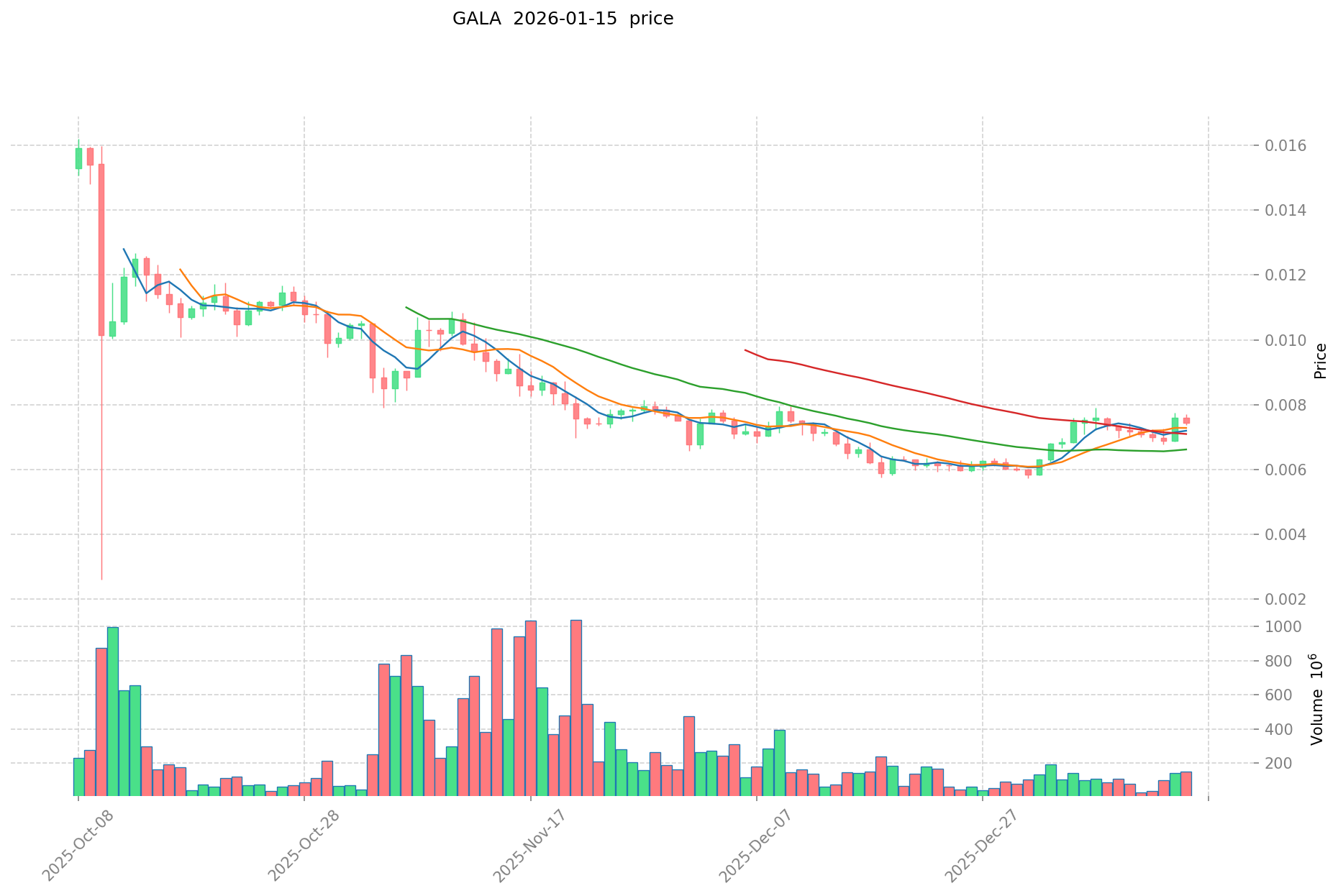
GALA is a notable asset in the cryptocurrency sector. Since its launch in 2020, it has achieved significant progress in the blockchain gaming and decentralized entertainment ecosystem. As of January 15, 2026, GALA has a market capitalization of approximately $340.37 million, with a circulating supply of around 47.06 billion tokens, and its current price is maintained around $0.007232. Positioned as a gaming-focused blockchain platform token, GALA has gradually become a focal point for investors discussing "Is Gala Games (GALA) a good investment?" The token operates within a user-supported network where node operators contribute to the platform and receive rewards including GALA tokens and limited edition NFTs. This article will comprehensively analyze GALA's investment value, historical trends, future price predictions, and investment risks to provide reference for investors.
I. Historical Price Review and Current Investment Value of GALA
Historical Price Trends and Investment Returns of Gala Games (GALA)
- 2020: Initial launch at $0.001497 → Early investors experienced significant growth potential as the project established its foundation in the blockchain gaming sector
- 2021: Price appreciation cycle → GALA reached $0.824837 in November, representing substantial returns from its launch price
- 2022-2025: Market adjustment period → The token experienced volatility, with prices declining from previous peak levels
- 2025-2026: Recent recovery trend → GALA showed a 30-day price increase of 11.41%, trading at $0.007232 as of January 2026
Current GALA Investment Market Status (January 2026)
- Current GALA Price: $0.007232
- 24-hour Trading Volume: $1,082,292.43
- Market Capitalization: $340,369,680
- Circulating Supply: 47,064,391,639.59 GALA (94.13% of maximum supply)
- Token Holders: 220,289 addresses
- Exchange Availability: Listed on 56 cryptocurrency exchanges
- Recent Performance: -1.40% (1H), -4.00% (24H), +0.12% (7D), +11.41% (30D)
Click to view real-time GALA market price
II. Core Factors Influencing Whether GALA is a Good Investment
Supply Mechanism and Scarcity
-
Supply mechanism and circulation dynamics: GALA has a maximum supply of 50,000,000,000 tokens, with a current circulating supply of approximately 47,064,391,639.59 tokens (94.13% of max supply). The high circulation ratio indicates that most tokens are already in the market, which may limit future scarcity-driven price appreciation.
-
Historical price performance: GALA has experienced significant volatility, with a recorded high of $0.824837 in November 2021 and a low of $0.00013475 in December 2020. As of January 15, 2026, the token trades at $0.007232, reflecting a decline of approximately 80.13% over the past year. This volatility underscores the speculative nature of the asset and highlights the importance of understanding supply dynamics when evaluating investment potential.
-
Investment implications: The relatively high circulating supply and low scarcity may pose challenges for long-term value appreciation. Investors should consider whether the supply mechanism aligns with their expectations for scarcity-driven growth.
Institutional Investment and Mainstream Adoption
-
Holder base: GALA currently has approximately 220,289 token holders, indicating a relatively broad distribution. However, no specific data on institutional holdings or major corporate adoption is available in the reference materials.
-
Listing and liquidity: GALA is listed on 56 exchanges, including major platforms, which provides liquidity and accessibility for investors. Increased exchange listings can enhance market visibility and facilitate institutional participation.
-
Adoption by mainstream entities: The reference materials do not provide concrete examples of significant enterprise or institutional adoption of GALA. The absence of such data may suggest that mainstream adoption remains limited, which could impact the token's investment attractiveness.
Macroeconomic Environment and Its Impact on GALA Investment
-
Monetary policy and interest rate environment: Broader macroeconomic conditions, including shifts in monetary policy and interest rate changes, can influence investor sentiment toward speculative assets like GALA. Tighter monetary conditions may reduce risk appetite, while accommodative policies could support demand for digital assets.
-
Inflation and hedge considerations: Some market participants view certain digital assets as potential hedges against inflation. However, GALA's role as an inflation hedge is not explicitly supported by the reference materials, and its investment case should be evaluated based on its ecosystem fundamentals rather than macroeconomic narratives alone.
-
Geopolitical uncertainty: Geopolitical developments and economic uncertainty can drive interest in decentralized digital assets. However, the specific impact on GALA's investment demand remains unclear without additional data.
Technology and Ecosystem Development
-
Ecosystem scope: Gala Games operates across gaming, music, and film sectors, with GalaChain serving as its Layer-1 blockchain infrastructure. The GALA token functions as the ecosystem's utility token for purchases, rewards, and cross-chain interactions. This diversified approach aims to position GALA within the broader Web3 entertainment landscape.
-
Growth potential in Web3 gaming: The reference materials suggest that GALA has potential in the gaming space, with future growth tied to Web3 adoption trends. However, as of 2025, market competition remains intense, and no major breakthrough developments are highlighted.
-
DeFi, NFT, and application expansion: The Gala ecosystem includes NFT-based rewards and node-based participation mechanisms. Users can operate Gala Nodes and receive rewards in GALA tokens and limited-edition NFTs. These ecosystem features may support long-term engagement, though their impact on investment value depends on sustained user activity and platform growth.
-
Technical infrastructure: GalaChain is described as a purpose-built Layer-1 blockchain designed to support the Gala ecosystem. The platform's ability to scale and attract developers will be important for maintaining competitive positioning in the Web3 entertainment sector.
III. GALA Future Investment Prediction and Price Outlook (Is Gala Games(GALA) worth investing in 2026-2031)
Short-term Investment Prediction (2026, short-term GALA investment outlook)
- Conservative Forecast: $0.00529104 - $0.007248
- Neutral Forecast: $0.007248
- Optimistic Forecast: $0.007248 - $0.0094224
Mid-term Investment Outlook (2027-2029, mid-term Gala Games(GALA) investment forecast)
- Market Stage Expectation: GALA may experience moderate growth during this period, with price fluctuations influenced by broader crypto market trends and ecosystem developments.
- Investment Return Prediction:
- 2027: $0.00750168 - $0.009918888 (potential increase of approximately 15%)
- 2028: $0.00702782388 - $0.00976593708 (potential increase of approximately 26%)
- 2029: $0.0082184467698 - $0.011335788648 (potential increase of approximately 30%)
- Key Catalysts: Platform ecosystem expansion, adoption rate of blockchain gaming, and overall cryptocurrency market sentiment.
Long-term Investment Outlook (Is GALA a good long-term investment?)
- Baseline Scenario: $0.0057151267767 - $0.010391139594 (assuming steady ecosystem growth and stable market conditions)
- Optimistic Scenario: $0.01132634215746 - $0.013365083745802 (assuming accelerated adoption and favorable market environment)
- Risk Scenario: Below $0.0057151267767 (under adverse market conditions or ecosystem setbacks)
Click to view GALA long-term investment and price prediction: Price Prediction
2026-2031 Long-term Outlook
- Base Scenario: $0.00529104 - $0.010391139594 (corresponding to steady progress and gradual mainstream application improvement)
- Optimistic Scenario: $0.01132634215746 - $0.013365083745802 (corresponding to large-scale adoption and favorable market environment)
- Transformative Scenario: Above $0.013365083745802 (if ecosystem achieves breakthrough progress and mainstream popularization)
- 2031-12-31 Predicted High: $0.013365083745802 (based on optimistic development assumptions)
Disclaimer: The above predictions are based on historical data and market analysis models. Cryptocurrency investments carry substantial risks, and actual prices may differ significantly from predictions due to market volatility, regulatory changes, technological developments, and other unforeseen factors. This information is for reference only and does not constitute investment advice. Investors should conduct their own research and consult with financial professionals before making investment decisions.
| Year |
Predicted High Price |
Predicted Average Price |
Predicted Low Price |
Price Change |
| 2026 |
0.0094224 |
0.007248 |
0.00529104 |
0 |
| 2027 |
0.009918888 |
0.0083352 |
0.00750168 |
15 |
| 2028 |
0.00976593708 |
0.009127044 |
0.00702782388 |
26 |
| 2029 |
0.011335788648 |
0.00944649054 |
0.0082184467698 |
30 |
| 2030 |
0.01226154472092 |
0.010391139594 |
0.0057151267767 |
43 |
| 2031 |
0.013365083745802 |
0.01132634215746 |
0.009514127412266 |
56 |
IV. GALA Investment Strategy and Risk Management (How to invest in Gala Games)
Investment Methodology (GALA investment strategy)
Long-term Holding (HODL GALA)
For conservative investors seeking steady exposure to the blockchain gaming sector, long-term holding of GALA tokens may be considered as part of a diversified portfolio strategy. This approach focuses on the potential development of Gala Games' ecosystem and its node-based reward mechanism over an extended period.
Active Trading
Active traders may utilize technical analysis and swing trading strategies when engaging with GALA. Given the token's price movements, traders typically monitor key technical indicators, support and resistance levels, and trading volume patterns. The 24-hour trading volume of approximately $1.08 million suggests moderate liquidity for short-term trading activities.
Risk Management (Risk management for GALA investment)
Asset Allocation Ratios
- Conservative Investors: May consider allocating 1-3% of their cryptocurrency portfolio to GALA, maintaining larger positions in more established digital assets
- Aggressive Investors: Might allocate 5-10% to GALA as part of a gaming-focused cryptocurrency strategy
- Professional Investors: Could implement dynamic allocation strategies based on market conditions and project developments
Risk Hedging Solutions
- Multi-asset Portfolio: Combine GALA with other blockchain gaming tokens and major cryptocurrencies to reduce concentration risk
- Hedging Instruments: Consider using stablecoin positions or derivatives (where available) to manage downside exposure
- Regular Rebalancing: Implement periodic portfolio adjustments to maintain desired risk levels
Secure Storage
- Cold Wallets: For long-term holdings, hardware wallets such as Ledger or Trezor provide enhanced security
- Hot Wallets: For active trading, use reputable exchanges with strong security measures and two-factor authentication
- Private Key Management: Maintain secure backup of recovery phrases in multiple physical locations
V. GALA Investment Risks and Challenges (Risks of investing in Gala Games)
Market Risk
- High Volatility: GALA has experienced significant price fluctuations, with recent 24-hour changes showing a -4% movement
- Price Manipulation: With a circulating supply of approximately 47.06 billion tokens and moderate daily trading volume, the token may be susceptible to market manipulation by large holders
- Historical Performance: The token's current price of $0.007232 represents a substantial decline from its all-time high, indicating considerable historical volatility
Regulatory Risk
- Policy Uncertainty: Different jurisdictions maintain varying approaches to gaming tokens and NFT-based ecosystems, which may impact GALA's operational environment
- Compliance Requirements: Changes in regulatory frameworks for blockchain gaming could affect the project's business model
- Cross-border Considerations: Investors should be aware of local regulations regarding cryptocurrency holdings and gaming token investments
Technical Risk
- Network Security: As an Ethereum-based token (contract address: 0xd1d2eb1b1e90b638588728b4130137d262c87cae), GALA's security depends on both the Ethereum network and the Gala Games infrastructure
- Upgrade Risks: Future protocol changes or ecosystem developments may introduce technical challenges
- Smart Contract Vulnerabilities: Potential risks associated with smart contract code, despite audit processes
VI. Conclusion: Is Gala Games a Good Investment?
Investment Value Summary
GALA presents characteristics typical of blockchain gaming tokens, with its value proposition centered on the Gala Games ecosystem and node-based reward structure. The token's current market capitalization of approximately $340 million and circulation ratio of 94.13% indicate substantial token distribution. However, the significant distance from its historical peak price suggests considerable market uncertainty.
Investor Recommendations
✅ Beginners: Consider dollar-cost averaging strategies with small allocations, and prioritize secure storage solutions using hardware wallets
✅ Experienced Investors: May employ swing trading strategies based on technical analysis, while maintaining diversified exposure across gaming and entertainment tokens
✅ Institutional Investors: Could evaluate GALA as part of a strategic blockchain gaming sector allocation, with comprehensive due diligence on ecosystem developments
⚠️ Disclaimer: Cryptocurrency investments carry substantial risk due to market volatility and regulatory uncertainty. This content is provided for informational purposes only and does not constitute investment advice. Investors should conduct independent research and consider their risk tolerance before making investment decisions.
VII. FAQ
Q1: Is Gala Games (GALA) a good investment for beginners in 2026?
GALA may be suitable for beginners as a small, exploratory allocation (1-3% of portfolio), but it requires caution due to high volatility and market risks. As of January 2026, GALA trades at $0.007232, representing a significant decline from its November 2021 peak of $0.824837. The token's 24-hour price fluctuations of -4% and its 80.13% decline over the past year indicate substantial volatility. Beginners should consider dollar-cost averaging strategies, prioritize secure storage using hardware wallets, and conduct thorough research on the Gala Games ecosystem before investing. The token's position within the blockchain gaming sector offers potential growth opportunities, but investors must understand that cryptocurrency investments carry considerable risks.
Q2: What is the long-term price prediction for GALA through 2031?
Long-term GALA price predictions vary significantly based on market scenarios. The base scenario projects a range of $0.00529104 to $0.010391139594 by 2030, assuming steady ecosystem growth and stable market conditions. Under an optimistic scenario, GALA could reach $0.013365083745802 by December 2031, representing approximately 85% growth from current levels, contingent upon accelerated Web3 gaming adoption and favorable market conditions. The 2027 neutral forecast suggests $0.0083352, indicating potential 15% growth. However, investors should note that these predictions are based on historical data and market analysis models. Actual prices may differ substantially due to market volatility, regulatory changes, technological developments, and competition within the blockchain gaming sector.
Q3: How does GALA's supply mechanism affect its investment potential?
GALA's supply mechanism presents both opportunities and challenges for investment potential. The token has a maximum supply of 50 billion tokens, with approximately 47.06 billion tokens (94.13%) already in circulation. This high circulation ratio indicates that most tokens are already distributed in the market, which may limit future scarcity-driven price appreciation. Unlike assets with lower circulation ratios, GALA's limited remaining supply offers minimal potential for scarcity-based valuation increases. The node operator reward system distributes GALA tokens and limited edition NFTs to network participants, providing ongoing utility but also adding to circulating supply. Investors evaluating GALA should consider whether this supply structure aligns with their expectations for long-term value growth, particularly in comparison to assets with more restrictive supply mechanisms.
Q4: What are the main risks of investing in Gala Games (GALA)?
GALA investment carries three primary risk categories that investors must carefully evaluate. Market risk includes high volatility, with recent 24-hour price changes of -4% and historical fluctuations from $0.00013475 to $0.824837, plus potential price manipulation given the moderate daily trading volume of approximately $1.08 million. Regulatory risk encompasses policy uncertainty across different jurisdictions regarding gaming tokens and NFT-based ecosystems, evolving compliance requirements for blockchain gaming, and varying cross-border regulations affecting cryptocurrency holdings. Technical risk involves network security dependencies on both Ethereum infrastructure and Gala Games systems, potential vulnerabilities in smart contract code despite audit processes, and risks associated with future protocol upgrades. Investors should implement risk management strategies including portfolio diversification, appropriate position sizing based on risk tolerance, and secure storage solutions using hardware wallets.
Q5: How does GALA compare to other blockchain gaming tokens for investment purposes?
GALA distinguishes itself through its diversified ecosystem spanning gaming, music, and film sectors, supported by GalaChain as a purpose-built Layer-1 blockchain. The platform's node-based participation mechanism allows users to operate Gala Nodes and receive rewards in GALA tokens and limited-edition NFTs, creating ongoing ecosystem engagement. With 220,289 token holders and listings on 56 exchanges, GALA demonstrates relatively broad distribution and accessibility. However, the reference materials do not provide detailed comparative analysis with competing blockchain gaming tokens. Investors evaluating GALA should consider its current market capitalization of $340 million, its positioning within the Web3 entertainment landscape, and its ability to compete in an intense market environment. The token's performance should be assessed against other gaming-focused cryptocurrencies based on ecosystem development, user adoption rates, and technological innovation.
Q6: What investment strategies work best for GALA token holders?
GALA investors can employ different strategies based on their risk profiles and investment objectives. Long-term holding (HODL) suits conservative investors seeking exposure to blockchain gaming sector growth, focusing on the ecosystem's development and node-based reward mechanisms over extended periods. Conservative investors might allocate 1-3% of their cryptocurrency portfolio to GALA, while aggressive investors could consider 5-10% allocations. Active trading strategies utilize technical analysis, monitoring support and resistance levels, and trading volume patterns given GALA's price movements. Effective risk management includes multi-asset portfolio diversification combining GALA with other blockchain gaming tokens and major cryptocurrencies, regular portfolio rebalancing to maintain desired risk levels, and implementing secure storage solutions using cold wallets for long-term holdings or reputable exchanges with strong security measures for active trading. Investors should also consider dollar-cost averaging to mitigate volatility impact.
Q7: What factors could drive GALA's price growth in 2026-2027?
Several key catalysts could influence GALA's price trajectory in the near to mid-term period. Platform ecosystem expansion, including the development of gaming, music, and film applications on GalaChain, could attract increased user participation and token utility. Broader adoption rates of blockchain gaming and Web3 entertainment technologies may drive demand for GALA tokens as the ecosystem grows. Overall cryptocurrency market sentiment and macroeconomic conditions, including monetary policy shifts and risk appetite for digital assets, will significantly impact GALA's price movements. The 30-day price increase of 11.41% as of January 2026 suggests emerging positive momentum. Additional factors include the success of node operator participation, NFT marketplace activity, and potential partnerships or integrations within the gaming industry. However, intense market competition and the absence of major breakthrough developments as of 2025 indicate that growth depends on sustained execution and favorable market conditions.
Q8: Should institutional investors consider adding GALA to their portfolios?
Institutional investors evaluating GALA should approach the opportunity with comprehensive due diligence focused on the blockchain gaming sector's long-term potential. GALA's current market position includes approximately 220,289 token holders, listings on 56 exchanges providing adequate liquidity, and a market capitalization of $340 million, positioning it as a mid-tier gaming token. However, the reference materials indicate limited data on significant enterprise or institutional adoption, suggesting mainstream acceptance remains developing. Professional investors could implement dynamic allocation strategies based on market conditions and project developments, viewing GALA as part of a strategic blockchain gaming sector allocation. Key evaluation criteria should include the GalaChain infrastructure's ability to scale, the platform's competitive positioning against other Web3 entertainment ecosystems, and the sustainability of the node-based reward model. Institutional investors must also consider regulatory compliance across different jurisdictions and technical risk factors before determining appropriate position sizes.
* The information is not intended to be and does not constitute financial advice or any other recommendation of any sort offered or endorsed by Gate.