GameBuild (GAME2) is a next-generation gaming infrastructure token launched in May 2024, designed to provide economic benefits to gamers, developers, and advertisers within the blockchain gaming ecosystem. As of January 2026, GAME2 trades at $0.001701 with a market capitalization of $31.67 million across 4 exchanges including Gate.com. This comprehensive analysis examines GAME2's investment characteristics, including its tokenomics structure with 86.93% circulating supply, historical price performance spanning from $0.013 (May 2024 peak) to $0.001405 (December 2025 low), and multi-scenario price forecasts through 2031. The article evaluates core investment factors such as supply mechanisms, institutional adoption, macroeconomic influences, and technology development, while addressing critical risks including market volatility, limited liquidity ($74,851 daily volume), regulatory uncertainties, and competitive pressures. Investors receive tailored strategies aligned with experience levels, comprehensive risk ma
Introduction: GameBuild (GAME2) Investment Position and Market Prospects
GameBuild (GAME2) represents a notable digital asset in the cryptocurrency sector, positioned as next-generation gaming infrastructure with a comprehensive toolkit designed to deliver economic benefits and experiences to gamers, developers, and advertisers. Launched in May 2024, the token has established its presence in the blockchain gaming ecosystem. As of January 21, 2026, GAME2 maintains a market capitalization of approximately 31.67 million USD, with a circulating supply of 18.62 billion tokens and a current trading price around 0.001701 USD. The token ranks 692nd in the overall cryptocurrency market with a market dominance of 0.0011%. With a circulating supply ratio of approximately 86.93% relative to its maximum supply of 21.42 billion tokens, GAME2 has attracted attention from investors evaluating the question "Is GameBuild (GAME2) a good investment?" This analysis examines GAME2's investment characteristics, historical price performance, future price scenarios, and associated risks to provide informational reference for market participants.
I. GAME2 Price History Review and Investment Value Status
- 2024: Token launch in May → Initial price at $0.0062, reached peak at $0.013 within the same month
- 2024-2025: Market adjustment phase → Price experienced volatility from May 2024 peak levels
- 2025: Market cycle transition → Price declined from earlier levels to $0.001405 in December
Current GAME2 Investment Market Status (January 2026)
- GAME2 current price: $0.001701
- 24-hour trading volume: $74,851.01
- Circulating supply: 18,620,882,436 GAME2
- Market capitalization: $31,674,121.02
- Fully diluted valuation: $36,434,805.94
- Market cap to FDV ratio: 86.93%
- Number of holders: 1,353
- Available on 4 exchanges
Click to view real-time GAME2 market price
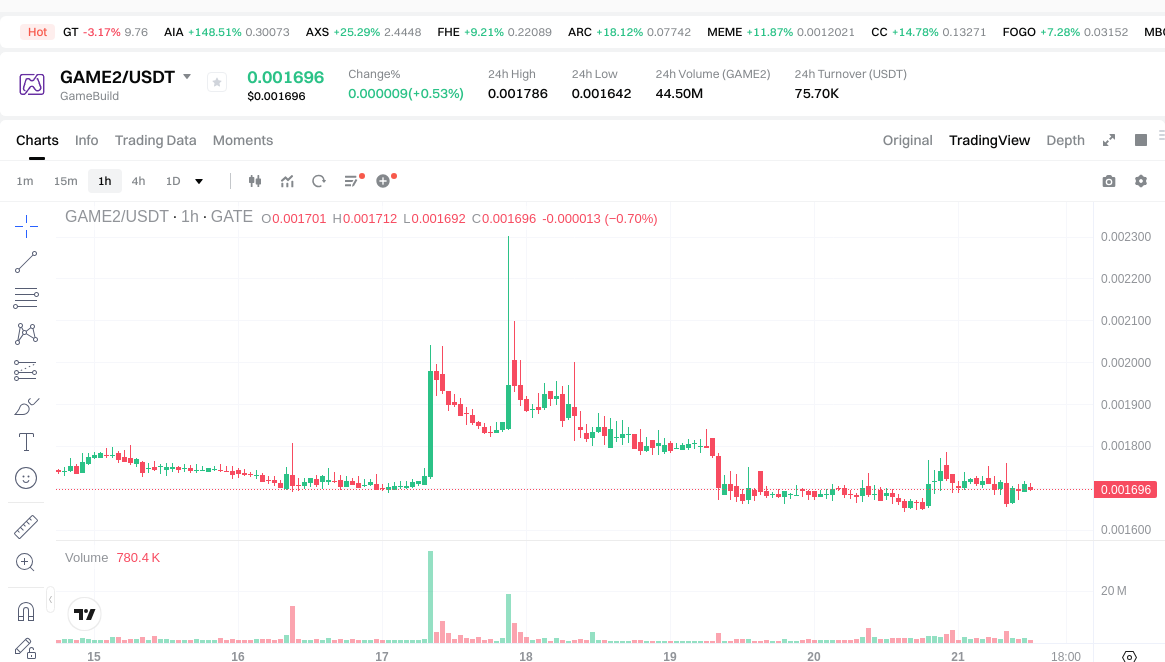
II. Core Factors Affecting Whether GAME2 is a Good Investment (Is GameBuild(GAME2) a Good Investment)
Supply Mechanism and Scarcity (GAME2 investment scarcity)
- Supply Mechanism → Affects price and investment value
- GameBuild (GAME2) has a maximum supply of 21,419,639,400 tokens, with a current circulating supply of 18,620,882,436 tokens, representing approximately 86.93% of the total supply. The relatively high circulation ratio suggests limited additional supply pressure in the near term.
- The token operates on the ERC20 standard on the Ethereum blockchain, with a contract address verified on Etherscan.
- Historical Patterns: Supply dynamics have influenced GAME2 price movements
- The token reached a notable price level of $0.013 on May 18, 2024, while experiencing a lower price point of $0.001405 on December 19, 2025. These fluctuations reflect market responses to supply and demand dynamics over time.
- Investment Significance: Scarcity characteristics represent a key consideration for long-term investment evaluation
- With over 86% of tokens already in circulation and a defined maximum supply, the token's supply structure may influence its price behavior as market conditions evolve.
Institutional Investment and Mainstream Adoption (Institutional investment in GAME2)
- Institutional Holding Trends: Current holder data indicates 1,353 addresses holding GAME2 tokens, suggesting a developing user base
- Trading Accessibility: GAME2 is available for trading on 4 exchanges, including Gate.com, providing liquidity channels for market participants
- Market Position: The token maintains a market capitalization of approximately $31.67 million as of January 21, 2026, with a market share of 0.0011% in the broader cryptocurrency landscape
Macroeconomic Environment's Impact on GAME2 Investment
- Monetary Policy and Interest Rate Changes → Alter investment attractiveness
- Broader macroeconomic conditions, including monetary policy shifts and interest rate adjustments by central banks, can influence capital flows into alternative assets like cryptocurrencies. Changes in traditional financial market conditions may affect investor appetite for digital assets.
- Inflationary Environment Hedging Role → "Digital Gold" positioning
- Cryptocurrencies have been explored by some market participants as potential hedging instruments during periods of currency devaluation or inflationary pressures, though this characteristic varies significantly across different digital assets.
- Geopolitical Uncertainty → Enhances demand considerations
- Global economic uncertainties and geopolitical developments may drive some investors to diversify portfolios with alternative assets, potentially affecting demand dynamics for tokens like GAME2.
Technology and Ecosystem Development (Technology & Ecosystem for GAME2 investment)
- Platform Infrastructure: GameBuild positions itself as next-generation gaming infrastructure with a comprehensive toolkit designed to provide economic benefits and experiences for gamers, developers, and advertisers
- Gaming-Focused Ecosystem: The project operates within the blockchain gaming sector, offering tools and infrastructure that connect various stakeholders in the gaming industry
- Ecosystem Applications: The platform's focus on integrating gaming activities with blockchain technology may support long-term value development as the gaming and Web3 sectors continue to evolve
- Technical Foundation: Built on Ethereum's ERC20 standard, GAME2 benefits from established blockchain infrastructure and interoperability with existing decentralized applications and services
III. GAME2 Future Investment Forecast and Price Outlook (Is GameBuild(GAME2) worth investing in 2026-2031)
Short-term Investment Forecast (2026, short-term GAME2 investment outlook)
- Conservative forecast: $0.00110305 - $0.001697
- Neutral forecast: $0.001697
- Optimistic forecast: $0.001697 - $0.00190064
Mid-term Investment Outlook (2027-2029, mid-term GameBuild(GAME2) investment forecast)
- Market stage expectation: GameBuild is anticipated to experience gradual growth as the gaming infrastructure sector matures. The platform's tools for gamers, developers, and advertisers may attract increasing adoption during this period.
- Investment return forecast:
- 2027: $0.0015829616 - $0.0024643834
- 2028: $0.001556069241 - $0.003005558397
- 2029: $0.002234664642195 - $0.00323641086111
- Key catalysts: Expansion of developer partnerships, enhanced gaming asset tokenization capabilities, broader market recovery in cryptocurrency sector, and potential integration with major gaming platforms.
Long-term Investment Outlook (Is GAME2 a good long-term investment?)
- Base scenario: $0.001886622045623 - $0.003453969591218 (assuming steady platform development and moderate user adoption)
- Optimistic scenario: $0.003453969591218 - $0.004593779556319 (assuming accelerated gaming industry blockchain adoption and successful ecosystem expansion)
- Risk scenario: Below $0.001556069241 (under adverse market conditions or limited platform traction)
Click to view GAME2 long-term investment and price forecast: Price Prediction
2026-01-21 - 2031 Long-term Outlook
- Base scenario: $0.001886622045623 - $0.003453969591218 (corresponding to steady progress and mainstream application gradual enhancement)
- Optimistic scenario: $0.003453969591218 - $0.004593779556319 (corresponding to large-scale adoption and favorable market environment)
- Transformative scenario: Above $0.004593779556319 (if ecosystem achieves breakthrough progress and mainstream popularization)
- 2031-12-31 predicted high: $0.004593779556319 (based on optimistic development assumptions)
Disclaimer: This forecast is based on historical data and market analysis. Cryptocurrency investments carry significant risks. Past performance does not guarantee future results. Investors should conduct thorough research and consider their risk tolerance before making investment decisions.
| Year |
Predicted High Price |
Predicted Average Price |
Predicted Low Price |
Price Change |
| 2026 |
0.00190064 |
0.001697 |
0.00110305 |
0 |
| 2027 |
0.0024643834 |
0.00179882 |
0.0015829616 |
5 |
| 2028 |
0.003005558397 |
0.0021316017 |
0.001556069241 |
25 |
| 2029 |
0.00323641086111 |
0.0025685800485 |
0.002234664642195 |
51 |
| 2030 |
0.00400544372763 |
0.002902495454805 |
0.001886622045623 |
70 |
| 2031 |
0.004593779556319 |
0.003453969591218 |
0.002210540538379 |
103 |
IV. GameBuild Investment Strategy and Risk Management (How to invest in Gaming Infrastructure Tokens)
Investment Methodology (GameBuild investment strategy)
Long-term Holding (HODL GameBuild): This approach may suit conservative investors who believe in the project's gaming infrastructure vision. GameBuild positions itself as next-generation gaming infrastructure with tools for players, developers, and advertisers. Investors considering this strategy should evaluate the project's roadmap execution, developer adoption rates, and competitive positioning within the gaming blockchain sector.
Active Trading: Technical analysis and swing trading opportunities exist given GameBuild's volatility characteristics. With 24-hour price fluctuations and trading volume of approximately $74,851, traders might identify entry and exit points using technical indicators. However, liquidity considerations should be evaluated, as the token trades on 4 exchanges with a relatively modest market capitalization.
Risk Management (Risk management for GameBuild investment)
Asset Allocation Ratios:
- Conservative investors: Consider limiting exposure to 1-3% of crypto portfolio due to GameBuild's smaller market cap and gaming sector concentration
- Moderate investors: May allocate 3-7% depending on conviction in gaming infrastructure narratives
- Experienced investors: Could consider higher allocations based on technical analysis and sector rotation strategies, while maintaining diversification
Risk Hedging Approaches:
- Multi-asset portfolio construction: Balance GameBuild exposure with established cryptocurrencies and other gaming tokens
- Position sizing: Implement gradual accumulation strategies rather than concentrated purchases
- Stop-loss mechanisms: Consider technical support levels for downside protection
Secure Storage:
- Cold wallet storage: Hardware wallets supporting ERC-20 tokens (GameBuild operates on Ethereum blockchain)
- Hot wallet considerations: Use reputable exchanges for active trading positions only
- Self-custody solutions: Popular hardware wallet options include Ledger and Trezor devices with Ethereum compatibility
V. GameBuild Investment Risks and Challenges (Risks of investing in Gaming Infrastructure Tokens)
Market Risks:
- High volatility: GameBuild has demonstrated significant price movements, with 1-year performance showing a -71.25% change
- Limited liquidity: With trading volume around $74,851 in 24 hours and presence on 4 exchanges, liquidity constraints may impact larger transactions
- Price discovery challenges: Smaller market cap tokens may experience wider bid-ask spreads
Regulatory Risks:
- Gaming token classification: Evolving regulatory frameworks across jurisdictions may affect gaming-related cryptocurrencies
- Cross-border compliance: Gaming infrastructure projects operating internationally face varying regulatory requirements
- Policy uncertainty: Changes in gaming regulations or cryptocurrency policies could impact project operations
Technical Risks:
- Smart contract vulnerabilities: ERC-20 token implementations require ongoing security auditing
- Network dependencies: GameBuild's reliance on Ethereum blockchain exposes it to base layer network issues
- Platform adoption risks: Success depends on developer and user adoption of the gaming infrastructure
- Competition: Gaming blockchain sector contains numerous competing projects with varying technical approaches
VI. Conclusion: Is Gaming Infrastructure Token a Good Investment?
Investment Value Summary: GameBuild represents a specialized gaming infrastructure play within the cryptocurrency sector. The project targets game developers, players, and advertisers with blockchain-based tools. However, investors should note the token's performance volatility and relatively smaller market presence.
Investor Recommendations:
✅ Beginners: Consider dollar-cost averaging with small position sizes + secure ERC-20 compatible wallet storage. Focus on understanding gaming blockchain fundamentals before investing.
✅ Experienced Investors: May explore swing trading opportunities based on technical patterns + maintain diversified gaming token portfolio. Monitor developer adoption metrics and platform usage statistics.
✅ Institutional Investors: Evaluate GameBuild within broader gaming infrastructure thesis + conduct thorough due diligence on team, technology, and competitive positioning before strategic allocation.
⚠️ Important Notice: Cryptocurrency investments carry substantial risks. GameBuild, as a gaming infrastructure token, faces sector-specific challenges including adoption uncertainties, competitive pressures, and market volatility. This content provides educational information only and does not constitute investment advice. Conduct independent research and consider consulting financial professionals before making investment decisions.
VII. FAQ
Q1: What is GameBuild (GAME2) and how does it differ from other gaming cryptocurrencies?
GameBuild is a next-generation gaming infrastructure token built on Ethereum's ERC-20 standard that provides comprehensive tools for gamers, developers, and advertisers within the blockchain gaming ecosystem. Unlike many gaming tokens that focus solely on in-game currencies or NFT assets, GameBuild positions itself as foundational infrastructure connecting multiple stakeholders—developers building blockchain games, players engaging with gaming experiences, and advertisers seeking to reach gaming audiences. Launched in May 2024, the token has a maximum supply of 21.42 billion tokens with approximately 86.93% already in circulation. The project differentiates itself through its multi-sided platform approach, offering economic benefits across the entire gaming value chain rather than serving a single gaming title or ecosystem.
Q2: What are the primary risks associated with investing in GAME2?
GAME2 presents several significant investment risks that potential investors should carefully evaluate. Market volatility represents a primary concern, with the token demonstrating substantial price fluctuations including a -71.25% decline over its first year and price movements from $0.013 (May 2024 peak) to $0.001405 (December 2025 low). Limited liquidity poses another challenge, with 24-hour trading volume around $74,851 and availability on only 4 exchanges, potentially impacting larger transactions and creating wider bid-ask spreads. Technical risks include smart contract vulnerabilities inherent to ERC-20 tokens, dependency on Ethereum network performance, and platform adoption uncertainties. Regulatory risks encompass evolving gaming token classification across jurisdictions and potential policy changes affecting blockchain gaming projects. Additionally, competitive pressures from numerous gaming infrastructure projects present ongoing challenges to market position and adoption rates.
Q3: What investment strategies are most appropriate for GAME2 holders?
Investment strategy selection for GAME2 should align with individual risk tolerance and market experience. Conservative investors focusing on long-term holding might allocate 1-3% of their crypto portfolio to GAME2, emphasizing the project's gaming infrastructure vision while managing concentration risk through diversification. This approach requires patient evaluation of roadmap execution, developer adoption metrics, and competitive positioning within blockchain gaming. Active traders might pursue swing trading strategies leveraging technical analysis, though they should carefully assess liquidity constraints given the token's modest trading volume. Position sizing strategies should incorporate gradual accumulation rather than concentrated purchases. Experienced investors could consider 3-7% allocations based on conviction in gaming infrastructure narratives, while implementing technical support level-based stop-loss mechanisms for downside protection. Regardless of strategy, secure storage through hardware wallets supporting ERC-20 tokens (such as Ledger or Trezor) is recommended for long-term holdings, with hot wallet usage limited to active trading positions only.
Q4: How does GameBuild's tokenomics affect its investment potential?
GameBuild's tokenomics structure significantly influences its investment characteristics and potential price behavior. With a maximum supply of 21.42 billion tokens and current circulating supply of 18.62 billion (86.93% circulation ratio), the token exhibits limited additional supply pressure compared to projects with lower circulation rates. This high circulation percentage suggests that most tokens are already in market circulation, potentially reducing future dilution concerns. The token's contract operates on Ethereum's established ERC-20 standard, providing interoperability with existing decentralized applications and established blockchain infrastructure. However, the relatively modest holder count of 1,353 addresses indicates a developing user base that has not yet achieved mass adoption. The market capitalization of approximately $31.67 million positions GAME2 as a smaller-cap asset with corresponding volatility characteristics and growth potential. The 86.93% market cap to fully diluted valuation ratio indicates limited gap between current and maximum potential dilution, which differs from projects with substantial unlocked token reserves that could create future selling pressure.
Q5: What are the realistic price expectations for GAME2 through 2031?
Price forecasts for GAME2 through 2031 vary significantly based on adoption scenarios and market conditions. Short-term outlook for 2026 suggests conservative price ranges between $0.00110305-$0.001697, with neutral forecasts around $0.001697 and optimistic scenarios reaching $0.00190064. Mid-term projections for 2027-2029 anticipate gradual growth as gaming infrastructure matures, with 2027 estimates ranging from $0.001583-$0.002464, 2028 forecasts between $0.001556-$0.003006, and 2029 projections spanning $0.002235-$0.003236. Long-term outlook through 2031 presents three scenarios: base scenario ($0.001887-$0.003454) assuming steady platform development and moderate adoption; optimistic scenario ($0.003454-$0.004594) reflecting accelerated blockchain gaming adoption and ecosystem expansion; and transformative scenario exceeding $0.004594 if breakthrough mainstream adoption occurs. The 2031 predicted high reaches $0.004594 under optimistic assumptions. However, investors should recognize these forecasts depend heavily on successful execution of GameBuild's roadmap, broader cryptocurrency market conditions, gaming industry blockchain adoption rates, and competitive dynamics. Past performance does not guarantee future results, and actual outcomes may differ substantially from projections.
Q6: How liquid is GAME2 and what are the implications for investors?
GAME2's liquidity profile presents important considerations for investment decision-making. The token currently trades on 4 exchanges including Gate.com, with 24-hour trading volume around $74,851—a relatively modest figure compared to larger-cap cryptocurrencies. This limited liquidity creates several practical implications: larger buy or sell orders may significantly impact market price due to insufficient order book depth; bid-ask spreads may be wider than more liquid assets, increasing transaction costs; and execution of substantial positions may require breaking orders into smaller tranches over extended timeframes. The 1,353 holder count suggests a developing but not yet widely distributed ownership base. For smaller retail investors executing transactions under $5,000-$10,000, current liquidity may prove adequate. However, larger investors or institutions seeking substantial positions should carefully evaluate liquidity constraints and potential market impact. The concentration of trading across only 4 exchanges also creates platform-specific risks and may limit arbitrage opportunities compared to assets with broader exchange availability. Investors should consider using limit orders rather than market orders to manage execution price, and those planning significant position sizes should assess liquidity depth across available trading venues before execution.
Q7: What role does GameBuild play in the broader blockchain gaming ecosystem?
GameBuild positions itself as foundational infrastructure within the evolving blockchain gaming landscape, distinguishing its role from gaming-specific tokens or individual game economies. The project's comprehensive toolkit approach addresses multiple ecosystem participants: game developers receive tools for integrating blockchain elements and tokenized economies into their titles; players access economic benefits and enhanced gaming experiences through blockchain integration; and advertisers gain channels for reaching gaming audiences through the platform. This multi-sided infrastructure positioning contrasts with projects focused exclusively on single games or narrow use cases. GameBuild's success depends significantly on developer adoption rates, as the platform's value proposition relies on attracting game creators who integrate its tools into their development processes. The project competes within a crowded blockchain gaming infrastructure sector alongside established protocols and emerging competitors, requiring continuous innovation and partnership development. As the gaming industry increasingly explores blockchain integration for asset ownership, play-to-earn mechanics, and decentralized gaming economies, infrastructure providers like GameBuild seek to capture value by serving as enabling technology. However, adoption faces challenges including developer learning curves, regulatory uncertainties around gaming tokens, and competition from both blockchain-native solutions and traditional gaming platforms exploring Web3 integration.
Q8: Should beginners invest in GAME2 or focus on more established cryptocurrencies first?
Beginners considering cryptocurrency investments should carefully evaluate whether GAME2 aligns with appropriate risk tolerance and knowledge levels. Gaming infrastructure tokens like GAME2 represent specialized, higher-risk investments compared to established cryptocurrencies such as Bitcoin or Ethereum. The token's -71.25% one-year performance, limited liquidity profile, smaller market capitalization ($31.67 million), and sector-specific adoption uncertainties create substantial volatility and risk characteristics that may prove challenging for newcomers to navigate. For beginners, a prudent approach involves first building foundational cryptocurrency knowledge and establishing core portfolio positions in more liquid, established assets before considering specialized tokens. If beginners choose to gain exposure to GAME2, recommended practices include: limiting allocation to 1-3% of total cryptocurrency portfolio to manage risk; implementing dollar-cost averaging strategies to mitigate timing risk; securing tokens in hardware wallets supporting ERC-20 standards; dedicating time to understanding blockchain gaming fundamentals and GameBuild's specific value proposition; and avoiding leverage or margin trading given the token's volatility characteristics. Beginners should recognize that gaming infrastructure represents a thesis-driven investment requiring conviction in blockchain gaming adoption trends, making it potentially more suitable for investors who have already gained experience with cryptocurrency markets and understand sector-specific dynamics. Educational focus on fundamental cryptocurrency concepts, secure storage practices, and portfolio risk management should precede investments in smaller-cap, sector-specific tokens.
* The information is not intended to be and does not constitute financial advice or any other recommendation of any sort offered or endorsed by Gate.