Gate Wrapped BTC (GTBTC) is a yield-generating wrapped Bitcoin asset issued by Gate Web3, backed by platform reserves, and designed for both CeFi and DeFi scenarios. As of January 2026, GTBTC trades at approximately $97,124 with a market cap of $291.99 million. This comprehensive analysis examines whether GTBTC represents a viable investment by evaluating its price history, supply mechanism backed by Gate's BTC reserves, institutional adoption potential, and multi-chain deployment across BSC, ETH, BASE, SOL, and ABS networks. The article addresses core investment considerations including performance trajectories, yield generation mechanics offering 3.00% annualized returns plus GT rewards, price volatility patterns, and strategic positioning within cryptocurrency portfolios. Critical risk factors encompassing market volatility, regulatory uncertainty, technical vulnerabilities, and limited liquidity are thoroughly examined. Investment recommendations differentiate approaches for beginners, experienced investo
Introduction: Gate Wrapped BTC (GTBTC) Investment Status and Market Outlook
Gate Wrapped BTC (GTBTC) is an on-chain BTC yield-generating asset in the cryptocurrency sector, issued by Gate Web3 and backed by the platform's BTC reserves. Since its launch in 2025, GTBTC has been designed to serve both CeFi and DeFi scenarios by combining yield generation with liquidity. As of January 15, 2026, GTBTC holds a market capitalization of approximately $291.99 million, with a circulating supply of 3,006.41 tokens and a current price around $97,124. The asset ranks 191st in the cryptocurrency market with a market dominance of 0.0085%. Positioned as a standardized on-chain token that allows users to stake BTC on Gate Exchange to mint GTBTC while earning yields through net asset value growth, the token has attracted attention from investors exploring "Is Gate Wrapped BTC (GTBTC) a good investment?" This article provides a comprehensive analysis of GTBTC's investment value, historical performance, future price projections, and associated risks to serve as a reference for investors.
I. Gate Wrapped BTC (GTBTC) Price History Review and Current Investment Value
- 2025: GTBTC launched on Gate platform with BTC staking mechanism → Users could mint GTBTC by staking BTC on Gate Staking, with yields automatically accumulated through net asset value growth
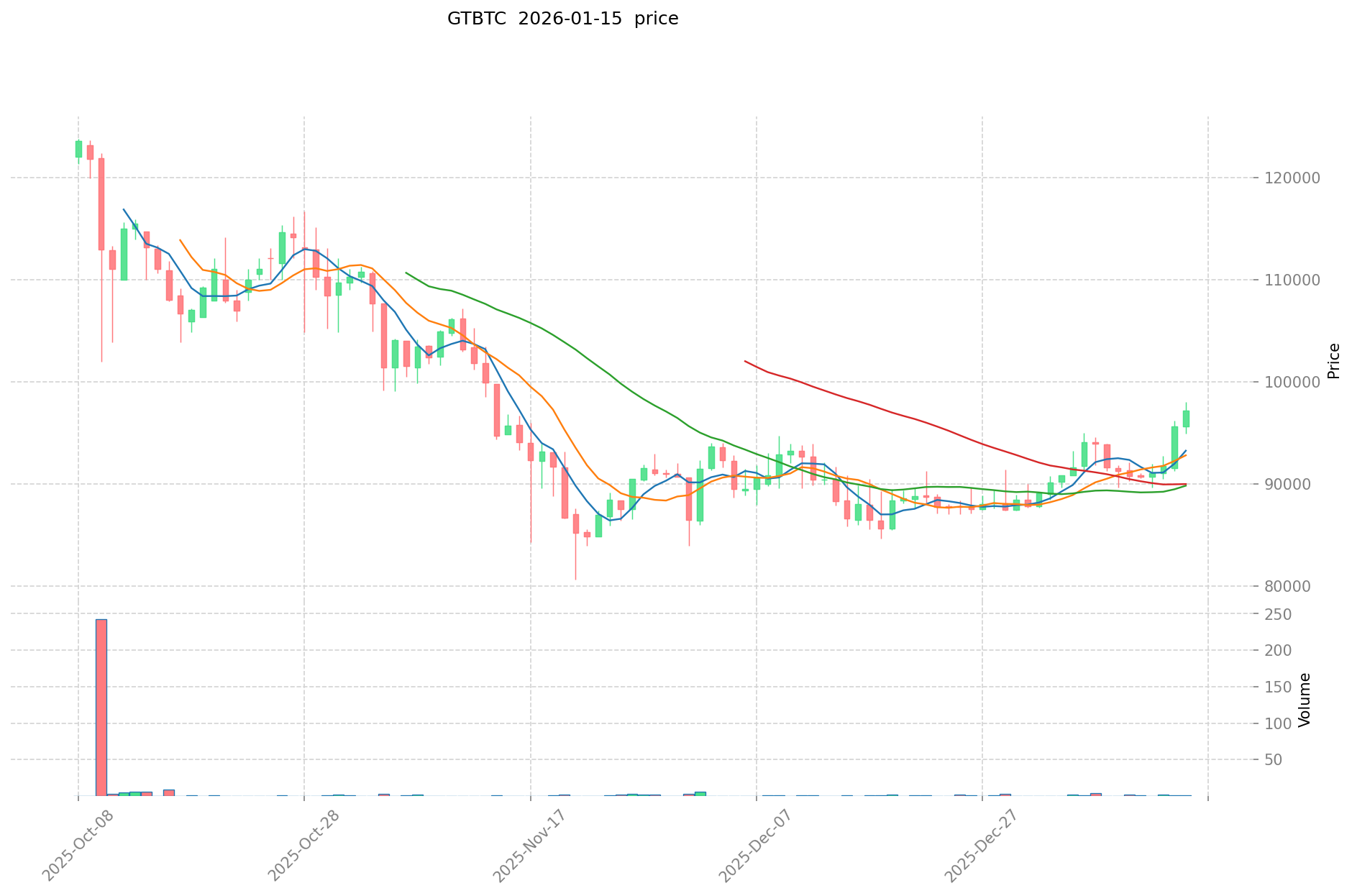
- October 6, 2025: GTBTC price reached approximately 125,918.6 USD → This marked a significant price level during the volatile period
- November 21, 2025: Price declined to approximately 80,604.9 USD → Market experienced notable correction
- January 2026: GTBTC trading at approximately 97,124 USD → Price showed recovery momentum with 1.95% increase over 24 hours
Current GTBTC Investment Market Status (January 2026)
- GTBTC current price: 97,124 USD
- 24-hour trading volume: 51,078.96 USD
- Price performance: +0.26% (1H), +1.95% (24H), +7.91% (7D), +12.47% (30D)
- Market capitalization: 291,994,392.94 USD
- Circulating supply: 3,006.41 GTBTC tokens
- Total supply: 3,006.41 GTBTC (100% circulation ratio)
- Market dominance: 0.0085%
- Gate BTC staking product data: Total staking volume reached 1,016.99 BTC with 3.00% annualized yield, plus additional GT rewards
Click to view real-time GTBTC market price
II. Core Factors Influencing Whether GTBTC Is a Good Investment
Supply Mechanism and Scarcity (GTBTC Investment Scarcity)
- Supply dynamics directly impact price and investment value
- GTBTC exhibits a fully circulating supply model, with total supply, circulating supply, and maximum supply all at 3,006.40823007 tokens, representing 100% circulation
- The asset's supply is backed by Gate's BTC reserves, with each GTBTC token representing a claim on underlying Bitcoin holdings
- Investment significance: The 1:1 backing mechanism and controlled supply structure may provide fundamental value support for long-term holders
Institutional Investment and Mainstream Adoption (Institutional Investment in GTBTC)
- Current holder base consists of 15 addresses, indicating an emerging adoption phase
- GTBTC is designed for both CeFi and DeFi scenarios, enabling institutional participants to access Bitcoin exposure through standardized on-chain tokens
- The asset is issued by Gate Web3 and backed by Gate exchange's BTC reserves, providing institutional-grade infrastructure
- Multi-chain deployment across BSC, ETH, BASE, and SOL networks enhances accessibility for diverse institutional portfolios
Macroeconomic Environment's Impact on GTBTC Investment
- As a BTC-backed yield-generating asset, GTBTC's investment attractiveness may be influenced by broader monetary policy and interest rate changes affecting Bitcoin
- The underlying Bitcoin exposure provides potential hedging characteristics during certain inflationary environments
- Geopolitical uncertainties affecting cryptocurrency markets may indirectly impact GTBTC's investment demand
Technology and Ecosystem Development (Technology & Ecosystem for GTBTC Investment)
- GTBTC functions as a standardized on-chain token with automatic yield accumulation through net asset value growth during the holding period
- Multi-chain compatibility (BSC, ETH, BASE, SOL, ABS) expands ecosystem reach and enhances liquidity options for investors
- The dual-scenario application design (CeFi and DeFi) broadens use cases, potentially supporting long-term investment value
- Integration with Gate exchange's "On-chain Earn" staking mechanism provides a structured minting and redemption framework
III. GTBTC Future Investment Prediction and Price Outlook (Is Gate Wrapped BTC (GTBTC) Worth Investing in 2026-2031)
Short-term Investment Prediction (2026, Short-term GTBTC Investment Outlook)
- Conservative Prediction: $82,466.83 - $97,019.80
- Neutral Prediction: $90,000 - $105,000
- Optimistic Prediction: $110,000 - $119,334.35
Mid-term Investment Outlook (2027-2029, Mid-term Gate Wrapped BTC (GTBTC) Investment Forecast)
-
Market Stage Expectation: GTBTC may experience gradual growth during this period, driven by its yield-generating mechanism and dual applicability in CeFi and DeFi scenarios. The asset's net value appreciation model could attract holders seeking BTC exposure with passive income potential.
-
Investment Return Prediction:
- 2027: $73,560.41 - $113,585.93
- 2028: $102,010.98 - $138,601.88
- 2029: $83,576.93 - $154,679.70
-
Key Catalysts: Expansion of GTBTC's presence across multiple blockchain networks (BSC, ETH, BASE, SOL), increased adoption in DeFi protocols, and broader recognition of wrapped BTC yield products within the crypto ecosystem.
Long-term Investment Outlook (Is GTBTC a Good Long-term Investment?)
- Baseline Scenario: $85,000 - $160,000 (assuming steady growth in wrapped BTC adoption and stable yield mechanisms)
- Optimistic Scenario: $140,000 - $180,000 (assuming enhanced liquidity, expanded exchange listings, and growing demand for BTC-backed yield assets)
- Risk Scenario: $70,000 - $100,000 (under conditions of reduced market confidence or competitive pressure from alternative wrapped BTC products)
Click to view GTBTC long-term investment and price prediction: Price Prediction
2026-2031 Long-term Outlook
- Base Scenario: $82,466.83 - $159,968.75 (corresponding to steady progress and gradual mainstream application growth)
- Optimistic Scenario: $120,000 - $180,226.80 (corresponding to large-scale adoption and favorable market conditions)
- Transformative Scenario: Above $180,000 (in case of breakthrough ecosystem developments and mainstream popularization)
- December 31, 2031 Predicted High: $180,226.80 (based on optimistic development assumptions)
Disclaimer: The above price predictions are based on historical data analysis and market trend modeling. Cryptocurrency markets are highly volatile, and actual prices may differ materially from predictions. This information does not constitute investment advice, and investors should conduct independent research and assess their risk tolerance before making any investment decisions.
| Year |
Predicted High Price |
Predicted Average Price |
Predicted Low Price |
Price Change |
| 2026 |
119334.354 |
97019.8 |
82466.83 |
0 |
| 2027 |
113585.93085 |
108177.077 |
73560.41236 |
11 |
| 2028 |
138601.87990625 |
110881.503925 |
102010.983611 |
14 |
| 2029 |
154679.697975375 |
124741.691915625 |
83576.93358346875 |
28 |
| 2030 |
180226.796479695 |
139710.6949455 |
85223.523916755 |
43 |
| 2031 |
175965.62028385725 |
159968.7457125975 |
127974.996570078 |
64 |
IV. GTBTC Investment Strategy and Risk Management (How to invest in GTBTC)
Investment Methodology (GTBTC investment strategy)
Long-term Holding (HODL GTBTC): Suitable for Conservative Investors
For investors seeking stable exposure to BTC with additional yield generation, GTBTC presents a structured approach through its yield-bearing mechanism. The token's design allows holders to accumulate returns through net asset value appreciation during the holding period, eliminating the need for active management. This passive income structure may appeal to investors who prefer a buy-and-hold strategy while maintaining exposure to BTC price movements.
Given that GTBTC is backed by Gate's BTC reserves and functions across both CeFi and DeFi environments, long-term holders can potentially benefit from the dual advantages of platform security and on-chain flexibility. The token's availability across multiple blockchain networks (BSC, ETH, BASE, SOL, ABS) provides holders with options for cross-chain liquidity management.
Active Trading: Relying on Technical Analysis and Swing Operations
GTBTC's recent price performance shows notable volatility patterns: a 0.26% increase over 1 hour, 1.95% over 24 hours, 7.91% over 7 days, and 12.47% over 30 days as of January 15, 2026. The 24-hour price range between $94,942.5 and $98,013.2 indicates intraday trading opportunities for active participants.
Traders utilizing technical analysis may observe that GTBTC has experienced significant price movements since its launch, with historical data showing a range between $80,604.9 (recorded on November 21, 2025) and $125,918.6 (recorded on October 6, 2025). These price boundaries can serve as reference points for establishing support and resistance levels in trading strategies.
The relatively modest 24-hour trading volume of approximately $51,078.96 suggests that liquidity considerations should factor into position sizing and execution strategies. Active traders should account for potential slippage in larger orders given the current market depth.
Risk Management (Risk management for GTBTC investment)
Asset Allocation Ratio: Conservative / Aggressive / Professional Investors
Conservative Investors: Given GTBTC's concentrated nature as a yield-bearing BTC wrapper, conservative portfolios might consider allocating a small percentage (3-5%) as part of a broader cryptocurrency exposure strategy. The token's backing by platform reserves provides a layer of structural support, though this does not eliminate market risk.
Aggressive Investors: Those with higher risk tolerance and conviction in BTC's long-term trajectory might allocate 10-15% of their crypto portfolio to GTBTC, particularly if they seek yield enhancement on their BTC holdings. The token's relatively short market history since its January 2025 launch requires careful consideration of liquidity and price discovery dynamics.
Professional Investors: Institutional or experienced participants may view GTBTC as a tactical instrument for yield optimization within their BTC allocation, potentially incorporating 15-25% of their crypto holdings. Professional investors should conduct thorough due diligence on the underlying reserve mechanism and platform custody arrangements.
GTBTC's correlation with BTC price movements necessitates diversification across uncorrelated assets. Investors might consider:
- Balancing GTBTC exposure with stablecoins or other yield-bearing instruments to reduce portfolio volatility
- Incorporating assets with different risk profiles and correlation patterns to the broader crypto market
- Monitoring the token's net asset value growth mechanism relative to direct BTC holdings to assess yield efficiency
Given the token's presence across multiple chains (BSC, ETH, BASE, SOL, ABS), cross-chain risk management becomes relevant. Investors should evaluate the security characteristics and bridge risks associated with each deployment environment.
Secure Storage: Hot and Cold Wallets + Hardware Wallet Recommendations
GTBTC's multi-chain architecture requires chain-specific storage considerations:
Cold Storage Options:
- Hardware wallets supporting EVM-compatible chains (for BSC, ETH, BASE, ABS deployments)
- Hardware wallets with Solana support (for SOL deployment)
- Multi-signature wallet configurations for larger holdings
Hot Wallet Considerations:
- For active traders, reputable software wallets with multi-chain support
- Enable two-factor authentication and withdrawal whitelist features where available
- Maintain only necessary trading amounts in hot storage
Platform Custody:
- GTBTC can be held directly on Gate exchange with platform security infrastructure
- Consider the trade-off between convenience and self-custody security based on holding size and investment horizon
V. GTBTC Investment Risks and Challenges (Risks of investing in GTBTC)
Market Risk: High Volatility and Price Fluctuations
GTBTC exhibits price movements closely tied to BTC market dynamics while incorporating its yield-bearing mechanism. The token has shown significant price variations since its launch in January 2025, with recorded prices ranging from $80,604.9 to $125,918.6 within its first year of operation. Current price of $97,124 represents a position within this historical range.
The token's market capitalization of approximately $291.99 million and circulation supply of 3,006.41 GTBTC indicate a relatively concentrated market structure. With only 15 holders recorded, liquidity depth may be limited compared to more widely distributed assets, potentially resulting in larger price impacts from individual transactions.
The 24-hour trading volume of approximately $51,078.96 relative to the market cap suggests modest trading activity, which may amplify volatility during periods of increased market interest or stress. Investors should anticipate potential price gaps and slippage, particularly during lower liquidity periods.
Regulatory Risk: Policy Uncertainty Across Different Countries
As a yield-bearing wrapped BTC product issued by a centralized exchange platform, GTBTC operates at the intersection of traditional finance and decentralized infrastructure. This positioning exposes the token to multiple regulatory dimensions:
Platform-Level Regulatory Exposure:
- The token's backing by Gate's BTC reserves and its issuance mechanism may face scrutiny under evolving securities regulations in various jurisdictions
- Yield-generating mechanisms in crypto assets have attracted regulatory attention in multiple markets, with classification questions regarding investment products
Cross-Border Considerations:
- GTBTC's availability across multiple blockchain networks may present compliance challenges as different jurisdictions develop distinct regulatory frameworks for digital assets
- Users should verify the regulatory status of such instruments in their local jurisdiction before participation
Reserve and Custody Framework:
- Regulatory developments regarding proof-of-reserves requirements and custodial standards may impact the operational framework of platform-backed wrapped assets
- Changes in licensing requirements for crypto asset service providers could affect the token's operational continuity
Technical Risk: Network Security Vulnerabilities and Upgrade Failures
Multi-Chain Deployment Risks:
GTBTC's presence across five different blockchain networks (BSC, ETH, BASE, SOL, ABS) creates multiple technical risk vectors:
- Each blockchain carries distinct security characteristics and consensus mechanisms
- Cross-chain bridge dependencies introduce potential vulnerability points
- Smart contract implementations across different chains require independent security verification
Smart Contract Risk:
- The token's standardized on-chain wrapper structure relies on smart contract code that could contain undiscovered vulnerabilities
- Contract addresses on EVM chains (0xc2d09cf86b9ff43cb29ef8ddca57a4eb4410d5f3) and Solana (gtBTCGWvSRYYoZpU9UZj6i3eUGUpgksXzzsbHk2K9So) represent potential points of technical failure
- The yield accumulation mechanism through net asset value growth depends on correct smart contract execution
Platform Infrastructure Risk:
- GTBTC's backing by Gate's BTC reserves creates dependency on platform security and operational continuity
- The minting and redemption mechanism through Gate's staking infrastructure requires ongoing platform functionality
- Custody arrangements for underlying BTC reserves represent a centralized risk factor
Network-Specific Considerations:
- Blockchain network congestion or upgrade events could affect transaction processing and token accessibility
- Changes to underlying blockchain protocols may require GTBTC contract adaptations
VI. Conclusion: Is GTBTC a Good Investment?
Investment Value Summary
GTBTC represents a specialized instrument within the crypto asset landscape, combining BTC exposure with a yield-generation mechanism through platform-backed reserves. The token's structure offers potential benefits for investors seeking enhanced returns on BTC holdings while maintaining on-chain flexibility.
The asset's performance since its January 2025 launch shows notable price movements, with recent momentum indicators suggesting positive short to medium-term trends (7.91% over 7 days, 12.47% over 30 days as of January 15, 2026). However, the relatively short operational history limits the ability to assess long-term performance patterns and mechanism sustainability.
Key considerations for investment evaluation include the token's concentrated holder base (15 holders), modest trading volumes relative to market cap, and dependence on platform infrastructure for core functionality. The multi-chain deployment offers flexibility but introduces additional technical complexity and risk vectors.
Investor Recommendations
✅ Beginners:
- Consider GTBTC only after understanding basic BTC investment principles and the specific mechanics of yield-bearing wrapped assets
- Start with small position sizes to gain familiarity with the token's behavior and yield accrual mechanism
- Utilize secure wallet storage appropriate for the chosen blockchain network
- Recognize that GTBTC combines both BTC price risk and platform-specific risks
✅ Experienced Investors:
- Evaluate GTBTC as a potential yield enhancement tool within existing BTC allocations
- Monitor the relationship between GTBTC's net asset value growth and alternative BTC yield opportunities
- Consider the token's liquidity profile when sizing positions for active trading strategies
- Diversify across multiple yield-bearing and non-yield-bearing BTC exposure vehicles
✅ Institutional Investors:
- Conduct thorough due diligence on reserve backing mechanisms and custody arrangements
- Assess GTBTC's role within broader portfolio construction and risk management frameworks
- Evaluate regulatory implications in relevant jurisdictions before commitment
- Consider the token's relatively small scale and holder concentration in liquidity planning
⚠️ Notice: Cryptocurrency investment carries substantial risk. GTBTC's yield-bearing mechanism, platform dependencies, and multi-chain architecture introduce additional complexity beyond standard BTC exposure. This content is for informational purposes only and does not constitute investment advice. Prospective investors should conduct independent research and consider their individual risk tolerance, investment objectives, and regulatory environment before making investment decisions.
VII. FAQ
Q1: What is GTBTC and how does it differ from regular Bitcoin?
GTBTC (Gate Wrapped BTC) is a yield-generating wrapped Bitcoin asset issued by Gate Web3 and backed by the platform's BTC reserves, while regular Bitcoin does not generate passive yields. Unlike standard BTC, GTBTC enables holders to earn returns through net asset value appreciation during the holding period without active management. Each GTBTC token represents a claim on underlying Bitcoin holdings in a 1:1 backing mechanism, and can be minted by staking BTC on Gate Exchange. Additionally, GTBTC is deployed across multiple blockchain networks (BSC, ETH, BASE, SOL, ABS), providing cross-chain flexibility that native Bitcoin does not inherently possess.
Q2: How does the GTBTC yield generation mechanism work?
GTBTC generates yields through automatic net asset value (NAV) growth during the holding period, with returns accumulating without requiring active participation from holders. The mechanism operates through Gate's BTC staking infrastructure, where users stake BTC to mint GTBTC tokens. As of January 2026, the Gate BTC staking product offers 3.00% annualized yield plus additional GT token rewards, with total staking volume reaching 1,016.99 BTC. The yield accrues directly through the token's increasing net asset value rather than through separate distributions, creating a compound growth structure for long-term holders.
Q3: What are the main risks associated with investing in GTBTC?
The primary risks include platform dependency risk, as GTBTC relies on Gate's infrastructure and BTC reserve custody; limited liquidity with only $51,078.96 in 24-hour trading volume and 15 holders; multi-chain technical risks across five different blockchain deployments; high price volatility demonstrated by historical ranges between $80,604.9 and $125,918.6; and regulatory uncertainty surrounding yield-bearing crypto assets issued by centralized platforms. Additionally, smart contract vulnerabilities across different chain implementations and the token's relatively short operational history since January 2025 contribute to the overall risk profile.
Q4: How liquid is GTBTC compared to other Bitcoin-related assets?
GTBTC exhibits relatively limited liquidity compared to mainstream Bitcoin products, with a 24-hour trading volume of approximately $51,078.96 against a market capitalization of $291.99 million. The concentrated holder base of 15 addresses indicates an emerging adoption phase with potential for significant price impact from individual transactions. This liquidity profile suggests that larger orders may experience notable slippage, and investors should size positions accordingly. The token's availability across multiple chains (BSC, ETH, BASE, SOL, ABS) provides some flexibility, but overall trading depth remains modest compared to direct Bitcoin or major wrapped BTC alternatives like WBTC.
Q5: What is the minimum investment amount and how can I acquire GTBTC?
GTBTC can be acquired through two primary methods: minting by staking BTC on Gate Exchange's staking platform, or purchasing directly on supported markets. The token's current price of approximately $97,124 represents the cost for one full GTBTC token, though fractional amounts may be available depending on the platform. To mint GTBTC, users must hold BTC on Gate Exchange and participate in the Gate Staking program, where the staked BTC is converted into GTBTC tokens. The multi-chain deployment means GTBTC can be accessed through different blockchain networks, each with potentially different minimum transaction requirements based on network-specific gas fees and smart contract parameters.
Q6: Is GTBTC suitable for long-term holding or short-term trading?
GTBTC's suitability depends on investor objectives and risk tolerance. For long-term holding, the yield-bearing mechanism through NAV appreciation offers potential benefits for investors seeking passive BTC exposure with enhanced returns, particularly given the 3.00% annualized yield plus GT rewards. The token's recent performance shows positive momentum (12.47% over 30 days), but limited operational history since January 2025 makes long-term pattern assessment challenging. For short-term trading, recent volatility indicators (7.91% weekly change) present opportunities, though modest liquidity ($51,078.96 daily volume) may constrain active trading strategies. Conservative investors might prefer long-term holding given the yield structure, while experienced traders could capitalize on price movements within the established historical range of $80,604.9 to $125,918.6.
Q7: How does GTBTC's price track Bitcoin, and what causes divergence?
GTBTC's price fundamentally tracks Bitcoin due to its 1:1 backing by BTC reserves, but several factors can cause divergence. The token's net asset value growth mechanism means GTBTC should theoretically trade at a premium to BTC reflecting accumulated yields, though market pricing may not always reflect this theoretical value. Divergence can occur due to limited liquidity creating pricing inefficiencies, platform-specific risk perceptions affecting demand, cross-chain arbitrage opportunities across the five deployment networks, and variations in redemption mechanisms between GTBTC and underlying BTC. Market sentiment specific to wrapped BTC products and Gate platform developments can also influence relative pricing beyond pure BTC tracking.
Q8: What are the tax implications of holding GTBTC versus regular Bitcoin?
Tax treatment of GTBTC may differ from regular Bitcoin holdings depending on jurisdiction, as the yield-bearing mechanism could trigger distinct tax events. In many jurisdictions, the automatic NAV appreciation may be classified as income or capital gains requiring periodic reporting, whereas holding regular Bitcoin typically only triggers tax events upon sale. The minting process (converting BTC to GTBTC) and redemption (converting back to BTC) may constitute taxable events in some regions. Additionally, the GT token rewards received through the staking mechanism could be treated as separate taxable income. Investors should consult tax professionals familiar with cryptocurrency regulations in their specific jurisdiction, as treatment varies significantly across different countries and evolving regulatory frameworks for yield-bearing crypto assets.
* The information is not intended to be and does not constitute financial advice or any other recommendation of any sort offered or endorsed by Gate.