This comprehensive analysis examines whether Gather (GAT) represents a viable investment opportunity within the Web3.0 infrastructure sector. As a decentralized messaging network token launched in 2024, GAT integrates cryptographic technology, GProto communication protocol, and G-BOX hardware devices to create infrastructure for distributed message exchange. Currently trading at $0.8195 with a market capitalization of $10.57 million, GAT demonstrates early-stage positioning with 12.9% of maximum supply circulating. The article evaluates GAT's investment value through price history analysis, core ecosystem factors including technology development and institutional adoption, and provides price forecasts ranging from conservative to optimistic scenarios through 2031. Investment strategies span from long-term holding to active trading, complemented by comprehensive risk management frameworks addressing market volatility, regulatory uncertainties, and technical dependencies. Suitable for investors seeking exposure
Introduction: Gather (GAT)'s Investment Position and Market Outlook
GAT is a significant asset in the cryptocurrency sector, launched in 2024 and building a decentralized message exchange network based on Web3.0 public chain, cryptographic technology, and the GProto communication protocol. As of January 2026, Gather holds a market capitalization of approximately $10.57 million, with a circulating supply of around 12.90 million tokens, and the current price stands near $0.8195. With its positioning as a distributed long-link cluster solution combined with G-BOX devices, GAT has gradually become a focal point for investors discussing "Is Gather (GAT) a good investment?" This article will comprehensively analyze GAT's investment value, historical trends, future price predictions, and investment risks, providing reference for investors.
I. Gather (GAT) Price History Review and Current Investment Value
- 2024: Project launch and listing on exchanges → GAT demonstrated significant volatility with notable price movements following its initial deployment
- 2024 Q3: Price reached elevated levels during market expansion phase → GAT experienced substantial fluctuations between $0.78 and elevated price zones
- 2024-2025: Market adjustment period → Price underwent corrections from previous higher levels to lower trading ranges
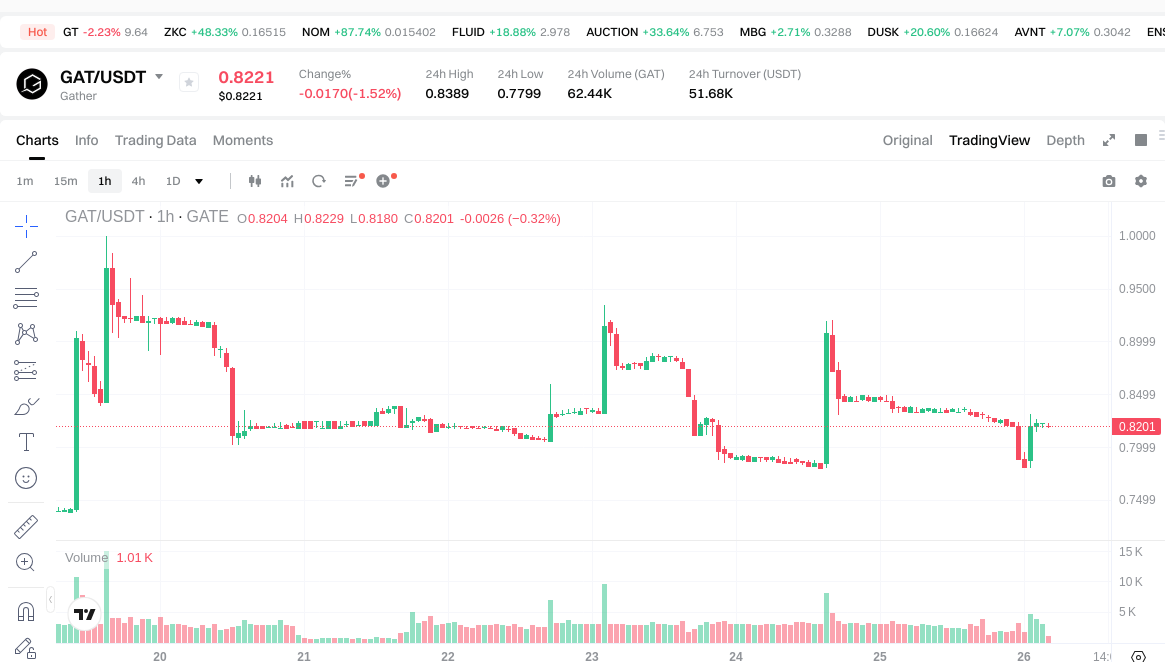
Current GAT Investment Market Status (January 2026)
- GAT current price: $0.8195
- 24-hour trading volume: $51,724.91
- Circulating supply: 12,898,998 GAT (12.90% of total supply)
- Market capitalization: $10,570,728.86
- Fully diluted valuation: $81,950,000
Click to view real-time GAT market price
II. Core Factors Affecting Whether GAT is a Good Investment (Is Gather(GAT) a Good Investment)
Supply Mechanism and Scarcity (GAT investment scarcity)
- Fixed Maximum Supply of 100,000,000 GAT → influences price and investment value
- Current Circulating Supply: 12,898,998 GAT (approximately 12.9% of max supply) → indicates controlled token release
- Investment Significance: Limited total supply and low circulation ratio may support long-term scarcity dynamics
Institutional Investment and Mainstream Adoption (Institutional investment in GAT)
- Exchange Presence: Listed on 1 exchange platform → limited accessibility compared to major cryptocurrencies
- Trading Volume: 24-hour trading volume of approximately $51,724 → reflects relatively modest market activity
- Market Capitalization Ranking: #1159 globally with 0.0026% market dominance → indicates early-stage market position
Macroeconomic Environment's Impact on GAT Investment
- Monetary Policy and Interest Rate Changes → may alter investment attractiveness for emerging crypto assets
- Inflation Environment Hedge Role → GAT's position as a messaging network infrastructure token differs from traditional "digital gold" positioning
- Geopolitical Uncertainty → potential impact on decentralized communication network demand
Technology and Ecosystem Development (Technology & Ecosystem for GAT investment)
- Web3.0 Public Chain Infrastructure: Built on cryptographic technology and GProto communication protocol → provides technical foundation for decentralized messaging
- G-BOX Device Integration: Distributed long-link cluster architecture → aims to create stable decentralized message exchange network
- NAC Blockchain Deployment: Token operates on NA Chain (contract address: 16) → ecosystem tied to specific blockchain infrastructure
- Decentralized Communication Application: Focus on messaging network services → differentiates from DeFi or NFT-focused projects
III. GAT Future Investment Forecast and Price Outlook (Is Gather(GAT) worth investing in 2026-2031)
Short-term Investment Forecast (2026, short-term GAT investment outlook)
- Conservative forecast: $0.61 - $0.82
- Neutral forecast: $0.70 - $0.90
- Optimistic forecast: $0.82 - $1.09
Mid-term Investment Outlook (2027-2028, mid-term Gather(GAT) investment forecast)
-
Market phase expectation: Based on the distributed messaging network infrastructure, GAT may experience gradual adoption growth as the decentralized communication sector matures. The token price trajectory suggests moderate volatility with potential upward momentum.
-
Investment return forecast:
- 2027: $0.54 - $1.17
- 2028: $0.87 - $1.46
-
Key catalysts: Expansion of G-BOX device deployments, adoption of the GProto communication protocol, development momentum of Web3.0 infrastructure, and growth in decentralized messaging use cases.
Long-term Investment Outlook (Is GAT a good long-term investment?)
- Base scenario: $0.90 - $1.40 (assuming steady development of decentralized messaging infrastructure and moderate market adoption)
- Optimistic scenario: $1.40 - $1.63 (assuming accelerated adoption of Web3.0 communication solutions and favorable regulatory environment)
- Risk scenario: $0.54 - $0.90 (in case of limited mainstream adoption or increased competition in the decentralized messaging sector)
Click to view GAT long-term investment and price forecast: Price Prediction
2026-01-26 - 2031 Long-term Outlook
- Base scenario: $0.93 - $1.39 USD (corresponding to steady progress and gradual mainstream application growth)
- Optimistic scenario: $1.39 - $1.63 USD (corresponding to large-scale adoption and favorable market conditions)
- Transformative scenario: Above $1.63 USD (if the ecosystem achieves breakthrough progress and mainstream popularization)
- 2031-12-31 predicted high: $1.63 USD (based on optimistic development assumptions)
Disclaimer: This analysis is for informational purposes only and does not constitute investment advice. Cryptocurrency markets are highly volatile, and past performance does not guarantee future results. Investors should conduct their own research and consult with financial professionals before making investment decisions.
| Year |
Predicted High Price |
Predicted Average Price |
Predicted Low Price |
Price Change |
| 2026 |
1.088738 |
0.8186 |
0.61395 |
0 |
| 2027 |
1.17301287 |
0.953669 |
0.54359133 |
16 |
| 2028 |
1.45677708095 |
1.063340935 |
0.8719395667 |
29 |
| 2029 |
1.32306195837375 |
1.260059007975 |
1.1340531071775 |
53 |
| 2030 |
1.498210160482275 |
1.291560483174375 |
0.904092338222062 |
57 |
| 2031 |
1.63201582653914 |
1.394885321828325 |
0.934573165624977 |
70 |
IV. Gather (GAT) Investment Strategy and Risk Management (How to invest in Gather)
Investment Strategy (Gather investment strategy)
Long-term Holding (HODL Gather)
Long-term holding represents a suitable approach for conservative investors seeking exposure to decentralized messaging infrastructure. This strategy involves accumulating GAT tokens during periods of market correction and maintaining positions through market cycles. Given Gather's focus on Web3.0 communication protocols and the G-BOX hardware ecosystem, investors adopting this approach typically align with the project's long-term vision of building decentralized message exchange networks.
Active Trading
Active trading strategies rely on technical analysis and swing trading methodologies. Traders monitor GAT's price movements within established support and resistance levels, utilizing indicators such as moving averages and volume patterns. The token's historical price range between $0.351 and previous higher levels provides reference points for identifying potential entry and exit positions. This approach requires continuous market monitoring and understanding of short-term price dynamics.
Risk Management (Risk management for Gather investment)
Asset Allocation Ratios
- Conservative investors: Allocate 1-3% of cryptocurrency portfolio to GAT, maintaining majority holdings in established digital assets
- Aggressive investors: Consider 5-10% allocation while maintaining diversification across multiple blockchain projects
- Professional investors: May allocate 10-15% with active monitoring and hedging strategies
Risk Hedging Strategies
Implementing a multi-asset portfolio approach helps mitigate concentration risk. Investors may consider combining GAT holdings with various blockchain infrastructure tokens and stablecoins. Position sizing techniques, such as dollar-cost averaging, can reduce exposure to short-term volatility. Setting predetermined exit points and stop-loss levels provides downside protection.
Secure Storage Solutions
Cold Wallet Storage: Hardware wallets offer enhanced security for long-term holdings, protecting assets from online threats. Options include devices that support multiple blockchain networks.
Hot Wallet Management: For active traders, maintaining smaller amounts in exchange wallets or software wallets enables quick transaction execution while limiting exposure.
Multi-signature Solutions: Advanced users may implement multi-signature wallet configurations for additional security layers.
V. Gather (GAT) Investment Risks and Challenges (Risks of investing in Gather)
Market Risks
Volatility Characteristics: GAT has demonstrated significant price fluctuations, with movements influenced by broader cryptocurrency market trends and project-specific developments. The limited trading volume of approximately $51,724.91 (as of recent data) suggests relatively lower liquidity compared to major cryptocurrencies, potentially leading to wider bid-ask spreads and increased slippage during trades.
Price Discovery Mechanisms: With a circulating supply of approximately 12.9 million tokens out of a maximum supply of 100 million, the token's price formation may be affected by supply-release schedules and market absorption capacity.
Regulatory Risks
Jurisdictional Uncertainties: Cryptocurrency regulations vary significantly across different countries and regions. Changes in regulatory frameworks regarding decentralized communication networks, data privacy laws, and cryptocurrency classifications could impact Gather's operational model and token utility.
Compliance Requirements: Evolving regulatory standards for blockchain projects, including potential requirements for decentralized messaging platforms, may necessitate operational adjustments that could affect token economics.
Technical Risks
Network Security: As a decentralized message exchange network utilizing cryptographic technology and the GProto communication protocol, the platform faces potential vulnerabilities including:
- Smart contract security concerns
- Network-level attack vectors
- Hardware device (G-BOX) security considerations
Upgrade Execution: Implementation of protocol upgrades and integration of new features within the Web3.0 infrastructure carries execution risks, including potential network disruptions or compatibility issues.
Infrastructure Dependencies: The project's reliance on G-BOX devices and distributed long-link clusters introduces hardware-related risks and maintenance requirements that differ from pure software-based blockchain projects.
VI. Conclusion: Is Gather (GAT) a Good Investment?
Investment Value Summary
Gather (GAT) presents characteristics of an infrastructure-focused blockchain project targeting decentralized communications. The project's integration of Web3.0 technology, cryptographic protocols, and hardware components (G-BOX) represents a specific approach within the broader blockchain ecosystem. However, factors such as limited exchange availability, circulating supply representing approximately 12.9% of maximum supply, and relatively modest trading volumes suggest considerations regarding liquidity and market maturity.
Investor Recommendations
✅ Beginner Investors: Consider implementing dollar-cost averaging strategies with small allocation percentages. Prioritize secure storage solutions using hardware wallets and thoroughly research the project's technical documentation and development roadmap before committing capital.
✅ Experienced Investors: May explore swing trading opportunities while maintaining diversified portfolio allocations. Monitor project developments, partnership announcements, and network adoption metrics. Implement risk management protocols including position sizing and stop-loss strategies.
✅ Institutional Investors: Conduct comprehensive due diligence covering technical architecture, team credentials, competitive landscape, and token economics. Consider strategic positioning within broader infrastructure-focused cryptocurrency portfolios while maintaining appropriate risk controls.
⚠️ Important Notice: Cryptocurrency investments carry substantial risk including potential loss of principal. Market conditions can change rapidly, and past performance does not indicate future results. This content serves informational purposes only and does not constitute financial advice, investment recommendations, or solicitation to buy or sell any assets. Individuals should conduct independent research and consult qualified financial advisors before making investment decisions.
VII. FAQ
Q1: What is the minimum recommended investment amount for GAT tokens?
There is no universal minimum investment amount for GAT, as it depends on individual financial circumstances and risk tolerance. However, conservative investors typically allocate 1-3% of their cryptocurrency portfolio to emerging infrastructure tokens like GAT, which translates to different absolute amounts based on total portfolio size. For beginners, starting with smaller amounts ($100-500) allows for learning about the token's behavior without significant capital exposure. The key principle is investing only what you can afford to lose, given the high volatility and relatively low liquidity of GAT compared to established cryptocurrencies. Dollar-cost averaging over time can help mitigate entry timing risk.
Q2: How does GAT differ from other cryptocurrency investments?
GAT distinguishes itself as a decentralized messaging infrastructure token rather than a payment system or DeFi protocol. Unlike Bitcoin's store-of-value positioning or Ethereum's smart contract platform focus, GAT specifically targets Web3.0 communication networks through its GProto protocol and G-BOX hardware devices. This specialization means GAT's value proposition depends on adoption of decentralized messaging solutions rather than broader cryptocurrency market sentiment alone. Additionally, with only 12.9% of maximum supply currently circulating and listing on just one exchange, GAT exhibits different liquidity characteristics and accessibility compared to major cryptocurrencies available across multiple platforms.
Q3: What are the primary indicators to monitor for GAT investment decisions?
Key indicators for GAT investment evaluation include: (1) Circulating supply changes, as the current 12.9% circulation rate suggests significant future token releases that could impact price dynamics; (2) Trading volume trends, with the current $51,724 daily volume indicating liquidity constraints; (3) G-BOX device deployment numbers and network activity metrics, which directly reflect platform adoption; (4) Development milestones related to the GProto communication protocol; (5) Exchange listing announcements, as additional trading venues would improve accessibility; and (6) Broader Web3.0 infrastructure adoption trends. Technical indicators such as support levels around $0.54-0.61 and resistance zones near $1.09-1.17 also provide trading reference points.
Q4: What is the realistic timeframe for potential returns on GAT investment?
Based on price forecasting models, short-term gains (2026) may range from -25% to +33% depending on market conditions, making quick returns uncertain. Mid-term outlook (2027-2028) suggests potential appreciation of 43-78% under favorable adoption scenarios, though this requires sustained development progress. Long-term projections (2029-2031) indicate possible 70-99% gains by 2031 in optimistic scenarios, contingent on mainstream adoption of decentralized messaging infrastructure. However, these are projections rather than guarantees. Investors should establish realistic expectations based on the project's early development stage, limited current adoption metrics, and the inherent unpredictability of emerging technology adoption curves. Risk scenarios also project potential -34% downside, emphasizing the importance of appropriate time horizons and risk management.
Q5: How should investors respond to GAT's limited exchange availability?
GAT's presence on only one exchange platform presents both challenges and considerations. This limitation affects liquidity, potentially resulting in wider bid-ask spreads and higher slippage during trades. Investors should: (1) Place limit orders rather than market orders to control execution prices; (2) Avoid large single transactions that could significantly impact price; (3) Maintain accounts on the listing exchange with proper security measures; (4) Monitor announcements for potential additional exchange listings, which historically boost accessibility and trading volume; and (5) Consider the limited availability as part of overall risk assessment, allocating accordingly. The concentration on a single platform increases counterparty risk, making secure personal storage (hardware wallets) more important for long-term holdings. Exchange diversification announcements could serve as positive catalysts for price appreciation.
Q6: What role does the G-BOX hardware component play in GAT investment value?
The G-BOX device represents a unique aspect of Gather's infrastructure approach, functioning as physical nodes in the distributed long-link cluster architecture. For investment evaluation, G-BOX deployment success directly impacts GAT's utility and adoption potential. Higher device installation rates indicate growing network infrastructure, which theoretically supports token demand through increased platform usage. However, hardware dependencies also introduce risks including: manufacturing and supply chain challenges, maintenance requirements, device security vulnerabilities, and adoption barriers compared to pure software solutions. Investors should monitor metrics such as G-BOX deployment numbers, device operational uptime, and user retention rates as indicators of network health. The hardware component differentiates GAT from purely digital infrastructure tokens but also adds complexity to the investment thesis requiring evaluation of both software and hardware adoption dynamics.
Q7: How does GAT's Web3.0 communication focus position it within the broader cryptocurrency market?
GAT occupies a specialized niche within the Web3.0 infrastructure sector, focusing specifically on decentralized messaging rather than the more crowded DeFi, NFT, or Layer-1 blockchain spaces. This positioning offers differentiation but also presents adoption challenges, as decentralized communication applications currently have less mainstream traction than financial applications. The market capitalization of $10.57 million and #1159 global ranking reflect early-stage positioning with potential for significant growth if the sector gains momentum, but also substantial risk if decentralized messaging remains a niche use case. Comparative analysis suggests GAT competes not only with other blockchain communication projects but also with established centralized messaging platforms that users must be motivated to abandon. Investment consideration should evaluate whether Web3.0 communication represents a growing market opportunity sufficient to justify the token's current valuation and projected growth assumptions.
Q8: What exit strategy should GAT investors consider?
Effective exit strategies for GAT investment should account for the token's volatility and liquidity characteristics. Recommended approaches include: (1) Profit-taking tiers: Setting predetermined price targets (e.g., 25% of position at +50% gain, another 25% at +100%) to systematically realize returns while maintaining exposure; (2) Time-based review: Quarterly reassessment of project development progress against roadmap milestones, with exit triggers if key objectives are consistently missed; (3) Stop-loss implementation: Establishing downside protection levels (typically 15-30% below entry for risk-tolerant investors) to prevent catastrophic losses; (4) Gradual exit execution: Given limited liquidity, planning exits over multiple transactions to minimize market impact; and (5) Rebalancing discipline: Maintaining predetermined portfolio allocation percentages, selling portions when GAT exceeds target weighting regardless of absolute price. Investors should document their exit criteria before entering positions to avoid emotional decision-making during periods of volatility.
* The information is not intended to be and does not constitute financial advice or any other recommendation of any sort offered or endorsed by Gate.