This article provides a comprehensive analysis of whether Gearbox (GEAR) represents a viable investment opportunity in the DeFi leverage protocol sector. As of January 2026, GEAR trades at $0.0006922 with a $6.92 million market cap, down 89.82% from its April 2024 peak. The article examines GEAR's dual-sided protocol model serving liquidity providers and leveraged traders, reviews historical price volatility and current market status across 8 exchanges including Gate, and presents multi-scenario price projections through 2031. Key investment considerations include supply mechanics, technology fundamentals, and macroeconomic factors alongside significant risks including market volatility, regulatory uncertainty, and smart contract vulnerabilities. Tailored recommendations address beginners, experienced investors, and institutions, while emphasizing risk management through strategic asset allocation and secure storage practices.
Introduction: Gearbox (GEAR)'s Investment Position and Market Prospects
GEAR is a significant asset in the cryptocurrency sector, having been launched in December 2022. As a universal leverage protocol, Gearbox serves both passive liquidity providers seeking yield opportunities and active traders or protocols requiring leveraged exposure. As of January 28, 2026, GEAR maintains a market capitalization of approximately $6.92 million, with a circulating supply of 10 billion tokens and a current price around $0.0006922. With its positioning as a decentralized leverage infrastructure, GEAR has gradually become a focal point when investors discuss "Is Gearbox (GEAR) a good investment?" This article provides a comprehensive analysis of GEAR's investment value, historical trends, future price projections, and associated risks to offer reference for investors.
The protocol operates through a dual-sided model: liquidity providers contribute single-asset liquidity to earn yield, while borrowers utilize these assets for trading or yield farming activities. The token has demonstrated notable price volatility, with recent data showing fluctuations across multiple timeframes. GEAR is traded on 8 exchanges and is held by over 11,000 addresses, indicating a degree of community distribution. The following sections examine the token's historical performance, technical characteristics, and potential factors influencing its future trajectory in the decentralized finance landscape.
I. Gearbox (GEAR) Price History Review and Current Investment Value
- 2024: GEAR experienced significant price volatility, with trading activity reflecting broader market conditions in the DeFi leverage protocol sector
- 2025: Market performance showed fluctuations, with GEAR trading around $0.001778 according to certain market analyses, while other assessments indicated prices near $0.0034, suggesting varied market conditions and liquidity across different exchanges
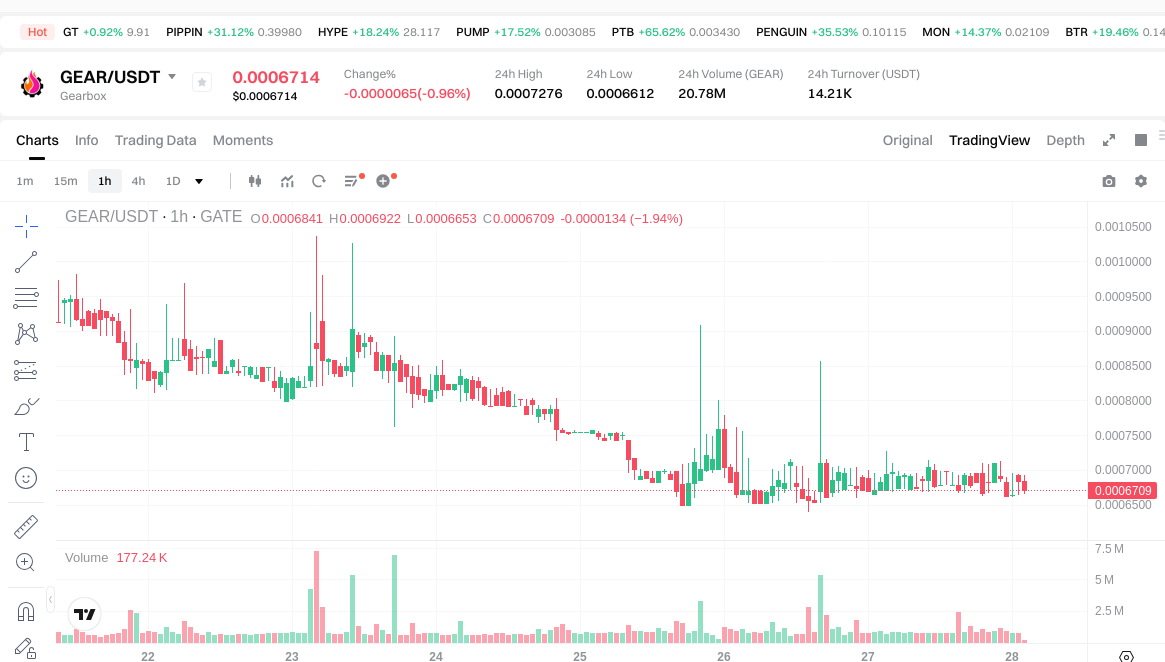
- 2026 (January): Price registered at $0.0006922, representing a decline from previous periods, with 24-hour trading volume of approximately $14,277.90
Current GEAR Investment Market Status (January 2026)
- Current GEAR Price: $0.0006922
- 24-hour Trading Volume: $14,277.9025274
- Market Capitalization: $6,922,000.00
- Circulating Supply: 10,000,000,000 GEAR (100% of total supply)
- 24-hour Price Change: -1.27%
- 7-day Price Change: -25.77%
- 30-day Price Change: -29.48%
- Exchange Availability: Listed on 8 exchanges
- Token Holders: 11,038
Click to view real-time GEAR market price
II. Core Factors Affecting Whether GEAR is a Good Investment
Supply Mechanism and Scarcity
- Supply Mechanism → Impacts price and investment value
- Total Supply: Gearbox (GEAR) has a total supply of 10,000,000,000 tokens, with 100% currently in circulation
- Maximum Supply: The maximum supply is capped at 10,000,000,000 GEAR tokens, indicating a fixed supply model
- Investment Significance: The complete circulation of the total supply eliminates future dilution risk, which may provide clarity for long-term investment considerations
Institutional Investment and Mainstream Adoption
- Holder Distribution: As of January 2026, GEAR has approximately 11,038 token holders
- Exchange Listings: GEAR is available on 8 cryptocurrency exchanges, including Gate.com, providing accessibility for institutional and retail investors
- Adoption Status: Gearbox functions as a universal leverage protocol, serving passive liquidity providers and active users seeking leveraged trading opportunities up to 10x
Macroeconomic Environment's Impact on GEAR Investment
- Market Performance: GEAR experienced a 24-hour price decline of 1.27%, with trading volume reaching approximately $14,277.90
- Market Capitalization: The project holds a market cap of approximately $6.92 million, representing 0.00022% market dominance
- Price Volatility: GEAR has shown significant price fluctuations, with a 7-day decline of 25.77% and a 1-year decline of 89.82%
- Historical Price Range: The token reached a price point of $0.03725561 in April 2024, while recording a lower price level of $0.00065316 in January 2026
Technology and Ecosystem Development
- Protocol Functionality: Gearbox operates as a dual-sided leverage protocol, enabling liquidity providers to earn yield while allowing borrowers to access leveraged positions
- Technical Infrastructure: The GEAR token is deployed on the Ethereum network (contract address: 0xba3335588d9403515223f109edc4eb7269a9ab5d)
- Ecosystem Components: The protocol supports leveraged trading and yield farming activities, contributing to DeFi ecosystem expansion
- Development Activity: The project maintains an active GitHub repository, indicating ongoing technical development
III. GEAR Future Investment Prediction and Price Outlook (Is Gearbox(GEAR) worth investing in 2026-2031)
Short-term Investment Prediction (2026, short-term GEAR investment outlook)
- Conservative Forecast: $0.000590 - $0.000671
- Neutral Forecast: $0.000671 - $0.000758
- Optimistic Forecast: $0.000758 and above
Mid-term Investment Outlook (2027-2029, mid-term Gearbox(GEAR) investment forecast)
- Market Phase Expectation: The token may experience a gradual recovery phase, with price fluctuations reflecting broader market sentiment and protocol adoption trends.
- Investment Return Prediction:
- 2027: $0.000407 - $0.000943
- 2028: $0.000671 - $0.001019
- 2029: $0.000721 - $0.001155
- Key Catalysts: Factors may include protocol upgrades, increased liquidity provision, expanded DeFi integrations, and overall market recovery dynamics.
Long-term Investment Outlook (Is Gearbox a good long-term investment?)
- Baseline Scenario: $0.000831 - $0.001039 (assuming steady protocol development and moderate DeFi sector growth)
- Optimistic Scenario: $0.001100 - $0.001549 (assuming accelerated adoption, strategic partnerships, and favorable regulatory environment)
- Risk Scenario: Below $0.000590 (under extreme market downturns, liquidity crises, or protocol-specific challenges)
Click to view GEAR long-term investment and price prediction: Price Prediction
2026-01-28 - 2031 Long-term Outlook
- Baseline Scenario: $0.000831 - $0.001039 USD (corresponding to steady progress and stable mainstream application growth)
- Optimistic Scenario: $0.001100 - $0.001549 USD (corresponding to large-scale adoption and favorable market environment)
- Transformative Scenario: Above $0.001549 USD (in case of breakthrough ecosystem developments and mainstream penetration)
- 2031-12-31 Predicted High: $0.001411 USD (based on optimistic development assumptions)
Disclaimer: The above predictions are based on historical data analysis and market trend modeling. Cryptocurrency markets are highly volatile and subject to numerous unpredictable factors. These forecasts do not constitute investment advice, and investors should conduct thorough research and risk assessment before making any investment decisions.
| Year |
Predicted High Price |
Predicted Average Price |
Predicted Low Price |
Price Change |
| 2026 |
0.000758117 |
0.0006709 |
0.000590392 |
-3 |
| 2027 |
0.00094315122 |
0.0007145085 |
0.000407269845 |
3 |
| 2028 |
0.0010194607278 |
0.00082882986 |
0.0006713521866 |
19 |
| 2029 |
0.001155181617375 |
0.0009241452939 |
0.000720833329242 |
33 |
| 2030 |
0.001549098548899 |
0.001039663455637 |
0.00083173076451 |
50 |
| 2031 |
0.001410875292472 |
0.001294381002268 |
0.001100223851928 |
86 |
IV. GEAR Investment Strategy and Risk Management (How to invest in DeFi Leverage Tokens)
Investment Strategy (GEAR investment strategy)
-
Long-term Holding (HODL GEAR): Suitable for conservative investors who believe in the long-term development potential of decentralized leverage protocols. This approach requires patience to weather market fluctuations and focuses on the protocol's technological evolution and ecosystem expansion.
-
Active Trading: Relies on technical analysis and swing trading strategies. Investors need to monitor market sentiment, trading volume changes, and key support/resistance levels. Given GEAR's notable price volatility, this strategy demands strong risk control capabilities and market judgment.
Risk Management (Risk management for GEAR investment)
-
Asset Allocation Ratio:
- Conservative investors: Allocate no more than 1-2% of total portfolio to GEAR
- Aggressive investors: May consider 3-5% allocation based on risk tolerance
- Professional investors: Can adjust flexibly according to market conditions and strategy requirements
-
Risk Hedging Solutions: Construct a diversified crypto asset portfolio, combining major cryptocurrencies with DeFi protocol tokens. Consider using stablecoin positions as hedging tools to reduce overall portfolio volatility.
-
Secure Storage: For long-term holdings, recommend using hardware wallets (such as Ledger, Trezor) for cold storage. For short-term trading needs, choose reputable exchanges with hot wallet services, but avoid storing large amounts on exchanges for extended periods.
V. GEAR Investment Risks and Challenges (Risks of investing in DeFi Leverage Tokens)
-
Market Risk: GEAR exhibits significant price volatility, with 24-hour fluctuations reaching -1.27%, 7-day decline of -25.77%, and 30-day drop of -29.48%. The token's relatively small market cap may lead to higher price sensitivity and potential manipulation risks.
-
Regulatory Risk: As a DeFi leverage protocol token, GEAR faces varying degrees of regulatory uncertainty across different jurisdictions. Policy changes regarding decentralized finance and leverage trading may impact the project's operational model and token value.
-
Technical Risk: The protocol faces potential smart contract vulnerabilities, network security threats, and upgrade implementation risks. As a leverage protocol, any technical issues could result in user fund losses, negatively affecting token value and market confidence.
VI. Conclusion: Is DeFi Leverage Token a Good Investment?
-
Investment Value Summary: GEAR, as a token of a universal leverage protocol, demonstrates innovation potential in the DeFi sector, but faces substantial short-term price volatility challenges. The project has recorded 11,038 holders and is listed on 8 exchanges, showing a certain level of market recognition. However, investors should note the token's significant decline from its peak, with a one-year drop of -89.82%.
-
Investor Recommendations:
✅ Beginners: Adopt dollar-cost averaging strategy combined with secure wallet storage, avoid heavy positions, and thoroughly understand the protocol mechanisms before investing.
✅ Experienced Investors: Implement swing trading strategies with portfolio diversification, closely monitor protocol development progress and market dynamics.
✅ Institutional Investors: Consider strategic long-term allocation as part of DeFi sector layout, conduct comprehensive due diligence and risk assessment.
⚠️ Disclaimer: Cryptocurrency investment carries substantial risks. This article is for reference purposes only and does not constitute investment advice. Investors should conduct thorough research and make decisions based on their own risk tolerance.
VII. FAQ
Q1: Is Gearbox (GEAR) a good investment for beginners in 2026?
GEAR presents significant risks for beginners due to extreme volatility and requires cautious approach with minimal allocation. As of January 2026, GEAR has declined 89.82% from its peak and shows sharp recent drops of 25.77% over 7 days and 29.48% over 30 days. For newcomers, it's advisable to allocate no more than 1-2% of total portfolio, employ dollar-cost averaging strategy, and thoroughly understand the protocol's leverage mechanism before investing. The token's small market cap ($6.92 million) makes it susceptible to price manipulation, which poses additional risks for inexperienced investors who may not recognize warning signs.
Q2: What distinguishes GEAR from other DeFi tokens in terms of investment potential?
GEAR operates as a universal leverage protocol enabling up to 10x leveraged positions, serving both liquidity providers and traders. Unlike standard DeFi governance tokens, GEAR's value proposition centers on its dual-sided protocol model where passive investors earn yield while active users access leveraged trading opportunities. The token maintains 100% circulation (10 billion tokens fully distributed), eliminating future dilution concerns that plague many crypto projects. However, its competitive advantage faces challenges from established leverage protocols, and with only 8 exchange listings and 11,038 holders, its network effect remains relatively modest compared to leading DeFi projects.
Q3: How does GEAR's price volatility compare to mainstream cryptocurrencies?
GEAR exhibits substantially higher volatility than major cryptocurrencies, making it a high-risk asset class. Recent data shows 24-hour price fluctuations of -1.27%, which while seemingly modest, compounds into dramatic multi-week swings of -25.77% (7-day) and -29.48% (30-day). In contrast, major cryptocurrencies typically experience more moderate fluctuations during similar periods. The token's historical range from $0.03725561 (April 2024 peak) to $0.00065316 (January 2026 low) represents approximately 98% decline, demonstrating extraordinary downside risk. This volatility stems from GEAR's small market cap, limited liquidity across 8 exchanges, and concentrated holder base.
Q4: What are the key catalysts that could drive GEAR's price recovery in 2027-2029?
Several factors could potentially catalyze GEAR's price appreciation during the mid-term horizon. Protocol upgrades enhancing leverage efficiency, security improvements, or expanded asset compatibility could attract more users and liquidity providers. Strategic partnerships with major DeFi platforms or integration into broader ecosystem applications may increase utility and demand. Overall DeFi sector recovery, particularly in leverage trading segments, could lift GEAR alongside comparable protocols. Regulatory clarity regarding decentralized leverage products might reduce uncertainty and enable institutional participation. However, predictions showing potential ranges of $0.000407-$0.000943 (2027) through $0.000721-$0.001155 (2029) should be viewed with caution given historical volatility and market unpredictability.
Q5: What are the primary risks investors face when holding GEAR long-term?
Long-term GEAR holders confront multiple risk dimensions that warrant careful consideration. Smart contract vulnerabilities pose existential threats to the protocol, as any exploit could result in fund losses and catastrophic token value decline. Regulatory uncertainty surrounding decentralized leverage products may lead to compliance burdens or operational restrictions across jurisdictions. The small market cap ($6.92 million) creates liquidity risk, potentially making large position exits difficult without significant price impact. Competition from established leverage protocols with greater liquidity and brand recognition threatens market share. Additionally, the token's 89.82% decline from peak demonstrates severe downside risk potential that could extend further in adverse market conditions.
Q6: How should investors approach dollar-cost averaging strategy with GEAR?
Dollar-cost averaging (DCA) with GEAR requires disciplined execution adapted to the token's high volatility profile. Investors should establish fixed investment amounts at regular intervals (weekly or monthly) regardless of price fluctuations, which helps mitigate timing risk in volatile markets. Given GEAR's tendency for sharp drawdowns, setting lower allocation limits per purchase (e.g., 0.5-1% of portfolio per interval) prevents overexposure during accumulation phases. Establish predetermined price thresholds where accumulation pauses if token experiences unusual volatility or fundamental changes occur. Maintain detailed records of purchase prices to calculate average cost basis and evaluate performance objectively. For GEAR specifically, extending DCA duration over 6-12 months allows capturing various market phases while limiting concentrated risk exposure.
Q7: What technical indicators should traders monitor when actively trading GEAR?
Active GEAR traders should employ comprehensive technical analysis combining multiple indicator classes. Volume analysis proves critical given the token's limited liquidity—monitor 24-hour trading volume relative to historical averages to identify genuine breakout movements versus low-volume manipulation. Support and resistance levels derived from historical price action help establish entry and exit points, though GEAR's volatility may produce frequent false breakouts. Moving averages (50-day and 200-day) provide trend direction context, though effectiveness diminishes during extreme volatility periods. Relative Strength Index (RSI) identifies overbought (>70) and oversold (<30) conditions, though GEAR may remain in extreme territories longer than typical assets. On-chain metrics including holder distribution changes and exchange flow patterns offer additional signals for anticipating directional moves.
Q8: Is GEAR suitable for portfolio diversification in DeFi sector exposure?
GEAR offers limited diversification benefits within DeFi portfolios due to its concentrated risk profile and correlation with broader leverage protocol performance. While the token provides specific exposure to decentralized leverage infrastructure, its small market cap and high volatility mean it contributes disproportionate risk relative to portfolio weight. For investors seeking DeFi diversification, GEAR might serve as a speculative satellite position (1-2% allocation maximum) complementing larger holdings in established DeFi blue chips. The token's correlation with general DeFi market movements limits its hedging value during sector-wide downturns. More effective diversification typically involves combining DeFi exposure with non-correlated asset classes rather than accumulating multiple high-risk DeFi tokens with similar risk characteristics and market dependencies.
* The information is not intended to be and does not constitute financial advice or any other recommendation of any sort offered or endorsed by Gate.