Gearbox (GEAR) is a decentralized leverage protocol launched in December 2022, currently trading at $0.0006778 with a market capitalization of $6.78 million as of January 2026. This comprehensive investment analysis examines GEAR's positioning within the DeFi sector, evaluating its price history showing an 89.63% one-year decline from historical highs, current market conditions with limited liquidity of $14,189 daily trading volume, and future price forecasts ranging from conservative to optimistic scenarios through 2031. The article addresses critical investment factors including supply mechanics with 100% token circulation, macroeconomic impacts on DeFi protocols, and technology ecosystem development supporting up to 10x leverage trading. Investment recommendations tailored for beginners, experienced traders, and institutional investors are provided alongside risk management strategies emphasizing portfolio allocation ranging from 1-10% depending on investor risk profiles. Key risks including market volatil
Introduction: Gearbox (GEAR) Investment Position and Market Prospects
GEAR is a notable asset in the cryptocurrency space, having been launched in December 2022. As of January 2026, Gearbox maintains a market capitalization of approximately $6.78 million, with a circulating supply of 10 billion tokens and a current price around $0.0006778. Positioned as a universal leverage protocol serving both passive liquidity providers and active traders seeking leveraged positions, GEAR has become a focal point when investors discuss "Is Gearbox (GEAR) a good investment?" This article provides a comprehensive analysis of GEAR's investment value, historical price movements, future price forecasts, and associated investment risks to serve as a reference for potential investors.
I. Gearbox (GEAR) Price History Review and Current Investment Value Status
- 2024: GEAR recorded a price level around $0.001778, with market capitalization reaching approximately $17.78 million and a circulating supply of 10 billion tokens.
- 2025: The token experienced price fluctuations with reports indicating values around $0.0034, corresponding to a market cap of approximately $34 million, though alternative data suggests prices near $0.001778 during certain periods.
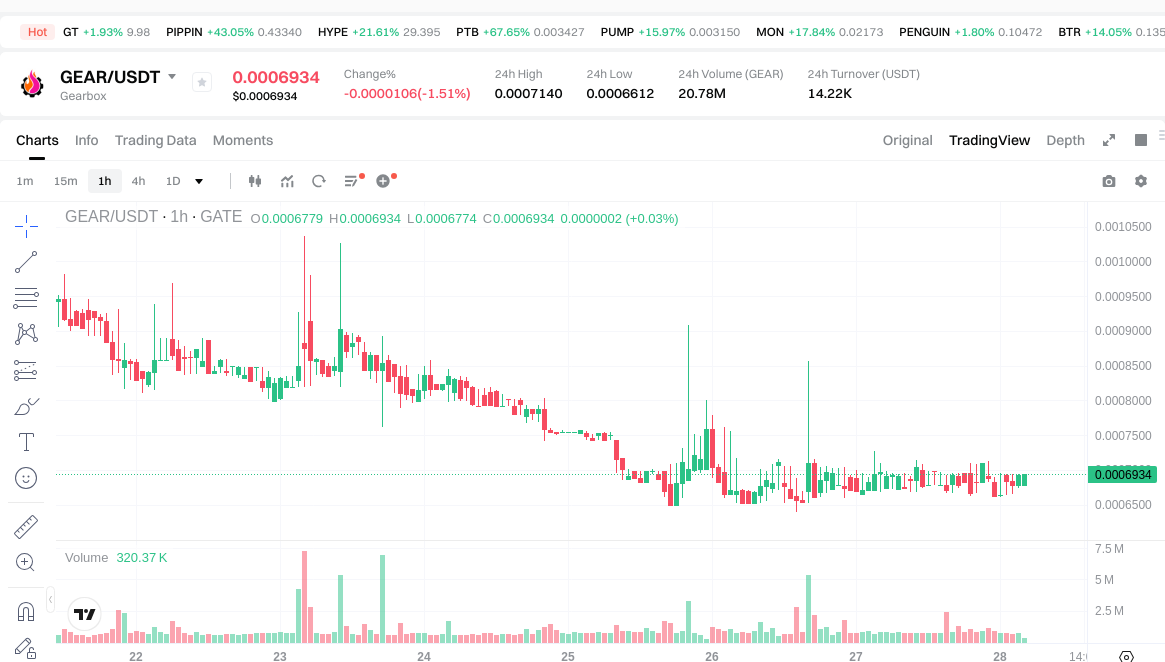
- 2026 (January): GEAR traded at approximately $0.0006778, representing a substantial decline from previous levels, with 24-hour price movements ranging between $0.0006612 and $0.000714.
Current GEAR Investment Market Status (January 2026)
- Current GEAR Price: $0.0006778
- 24-Hour Trading Volume: $14,189.78
- Price Change (24H): +0.1%
- Price Change (7D): -26.34%
- Price Change (30D): -29.02%
- Price Change (1Y): -89.63%
- Market Capitalization: $6,778,000
- Circulating Supply: 10,000,000,000 GEAR (100% of max supply)
- Fully Diluted Valuation: $6,778,000
- Number of Holders: 11,038
- Available on Exchanges: 8 platforms
Click to view real-time GEAR market price
II. Core Factors Affecting Whether GEAR is a Good Investment
Supply Mechanism and Scarcity (GEAR Investment Scarcity)
- Fixed supply structure influences price and investment value
- GEAR has a maximum supply of 10,000,000,000 tokens with 100% currently in circulation, creating a fully diluted market condition
- Historical price movements show volatility, with the token experiencing a decline of approximately 98.18% from its previous high level of $0.03725561 recorded in April 2024 to current levels around $0.0006778 as of January 2026
- Investment significance: The complete circulation of total supply may limit speculative upside driven by future token unlocks, while the fixed cap provides a defined scarcity framework
Macroeconomic Environment Impact on GEAR Investment
- The protocol operates within the DeFi lending and leverage sector, where broader cryptocurrency market conditions significantly influence investment attractiveness
- Market capitalization stands at approximately $6.78 million with a 0.00021% dominance in the overall cryptocurrency market, indicating limited market presence
- Trading volume of $14,189.78 over 24 hours reflects relatively low liquidity conditions, which may affect investment entry and exit strategies
- Recent price performance shows negative trends across multiple timeframes: -26.34% over 7 days, -29.02% over 30 days, and -89.63% over 1 year, reflecting challenging market conditions for the asset
Technology and Ecosystem Development (Technology & Ecosystem for GEAR Investment)
- Gearbox Protocol functions as a universal leverage protocol with dual aspects: passive liquidity provision for low-risk yield generation, and active borrowing mechanisms enabling up to 10x leverage for trading and yield farming activities
- The protocol's architecture supports single-asset liquidity provision, potentially simplifying participation for liquidity providers compared to multi-asset pool models
- Active holder base of 11,038 addresses suggests ongoing community engagement, though this represents a relatively modest user base compared to larger DeFi protocols
- Availability on 8 exchanges provides multiple access points for investors, though limited exchange coverage compared to major cryptocurrency assets may affect market depth and price discovery
III. GEAR Future Investment Forecast and Price Outlook (Is Gearbox(GEAR) worth investing in 2026-2031)
Short-term Investment Forecast (2026, short-term GEAR investment outlook)
- Conservative Forecast: $0.000534 - $0.000623
- Neutral Forecast: $0.000693 - $0.000741
- Optimistic Forecast: $0.000790 - $0.000868
Mid-term Investment Outlook (2027-2029, mid-term Gearbox(GEAR) investment forecast)
- Market Phase Expectation: GEAR may experience moderate growth fluctuations. Price projections suggest potential upward movement supported by protocol adoption trends and DeFi market conditions.
- Investment Return Forecast:
- 2027: $0.000623 - $0.000868
- 2028: $0.000684 - $0.001199
- 2029: $0.000962 - $0.001323
- Key Catalysts: Protocol development, liquidity pool expansion, leverage protocol adoption rates, and overall DeFi ecosystem growth.
Long-term Investment Outlook (Is GEAR a good long-term investment?)
- Baseline Scenario: $0.001003 - $0.001180 (assuming steady protocol development and maintained DeFi relevance)
- Optimistic Scenario: $0.001180 - $0.001333 (assuming increased adoption of leverage protocols and favorable DeFi market conditions)
- Risk Scenario: Below $0.000534 (under extreme market downturns or significant protocol challenges)
Click to view GEAR long-term investment and price prediction: Price Prediction
2026-2031 Long-term Outlook
- Base Scenario: $0.000534 - $0.001180 (corresponding to steady progress and gradual mainstream application growth)
- Optimistic Scenario: $0.001180 - $0.001333 (corresponding to large-scale adoption and favorable market environment)
- Transformative Scenario: Above $0.001333 (contingent on breakthrough ecosystem developments and mainstream adoption)
- 2031-12-31 Predicted High: $0.001333 (based on optimistic development assumptions)
Disclaimer: These forecasts are based on historical data and market analysis models. Cryptocurrency investments carry substantial risk. Past performance does not guarantee future results. Investors should conduct independent research and consider their risk tolerance before making investment decisions.
| Year |
Predicted High Price |
Predicted Average Price |
Predicted Low Price |
Price Change |
| 2026 |
0.000790476 |
0.0006934 |
0.000533918 |
2 |
| 2027 |
0.00086806746 |
0.000741938 |
0.00062322792 |
9 |
| 2028 |
0.0011994540677 |
0.00080500273 |
0.0006842523205 |
18 |
| 2029 |
0.001322941486482 |
0.00100222839885 |
0.000962139262896 |
47 |
| 2030 |
0.001197462490945 |
0.001162584942666 |
0.001081203996679 |
71 |
| 2031 |
0.00133342679999 |
0.001180023716806 |
0.001003020159285 |
74 |
IV. Gearbox (GEAR) Investment Strategy and Risk Management (How to invest in DeFi leverage protocols)
Investment Strategy (GEAR investment strategy)
-
Long-term holding (HODL GEAR): This approach may suit investors who believe in the potential growth of decentralized leverage protocols and DeFi infrastructure development. Given GEAR's current price levels and market position, long-term holders should consider the protocol's adoption rate and ecosystem development as key metrics.
-
Active trading: Traders may leverage technical analysis and price momentum strategies. GEAR has shown notable price movements, with a 2.27% increase in 1 hour and a 0.1% change over 24 hours as of January 28, 2026. However, the token has experienced significant volatility, with a -26.34% change over 7 days and -29.020% over 30 days, indicating potential opportunities for swing trading strategies.
Risk Management (Risk management for GEAR investment)
-
Asset allocation ratio:
- Conservative investors: Consider allocating no more than 1-3% of portfolio to GEAR given its volatility
- Moderate investors: May allocate 3-5% depending on risk tolerance
- Experienced DeFi investors: Could consider 5-10% allocation as part of a diversified crypto portfolio
-
Risk hedging approach: Implement a diversified portfolio strategy combining multiple DeFi assets and stablecoins. Consider using stop-loss orders and position sizing based on market conditions.
-
Secure storage: Utilize cold storage solutions for long-term holdings, such as hardware wallets (Ledger, Trezor). For active trading portions, use reputable exchanges with strong security measures. GEAR operates on Ethereum (contract address: 0xba3335588d9403515223f109edc4eb7269a9ab5d), requiring ETH-compatible wallet solutions.
V. Risks of Investing in Gearbox (GEAR) (Risks of investing in DeFi leverage protocols)
-
Market risk: GEAR exhibits substantial price volatility. The token has declined -89.63% over one year, and its 24-hour trading volume of approximately $14,189 USD suggests relatively limited liquidity compared to major cryptocurrencies. The price range between $0.0006612 and $0.000714 within 24 hours demonstrates intraday volatility that investors should carefully consider.
-
Regulatory risk: DeFi leverage protocols like Gearbox operate in an evolving regulatory landscape. Different jurisdictions maintain varying approaches to DeFi regulation, which could impact protocol operations and token value. Investors should monitor regulatory developments in their respective countries and globally.
-
Technical risk: As a leverage protocol, Gearbox faces smart contract risks inherent to DeFi platforms. Protocol upgrades, potential security vulnerabilities, and dependency on Ethereum network stability represent technical considerations. The protocol's security measures and audit history should be evaluated by investors.
VI. Conclusion: Is Gearbox (GEAR) a Good Investment?
-
Investment value summary: GEAR represents exposure to the DeFi leverage protocol sector. With a current market cap of approximately $6.78 million and a fully diluted market cap matching this figure (indicating 100% circulating supply of 10 billion tokens), the token presents both opportunities and challenges. The significant price decline of -89.63% over one year and current trading near historical lows suggests elevated risk profiles.
-
Investor recommendations:
✅ Beginners: Consider starting with small allocations through dollar-cost averaging (DCA) strategy. Prioritize secure storage using hardware wallets and thoroughly research the protocol's mechanism before investing.
✅ Experienced investors: May explore swing trading opportunities given GEAR's volatility patterns. Maintain disciplined position sizing and implement stop-loss strategies. Consider GEAR as part of a broader DeFi portfolio allocation.
✅ Institutional investors: Evaluate Gearbox's role within the DeFi ecosystem and assess long-term viability of leverage protocols. Consider protocol adoption metrics, total value locked (TVL), and competitive positioning before strategic allocation.
⚠️ Disclaimer: Cryptocurrency investments carry substantial risk. GEAR has experienced significant price volatility and substantial declines. This content is for informational purposes only and does not constitute investment advice. Conduct thorough research and consider your risk tolerance before making investment decisions.
VII. FAQ
Q1: What is Gearbox (GEAR) and how does the protocol generate value for token holders?
Gearbox (GEAR) is a decentralized leverage protocol launched in December 2022 that operates on Ethereum, enabling users to access up to 10x leverage for trading and yield farming activities. The protocol serves two primary user groups: passive liquidity providers who supply single-asset liquidity for low-risk yield generation, and active traders who borrow these assets for leveraged positions. GEAR tokens represent governance rights within the protocol ecosystem, though the token's value proposition has been challenged by market conditions, as evidenced by the 89.63% price decline over the past year and current market capitalization of approximately $6.78 million.
Q2: Why has GEAR experienced such significant price declines from its historical highs?
GEAR has declined approximately 98.18% from its April 2024 peak of $0.03725561 to current levels around $0.0006778 as of January 2026. This substantial decline reflects multiple factors including broader cryptocurrency market corrections, limited protocol adoption relative to competing DeFi platforms, and challenging liquidity conditions evidenced by the modest 24-hour trading volume of $14,189 USD. The complete circulation of the 10 billion token supply (100% of maximum supply) has eliminated speculative upside from future token unlocks, while the protocol's relatively small holder base of 11,038 addresses and availability on only 8 exchanges suggests limited market depth and institutional interest compared to larger DeFi protocols.
Q3: What are the realistic price expectations for GEAR in 2026 and beyond?
Based on current market analysis, GEAR's 2026 price forecasts range from a conservative scenario of $0.000534-$0.000623 to an optimistic scenario of $0.000790-$0.000868, representing potential modest gains from current levels near $0.0006778. Medium-term projections for 2027-2029 suggest gradual appreciation contingent on protocol adoption, with 2029 estimates ranging from $0.000962 to $0.001323. Long-term forecasts through 2031 project a potential high of $0.001333 under optimistic development assumptions, though these projections remain highly speculative given the token's current volatility patterns and market position. Investors should recognize these forecasts are based on historical data models and do not guarantee future performance.
Q4: What percentage of a cryptocurrency portfolio should be allocated to GEAR?
Portfolio allocation to GEAR should vary significantly based on investor risk profiles and experience levels. Conservative investors should consider limiting GEAR exposure to 1-3% of their total cryptocurrency portfolio given the token's substantial volatility, recent negative performance trends, and relatively limited liquidity. Moderate risk-tolerant investors might allocate 3-5% depending on their conviction in DeFi leverage protocol adoption, while experienced DeFi investors with higher risk tolerance could consider 5-10% allocation as part of a diversified crypto portfolio strategy. Given GEAR's 26.34% decline over 7 days and 29.02% decline over 30 days as of January 2026, implementing dollar-cost averaging (DCA) rather than lump-sum investment may help mitigate timing risk.
Q5: What are the primary risks investors should consider before investing in GEAR?
Investing in GEAR involves multiple risk dimensions that require careful evaluation. Market risk is substantial, evidenced by the 89.63% one-year decline and low trading volume of approximately $14,189 USD, suggesting limited liquidity that could impact entry and exit strategies. Technical risk stems from smart contract vulnerabilities inherent to DeFi protocols and dependency on Ethereum network stability. Regulatory risk exists as DeFi leverage protocols operate in evolving regulatory environments across different jurisdictions, potentially affecting protocol operations. The token's small market capitalization of $6.78 million and 0.00021% market dominance indicate susceptibility to price manipulation and heightened volatility compared to larger cryptocurrency assets.
Q6: How does GEAR's fully diluted supply affect its investment potential?
GEAR has achieved complete token distribution with 10 billion tokens (100% of maximum supply) already in circulation, resulting in a fully diluted market capitalization that equals the current market cap of approximately $6.78 million. This complete circulation eliminates potential price pressure from future token unlocks, a positive factor distinguishing GEAR from projects with significant locked supply scheduled for release. However, this also means the token lacks the speculative upside that sometimes accompanies planned token unlock events in the cryptocurrency market. The fixed supply cap provides a defined scarcity framework, though with 11,038 holders and availability on only 8 exchanges, the distribution pattern suggests concentration risk and limited mainstream adoption that constrains immediate price appreciation potential.
Q7: Is GEAR suitable for beginners entering the cryptocurrency investment space?
GEAR presents significant challenges for cryptocurrency beginners due to multiple complexity factors. The token's extreme volatility, demonstrated by the 98.18% decline from historical peaks and recent 26.34% seven-day drop, requires emotional discipline and risk management experience that novice investors may lack. The relatively specialized nature of leverage protocols demands understanding of DeFi mechanisms, smart contract risks, and decentralized finance concepts that exceed basic cryptocurrency knowledge. If beginners choose to invest in GEAR, they should start with minimal allocations (1-2% of crypto portfolio), implement dollar-cost averaging strategies to mitigate timing risk, prioritize secure storage using hardware wallets, and thoroughly research the Gearbox protocol's mechanism before committing capital. Educational preparation and acknowledgment of the high-risk nature of this investment are essential prerequisites.
Q8: What key metrics should investors monitor to evaluate GEAR's investment potential?
Investors evaluating GEAR should track multiple performance indicators beyond price movements. Protocol-level metrics include Total Value Locked (TVL) in Gearbox liquidity pools, which indicates actual usage and capital deployment, as well as active borrower counts and leverage utilization rates that demonstrate protocol adoption. Market metrics to monitor include 24-hour trading volume trends (currently $14,189 USD), exchange listing developments beyond the current 8 platforms, and holder growth from the current 11,038 addresses. Technical analysis should incorporate support and resistance levels, with current trading range between $0.0006612 and $0.000714 providing short-term boundaries. Additionally, tracking competing DeFi leverage protocols' performance, broader DeFi sector trends, and Ethereum network developments provides essential context for evaluating GEAR's relative positioning and future viability within the decentralized finance ecosystem.
* The information is not intended to be and does not constitute financial advice or any other recommendation of any sort offered or endorsed by Gate.