This comprehensive analysis examines whether GEODNET (GEOD) represents a viable investment opportunity within the decentralized physical infrastructure (DePIN) sector. As of January 2026, GEOD trades at $0.1565 with a $68.66 million market cap, operating the world's largest Real-Time Kinematics (RTK) positioning network offering centimeter-level accuracy. The article evaluates GEOD's historical price performance, revenue growth trajectory ($5M to $7.3M annualized recurring revenue), supply mechanics featuring active token burns, and multiple price forecast scenarios through 2031. Key investment considerations include market volatility (-54.44% annually), institutional adoption metrics, technology roadmap enhancements, and regulatory landscape uncertainties. The analysis provides tailored strategies for beginners (dollar-cost averaging), experienced traders (swing trading), and institutional investors (strategic allocation), while detailing comprehensive risk management frameworks and secure storage recommenda
Introduction: GEODNET (GEOD) Investment Position and Market Prospects
GEOD is a notable asset in the cryptocurrency sector, having launched in September 2023 with a focus on decentralized physical infrastructure networks (DePIN). As of January 18, 2026, GEODNET holds a market capitalization of approximately $68.66 million with a circulating supply of 438.78 million tokens, and the current price stands at around $0.1565. Positioned as a provider of Real-Time Kinematics (RTK) positioning services through a decentralized network of Space Weather mining stations, GEOD has gradually attracted attention from investors exploring whether "Is GEODNET (GEOD) a good investment?" This article comprehensively analyzes GEOD's investment value, historical price movements, future price forecasts, and associated investment risks to provide reference for potential investors.
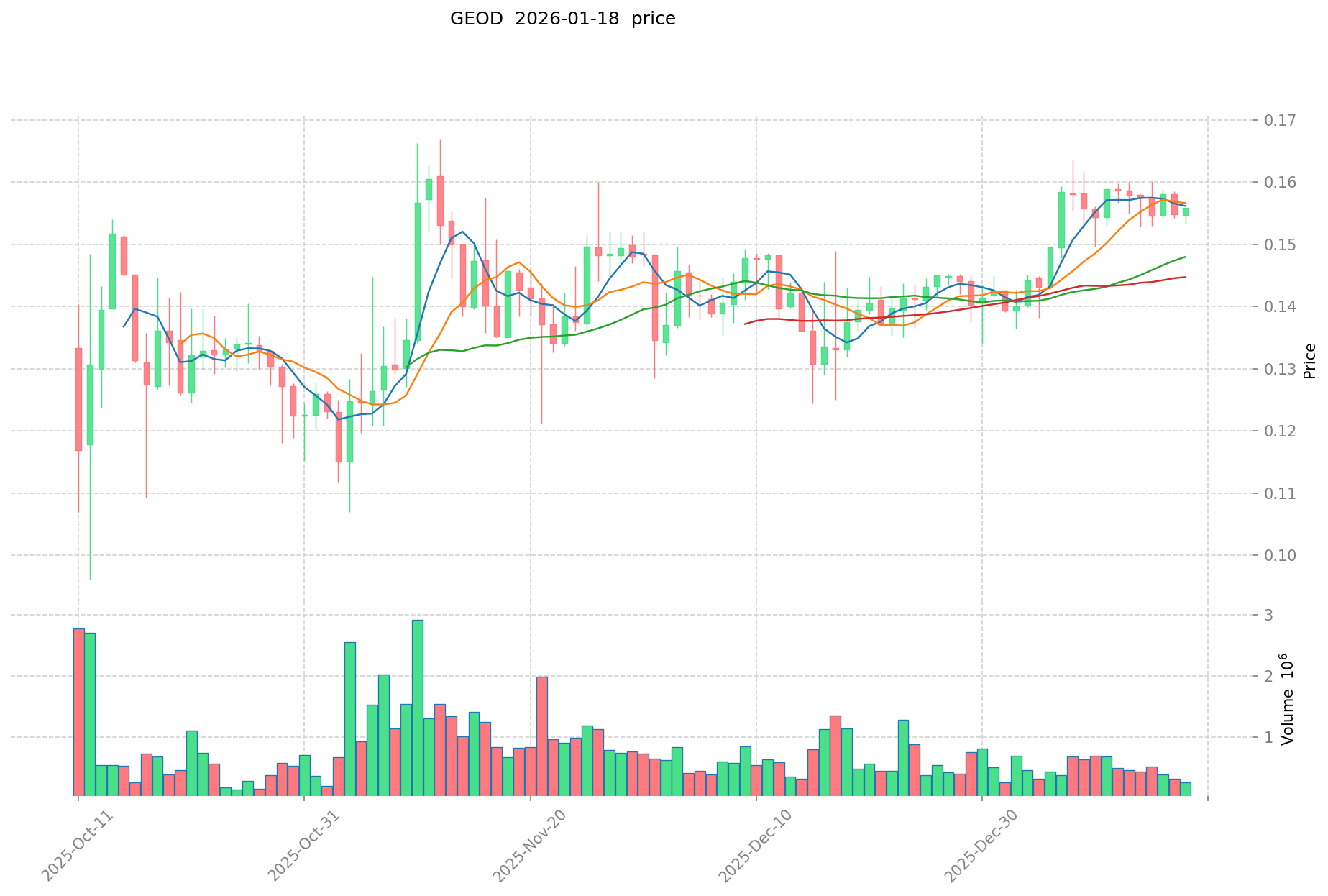
The project operates the world's largest RTK network, offering positioning accuracy of 1 centimeter and nanosecond-level time precision through its distributed infrastructure. With a total supply capped at 1 billion tokens and approximately 43.88% currently in circulation, GEOD presents a specific tokenomics structure. The asset has experienced notable price volatility, with a 12.06% increase over the past 30 days, while showing a 54.44% decline over the past year. The all-time high of $0.379 was recorded in January 2025, while the all-time low of $0.0961 occurred in October 2025. Currently ranking 444th by market capitalization with a 0.0046% market dominance, GEOD maintains trading activity across 4 exchanges with a 24-hour trading volume of approximately $55,055. The token is deployed as a contract on the Polygon network, with 16,546 holders as of the latest data.
I. GEODNET (GEOD) Price History Review and Current Investment Value
- September 2023: GEOD launched on exchanges with an initial publish price of $0.15, marking its entry into the decentralized physical infrastructure network (DePIN) sector
- January 2025: GEOD experienced notable price appreciation, reaching $0.37899 during a period of increased market interest in DePIN projects
- October 2025: Market correction phase brought GEOD to $0.09605, reflecting broader crypto market volatility and sector-specific adjustments
- January 2026: Price stabilization observed at approximately $0.15649, demonstrating a return to levels near its initial valuation after market cycles
Current GEOD Investment Market Status (January 2026)
- Current GEOD Price: $0.15649
- 24-Hour Trading Volume: $55,055.45
- Market Capitalization: $68.66 million
- Circulating Supply: 438.78 million GEOD (43.88% of max supply)
- Fully Diluted Valuation: $156.49 million
- Token Holders: 16,546 addresses
- Recent Price Movement: +1.19% (24h), +12.06% (30d), -0.72% (7d)
View real-time GEOD market price
The token maintains listings on 4 exchanges with ongoing trading activity. GEODNET's positioning within the real-time kinematics (RTK) and space weather monitoring infrastructure sector provides context for its market performance, though price movements remain subject to broader cryptocurrency market dynamics and adoption rates of decentralized infrastructure solutions.
II. Core Factors Affecting Whether GEOD is a Good Investment
Supply Mechanism and Scarcity (GEOD Investment Scarcity)
- Total supply capped at 1,000,000,000 GEOD with 438,777,944 tokens in circulation (43.88% circulating ratio) → influences price dynamics and investment value
- Token burn mechanism: Q4 2025 data shows 901K GEOD burned weekly, offsetting approximately 80% of new token issuance → enhances scarcity over time
- Investment significance: the project expects to achieve "Net-Positive" status (tokens burned from data revenue exceeding tokens mined) in 2026-2027, which could fundamentally alter supply-demand dynamics and support long-term investment positioning
Institutional Investment and Mainstream Adoption (Institutional Investment in GEOD)
- Revenue growth trajectory: Annualized Recurring Revenue (ARR) increased from $5 million to $7.3 million as of December 2025, demonstrating commercial traction
- Q2 2025 showed 19% quarter-over-quarter revenue increase (from $812,000 to over $963,000), while Q3 2025 RTK data service revenue reached $1.2 million with 27.9% month-over-month and 216.9% year-over-year growth
- Geographic expansion: Korea and Japan initiatives launched in July 2025 with free base station distribution, aiming to accelerate coverage and decentralize precision navigation across Asia
- Enterprise positioning: GEODNET utilizes blockchain to reconstruct traditional RTK networks, with unit economics reportedly superior to established competitors in the geospatial sector
Macroeconomic Environment Impact on GEOD Investment
- Market capitalization stands at $68,664,360.46 with 0.0046% market dominance as of January 18, 2026 → reflects current positioning within broader crypto asset landscape
- DePIN sector context: GEODNET represents one of the projects transitioning from network building phase to commercial monetization phase, potentially positioning it differently amid varying macroeconomic conditions
- Revenue-based model: reliance on RTK data service revenue rather than purely inflationary incentives may provide differentiated exposure compared to traditional tokenomics during changing monetary policy environments
Technology and Ecosystem Development (Technology & Ecosystem for GEOD Investment)
- Infrastructure upgrades planned throughout 2025: integration of Low Earth Orbit (LEO) satellite tracking to enhance GNSS reliability in dense urban and indoor environments
- Technical enhancement roadmap: fusion of RTK with IMUs and LiDAR for precise positioning in signal-challenged environments, plus incorporation of multi-camera vision systems to improve robotic perception
- Application domains: RTK-powered DePIN network demonstrated at XPONENTIAL Show in June 2025, highlighting real-time precision for drones, autonomous vehicles, and smart infrastructure
- Network scale: operates as a Decentralized Physical Infrastructure Network (DePIN) delivering high-precision geospatial data through a decentralized Real-Time Kinematics (RTK) network with space weather mining stations reporting real-time solar wind influence on GNSS signals
III. GEOD Future Investment Predictions and Price Outlook (Is GEODNET(GEOD) worth investing in 2026-2031)
Short-term Investment Prediction (2026, short-term GEOD investment outlook)
- Conservative forecast: $0.1284 - $0.1513
- Neutral forecast: $0.1583 - $0.1617
- Optimistic forecast: $0.1617 - $0.1973
Mid-term Investment Outlook (2027-2028, mid-term GEODNET(GEOD) investment forecast)
-
Market phase expectation: Based on available prediction models, GEOD may experience moderate growth during the 2027-2028 period, with price levels potentially rising above the 2026 baseline. The token could demonstrate gradual appreciation as the project's RTK network infrastructure continues to expand.
-
Investment return prediction:
- 2027: $0.1504 - $0.2265
- 2028: $0.1291 - $0.2360
-
Key catalysts: Expansion of the DePIN-based space weather mining station network, increased adoption of RTK positioning services, and potential growth in GNSS signal correction applications.
Long-term Investment Outlook (Is GEOD a good long-term investment?)
- Base scenario: $0.1488 - $0.2869 (assuming steady network growth and stable market conditions)
- Optimistic scenario: $0.2869 - $0.4063 (assuming accelerated adoption of centimeter-level positioning services and favorable market environment)
- Risk scenario: $0.1291 - $0.1748 (under adverse market conditions or slower-than-expected network expansion)
Click to view GEOD long-term investment and price prediction: Price Prediction
2026-01-18 - 2031 Long-term Outlook
- Base scenario: $0.1749 - $0.2869 USD (corresponding to steady progress and gradual mainstream application growth)
- Optimistic scenario: $0.2869 - $0.4063 USD (corresponding to large-scale adoption and favorable market environment)
- Transformative scenario: Above $0.4063 USD (if the ecosystem achieves breakthrough developments and mainstream penetration)
- 2031-12-31 predicted high: $0.4063 USD (based on optimistic development assumptions)
Disclaimer: The information provided represents analytical forecasts based on historical data and current market trends. Cryptocurrency investments carry substantial risk. Price predictions are subject to high uncertainty and should not be considered as financial advice. Past performance does not guarantee future results. Investors should conduct independent research and consider their risk tolerance before making investment decisions.
| Year |
Predicted High Price |
Predicted Average Price |
Predicted Low Price |
Price Change |
| 2026 |
0.1972908 |
0.15658 |
0.1283956 |
0 |
| 2027 |
0.226477312 |
0.1769354 |
0.15039509 |
13 |
| 2028 |
0.23599643652 |
0.201706356 |
0.12909206784 |
28 |
| 2029 |
0.3260885804274 |
0.21885139626 |
0.1334993517186 |
39 |
| 2030 |
0.29971698717807 |
0.2724699883437 |
0.174380792539968 |
74 |
| 2031 |
0.406252752620456 |
0.286093487760885 |
0.14876861363566 |
82 |
IV. GEODNET Investment Strategy and Risk Management (How to invest in DePIN tokens)
Investment Methodology (GEODNET investment strategy)
-
Long-term Holding (HODL GEOD): Suitable for conservative investors
Long-term holding strategies may be considered by investors who believe in the fundamental value proposition of decentralized physical infrastructure networks. This approach involves acquiring GEOD tokens and maintaining positions through market cycles, focusing on the project's long-term development trajectory rather than short-term price movements.
-
Active Trading: Relies on technical analysis and swing trading
Active traders may utilize technical analysis tools to identify potential entry and exit points. Given GEOD's 24-hour price change of 1.19% and 7-day change of -0.72%, traders should carefully monitor short-term price patterns and volume indicators. The token's historical price range between $0.09605 and $0.37899 suggests significant volatility that may present trading opportunities.
Risk Management (Risk management for GEOD investment)
-
Asset Allocation Ratio: Conservative / Aggressive / Professional investors
Conservative investors might consider limiting DePIN token exposure to 1-3% of their total portfolio. Aggressive investors comfortable with higher volatility may allocate 5-10%, while professional investors with deep market understanding might consider larger positions based on thorough due diligence and risk tolerance.
-
Risk Hedging Solutions: Multi-asset portfolio + hedging instruments
Portfolio diversification across different cryptocurrency sectors and traditional assets can help mitigate concentration risk. Investors may consider combining GEOD holdings with established cryptocurrencies, stablecoins, or other DePIN projects to balance risk exposure.
-
Secure Storage: Hot and cold wallets + hardware wallet recommendations
Given that GEOD operates on the Polygon network (contract address: 0xac0f66379a6d7801d7726d5a943356a172549adb), investors should utilize wallets compatible with Polygon. For long-term holdings, hardware wallets offering Polygon support provide enhanced security. Smaller amounts used for trading may be kept in reputable exchange wallets, while larger holdings should be transferred to cold storage solutions.
V. GEODNET Investment Risks and Challenges (Risks of investing in DePIN tokens)
-
Market Risk: High volatility, price manipulation potential
GEOD has demonstrated significant price volatility, with a 1-year change of -54.44% and a 30-day change of 12.06%. The relatively modest 24-hour trading volume of approximately $55,055 suggests lower liquidity compared to major cryptocurrencies, which may amplify price swings and increase vulnerability to large orders. The token's market capitalization of approximately $68.66 million represents a mid-cap position, carrying higher volatility risk than established large-cap assets.
-
Regulatory Risk: Policy uncertainty across different jurisdictions
Decentralized physical infrastructure networks operate in a regulatory environment that continues to evolve globally. Different countries maintain varying approaches to cryptocurrency classification and regulation. Changes in regulatory frameworks could impact GEODNET's operational model or token utility, affecting valuation. Investors should monitor regulatory developments in key markets where the project operates.
-
Technical Risk: Network security vulnerabilities, upgrade failures
As a project built on Polygon infrastructure, GEODNET faces technical dependencies on the underlying blockchain's security and performance. Smart contract vulnerabilities in the token contract (0xac0f66379a6d7801d7726d5a943356a172549adb) could pose risks. Additionally, the project's integration of hardware mining stations creates technical complexity that may present operational challenges or potential points of failure in the network architecture.
VI. Conclusion: Is DePIN a Good Investment?
-
Investment Value Summary: GEODNET presents a unique value proposition in the decentralized physical infrastructure sector, but exhibits significant short-term price volatility.
The project's positioning as a large-scale RTK network utilizing DePIN principles represents an innovative approach to location services infrastructure. However, the token's price performance shows substantial fluctuations, with circulating supply representing 43.88% of maximum supply and a market cap to fully diluted valuation ratio of 43.88%.
-
Investor Recommendations:
✅ Beginners: Dollar-cost averaging + secure wallet storage
New investors should consider gradual accumulation through regular purchases rather than lump-sum investments to mitigate timing risk. Prioritize learning proper wallet security practices and start with small positions to gain market experience.
✅ Experienced Investors: Swing trading + portfolio allocation
Those with trading experience may explore technical analysis strategies while maintaining core positions. Consider GEOD as part of a diversified cryptocurrency portfolio, allocating based on personal risk tolerance and market outlook.
✅ Institutional Investors: Strategic long-term allocation
Institutions evaluating DePIN sector exposure may conduct comprehensive due diligence on GEODNET's technology, team, partnerships, and competitive positioning. Long-term strategic positions should be sized appropriately within broader cryptocurrency and alternative asset allocations.
⚠️ Disclaimer: Cryptocurrency investments carry substantial risk. This content is for informational purposes only and does not constitute investment advice. Investors should conduct independent research and consult financial professionals before making investment decisions.
VII. FAQ
Q1: What is GEODNET and what makes it different from other cryptocurrency projects?
GEODNET is a decentralized physical infrastructure network (DePIN) that operates the world's largest Real-Time Kinematics (RTK) positioning network, offering centimeter-level positioning accuracy and nanosecond-level time precision. Unlike purely digital cryptocurrency projects, GEODNET combines blockchain technology with physical infrastructure through space weather mining stations that provide high-precision geospatial data and monitor real-time solar wind influence on GNSS signals. The project distinguishes itself by delivering tangible utility through positioning services for autonomous vehicles, drones, and smart infrastructure, while generating revenue from RTK data services rather than relying solely on inflationary token incentives.
Q2: Is GEODNET (GEOD) a good short-term investment in 2026?
Short-term investment in GEOD carries significant volatility risk. As of January 18, 2026, the token shows 1.19% gain over 24 hours but -54.44% decline over one year, demonstrating substantial price fluctuations. Conservative forecasts for 2026 range from $0.1284 to $0.1513, while optimistic scenarios suggest $0.1617 to $0.1973. The relatively low 24-hour trading volume of approximately $55,055 indicates limited liquidity, which may amplify price swings. Short-term traders should employ strict risk management strategies, utilize technical analysis tools, and maintain position sizes aligned with their risk tolerance.
Q3: What are the main risks associated with investing in GEODNET?
Three primary risks characterize GEOD investment: market risk includes high volatility (54.44% annual decline) and potential price manipulation due to modest liquidity; regulatory risk stems from evolving global policies on cryptocurrency and decentralized infrastructure networks that could impact operational models; technical risk involves dependencies on Polygon blockchain security, potential smart contract vulnerabilities in the token contract (0xac0f66379a6d7801d7726d5a943356a172549adb), and operational challenges associated with hardware mining station networks. The token's market capitalization of $68.66 million positions it as a mid-cap asset with higher volatility than established large-cap cryptocurrencies.
Q4: How does GEODNET's token economics support long-term investment value?
GEODNET's tokenomics features a capped supply of 1 billion tokens with 438.78 million (43.88%) currently in circulation. The project implements a token burn mechanism that destroyed 901K GEOD weekly in Q4 2025, offsetting approximately 80% of new token issuance. Revenue generation shows positive trends with Annualized Recurring Revenue increasing from $5 million to $7.3 million by December 2025, and Q3 2025 RTK data service revenue reaching $1.2 million with 216.9% year-over-year growth. The project anticipates achieving "Net-Positive" status in 2026-2027, where tokens burned from data revenue exceed tokens mined, potentially creating deflationary pressure that could support long-term value appreciation for patient investors.
Q5: What investment strategy should beginners use for GEODNET?
Beginners should prioritize dollar-cost averaging (DCA) to mitigate timing risk and reduce exposure to GEOD's significant price volatility. Start with small positions representing 1-3% of total portfolio value to limit downside exposure while gaining market experience. Focus on secure storage by using Polygon-compatible wallets, with hardware wallets recommended for long-term holdings exceeding smaller trading amounts. Conduct thorough research on DePIN sector fundamentals and GEODNET's competitive positioning before increasing allocation. Avoid attempting short-term trading without technical analysis experience, and maintain realistic expectations given the token's historical price range between $0.09605 and $0.37899.
Q6: What factors could drive GEODNET's price growth in 2027-2028?
Multiple catalysts may influence mid-term price appreciation: expansion of the DePIN-based space weather mining station network increases infrastructure coverage and utility; growing adoption of centimeter-level RTK positioning services in autonomous vehicles, drones, and precision agriculture sectors; planned integration of Low Earth Orbit (LEO) satellite tracking to enhance GNSS reliability; technological upgrades including fusion of RTK with IMUs, LiDAR, and multi-camera vision systems; geographic expansion initiatives in Korea and Japan; and continued revenue growth trajectory following Q3 2025's 216.9% year-over-year increase. Price predictions for 2027 range from $0.1504 to $0.2265, with 2028 forecasts between $0.1291 and $0.2360 under varying scenarios.
Q7: How liquid is GEODNET and where can it be traded?
GEODNET demonstrates limited liquidity compared to major cryptocurrencies. The token maintains listings on 4 exchanges with approximately $55,055 in 24-hour trading volume as of January 18, 2026. This relatively modest volume may result in wider bid-ask spreads and increased price sensitivity to larger orders. The token operates on the Polygon network (contract address: 0xac0f66379a6d7801d7726d5a943356a172549adb) with 16,546 holders. Investors should consider liquidity constraints when sizing positions and may experience slippage when executing larger trades. For price discovery and trading access, monitor real-time GEOD market data through supported exchanges and maintain awareness that low liquidity environments can amplify both upside and downside price movements.
Q8: What distinguishes GEODNET's business model from traditional RTK providers?
GEODNET utilizes blockchain technology to reconstruct traditional RTK networks with reportedly superior unit economics compared to established competitors in the geospatial sector. Traditional RTK services typically operate through centralized infrastructure with subscription-based revenue models, while GEODNET leverages decentralized physical infrastructure where space weather mining station operators contribute network coverage and earn token rewards. This approach potentially reduces capital expenditure requirements and distributes network ownership among participants. The project generates revenue through RTK data services while using token burns to offset mining rewards, creating a hybrid model that combines cryptocurrency incentives with commercial revenue streams, positioning it differently from both conventional geospatial service providers and purely speculative crypto projects.
* The information is not intended to be and does not constitute financial advice or any other recommendation of any sort offered or endorsed by Gate.