This comprehensive guide evaluates whether GHO (GHO) represents a sound investment within the decentralized stablecoin ecosystem. GHO, a decentralized over-collateralized stablecoin native to the Aave Protocol, maintains a market capitalization of $352.75 million and trades near its $1.00 peg. The article analyzes GHO's investment characteristics through multiple dimensions: historical price stability ranging from $0.9478 to $1.60 in 2025, current market metrics including 6,773 holders and availability on Gate exchange, and core investment factors such as on-demand minting mechanisms and Aave governance influence. Detailed price forecasts span 2026-2031 across conservative, neutral, and optimistic scenarios. The guide provides tailored investment strategies for beginners through institutional investors, addresses specific risk management approaches, and examines market, regulatory, and technical risks inherent to stablecoin investments, offering evidence-based insights for informed decision-making in DeFi mar
Introduction: GHO's Investment Position and Market Prospects
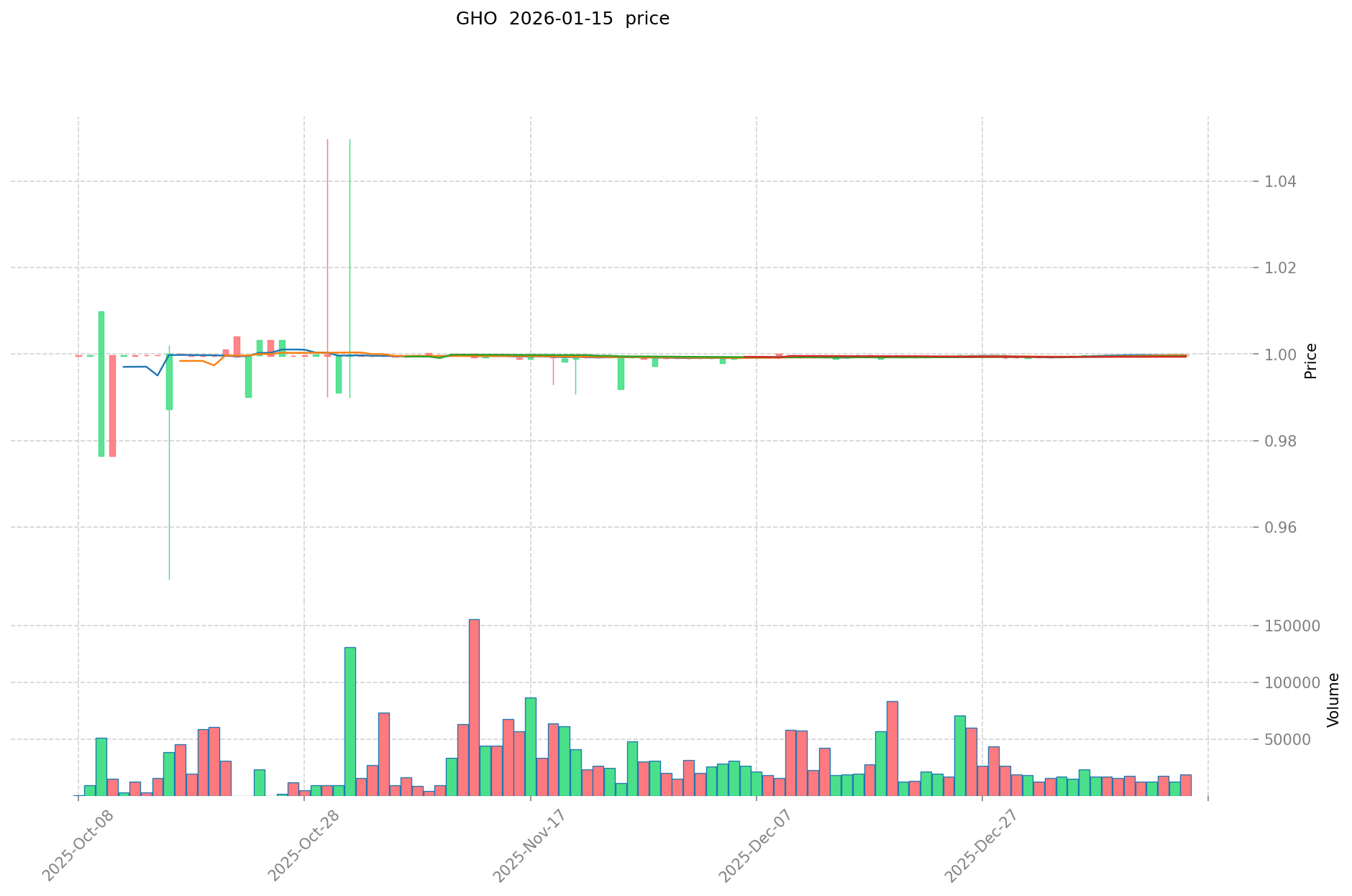
GHO is a decentralized, over-collateralized stablecoin native to the Aave Protocol. As of 15 January 2026, GHO holds a market capitalization of approximately $352.75 million, with a circulating supply of 352.82 million tokens. The current price is maintained at around $0.9998, closely tracking its U.S. dollar peg. With its positioning as a fully backed and transparent stablecoin, GHO has become a subject of interest for investors evaluating "Is GHO (GHO) a good investment?" This article provides a comprehensive analysis of GHO's investment value, historical price trends, future price predictions, and associated investment risks to serve as a reference for investors.
GHO operates through an on-demand minting mechanism within the Aave Protocol, where users can mint GHO against their collateral subject to governance-set mint caps. The token's stability is maintained through market efficiencies and over-collateralization mechanisms inherent to the protocol. With 6,773 holders and availability on 2 exchanges as of the current date, GHO demonstrates moderate adoption within the decentralized finance ecosystem. The token's price has shown relatively stable performance, with minor fluctuations of 0.01% over 24 hours and 0.10% over the past year, reflecting its stablecoin design objectives.
I. GHO (GHO) Price History Review and Investment Value Status
- 2025: Market launch and volatility → GHO experienced significant price fluctuations during its initial trading period
- September 2025: Peak price level → GHO reached $1.60 during market expansion
- October 2025: Price correction phase → declined from higher levels to $0.9478
- January 2026: Stabilization period → GHO maintains price around $0.9998, demonstrating relative stability
Current GHO Investment Market Status (January 2026)
- GHO current price: $0.9998
- 24-hour trading volume: $24,371.17
- Market capitalization: $352,750,753.74
- Circulating supply: 352,821,318 GHO
- Total supply: 352,821,318 GHO
- Holder count: 6,773 addresses
- 24-hour price range: $0.9997 - $0.9998
- Price changes: 1H (-0.01%), 24H (+0.01%), 7D (+0.01%), 30D (+0.04%), 1Y (+0.10%)
Click to view real-time GHO market price
II. Core Factors Influencing Whether GHO is a Good Investment
Supply Mechanism and Scarcity (GHO investment scarcity)
- On-demand minting mechanism subject to governance-set caps → impacts price stability and investment characteristics
- Historical pattern: GHO supply experienced a 10X increase in 2024, reflecting expanding adoption within the Aave ecosystem
- Investment significance: mint cap limitations and over-collateralization requirements provide structural constraints that may influence long-term supply dynamics
Institutional Investment and Mainstream Adoption (Institutional investment in GHO)
- Integration trend: GHO is native to the Aave Protocol, one of the established DeFi lending platforms, with over 6,773 holders as of January 15, 2026
- Revenue model: according to Aave-Chan Initiative, each GHO minted generates revenue comparable to $10 borrowed on Aave, indicating economic significance within the protocol
- Governance influence: Aave's governance structure and active community participation affect GHO's operational parameters and adoption trajectory
Macroeconomic Environment's Impact on GHO Investment
- Monetary policy context: as a stablecoin pegged to the U.S. dollar, GHO's investment profile differs from volatile crypto assets, with performance tied to dollar stability and DeFi lending demand
- Market conditions: circulating supply stands at 352,821,318 GHO with a market capitalization of approximately $352.75 million, representing a relatively modest position in the stablecoin sector
- Regulatory landscape: stablecoin regulatory developments may influence adoption patterns and operational frameworks for dollar-pegged digital assets
Technology and Ecosystem Development (Technology & Ecosystem for GHO investment)
- Protocol integration: GHO operates as an ERC-20 token on Ethereum (contract: 0x40d16fc0246ad3160ccc09b8d0d3a2cd28ae6c2f), benefiting from Ethereum's established infrastructure
- Aave V4 development: ongoing protocol upgrades aim to enhance functionality, with stated goals to expand GHO supply significantly in the current period
- DeFi positioning: GHO's role within Aave's lending and borrowing ecosystem provides utility through interest rate mechanisms and collateral management, which may influence its adoption in decentralized finance applications
III. GHO Future Investment Prediction and Price Outlook (Is GHO(GHO) worth investing in 2026-2031)
Short-term Investment Prediction (2026, short-term GHO investment outlook)
- Conservative Forecast: $0.7698 - $0.9997
- Neutral Forecast: $0.9997 - $1.1097
- Optimistic Forecast: $1.1097 - $1.2196
Mid-term Investment Outlook (2027-2029, mid-term GHO(GHO) investment forecast)
-
Market Stage Expectation: The GHO ecosystem may experience gradual growth during the mid-term period, with market participants potentially gaining increased confidence in its decentralized stablecoin mechanism and integration within the Aave Protocol.
-
Investment Return Prediction:
- 2027: $0.7657 - $1.5202
- 2028: $0.9073 - $1.6700
- 2029: $0.8209 - $1.6417
-
Key Catalysts: Developments in Aave Protocol governance decisions, changes in mint cap limitations, market efficiency improvements, and broader adoption of over-collateralized stablecoin models may influence GHO's performance.
Long-term Investment Outlook (Is GHO a good long-term investment?)
- Base Scenario: $1.1440 - $1.5671 (assuming steady protocol development and maintained peg stability)
- Optimistic Scenario: $1.6418 - $1.9745 (assuming enhanced market adoption and favorable DeFi sector conditions)
- Risk Scenario: $0.7698 - $0.9073 (under conditions of reduced market confidence or regulatory challenges)
Click to view GHO long-term investment and price prediction: Price Prediction
2026-2031 Long-term Outlook
- Base Scenario: $1.1440 - $1.5671 (corresponding to steady progress and gradual mainstream application growth)
- Optimistic Scenario: $1.6418 - $1.9745 (corresponding to large-scale adoption and favorable market conditions)
- Transformative Scenario: Above $1.9745 (in case of breakthrough ecosystem developments and mainstream popularization)
- 2031-12-31 Predicted High: $1.9745 (based on optimistic development assumptions)
Disclaimer: This analysis is for informational purposes only and does not constitute investment advice. Cryptocurrency markets are highly volatile, and past performance does not guarantee future results. Users should conduct their own research and consult financial advisors before making investment decisions.
| Year |
Predicted High Price |
Predicted Average Price |
Predicted Low Price |
Price Change |
| 2026 |
1.219634 |
0.9997 |
0.769769 |
0 |
| 2027 |
1.52024379 |
1.109667 |
0.76567023 |
10 |
| 2028 |
1.66999335165 |
1.314955395 |
0.90731922255 |
31 |
| 2029 |
1.6417218106575 |
1.492474373325 |
0.82086090532875 |
49 |
| 2030 |
1.974543595908975 |
1.56709809199125 |
1.143981607153612 |
56 |
| 2031 |
1.965611136784624 |
1.770820843950112 |
1.345823841402085 |
77 |
IV. GHO Investment Strategy and Risk Management (How to invest in stablecoins)
Investment Methodology (GHO investment strategy)
Long-term Holding (HODL GHO)
GHO, as a decentralized, over-collateralized stablecoin pegged to the U.S. dollar, may suit conservative investors seeking stability. The token maintains its value through market efficiencies and over-collateralization mechanisms inherent in the Aave Protocol. As of January 15, 2026, GHO trades at $0.9998, demonstrating its peg stability. Long-term holders may benefit from its role within the Aave ecosystem while minimizing exposure to typical cryptocurrency volatility.
Active Trading
Active trading strategies for GHO differ from typical cryptocurrencies due to its stablecoin nature. Price fluctuations remain minimal, with 24-hour changes at 0.01% and a narrow trading range between $0.9997 and $0.9998. Technical analysis and swing trading approaches may offer limited opportunities given the token's price stability design. Traders might focus on arbitrage opportunities when GHO deviates from its $1.00 peg or explore yield strategies within the Aave Protocol.
Risk Management (Risk management for GHO investment)
Asset Allocation Ratio
- Conservative Investors: May allocate a higher proportion to GHO as a stable store of value within a crypto portfolio, potentially 30-50% of total crypto holdings
- Aggressive Investors: Might maintain 10-20% in GHO for liquidity and stability while pursuing higher returns elsewhere
- Professional Investors: Could use GHO strategically as collateral or a trading base, with allocation varying based on market conditions and strategy requirements
Risk Hedging Solutions
A diversified portfolio approach includes:
- Combining GHO with other asset classes to balance stability and growth potential
- Utilizing hedging instruments available within DeFi protocols
- Maintaining exposure to multiple stablecoins to mitigate protocol-specific risks
- Monitoring the over-collateralization ratio within the Aave Protocol to assess systemic stability
Secure Storage
GHO operates on the Ethereum network (contract address: 0x40d16fc0246ad3160ccc09b8d0d3a2cd28ae6c2f). Storage options include:
- Cold Wallets: Hardware wallets supporting ERC-20 tokens provide enhanced security for long-term storage
- Hot Wallets: Software wallets offer convenience for active trading and DeFi interactions
- Hardware Wallet Recommendations: Devices compatible with Ethereum and ERC-20 tokens, featuring multi-signature capabilities and regular firmware updates
V. GHO Investment Risks and Challenges (Risks of investing in stablecoins)
Market Risks
While GHO demonstrates stability relative to traditional cryptocurrencies, certain market risks exist:
- Price Volatility: Historical data shows GHO has traded between $0.9478 (October 16, 2025) and $1.60 (September 30, 2025), indicating potential de-pegging scenarios
- Liquidity Concerns: With 24-hour trading volume at $24,371.17 as of January 15, 2026, limited liquidity may impact large transactions
- Market Manipulation: Lower trading volumes and limited exchange listings (2 exchanges) may create vulnerability to coordinated trading activities
Regulatory Risks
Stablecoin regulations vary significantly across jurisdictions:
- Different countries maintain evolving policy frameworks for algorithmic and collateralized stablecoins
- Regulatory uncertainty may impact GHO's adoption, listing availability, and operational parameters
- Compliance requirements could affect the Aave Protocol's governance decisions regarding GHO's minting caps and collateralization ratios
Technical Risks
As a protocol-native stablecoin, GHO faces specific technical challenges:
- Network Security: Smart contract vulnerabilities could compromise the over-collateralization mechanism or minting process
- Protocol Dependencies: GHO's stability relies on the Aave Protocol's continued functionality and security
- Upgrade Failures: Changes to the underlying protocol or governance decisions regarding mint caps could affect GHO's stability and utility
- Blockchain Network Risks: As an ERC-20 token on Ethereum, GHO inherits risks related to network congestion, high transaction fees, or potential Ethereum protocol issues
VI. Conclusion: Is Stablecoin a Good Investment?
Investment Value Summary
GHO presents a unique value proposition as a decentralized, over-collateralized stablecoin native to the Aave Protocol. With a market capitalization of $352,750,753.74 and 6,773 holders as of January 15, 2026, GHO demonstrates growing adoption within the DeFi ecosystem. The token's 100% circulation ratio and transparent, fully-backed structure provide clarity for investors. While short-term price fluctuations remain minimal by design, the token's utility within Aave and its governance-driven framework may support long-term relevance in decentralized finance.
Investor Recommendations
✅ Beginners: Consider dollar-cost averaging into GHO combined with secure hardware wallet storage. Focus on understanding the Aave Protocol's mechanics and the over-collateralization process before significant allocation.
✅ Experienced Investors: Explore strategic opportunities within the Aave ecosystem, monitor de-pegging events for tactical positions, and integrate GHO into broader DeFi strategies while maintaining diversified stablecoin exposure.
✅ Institutional Investors: Evaluate GHO for strategic long-term allocation as a decentralized stablecoin alternative, assess integration opportunities with existing DeFi infrastructure, and consider governance participation in Aave's decision-making processes.
⚠️ Disclaimer: Cryptocurrency investments carry substantial risks. This content serves informational purposes only and does not constitute investment advice. Conduct thorough research and consult qualified financial advisors before making investment decisions.
VII. FAQ
Q1: Is GHO a good investment for risk-averse investors seeking stability?
GHO can be suitable for conservative investors prioritizing stability over high returns. As a decentralized, over-collateralized stablecoin pegged to the U.S. dollar, GHO maintains minimal price volatility, with current trading at $0.9998 and 24-hour fluctuations of only 0.01%. Unlike volatile cryptocurrencies, GHO is designed to preserve value through market efficiencies and over-collateralization mechanisms within the Aave Protocol. However, investors should note historical de-pegging events (ranging from $0.9478 to $1.60 in 2025) and consider GHO as one component of a diversified portfolio rather than a standalone investment.
Q2: What differentiates GHO from other stablecoins like USDT or USDC?
GHO distinguishes itself through its decentralized, protocol-native architecture rather than centralized reserve management. Unlike USDT or USDC, which are backed by off-chain fiat reserves held by centralized entities, GHO is minted on-demand by users depositing collateral into the Aave Protocol, with governance-set mint caps ensuring supply control. This over-collateralization model provides transparency through on-chain verification, eliminates reliance on traditional banking systems, and generates revenue for the Aave ecosystem. However, this decentralized approach also means GHO's stability depends on protocol health and governance decisions rather than regulated financial institutions.
Q3: How does GHO's low trading volume affect investment decisions?
GHO's limited trading volume of $24,371.17 (as of January 15, 2026) presents both challenges and considerations for investors. Low liquidity may result in higher slippage for large transactions, difficulty executing quick entries or exits at desired prices, and potential vulnerability to price manipulation. With availability on only 2 exchanges and 6,773 holders, GHO demonstrates moderate adoption compared to mainstream stablecoins. Investors planning substantial allocations should assess whether current liquidity meets their trading needs, consider gradual position building through dollar-cost averaging, and maintain realistic expectations about transaction execution, particularly for institutional-sized trades.
Q4: What are the primary risks associated with investing in GHO?
GHO carries several distinct risk categories. Market risks include historical de-pegging events and limited liquidity that may impact large transactions. Technical risks involve smart contract vulnerabilities, protocol dependencies on Aave's continued functionality, and potential Ethereum network issues affecting this ERC-20 token. Regulatory risks stem from evolving stablecoin regulations across jurisdictions that could affect operations, listings, and governance decisions. Additionally, GHO's performance relies on the Aave Protocol's security, governance decisions regarding mint caps and collateralization ratios, and overall DeFi market conditions. Investors should conduct thorough due diligence and maintain diversified exposure across multiple stablecoins and asset classes.
Q5: Is GHO suitable for long-term holding or short-term trading strategies?
GHO's characteristics favor long-term holding over active short-term trading. As a stablecoin maintaining price near $1.00, GHO offers minimal volatility, with price changes of +0.01% (24H), +0.01% (7D), and +0.10% (1Y). This stability makes traditional swing trading or technical analysis strategies largely ineffective. Long-term holders may benefit from GHO's role within the Aave ecosystem, using it as stable collateral, earning protocol rewards, or maintaining liquidity for DeFi opportunities. Short-term traders might explore arbitrage opportunities during rare de-pegging events or utilize GHO strategically within yield farming strategies, but profit potential from price appreciation remains limited by design.
Q6: How does Aave Protocol governance affect GHO investment value?
Aave's governance structure directly influences GHO's operational parameters and investment characteristics. Governance decisions determine mint caps that control supply expansion, collateralization requirements affecting stability mechanisms, and protocol upgrades impacting functionality. With planned Aave V4 development aiming to significantly expand GHO supply, governance votes shape the token's adoption trajectory and ecosystem utility. According to Aave-Chan Initiative, each GHO minted generates revenue comparable to $10 borrowed on Aave, demonstrating economic significance within the protocol. Investors should monitor governance proposals, participate in community discussions if holding AAVE tokens, and understand that changes to protocol parameters can affect GHO's stability, liquidity, and long-term value proposition within the DeFi ecosystem.
Q7: What is the recommended portfolio allocation for GHO across different investor profiles?
Portfolio allocation for GHO varies significantly by investor risk tolerance and objectives. Conservative investors seeking stability may allocate 30-50% of crypto holdings to GHO as a stable store of value, minimizing exposure to typical cryptocurrency volatility. Aggressive investors pursuing higher returns might maintain 10-20% in GHO primarily for liquidity and strategic positioning while focusing capital on growth-oriented assets. Professional investors could use GHO strategically with variable allocation based on market conditions, utilizing it as collateral within DeFi protocols, a trading base for opportunities, or a hedge during volatile periods. All investors should avoid over-concentration in any single stablecoin, maintain diversified exposure across multiple protocols and asset classes, and regularly rebalance based on evolving market conditions and personal risk tolerance.
Q8: What storage solutions are recommended for securing GHO holdings?
Proper storage is essential for protecting GHO investments. As an ERC-20 token on Ethereum (contract: 0x40d16fc0246ad3160ccc09b8d0d3a2cd28ae6c2f), GHO supports various storage options. Cold storage through hardware wallets compatible with Ethereum and ERC-20 tokens provides optimal security for long-term holdings, offering offline protection against hacking and featuring multi-signature capabilities. Hot wallets, including software and mobile wallets, offer convenience for active trading and DeFi interactions but carry higher security risks. Best practices include using hardware wallets for significant holdings, maintaining hot wallets only for active trading amounts, enabling all available security features including two-factor authentication, regularly updating wallet firmware and software, backing up recovery phrases securely offline, and verifying the correct contract address before any transactions to avoid scams.
* The information is not intended to be and does not constitute financial advice or any other recommendation of any sort offered or endorsed by Gate.