This comprehensive analysis evaluates Gnosis (GNO), an Ethereum-based decentralized prediction market platform with a current market cap of $388.28 million and price of $147.10. The article examines GNO's investment potential through multiple dimensions: historical price performance (peaked at $644.2 in 2021, currently down 40.12% annually but up 26.36% monthly), tokenomics structure with 2.64M circulating tokens of 10M maximum supply, and core ecosystem factors including institutional adoption and technology development. Readers will discover detailed investment strategies ranging from long-term holding to active trading, comprehensive risk management frameworks addressing market volatility and regulatory uncertainty, and price forecasts extending through 2031. The analysis concludes that GNO presents a specialized opportunity for informed investors understanding prediction markets and blockchain infrastructure, while emphasizing substantial risks including price volatility, regulatory challenges, and smart
Introduction: Gnosis (GNO)'s Investment Position and Market Outlook
GNO is a significant asset in the cryptocurrency space, having been launched in April 2017 with an initial price of $31.25. Operating as a decentralized prediction market protocol built on Ethereum, the project has established its presence in the blockchain infrastructure and decentralized finance sectors. As of January 15, 2026, Gnosis holds a market capitalization of approximately $388.28 million, with a circulating supply of 2,639,589 tokens and a current price around $147.10. The token ranks 159th by market cap, representing 0.012% market dominance within the broader cryptocurrency ecosystem.
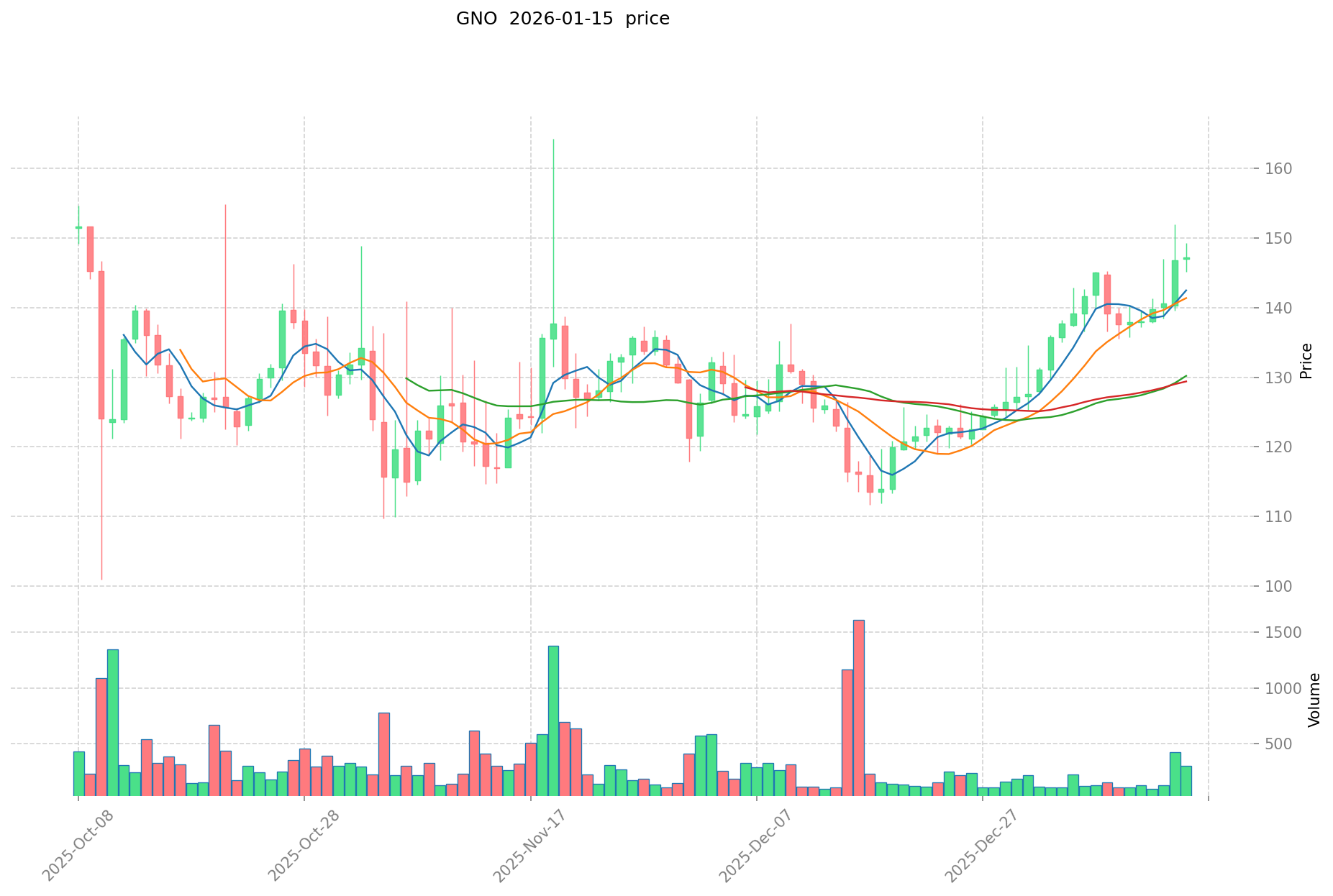
The project has demonstrated notable price volatility throughout its history, with a recorded peak of $644.2 in November 2021 and a low of $6.88 in March 2020. Recent performance shows a 5.75% increase over the past seven days and a 26.36% gain over the past month, though the token has experienced a decline of 40.12% over the past year. With a total supply of 3 million tokens and a maximum supply capped at 10 million, the current circulation ratio stands at approximately 26.4%, resulting in a fully diluted valuation of $441.30 million.
Gnosis's infrastructure serves as an open platform for prediction market applications, leveraging blockchain technology and smart contracts to facilitate decentralized forecasting mechanisms. The token is listed on 24 exchanges and has attracted a holder base of over 20,000 addresses. When evaluating "Is Gnosis (GNO) a good investment?", market participants consider factors including its Ethereum-based architecture, tokenomics structure, historical price patterns, and the evolving decentralized application landscape. This analysis examines GNO's investment characteristics, historical performance trends, future price considerations, and associated risk factors to provide a comprehensive reference for market observers.
I. Gnosis (GNO) Price History Review and Current Investment Value
- 2021: GNO reached a notable price level of $644.2 in November → investors who entered earlier in the cycle experienced significant returns during this period
- 2020: During the March market downturn, GNO traded near $6.88 → the token demonstrated considerable volatility aligned with broader crypto market cycles
- 2024-2025: GNO showed recovery momentum, with the price moving from lower levels to approximately $147.1 by early 2026 → the token exhibited upward movement following extended consolidation
Current GNO Investment Market Status (January 2026)
- GNO Current Price: $147.1
- 24-hour Trading Volume: $32,644,433.1
- Market Capitalization: $388,283,541.9
- Circulating Supply: 2,639,589 GNO
- Total Supply: 3,000,000 GNO
- Market Dominance: 0.012%
- Recent Price Performance: -0.61% (1H), -0.2% (24H), +5.75% (7D), +26.36% (30D), -40.12% (1Y)
Click to view real-time GNO market price
II. Core Factors Influencing Whether GNO is a Good Investment
Supply Mechanism and Scarcity (GNO Investment Scarcity)
- Limited token supply structure → influences price dynamics and investment value
- Total supply of 3,000,000 GNO with a maximum supply cap of 10,000,000 tokens
- Current circulating supply represents approximately 26.4% of total supply, with 2,639,589 tokens in circulation
- Market cap to fully diluted valuation ratio of 26.4% indicates significant unreleased supply
- Historical price variation: GNO has traded between $6.88 and $644.2 since its launch in April 2017
- Investment significance: controlled token release schedule may support long-term value proposition through managed supply expansion
Institutional Investment and Mainstream Adoption (Institutional Investment in GNO)
- Current holder base: approximately 20,075 addresses holding GNO tokens
- Trading availability: listed on 24 cryptocurrency exchanges globally
- Market presence: GNO maintains a market dominance of 0.012% within the broader cryptocurrency market
- The token serves multiple functions within the Gnosis ecosystem, including governance participation and network validation
- Adoption indicators: growing number of addresses interacting with GNO contracts on Ethereum mainnet
Macroeconomic Environment Impact on GNO Investment
- Cryptocurrency market conditions → affect overall investment attractiveness
- Recent performance trends: -40.12% change over one-year period, +26.36% change over 30-day period
- Broader market volatility influences GNO price movements alongside fundamental factors
- Correlation with Ethereum network activity given GNO's deployment on ETH blockchain
- Market capitalization positioning at rank 159 reflects mid-tier asset status within crypto markets
Technology and Ecosystem Development (Technology & Ecosystem for GNO Investment)
- Ethereum-based infrastructure: GNO operates as an ERC-20 token on Ethereum mainnet (contract: 0x6810e776880c02933d47db1b9fc05908e5386b96)
- Decentralized prediction market platform → provides core utility for token holders
- Smart contract automation enables flexible participation in prediction markets
- Historical token migration: STAKE tokens were previously converted to GNO at a ratio of 1:0.0326292707
- Ecosystem expansion potential: prediction market applications, IoT integration capabilities, and blockchain-based information asset trading
- Active development: multiple GitHub repositories maintained including safe-contracts, conditional-tokens-explorer, and gp-v2-contracts
- Community engagement channels: active presence on Twitter, Reddit, Facebook, and dedicated forums (forum.gnosis.io, blog.gnosis.io)
- DeFi integration potential: prediction markets intersect with decentralized finance applications
III. GNO Future Investment Forecast and Price Outlook (Is Gnosis(GNO) worth investing in 2026-2031)
Short-term Investment Forecast (2026, short-term GNO investment outlook)
- Conservative forecast: $117.76 - $147.2
- Neutral forecast: $147.2 - $178.112
- Optimistic forecast: $178.112 - $209.024
Mid-term Investment Outlook (2027-2029, mid-term Gnosis(GNO) investment forecast)
-
Market stage expectation: The token may experience a growth phase with technical indicators showing mixed signals. The circulating supply remains relatively stable at approximately 26.4% of total supply, which could support gradual price appreciation if demand increases.
-
Investment return forecast:
- 2027: $101.52 - $244.01
- 2028: $118.20 - $301.82
- 2029: $158.99 - $310.29
-
Key catalysts: Platform development progress, prediction market adoption trends, and overall cryptocurrency market conditions may influence price movements.
Long-term Investment Outlook (Is GNO a good long-term investment?)
- Base scenario: $217.63 - $340.04 (assuming steady ecosystem development and maintained market position)
- Optimistic scenario: $340.04 - $431.85 (assuming enhanced platform utility and increased adoption)
- Risk scenario: Below $217.63 (under adverse market conditions or reduced platform engagement)
For detailed GNO long-term investment and price predictions, visit: Price Prediction
2026-01-15 to 2031 Long-term Outlook
- Base scenario: $217.63 - $340.04 USD (corresponding to steady progress and gradual mainstream application growth)
- Optimistic scenario: $340.04 - $431.85 USD (corresponding to large-scale adoption and favorable market environment)
- Transformative scenario: Above $431.85 USD (if ecosystem achieves breakthrough developments and mainstream popularization)
- 2031-12-31 predicted high: $431.85 USD (based on optimistic development assumptions)
Disclaimer: These forecasts are based on historical data patterns and current market conditions. Cryptocurrency investments carry inherent risks, and actual prices may vary significantly from predictions due to market volatility, regulatory changes, and unforeseen events. This information does not constitute investment advice.
| Year |
Predicted High Price |
Predicted Average Price |
Predicted Low Price |
Price Change |
| 2026 |
209.024 |
147.2 |
117.76 |
0 |
| 2027 |
244.01344 |
178.112 |
101.52384 |
21 |
| 2028 |
301.8196896 |
211.06272 |
118.1951232 |
43 |
| 2029 |
310.293857808 |
256.4412048 |
158.993546976 |
74 |
| 2030 |
396.7145438256 |
283.367531304 |
226.6940250432 |
92 |
| 2031 |
431.852117707296 |
340.0410375648 |
217.626264041472 |
131 |
IV. Gnosis (GNO) Investment Strategy and Risk Management (How to invest in Gnosis)
Investment Methodology (Gnosis investment strategy)
Long-term Holding (HODL GNO)
Long-term holding represents a suitable approach for conservative investors seeking exposure to Gnosis. This strategy involves acquiring GNO tokens and maintaining positions over extended periods, typically measured in years rather than months. The methodology aligns with the project's evolution from a prediction market platform to a broader ecosystem encompassing decentralized governance and infrastructure.
Investors adopting this approach may consider the token's fundamental characteristics, including its capped maximum supply of 10,000,000 tokens and current circulating supply of 2,639,589 tokens, representing approximately 26.4% of total supply. The market capitalization to fully diluted valuation ratio of 26.4% suggests potential supply expansion considerations for long-term positioning.
Active Trading Strategy
Active trading methodologies for GNO rely on technical analysis frameworks and swing trading operations. Recent price performance data indicates:
- 1-hour price movement: -0.61%
- 24-hour fluctuation: -0.2%
- 7-day performance: +5.75%
- 30-day trajectory: +26.36%
- 1-year performance: -40.12%
The 24-hour trading range between $145.1 and $149.3 demonstrates intraday volatility patterns that active traders may utilize for position management. The current price of $147.1 represents a significant discount from the historical peak of $644.2 recorded on November 9, 2021, while maintaining substantial appreciation from the historical low of $6.88 on March 13, 2020.
Risk Management Framework (Risk management for Gnosis investment)
Asset Allocation Models
Conservative Allocation: Conservative investors may consider limiting GNO exposure to 2-5% of total cryptocurrency portfolio allocation, complemented by established assets with higher market capitalizations and lower volatility profiles.
Moderate Allocation: Balanced investors with moderate risk tolerance could allocate 5-10% of cryptocurrency holdings to GNO, incorporating the token within a diversified digital asset portfolio spanning multiple blockchain ecosystems.
Aggressive Allocation: Experienced investors with higher risk appetite and deep understanding of prediction markets and decentralized governance mechanisms might allocate 10-20% of cryptocurrency portfolios to GNO, acknowledging the elevated risk-return profile.
Risk Hedging Approaches
Multi-asset portfolio construction serves as a primary hedging mechanism. Investors may balance GNO positions with:
- Established layer-1 blockchain tokens
- Stablecoin allocations for liquidity management
- Traditional financial instruments in balanced portfolios
Position sizing relative to overall portfolio value provides systematic risk management, preventing overconcentration in single assets.
Security and Storage Solutions
Given that GNO operates as an ERC-20 token on the Ethereum network (contract address: 0x6810e776880c02933d47db1b9fc05908e5386b96), investors should implement appropriate storage protocols:
Cold Storage Solutions: Hardware wallets compatible with Ethereum-based tokens offer offline security for long-term holdings, protecting assets from online vulnerabilities.
Hot Wallet Management: For active trading operations, reputable software wallets with multi-signature capabilities and robust security features provide necessary accessibility while maintaining security standards.
Custodial Considerations: Investors should evaluate the security track record and insurance provisions of exchanges or custodial services holding GNO assets.
V. Gnosis (GNO) Investment Risks and Challenges (Risks of investing in Gnosis)
Market Risk Factors
Price Volatility Characteristics
GNO demonstrates significant price fluctuation patterns characteristic of mid-cap cryptocurrency assets. The token's 1-year performance showing a decline of 40.12% illustrates the substantial downside volatility potential. Conversely, the 30-day performance of +26.36% demonstrates rapid appreciation capacity, creating challenges for risk assessment and position management.
With a current market capitalization of approximately $388.28 million and ranking #159 among cryptocurrencies, GNO maintains relatively limited liquidity compared to larger-cap assets. The 24-hour trading volume of $32,644.43 represents approximately 0.0084% of market capitalization, indicating potential liquidity constraints during periods of market stress.
Market Manipulation Considerations
Lower liquidity environments may present elevated susceptibility to price manipulation through concentrated buying or selling pressure. Investors should recognize that limited order book depth could result in significant price impact from large transactions.
Regulatory Risk Environment
Jurisdictional Uncertainty
Cryptocurrency regulatory frameworks vary substantially across jurisdictions, creating compliance complexities for projects and investors. Prediction market platforms, including those built on decentralized infrastructure, may face scrutiny regarding gambling regulations, securities laws, and consumer protection requirements in various countries.
The evolving nature of digital asset regulation creates ongoing uncertainty regarding:
- Classification of GNO tokens under securities regulations
- Taxation treatment across different jurisdictions
- Potential restrictions on prediction market operations
- Cross-border transaction compliance requirements
Policy Development Impact
Regulatory developments in major markets could materially affect GNO valuation and utility. Investors should monitor policy evolution in key jurisdictions and assess potential implications for project operations and token economics.
Technical and Operational Risks
Smart Contract Security
As an Ethereum-based platform utilizing smart contracts for prediction markets and governance mechanisms, Gnosis faces inherent smart contract risks. Potential vulnerabilities in contract code could result in:
- Unauthorized fund access or exploitation
- Operational disruptions affecting platform functionality
- Loss of user confidence impacting token valuation
While the project maintains multiple GitHub repositories for various components (including safe-contracts, conditional-tokens-explorer, and gp-v2-contracts), ongoing security audits and vulnerability management remain critical for platform integrity.
Network Dependency
GNO's operation on the Ethereum network creates dependency on Ethereum infrastructure performance, including:
- Network congestion affecting transaction costs and speeds
- Ethereum protocol upgrades and potential compatibility issues
- Layer-1 security considerations
Upgrade and Governance Risks
The project's evolution, including the historical token migration from STAKE to GNO at a ratio of 1:0.0326292707, demonstrates ongoing development and governance activities. Future upgrades or governance decisions could affect token economics, platform functionality, or user adoption patterns.
VI. Conclusion: Is Gnosis (GNO) a Good Investment?
Investment Value Assessment
Gnosis (GNO) presents a specialized investment opportunity within the decentralized prediction market and governance infrastructure sector. The token's long-term potential relates to the continued development of prediction market applications, decentralized governance mechanisms, and broader ecosystem expansion. However, investors should recognize that short-term price movements may exhibit substantial volatility, as evidenced by the 1-year decline of 40.12% alongside the 30-day appreciation of 26.36%.
The project's position at market cap rank #159 with approximately 20,075 token holders indicates a established but relatively niche ecosystem compared to larger blockchain platforms. The significant discount from historical peak prices may present opportunity for value-oriented investors, while also reflecting market reassessment of project valuations across the cryptocurrency sector.
Investor Recommendations
✅ New Investors
Individuals new to cryptocurrency investment considering GNO exposure should:
- Implement systematic accumulation strategies (dollar-cost averaging) to mitigate timing risk
- Prioritize secure storage solutions, utilizing hardware wallets for long-term holdings
- Limit initial allocation to a small percentage of overall investment portfolio
- Develop understanding of prediction market mechanics and decentralized governance before significant commitment
✅ Experienced Investors
Investors with established cryptocurrency portfolios may approach GNO through:
- Tactical trading strategies capitalizing on volatility patterns while maintaining core long-term positions
- Portfolio diversification incorporating GNO alongside complementary blockchain ecosystem tokens
- Active monitoring of project developments, governance proposals, and ecosystem expansion
- Position sizing aligned with risk tolerance and conviction level regarding prediction market adoption
✅ Institutional Participants
Institutional investors evaluating GNO should consider:
- Strategic long-term allocation as part of diversified blockchain infrastructure exposure
- Due diligence encompassing technical architecture, governance frameworks, and regulatory compliance
- Liquidity assessment for position entry and exit planning
- Correlation analysis relative to broader cryptocurrency market and traditional asset classes
⚠️ Important Disclaimer
Cryptocurrency investments carry substantial risk, including potential loss of principal. Market volatility, regulatory uncertainty, technical vulnerabilities, and liquidity constraints represent material risk factors affecting GNO and similar digital assets. This analysis provides informational content for educational purposes and does not constitute investment advice, financial guidance, or recommendations to buy, sell, or hold any cryptocurrency. Investors should conduct independent research, assess personal risk tolerance, and consult qualified financial advisors before making investment decisions.
VII. FAQ
Q1: What is Gnosis (GNO) and what makes it unique in the cryptocurrency space?
Gnosis (GNO) is an Ethereum-based token that powers a decentralized prediction market platform and governance infrastructure. Launched in April 2017, it enables users to create and participate in prediction markets through smart contracts, distinguishing itself by combining forecasting mechanisms with decentralized governance capabilities. The platform utilizes blockchain technology to facilitate information trading and has evolved into a broader ecosystem encompassing DeFi applications and decentralized autonomous organization (DAO) infrastructure.
Q2: How volatile is GNO as an investment compared to other cryptocurrencies?
GNO exhibits significant price volatility characteristic of mid-cap cryptocurrencies. Historical data shows the token reached a peak of $644.2 in November 2021 and a low of $6.88 in March 2020. Recent performance demonstrates this volatility with a 40.12% decline over one year, yet a 26.36% gain over 30 days. With a market cap rank of 159 and relatively limited liquidity ($32.64 million in 24-hour volume), GNO experiences more pronounced price swings than larger-cap assets, requiring careful risk management.
Q3: What is the tokenomics structure of GNO and how does supply affect investment value?
GNO has a maximum supply cap of 10 million tokens, with a total supply of 3 million and current circulating supply of 2,639,589 tokens (approximately 26.4% circulation ratio). This limited supply structure creates scarcity dynamics that may support long-term value. The low circulation ratio indicates significant unreleased supply, which could affect future price movements as additional tokens enter circulation. The controlled token release schedule represents both an opportunity through managed supply expansion and a risk factor investors should monitor.
Q4: What are the main risks associated with investing in GNO?
Key risks include: (1) Price volatility and market risk, with potential for substantial short-term fluctuations; (2) Regulatory uncertainty affecting prediction market platforms across different jurisdictions; (3) Smart contract vulnerabilities that could compromise platform security; (4) Liquidity constraints due to relatively limited trading volume; (5) Dependency on Ethereum network performance and upgrades; and (6) Competition from other prediction market and governance platforms. Investors should assess these risks against their risk tolerance before committing capital.
Q5: How should investors approach GNO allocation in their portfolio?
Portfolio allocation should align with individual risk tolerance: Conservative investors might limit GNO to 2-5% of cryptocurrency holdings; moderate investors could allocate 5-10%; while aggressive investors with deep understanding of prediction markets might allocate 10-20%. Long-term holding (HODL) strategies suit patient investors, while active trading approaches can capitalize on volatility patterns. Dollar-cost averaging helps mitigate timing risk for new investors, and all holders should implement secure storage solutions, preferably hardware wallets for long-term positions.
Q6: What factors could drive GNO's price appreciation in the future?
Potential catalysts include: (1) Increased adoption of prediction market applications across various sectors; (2) Expansion of the Gnosis ecosystem into DeFi and DAO infrastructure; (3) Successful platform upgrades and technical developments visible in active GitHub repositories; (4) Growing holder base beyond the current 20,075 addresses; (5) Favorable cryptocurrency market conditions and Ethereum network growth; (6) Enhanced liquidity through additional exchange listings beyond current 24 platforms; and (7) Mainstream recognition of decentralized governance mechanisms. However, these factors remain speculative and subject to market dynamics.
Q7: Is GNO suitable for long-term investment or better for short-term trading?
GNO can serve both strategies depending on investor objectives. Long-term holding suits investors believing in prediction market adoption and decentralized governance evolution over multi-year timeframes. The token's fundamental infrastructure positioning supports this approach. Short-term trading opportunities arise from volatility patterns, with recent data showing intraday ranges of $145.1-$149.3 and weekly fluctuations of 5.75%. Active traders can capitalize on these movements, while long-term investors should focus on ecosystem development and adoption metrics rather than short-term price action.
Q8: Where can investors safely store and trade GNO tokens?
As an ERC-20 token on Ethereum (contract: 0x6810e776880c02933d47db1b9fc05908e5386b96), GNO requires Ethereum-compatible storage solutions. Hardware wallets like Ledger or Trezor offer maximum security for long-term holdings through offline storage. For active trading, reputable software wallets with multi-signature capabilities provide necessary accessibility. GNO is available on 24 cryptocurrency exchanges globally, and investors should select platforms with strong security track records, adequate insurance provisions, and appropriate regulatory compliance in their jurisdiction.
* The information is not intended to be and does not constitute financial advice or any other recommendation of any sort offered or endorsed by Gate.