Golem (GLM) is a decentralized computing power rental platform on Ethereum with a current market cap of $312.1 million and token price of $0.3121 as of January 2026. The article provides a comprehensive investment analysis examining GLM's price history from its 2016 launch through current market performance, including its 45.49% 30-day gain but -19.88% yearly decline. It addresses core investment factors including fixed tokenomics (1 billion tokens fully circulated), institutional adoption across 36 exchanges, and the growing decentralized computing sector. Price forecasts range from conservative ($0.24-$0.28) to optimistic ($0.40-$0.44) for 2026, with long-term projections reaching $0.77-$0.80 by 2031 under favorable conditions. The analysis covers investment strategies suitable for different investor types, essential risk management approaches, and significant risks including market volatility, regulatory uncertainty, and technical dependencies. The comprehensive guide helps investors evaluate whether GLM r
Introduction: Golem (GLM) Investment Position and Market Outlook
Golem (GLM) represents a notable asset in the cryptocurrency sector, having established itself as a decentralized computing power rental platform built on the Ethereum blockchain since its launch in November 2016. As of January 15, 2026, GLM holds a market capitalization of approximately $312.1 million, with a fully circulating supply of 1 billion tokens and a current trading price around $0.3121. Positioned as a global, open-source decentralized supercomputer accessible to anyone, Golem enables users to become either providers or consumers of computing power, ranging from individual idle home computers to large-scale data centers. With a market ranking of 186 and trading availability across 36 exchanges, GLM has attracted attention from approximately 19,951 holders. The token's performance shows varied trajectories across different timeframes, with a 14.31% increase over the past 7 days and a 45.49% gain over the past 30 days, while experiencing a -19.88% change over the past year. This article provides a comprehensive analysis of GLM's investment characteristics, historical price movements, future price projections, and associated risks to assist investors in evaluating the token's potential within the decentralized computing infrastructure landscape.
I. Golem (GLM) Price History Review and Current Investment Value
-
2016: Golem launched with an initial offering price of $0.0105, marking the project's entry into the decentralized computing market. The token was listed on 36 exchanges, establishing early liquidity channels for investors.
-
2018: GLM reached a significant price level of $1.32 on April 13, representing a period of heightened market interest in the project's computing rental platform vision. This price point reflected growing attention to decentralized infrastructure solutions built on Ethereum.
-
2020: The project underwent a rebranding transition, with GNT tokens converted to GLM at a 1:1 ratio on November 19. This technical upgrade aimed to enhance the token's functionality within the evolving Golem ecosystem.
-
2023-2024: GLM experienced price fluctuations consistent with broader cryptocurrency market cycles, with the token navigating through periods of varying investor sentiment and trading activity.
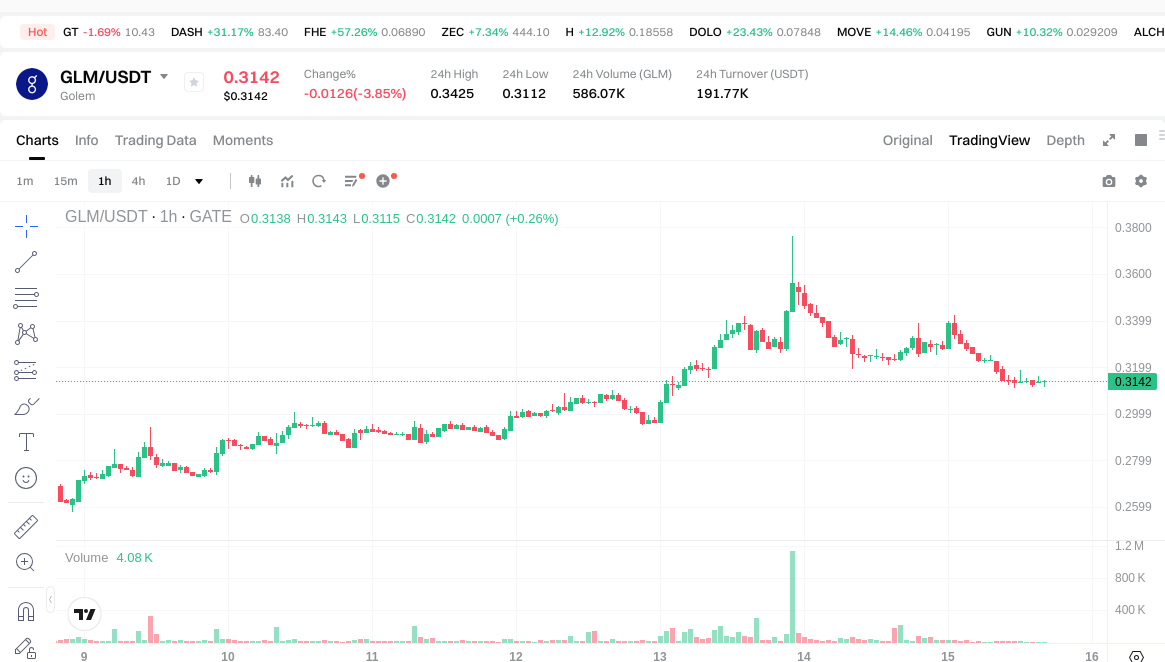
Current GLM Investment Market Status (January 2026)
- GLM Current Price: $0.3121
- Market Capitalization: $312.1 million, ranking #186 among cryptocurrencies
- Market Share: 0.0091% of total cryptocurrency market capitalization
- 24-Hour Trading Volume: $192,547.81
- 24-Hour Price Range: $0.3112 - $0.3425
- Circulating Supply: 1,000,000,000 GLM (100% of total supply)
- Fully Diluted Market Cap: $312.1 million
- Token Holder Count: 19,951 addresses
- Price Changes: -0.44% (1H), -4.4% (24H), +14.31% (7D), +45.49% (30D), -19.88% (1Y)
Click to view real-time GLM market price
II. Core Factors Affecting Whether GLM is a Good Investment
Supply Mechanism and Scarcity (GLM Investment Scarcity)
- Fixed supply mechanism → Impacts price and investment value
- Historical pattern: GLM's total supply is capped at 1,000,000,000 tokens, with 100% currently in circulation, establishing a fully diluted market from launch
- Investment significance: The complete circulation and fixed maximum supply create a transparent scarcity model that supports long-term investment consideration
Institutional Investment and Mainstream Adoption (Institutional Investment in GLM)
- Holder distribution: As of January 2026, GLM has approximately 19,951 holders, indicating a distributed ownership structure
- Exchange presence: GLM is listed on 36 exchanges globally, providing liquidity and accessibility for investors
- Market positioning: The decentralized computing power rental model positions GLM within the utility token category, targeting computational resource sharing markets
Macroeconomic Environment's Impact on GLM Investment
- Market volatility: Cryptocurrency markets remain highly volatile, making precise price predictions challenging and requiring investors to consider significant risk factors
- Performance context: GLM has shown varied performance across different timeframes, with a 45.49% increase over 30 days but a -19.88% change over one year as of January 15, 2026
- Trading dynamics: 24-hour trading volume of $192,547.81 and market capitalization of $312.1 million reflect current market participation levels
Technology and Ecosystem Development (Technology & Ecosystem for GLM Investment)
- Platform foundation: Golem operates as a decentralized computing power leasing platform built on Ethereum, utilizing Ethereum-based transaction systems for settlement
- Network utility: The platform enables users to both provide and lease computational resources, ranging from individual home computers to data center infrastructure
- Token evolution: GNT was renamed to GLM on November 19, 2020, in a 1:1 conversion, representing a branding and technical evolution in the project's development
III. GLM Future Investment Forecast and Price Outlook (Is Golem(GLM) worth investing in 2026-2031)
Short-term Investment Forecast (2026, short-term GLM investment outlook)
Based on available market data and technical indicators, short-term price projections for GLM in 2026 show varied estimates:
- Conservative forecast: $0.24 - $0.28
- Neutral forecast: $0.31 - $0.38
- Optimistic forecast: $0.40 - $0.44
Technical analysis suggests GLM's 200-day SMA may reach approximately $0.24 by mid-February 2026, while the 50-day SMA could approach $0.27 during the same period. Market indicators present mixed signals, with RSI and Stochastic RSI showing sell pressure, while volume-weighted moving averages indicate potential buying interest.
Mid-term Investment Outlook (2027-2029, mid-term Golem(GLM) investment forecast)
- Market stage expectation: The mid-term period may see GLM navigating through consolidation phases with potential for gradual appreciation as the decentralized computing market matures.
- Investment return forecast:
- 2027: $0.28 - $0.51 (representing potential growth of 21% from 2026 baseline)
- 2028: $0.39 - $0.59 (indicating possible 41% advancement)
- 2029: $0.44 - $0.63 (suggesting potential 65% increase from initial 2026 levels)
- Key catalysts: Growth in the decentralized computing sector, expanding IoT integration, technological developments within the Ethereum ecosystem, and increasing demand for distributed computational resources may influence mid-term price movements.
Long-term Investment Outlook (Is Golem a good long-term investment?)
- Baseline scenario: $0.38 - $0.67 (2030-2031 range, assuming steady ecosystem development and moderate adoption growth)
- Optimistic scenario: $0.77 - $0.80 (contingent upon substantial platform adoption, favorable market conditions, and successful technological upgrades)
- Risk scenario: $0.24 - $0.38 (under challenging market conditions, increased competition, or delays in platform development)
For detailed GLM long-term investment and price predictions, visit: Price Prediction
2026-2031 Long-term Outlook
- Base scenario: $0.38 - $0.67 (corresponding to stable progress and gradual mainstream application growth)
- Optimistic scenario: $0.77 - $0.80 (corresponding to large-scale adoption and favorable market environment)
- Transformative scenario: Above $0.80 (contingent upon breakthrough ecosystem developments and mainstream adoption)
- Projected high for December 31, 2031: $0.80 (based on optimistic development assumptions)
Disclaimer: These forecasts are based on available market data and technical analysis as of January 15, 2026. Cryptocurrency markets are highly volatile and subject to numerous unpredictable factors. Past performance does not guarantee future results. These projections should not be construed as investment advice, and investors should conduct thorough research and consider their risk tolerance before making investment decisions.
| Year |
Predicted High Price |
Predicted Average Price |
Predicted Low Price |
Price Change |
| 2026 |
0.443022 |
0.3142 |
0.241934 |
0 |
| 2027 |
0.50733874 |
0.378611 |
0.27638603 |
21 |
| 2028 |
0.5935863258 |
0.44297487 |
0.3898178856 |
41 |
| 2029 |
0.627119523459 |
0.5182805979 |
0.435355702236 |
65 |
| 2030 |
0.76741808131053 |
0.5727000606795 |
0.52688405582514 |
83 |
| 2031 |
0.804070885194018 |
0.670059070995015 |
0.375233079757208 |
114 |
IV. Golem (GLM) Investment Strategy and Risk Management (How to invest in Golem)
Investment Methodology (Golem investment strategy)
Investors in Golem (GLM) may consider different approaches based on their risk tolerance and market understanding:
-
Long-term Holding (HODL Golem): This approach suits conservative investors who believe in the long-term potential of decentralized computing power rental platforms. Given Golem's established presence since 2016 and its transition from GNT to GLM in November 2020, holding GLM allows investors to participate in the growth of the decentralized computing market without engaging in frequent trading activities.
-
Active Trading: More experienced traders may utilize technical analysis and swing trading strategies to capitalize on GLM's price movements. With a 24-hour price change of -4.4% and a 7-day change of +14.31%, GLM demonstrates notable price volatility that may present trading opportunities for those skilled in market timing.
Risk Management (Risk management for Golem investment)
V. Golem (GLM) Investment Risks and Challenges (Risks of investing in Golem)
-
Market Risk: GLM exhibits significant price volatility, with a 1-year performance of -19.88% and 30-day performance of +45.49%. The 24-hour trading volume of approximately $192,548 suggests moderate liquidity, which may result in price fluctuations during periods of concentrated buying or selling activity. The token experienced a decline from its historical high of $1.32 (April 2018) to a current price of $0.3121, representing approximately 76% below its peak.
-
Regulatory Risk: As a decentralized computing platform built on Ethereum, Golem faces regulatory uncertainties across different jurisdictions. Changes in cryptocurrency regulations, particularly those affecting utility tokens or decentralized networks, could impact GLM's adoption and market performance. Investors should monitor regulatory developments in their respective regions.
-
Technical Risk:
- Network security: As an Ethereum-based project, GLM's security depends partly on Ethereum's network integrity
- Platform development: The success of Golem relies on continuous technical improvements and adoption of its decentralized computing marketplace
- Competition: The decentralized computing sector faces competition from both blockchain-based projects and traditional cloud computing providers
- Smart contract risks: Potential vulnerabilities in smart contract code could affect token functionality
VI. Conclusion: Is Golem a Good Investment?
-
Investment Value Summary: Golem (GLM) represents a distinctive approach to decentralized computing power rental on the Ethereum platform. With full token circulation (100% of 1 billion GLM tokens in circulation) and a market capitalization of approximately $312.1 million, the project has established market presence. However, the token's performance shows considerable short-term price fluctuations, as evidenced by its 24-hour decline of -4.4% contrasted with a 7-day gain of +14.31%.
-
Investor Recommendations:
✅ Beginners: Consider dollar-cost averaging (DCA) strategy combined with secure wallet storage. Start with small allocations to understand GLM's price behavior before increasing exposure.
✅ Experienced Investors: May employ swing trading strategies while maintaining core holdings. Portfolio diversification across multiple blockchain sectors is advisable.
✅ Institutional Investors: Could consider strategic long-term allocation as part of a broader decentralized infrastructure thesis, with appropriate risk management protocols.
⚠️ Notice: Cryptocurrency investments carry substantial risks. This content is provided for informational purposes only and does not constitute investment advice. Investors should conduct thorough research and consider their financial circumstances before making investment decisions.
VII. FAQ
Q1: What is Golem (GLM) and how does it work?
Golem (GLM) is a decentralized computing power rental platform built on the Ethereum blockchain that operates as a global, open-source supercomputer accessible to anyone. The platform enables users to become either providers or consumers of computing power, creating a marketplace where idle computational resources from individual home computers to large-scale data centers can be rented out. GLM serves as the utility token for transactions within this ecosystem, facilitating payments between computing power providers and consumers. The platform was originally launched in November 2016 as GNT and underwent a rebranding transition to GLM on November 19, 2020, with tokens converted at a 1:1 ratio to enhance functionality within the evolving ecosystem.
Q2: Is Golem (GLM) a good investment for 2026?
GLM presents a mixed investment profile for 2026 with both opportunities and risks. The token shows positive momentum with a 45.49% gain over the past 30 days and 14.31% increase over the past 7 days. Price forecasts for 2026 range from conservative estimates of $0.24-$0.28 to optimistic projections of $0.40-$0.44. However, investors should consider that GLM has experienced a -19.88% decline over the past year and significant volatility, with 24-hour trading volume of only $192,548 suggesting moderate liquidity. The investment suitability depends on individual risk tolerance, with conservative investors advised to allocate only 1-3% of their crypto portfolio to GLM while maintaining diversification across other digital assets.
Q3: What are the main risks associated with investing in Golem (GLM)?
GLM investment carries several significant risks that potential investors should carefully evaluate. Market risk is substantial, evidenced by the token's 76% decline from its April 2018 peak of $1.32 to the current price of $0.3121, along with high short-term volatility. Technical risks include dependence on Ethereum's network security, potential smart contract vulnerabilities, and competition from both blockchain-based projects and traditional cloud computing providers. Regulatory uncertainty represents another challenge, as changes in cryptocurrency regulations affecting utility tokens or decentralized networks could impact GLM's adoption and market performance. Additionally, the relatively low 24-hour trading volume of approximately $192,548 may result in liquidity constraints during periods of concentrated buying or selling activity.
Q4: How does Golem's tokenomics affect its investment potential?
Golem's tokenomics feature a fixed supply mechanism with a maximum cap of 1,000,000,000 GLM tokens, all of which are currently in circulation (100% circulating supply). This complete circulation creates a fully diluted market and transparent scarcity model that eliminates concerns about future token inflation or dilution from additional supply releases. With approximately 19,951 token holders and availability on 36 exchanges globally, GLM has established distributed ownership and reasonable accessibility for investors. The fixed supply cap supports long-term investment consideration by providing price stability against supply-side inflation, though demand factors and market conditions remain primary determinants of value. This tokenomic structure positions GLM as a mature asset with no additional supply pressure, allowing valuation to be driven primarily by platform adoption and market sentiment.
Q5: What are the price predictions for Golem (GLM) from 2027 to 2031?
Price forecasts for GLM suggest potential gradual appreciation through 2031, though with considerable uncertainty. For 2027, projections range from $0.28 to $0.51, representing approximately 21% growth from 2026 baseline levels. By 2028, estimates suggest $0.39 to $0.59 (41% potential advancement), while 2029 forecasts indicate $0.44 to $0.63 (65% potential increase from initial 2026 levels). Long-term outlook for 2030-2031 presents a base scenario of $0.38-$0.67, an optimistic scenario of $0.77-$0.80, and a transformative scenario above $0.80, with a projected high of $0.80 by December 31, 2031. These projections depend on factors including decentralized computing sector growth, expanding IoT integration, Ethereum ecosystem developments, and increasing demand for distributed computational resources. However, cryptocurrency markets remain highly volatile, and these forecasts should not be construed as investment advice.
Q6: How should different types of investors approach Golem (GLM)?
Investment strategies for GLM should align with investor experience levels and risk tolerance. Beginners are advised to utilize dollar-cost averaging (DCA) strategies combined with secure wallet storage, starting with small allocations to understand GLM's price behavior before increasing exposure. Conservative investors should consider allocating only 1-3% of their crypto portfolio to GLM and employ a long-term holding (HODL) approach, participating in the growth of the decentralized computing market without frequent trading. Experienced investors may allocate 3-7% of their portfolio and employ swing trading strategies to capitalize on GLM's volatility (evidenced by -4.4% 24-hour and +14.31% 7-day changes) while maintaining core holdings. Institutional investors could consider strategic long-term allocation of appropriate percentages as part of a broader decentralized infrastructure thesis, with comprehensive risk management protocols including multi-asset diversification and stablecoin reserves for opportunistic buying during market corrections.
Q7: What factors could drive Golem's price growth in the future?
Several key catalysts may influence GLM's future price appreciation. Growth in the decentralized computing sector represents the primary driver, as increasing demand for distributed computational resources expands the addressable market for Golem's platform. Expanding IoT integration could create new use cases for decentralized computing power rental, broadening the platform's utility. Technological developments within the Ethereum ecosystem, including scalability improvements and reduced transaction costs, may enhance Golem's operational efficiency and attractiveness. Platform-specific factors such as successful technological upgrades, increased user adoption, and expansion of computing power providers on the network would strengthen fundamental value. Favorable macroeconomic conditions for cryptocurrency markets and positive regulatory developments for utility tokens could provide tailwind support. However, realization of these growth factors remains uncertain, and investors should consider that competition from both blockchain-based projects and traditional cloud computing providers presents ongoing challenges to market share expansion.
Q8: Where and how can investors securely purchase and store Golem (GLM)?
Investors can purchase GLM on 36 exchanges globally, providing multiple access points for acquiring the token. Since GLM operates on the Ethereum network as an ERC-20 token (contract address: 0x7DD9c5Cba05E151C895FDe1CF355C9A1D5DA6429), investors require compatible ERC-20 wallets for storage. For long-term holdings, cold wallets such as hardware wallets (Ledger or Trezor) provide enhanced security by keeping private keys offline and protected from potential online threats. Hot wallets are suitable for active traders who need frequent access to their holdings, though amounts stored in hot wallets should be limited to trading needs to minimize security risks. Investors should verify they are using official wallet applications, enable two-factor authentication where available, and maintain secure backup of recovery phrases. When selecting exchanges for purchase, consider factors including trading volume, fee structures, security track record, and regulatory compliance in your jurisdiction.
* The information is not intended to be and does not constitute financial advice or any other recommendation of any sort offered or endorsed by Gate.