This comprehensive analysis examines whether Gravity (G) represents a sound investment opportunity. As the native gas token for the Gravity chain and utility token across Gravity and Galxe ecosystems, G currently trades at $0.004375 with a market cap of $31.64 million. The article evaluates G's historical performance, tokenomics, and price projections through 2031 while identifying key investment catalysts including staking implementation and ecosystem expansion. It addresses critical risk factors including price volatility (83.46% decline from peak), liquidity constraints, regulatory uncertainty, and technical execution risks. Tailored investment strategies accommodate different investor profiles—from conservative dollar-cost averaging approaches to active trading tactics—with recommended portfolio allocations ranging from 1-3% for conservative investors to 7-15% for experienced participants. The analysis concludes that G presents opportunities for ecosystem believers but requires careful risk management and
Introduction: Gravity (G)'s Investment Position and Market Outlook
G is a significant asset in the cryptocurrency space, serving as the native token of the Gravity mainnet and the utility token for both the Gravity and Galxe ecosystems. Since its launch in July 2024, G has been positioned to power transactions as a gas token and facilitate governance decisions, growth incentives, and payments across both ecosystems. As of January 21, 2026, G has a market capitalization of approximately $31.64 million, with a circulating supply of about 7.23 billion tokens, and its current price is around $0.004375. With a total supply of 12 billion tokens and a maximum supply cap of 12 billion, G represents about 60.27% of its fully diluted valuation in circulation. Trading on 33 exchanges and held by approximately 24,725 addresses, G has established a presence in the market. This article will comprehensively analyze G's investment characteristics, historical price movements, future price considerations, and associated investment risks to provide reference information for those exploring "Is Gravity (G) a good investment?"
I. Gravity (G) Price History Review and Investment Value Status
- 2024: Token launch in July → G token was introduced to the market with an initial price structure
- 2024-2025: Market volatility period → G price experienced significant fluctuations during this cycle
- Recent period: Price adjustment phase → Market value declined from higher levels to current trading range
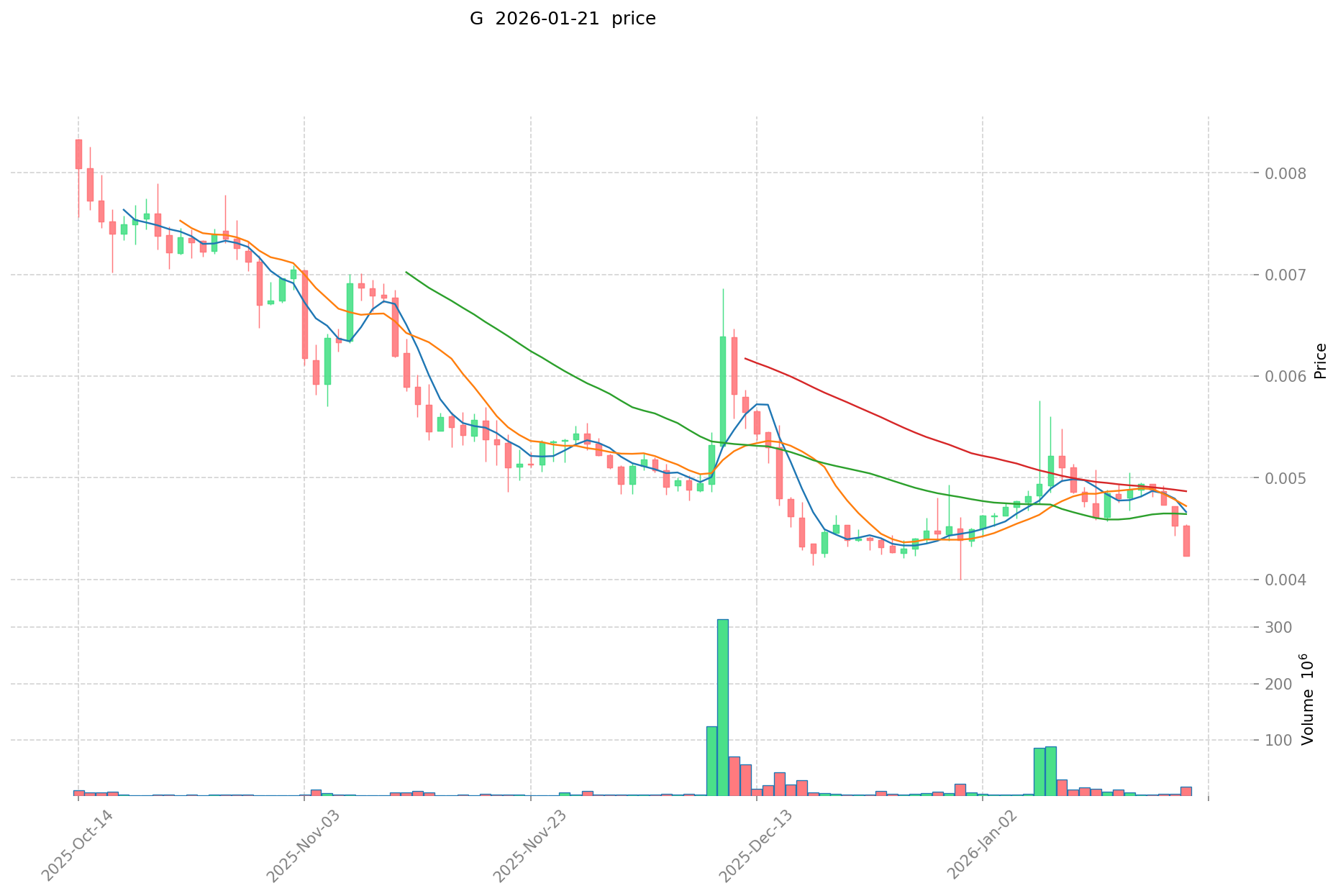
Current G Investment Market Status (January 2026)
- G current price: $0.004375
- 24-hour trading volume: $79,127.46
- Price change (24H): -3.44%
- Price change (7D): -11.06%
- Price change (1Y): -83.46%
- Market capitalization: $31,643,062.50
- Circulating supply: 7,232,700,000 G
- Token holders: 24,725
Click to view real-time G market price
II. Core Factors Affecting Whether G is a Good Investment
Supply Mechanism and Scarcity (G investment scarcity)
- Maximum supply capped at 12,000,000,000 tokens → influences price dynamics and investment valuation
- Current circulating supply represents approximately 60.27% of total supply, with 7,232,700,000 tokens in circulation
- Investment significance: The defined supply cap establishes a framework for potential scarcity considerations in long-term investment analysis
Institutional Investment and Mainstream Adoption (Institutional investment in G)
- Current holder base comprises 24,725 addresses, reflecting distribution across the network
- G serves as both the gas token for Gravity network transactions and a utility token across Gravity and Galxe ecosystems
- The token's governance function enables participation in ecosystem decision-making processes
Macroeconomic Environment's Impact on G Investment
- Monetary policy shifts and interest rate adjustments may alter the relative attractiveness of digital assets
- Broader market conditions influence capital flows across cryptocurrency sectors
- Regulatory developments and geopolitical uncertainties continue to shape digital asset investment landscapes
Technology and Ecosystem Development (Technology & Ecosystem for G investment)
- G functions as the native gas token powering transactions on the Gravity network
- Planned staking mechanism implementation aims to enhance network security through token-based participation
- Integration across Gravity and Galxe ecosystems positions G as a utility token facilitating governance, growth incentives, and payment functions
- Token deployment on Ethereum network (contract: 0x9c7beba8f6ef6643abd725e45a4e8387ef260649) enables cross-platform accessibility
III. G Future Investment Forecast and Price Outlook (Is Gravity(G) worth investing in 2026-2031)
Short-term G Investment Outlook (2026)
- Conservative forecast: $0.00384 - $0.00436
- Neutral forecast: $0.00436 - $0.00491
- Optimistic forecast: $0.00491 - $0.00550
Mid-term Gravity(G) Investment Forecast (2027-2029)
-
Market stage expectation: As Gravity continues to develop its mainnet capabilities and expand the Galxe ecosystem integration, G token utility may experience gradual growth driven by increasing transaction volumes and potential staking mechanisms. The mid-term period could witness enhanced governance participation and broader payment adoption across both ecosystems.
-
Investment return forecast:
- 2027: $0.00286 - $0.00656
- 2028: $0.00419 - $0.00643
- 2029: $0.00481 - $0.00706
-
Key catalysts: Implementation of staking functionality, growth in Galxe ecosystem activity, expansion of governance participation, increased adoption of G as gas token across network transactions, potential partnerships or integrations that enhance utility across both Gravity and Galxe platforms.
Long-term Investment Outlook (Is G a good long-term investment?)
- Base scenario: $0.00348 - $0.00788 (assuming steady ecosystem development and moderate market conditions)
- Optimistic scenario: $0.00649 - $0.00962 (assuming accelerated adoption, successful staking implementation, and favorable market environment)
- Risk scenario: Below $0.00286 (under adverse market conditions or significant competitive pressure)
Click to view G long-term investment and price forecast: Price Prediction
2026-01-21 - 2031 Long-term Outlook
- Base scenario: $0.00348 - $0.00788 USD (corresponding to steady progress and gradual mainstream application growth)
- Optimistic scenario: $0.00649 - $0.00962 USD (corresponding to large-scale adoption and favorable market environment)
- Transformative scenario: Above $0.00962 USD (if ecosystem achieves breakthrough developments and mainstream popularization)
- 2031-12-31 predicted high: $0.00962 USD (based on optimistic development assumptions)
Disclaimer: These predictions are based on historical data, current market conditions, and technological development assumptions. Cryptocurrency markets are highly volatile and subject to numerous unpredictable factors. This analysis does not constitute investment advice. Investors should conduct their own research and consider their risk tolerance before making any investment decisions.
| Year |
Predicted High Price |
Predicted Average Price |
Predicted Low Price |
Price Change |
| 2026 |
0.00549738 |
0.004363 |
0.00383944 |
0 |
| 2027 |
0.0065571527 |
0.00493019 |
0.0028595102 |
12 |
| 2028 |
0.006432911912 |
0.00574367135 |
0.0041928800855 |
31 |
| 2029 |
0.00706241829196 |
0.006088291631 |
0.00480975038849 |
39 |
| 2030 |
0.009073989846842 |
0.00657535496148 |
0.003484938129584 |
50 |
| 2031 |
0.009624347057118 |
0.007824672404161 |
0.006494478095453 |
78 |
IV. Gravity Investment Strategy and Risk Management (How to invest in Gravity)
Investment Methodology (Gravity investment strategy)
Long-term Holding (HODL Gravity)
For conservative investors seeking exposure to the Gravity ecosystem, a long-term holding strategy may be considered. This approach involves accumulating G tokens during market corrections and maintaining positions through market cycles. Given Gravity's role as both a gas token and utility token across the Gravity and Galxe ecosystems, holders may benefit from ecosystem growth over extended periods. However, investors should note the token's historical price fluctuation, with movements ranging from $0.003997 to $0.05764 since launch.
Active Trading
Active traders may employ technical analysis and swing trading strategies based on Gravity's price movements. With 24-hour trading volume of approximately $79,127 and presence on 33 exchanges, the token demonstrates sufficient liquidity for tactical trading approaches. Traders should monitor key price levels, including the current range between $0.004228 and $0.004537, while considering the token's volatility patterns across different timeframes.
Risk Management (Risk management for Gravity investment)
Asset Allocation Ratios
- Conservative investors: Consider limiting Gravity exposure to 1-3% of cryptocurrency portfolio allocation, with primary holdings in established digital assets
- Moderate investors: May allocate 3-7% to Gravity as part of a diversified ecosystem token strategy
- Experienced investors: Could consider 7-15% allocation while maintaining broader market exposure and risk controls
Risk Hedging Solutions
Implementing a multi-asset portfolio approach can help mitigate concentration risk. Investors might consider:
- Diversification across different blockchain ecosystems
- Maintaining positions in established cryptocurrencies alongside ecosystem tokens
- Utilizing stablecoin allocations for portfolio rebalancing opportunities
- Monitoring correlation patterns between Gravity and broader market movements
Secure Storage
Cold Wallet Solutions: For long-term holders, hardware wallets such as Ledger or Trezor provide offline storage security for ERC20 tokens like Gravity. These devices protect against online threats while maintaining user control of private keys.
Hot Wallet Considerations: Active traders may utilize exchange wallets or software wallets for operational convenience, though this approach carries increased security considerations. Users should enable all available security features including two-factor authentication and withdrawal whitelisting.
Wallet Diversification: Distributing holdings across multiple storage solutions (hardware wallets for long-term holdings, secure software wallets for medium-term positions, and exchange wallets for active trading) can provide balanced security and accessibility.
V. Gravity Investment Risks and Challenges (Risks of investing in Gravity)
Market Risks
Price Volatility: Gravity has experienced significant price fluctuations, with the current price of $0.004375 representing an 83.46% decline from its peak. The token has demonstrated movements of -11.06% over 7 days and -3.44% over 24 hours, indicating substantial short-term volatility patterns.
Liquidity Considerations: With a 24-hour trading volume of approximately $79,127 and market capitalization of around $31.64 million, investors should be aware of potential liquidity constraints during periods of market stress. The market cap to fully diluted valuation ratio of 60.27% suggests additional token supply may enter circulation.
Market Manipulation Potential: Lower market cap assets may be more susceptible to coordinated trading activities. Investors should exercise caution with position sizing and employ appropriate risk management tools.
Regulatory Risks
Jurisdictional Uncertainty: Cryptocurrency regulations vary significantly across different jurisdictions. Investors should monitor regulatory developments in their respective regions, as policy changes could impact token trading, taxation, or usage within the Gravity ecosystem.
Compliance Evolution: As regulatory frameworks for utility tokens continue to develop globally, Gravity's classification and operational requirements may face adjustments. Such changes could affect token functionality, exchange listings, or accessibility in certain markets.
Technical Risks
Network Security: As Gravity transitions to implement staking mechanisms for network security, the technical implementation and validator network stability will be critical factors. Investors should monitor network performance metrics and security audit results.
Smart Contract Risks: The token operates on Ethereum (contract address: 0x9c7beba8f6ef6643abd725e45a4e8387ef260649), exposing it to potential smart contract vulnerabilities. While ERC20 is a established standard, users should verify contract interactions and remain aware of potential technical issues.
Ecosystem Dependency: Gravity's value proposition is closely tied to the development and adoption of both the Gravity chain and Galxe ecosystem. Technical challenges, development delays, or changes in ecosystem direction could impact token utility and demand.
Upgrade Execution: Future protocol upgrades or the implementation of planned staking features carry execution risks. Unsuccessful deployments or unexpected technical issues during transitions could temporarily or permanently affect network operations.
VI. Conclusion: Is Gravity a Good Investment?
Investment Value Summary
Gravity presents a dual-utility proposition as both a gas token for the Gravity chain and a utility token across the Gravity and Galxe ecosystems. The token's role in governance, growth incentives, and payment facilitation provides fundamental use cases within its target ecosystem. However, the significant price decline of 83.46% from historical peaks and current market capitalization of approximately $31.64 million reflect substantial volatility and market uncertainty.
The circulating supply represents 60.27% of maximum supply, with 7.23 billion tokens in circulation out of a 12 billion maximum. This supply dynamic, combined with the planned implementation of staking mechanisms, may influence future token economics and price behavior.
Investor Recommendations
✅ Newcomers: Consider a systematic accumulation approach (dollar-cost averaging) rather than concentrated purchases. Prioritize secure storage solutions using hardware wallets and allocate only capital that can be held through market cycles. Begin with minimal exposure (1-2% of cryptocurrency portfolio) while developing understanding of the Gravity ecosystem.
✅ Experienced Investors: May implement tactical trading strategies based on technical analysis while maintaining core positions for ecosystem exposure. Consider portfolio allocation of 3-7% depending on risk tolerance and conviction in the Gravity/Galxe development roadmap. Monitor network metrics, governance proposals, and ecosystem adoption indicators.
✅ Institutional Investors: Could evaluate Gravity as part of a broader blockchain ecosystem investment thesis, particularly for funds focused on Web3 infrastructure or loyalty/rewards platforms. Conduct thorough due diligence on development team, technical architecture, and competitive positioning. Consider staged entry strategies and maintain diversification across multiple ecosystem tokens.
⚠️ Disclosure: Cryptocurrency investments carry substantial risk, including potential complete loss of capital. This analysis is provided for informational purposes only and does not constitute financial advice, investment recommendation, or solicitation. Investors should conduct independent research, consider their financial situation and risk tolerance, and consult with qualified financial advisors before making investment decisions. Past performance does not guarantee future results.
VII. FAQ
Q1: Is Gravity (G) a good investment for 2026?
Gravity presents both opportunities and challenges for 2026 investment consideration. As a dual-utility token powering the Gravity chain and Galxe ecosystem, G offers fundamental use cases including gas fee payments, governance participation, and ecosystem incentives. However, several factors require careful evaluation: the token has experienced an 83.46% decline from its peak, currently trading at $0.004375 with a modest market cap of $31.64 million. Short-term forecasts suggest potential price ranges between $0.00384 to $0.00550 depending on ecosystem development and market conditions. The planned staking mechanism implementation and increasing transaction volumes could serve as positive catalysts. Investment suitability depends heavily on individual risk tolerance, portfolio diversification strategy, and belief in the long-term development of the Gravity and Galxe ecosystems. Conservative investors should consider limiting exposure to 1-3% of crypto portfolio allocation.
Q2: What are the main risks of investing in Gravity (G)?
Gravity investment carries multiple risk categories that investors must understand. Market risks include significant price volatility evidenced by recent declines of 11.06% (7-day) and 83.46% (1-year), plus relatively limited liquidity with approximately $79,127 in 24-hour trading volume that may constrain exit strategies during market stress. Technical risks encompass smart contract vulnerabilities despite using the established ERC20 standard, network security concerns during the transition to staking mechanisms, and dependency on successful execution of planned protocol upgrades. Regulatory uncertainty across different jurisdictions could impact token trading, taxation, or usage rights. Additionally, Gravity's value proposition is closely tied to the adoption and success of both the Gravity chain and Galxe ecosystem, meaning development delays or competitive challenges could materially affect token utility and demand.
Q3: How does Gravity's tokenomics affect its investment potential?
Gravity's tokenomics structure presents a specific supply-demand framework for investment analysis. The token has a fixed maximum supply of 12 billion G tokens, with approximately 7.23 billion currently in circulation representing 60.27% of total supply. This supply schedule means nearly 40% of tokens have yet to enter circulation, which could create selling pressure as additional tokens unlock. However, the defined supply cap establishes a scarcity framework that may support long-term valuation as adoption increases. The planned staking mechanism could introduce deflationary pressure by locking tokens out of circulation while providing network security incentives. G's dual utility as both a gas token for network transactions and a governance/payment token across Gravity and Galxe ecosystems creates multiple demand drivers. The tokenomics impact depends largely on the balance between new token emissions, adoption-driven demand growth, and staking participation rates once implemented.
Q4: What is the recommended investment strategy for Gravity (G)?
Investment strategy for Gravity should align with investor experience level and risk tolerance. For newcomers, a dollar-cost averaging approach is recommended—systematically accumulating small positions over time rather than making concentrated purchases. Begin with minimal exposure of 1-2% of total cryptocurrency portfolio and prioritize secure storage using hardware wallets like Ledger or Trezor. Experienced investors may implement tactical trading strategies based on technical analysis while maintaining 3-7% core positions for ecosystem exposure, monitoring key price levels around $0.004228 to $0.004537 support/resistance zones. Active traders can exploit short-term volatility given presence on 33 exchanges, though they should employ strict risk management including stop-loss orders and position sizing discipline. Long-term holders (HODL strategy) should focus on accumulation during market corrections and maintain positions through cycles, betting on ecosystem growth and utility expansion across Gravity and Galxe platforms.
Q5: How does Gravity compare to other blockchain ecosystem tokens?
Gravity occupies a specific niche within the blockchain ecosystem token landscape. Unlike pure governance tokens, G serves as a functional gas token for the Gravity chain while providing utility across both Gravity and Galxe ecosystems for governance, growth incentives, and payments. This multi-functional design differs from many single-purpose ecosystem tokens. The current market cap of $31.64 million positions Gravity as a smaller-cap asset compared to established blockchain ecosystem tokens, offering higher potential upside but correspondingly greater risk. The token's integration with Galxe, a Web3 credential network, provides differentiated use cases focused on loyalty programs and community engagement rather than pure DeFi or infrastructure plays. With 24,725 token holders and presence on 33 exchanges, Gravity demonstrates moderate distribution and accessibility. Compared to larger ecosystem tokens, Gravity offers earlier-stage investment exposure with corresponding higher volatility and development risk.
Q6: What factors could drive Gravity's price growth in the future?
Multiple catalysts could influence Gravity's future price trajectory. The successful implementation of staking mechanisms represents a significant technical milestone that could attract holders seeking yield opportunities while reducing circulating supply. Increased transaction volume on the Gravity chain as network adoption grows would create sustained demand for G as gas token. Expansion of the Galxe ecosystem and deeper integration of G within its platforms for rewards, governance, and payments could broaden utility and user base. Strategic partnerships or integrations that enhance cross-platform functionality may drive adoption. Broader cryptocurrency market recovery and improved risk sentiment toward mid-cap tokens could lift valuations across the sector including Gravity. Enhanced governance participation and active community development initiatives may signal ecosystem health and longevity. However, these potential catalysts carry execution risk, and actual price impact depends on successful delivery, market timing, and competitive dynamics within the blockchain ecosystem landscape.
Q7: Should I hold Gravity (G) for the long term or trade it actively?
The decision between long-term holding and active trading of Gravity depends on multiple factors including investment goals, risk tolerance, and market expertise. Long-term holding suits investors who believe in the fundamental development thesis of Gravity and Galxe ecosystems and can withstand significant volatility—evidenced by the 83.46% historical decline. This approach benefits from avoiding trading fees, potential ecosystem growth over years, and reduced tax implications in many jurisdictions. Base case long-term projections suggest potential price ranges of $0.00348 to $0.00788 by 2030, while optimistic scenarios extend to $0.00649-$0.00962, though these carry substantial uncertainty. Active trading may suit experienced traders comfortable with technical analysis and able to manage the token's volatility patterns across different timeframes. With modest daily volume around $79,127, traders should be cautious about liquidity constraints during rapid moves. A hybrid approach—maintaining a core long-term position (60-70% of Gravity allocation) while actively trading a smaller portion (30-40%)—may balance conviction in ecosystem development with tactical profit-taking opportunities.
Q8: What security measures should I take when investing in Gravity?
Securing Gravity holdings requires implementing multiple protective layers appropriate to investment timeframe and holding size. For long-term storage, hardware wallets such as Ledger or Trezor provide offline security for the ERC20 token, protecting against online threats while maintaining private key control. These devices should be purchased directly from manufacturers and secured with strong PIN codes and backup recovery phrases stored in multiple secure physical locations. For medium-term holdings, reputable software wallets with strong security features including multi-signature support and two-factor authentication offer balanced accessibility and protection. Active traders using exchange wallets should enable all available security features: two-factor authentication (preferably hardware-based), withdrawal whitelisting, email confirmations, and API restrictions if using automated trading. Diversifying storage across multiple solutions—hardware wallets for majority holdings, secure software wallets for medium-term positions, and exchange wallets for active trading—provides risk mitigation against single points of failure. Regularly verify the official Gravity contract address (0x9c7beba8f6ef6643abd725e45a4e8387ef260649) before transactions to prevent scam token interactions.
* The information is not intended to be and does not constitute financial advice or any other recommendation of any sort offered or endorsed by Gate.