This comprehensive analysis examines GRIFFAIN, an AI agent creator platform on Solana, to determine its investment viability in 2024-2031. Currently trading at $0.016205 with a $16.2 million market cap, GRIFFAIN has declined 96.73% from its January 2025 peak of $0.6428. The article evaluates critical investment factors including token supply mechanisms, market position among 53,017 holders across 21 Gate.com and partner exchanges, technological infrastructure, and macroeconomic influences. Price forecasts range from $0.01323-$0.01614 conservatively through 2031's optimistic $0.04292. Risk analysis addresses market volatility, regulatory uncertainty, and technology dependencies. Tailored investment strategies and risk management protocols are provided for different investor profiles, alongside FAQ guidance addressing platform functionality, historical performance, and allocation recommendations.
Introduction: GRIFFAIN's Investment Position and Market Outlook
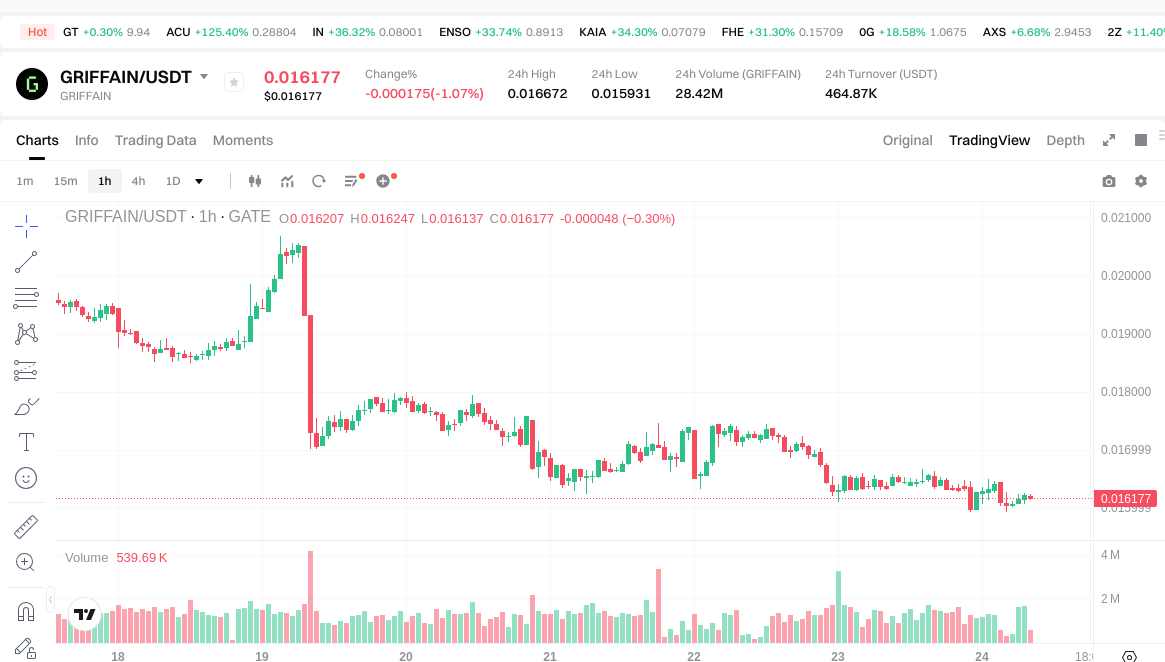
GRIFFAIN is a notable asset in the cryptocurrency sector, launched in December 2024 as an AI agent creator platform on the Solana network. As of January 24, 2026, GRIFFAIN has a market capitalization of approximately $16.20 million, with a circulating supply of around 999.85 million tokens, and the current price is maintained at approximately $0.016205. With its positioning as an AI-driven platform enabling token trading, meme token creation, SOL transfers, and social media interactions, GRIFFAIN has gradually become a focal point for investors discussing "Is GRIFFAIN a good investment?" This article will comprehensively analyze GRIFFAIN's investment value, historical trends, future price predictions, and investment risks to provide reference for investors.
GRIFFAIN ranks 967th by market capitalization with a market dominance of 0.00051%. The token is listed on 21 exchanges and has attracted 53,017 holders. The platform's key features include token trading capabilities, meme token generation, SOL token transfers, tweet posting and replies, and tweet lookup functions. The circulating supply represents approximately 99.997% of the total supply, with a fully diluted valuation closely matching the current market cap at $16.20 million. Recent price performance shows a 0.27% increase over 1 hour, a decline of 1.09% over 24 hours, and an 18.26% decrease over 7 days, reflecting the volatility typical of emerging AI-focused crypto assets.
I. GRIFFAIN Price History Review and Investment Value Status
- 2025: Platform launched on Solana network in December → Token price started at $0.288
- 2025: Price reached $0.6428 in January 2025 → Experienced volatility with subsequent decline
- 2025: Market adjustment period → Price decreased from peak levels to lower ranges throughout the year
Current GRIFFAIN Investment Market Status (January 2026)
- GRIFFAIN current price: $0.016205
- 24-hour trading volume: $463,294.82
- Circulating supply: 999,851,790.15 GRIFFAIN tokens
- Market capitalization: $16,202,598.26
- Token holders: 53,017
Click to view real-time GRIFFAIN market price
II. Core Factors Affecting Whether GRIFFAIN is a Good Investment (Is GRIFFAIN(GRIFFAIN) a Good Investment)
Supply Mechanism and Scarcity (GRIFFAIN investment scarcity)
- Supply Structure → GRIFFAIN has a maximum supply of approximately 999.88 million tokens, with a circulating supply of around 999.85 million tokens, representing a circulation ratio of nearly 100%. This near-complete circulation may reduce expectations of scarcity-driven price appreciation compared to tokens with lower circulation ratios.
- Market Capitalization Performance → As of January 24, 2026, GRIFFAIN's market capitalization stands at approximately $16.2 million, with a market dominance of 0.00051%, indicating a relatively small market position that may affect liquidity and institutional interest.
- Investment Consideration → The high circulation ratio and fully diluted valuation close to current market cap suggest limited supply-side pressure, though scarcity effects may be less pronounced compared to tokens with lower circulation or programmed supply reductions.
Institutional Investment and Mainstream Adoption (Institutional investment in GRIFFAIN)
- Holder Distribution → GRIFFAIN has approximately 53,017 token holders as of January 2026, reflecting a degree of community distribution, though specific institutional holdings data is not available in the provided materials.
- Exchange Listings → The token is listed on 21 exchanges, including Gate.com, which may facilitate broader accessibility for retail and institutional participants.
- Platform Positioning → GRIFFAIN operates as an AI agent creator platform on the Solana network, positioning itself within the emerging AI and blockchain intersection sector, which may attract interest from participants focused on AI-related crypto projects.
Macroeconomic Environment's Impact on GRIFFAIN Investment
- Market Volatility Context → GRIFFAIN has experienced significant price volatility, with a 1-year decline of approximately 96.73% from its historical high of $0.6428 in January 2025 to its current price of $0.016205, reflecting broader crypto market dynamics and risk factors.
- Sector-Specific Factors → As an AI-focused token on Solana, GRIFFAIN's investment prospects may be influenced by trends in AI adoption, Solana ecosystem development, and broader sentiment toward AI-crypto convergence projects.
- Risk Considerations → The token's substantial decline from historical highs and relatively low market dominance suggest high volatility and speculative risk characteristics typical of smaller-cap crypto assets.
Technology and Ecosystem Development (Technology & Ecosystem for GRIFFAIN investment)
- Platform Functionality → GRIFFAIN's AI agent platform features capabilities including token trading, meme token creation, SOL transfers, token search, and Twitter integration for posting and replying to tweets.
- Solana Network Integration → Built on Solana using the SPL token standard (contract address: KENJSUYLASHUMfHyy5o4Hp2FdNqZg1AsUPhfH2kYvEP), GRIFFAIN benefits from Solana's high-performance infrastructure for AI agent operations.
- Ecosystem Applications → The platform's focus on AI agent creation and social media integration positions it within the emerging AI-driven crypto application sector, though long-term adoption and competitive positioning remain key factors for investment value.
III. GRIFFAIN Future Investment Forecast and Price Outlook (Is GRIFFAIN(GRIFFAIN) worth investing in 2026-2031)
Short-term Investment Forecast (2026, short-term GRIFFAIN investment outlook)
- Conservative forecast: $0.01323 - $0.01614
- Neutral forecast: $0.01614 - $0.01808
- Optimistic forecast: $0.01808 and above
Mid-term Investment Outlook (2027-2029, mid-term GRIFFAIN(GRIFFAIN) investment forecast)
-
Market stage expectation: GRIFFAIN may experience moderate growth as the AI agent ecosystem on Solana continues to develop. The project's utility in token trading, meme token creation, and social media integration could attract increased user adoption.
-
Investment return forecast:
- 2027: $0.00941 - $0.02241
- 2028: $0.01857 - $0.02667
- 2029: $0.01811 - $0.03436
-
Key catalysts: Platform user growth, expansion of AI agent capabilities, broader Solana ecosystem developments, and potential partnerships within the DeFi and social media sectors.
Long-term Investment Outlook (Is GRIFFAIN a good long-term investment?)
- Base scenario: $0.01756 - $0.03253 (assuming steady platform development and moderate market conditions)
- Optimistic scenario: $0.02054 - $0.04292 (assuming accelerated adoption of AI agents and favorable market sentiment)
- Risk scenario: Below $0.01756 (in case of reduced platform activity or adverse market conditions)
View GRIFFAIN long-term investment and price prediction: Price Prediction
2026-01-24 - 2031 Long-term Outlook
- Base scenario: $0.01756 - $0.03253 (corresponding to stable progress and steady mainstream application growth)
- Optimistic scenario: $0.02054 - $0.04292 (corresponding to large-scale adoption and favorable market environment)
- Transformative scenario: Above $0.04292 (if ecosystem achieves breakthrough progress and mainstream popularization)
- 2031-12-31 projected high: $0.04292 (based on optimistic development assumptions)
Disclaimer: This forecast is for informational purposes only and does not constitute investment advice. Cryptocurrency markets are highly volatile and subject to various risks. Past performance does not guarantee future results.
| Year |
Predicted High Price |
Predicted Average Price |
Predicted Low Price |
Price Change |
| 2026 |
0.01807568 |
0.016139 |
0.01323398 |
0 |
| 2027 |
0.0224106154 |
0.01710734 |
0.009409037 |
5 |
| 2028 |
0.026674619895 |
0.0197589777 |
0.018573439038 |
21 |
| 2029 |
0.0343608622203 |
0.0232167987975 |
0.01810910306205 |
43 |
| 2030 |
0.032531378475057 |
0.0287888305089 |
0.017561186610429 |
77 |
| 2031 |
0.042924146288769 |
0.030660104491978 |
0.020542270009625 |
89 |
IV. GRIFFAIN Investment Strategy and Risk Management (How to invest in GRIFFAIN)
Investment Methodology (GRIFFAIN investment strategy)
Investors considering GRIFFAIN may adopt different approaches based on their risk tolerance and investment objectives:
-
Long-term Holding (HODL GRIFFAIN): This strategy suits conservative investors who believe in the long-term potential of AI agent platforms on Solana. Given GRIFFAIN's current price of $0.016205, significantly below its historical high of $0.6428 recorded on January 22, 2025, long-term holders may view this as an accumulation opportunity. However, the token has experienced substantial volatility, with a 96.73% decline over one year, suggesting careful position sizing is essential.
-
Active Trading: Traders may leverage technical analysis and momentum strategies, capitalizing on GRIFFAIN's price fluctuations. Recent data shows mixed short-term performance: +0.27% (1H), -1.09% (24H), and -18.26% (7D). The 24-hour trading volume of $463,294.82 indicates moderate liquidity, though traders should remain cautious of slippage during periods of lower activity.
Risk Management (Risk management for GRIFFAIN investment)
-
Asset Allocation Ratio:
- Conservative investors: Limit GRIFFAIN exposure to 1-3% of crypto portfolio
- Moderate investors: Consider 5-8% allocation within diversified holdings
- Experienced investors: May allocate 10-15% while maintaining strict stop-loss levels
-
Risk Hedging Approach: Investors should diversify across multiple asset classes and blockchain ecosystems. Given GRIFFAIN's correlation with Solana ecosystem performance, hedging with established tokens or stablecoins may help mitigate portfolio volatility. Consider setting position limits and regularly rebalancing based on market conditions.
-
Secure Storage:
- Cold wallets: Hardware wallets supporting Solana SPL tokens provide enhanced security for long-term holdings
- Hot wallets: Use reputable Solana-compatible wallets for active trading, but limit stored amounts
- Multi-signature solutions: Institutional investors should implement multi-sig protocols for larger holdings
V. GRIFFAIN Investment Risks and Challenges (Risks of investing in GRIFFAIN)
Market Risk
GRIFFAIN exhibits substantial price volatility, with a historical range from $0.0101 (October 10, 2025) to $0.6428 (January 22, 2025). The current price of $0.016205 represents a 96.73% decline from its peak, highlighting the token's susceptibility to rapid value fluctuations. With a relatively modest market capitalization of approximately $16.2 million and market dominance of 0.00051%, GRIFFAIN remains vulnerable to large-scale market movements and potential price manipulation by concentrated holders.
Regulatory Risk
As an AI agent platform token deployed on Solana, GRIFFAIN operates in an evolving regulatory landscape. Different jurisdictions maintain varying approaches to cryptocurrency classification, particularly for tokens associated with AI and automated trading features. Investors should monitor:
- Potential classification changes affecting AI-related tokens
- Jurisdiction-specific restrictions on algorithmic trading platforms
- Evolving compliance requirements for decentralized AI agent platforms
Regulatory developments could significantly impact GRIFFAIN's accessibility and utility across different markets.
Technology Risk
GRIFFAIN's infrastructure presents several technical considerations:
-
Network Dependency: As an SPL token on Solana, GRIFFAIN's functionality depends on Solana network stability. Historical network congestion or outages could affect transaction processing and platform operations.
-
Smart Contract Vulnerabilities: AI agent platforms involve complex smart contract interactions. Potential security vulnerabilities in the platform's code could expose users to exploitation risks.
-
Platform Development Risk: The success of GRIFFAIN's AI agent creation features depends on continued technical development and adoption. Development delays or technical limitations may impact token utility and value.
VI. Conclusion: Is GRIFFAIN a Good Investment?
Investment Value Summary
GRIFFAIN presents both opportunities and challenges for cryptocurrency investors. As an AI agent creator platform on Solana, it operates within a growing sector combining artificial intelligence and blockchain technology. The token's significant price decline of 96.73% from its peak suggests considerable downside has already occurred, though this also indicates substantial historical volatility.
With 53,017 holders and listing on 21 exchanges, GRIFFAIN demonstrates some level of market acceptance and liquidity. However, its modest market capitalization of $16.2 million and 0.00051% market dominance indicate it remains a relatively small-cap token with corresponding risks.
Investor Recommendations
✅ Beginners: Consider dollar-cost averaging with very small position sizes (1-2% of crypto portfolio). Prioritize secure wallet storage using hardware wallets supporting SPL tokens. Focus on understanding the underlying technology before increasing exposure.
✅ Experienced Investors: May explore tactical trading strategies based on technical analysis, given the token's volatility patterns. Consider portfolio allocation of 5-10% maximum, with strict stop-loss protocols. Diversify across multiple blockchain ecosystems to mitigate concentration risk.
✅ Institutional Investors: Conduct thorough due diligence on the platform's technical architecture, team credentials, and competitive positioning within the AI agent space. Implement robust custody solutions and risk management frameworks before any strategic allocation.
⚠️ Disclaimer: Cryptocurrency investments carry substantial risk, including potential complete loss of capital. GRIFFAIN's price history demonstrates extreme volatility, with significant downside movements possible. This analysis provides information for educational purposes only and does not constitute financial, investment, or trading advice. Investors should conduct independent research and consult qualified financial advisors before making investment decisions.
VII. FAQ
Q1: What is GRIFFAIN's current market position and trading accessibility?
GRIFFAIN currently ranks 967th by market capitalization with a valuation of approximately $16.20 million as of January 24, 2026. The token is listed on 21 cryptocurrency exchanges including Gate.com, providing reasonable accessibility for both retail and institutional investors. With approximately 53,017 token holders and a 24-hour trading volume of $463,294.82, GRIFFAIN demonstrates moderate liquidity, though investors should remain cautious of potential slippage during periods of lower trading activity. The token operates as a Solana SPL token (contract address: KENJSUYLASHUMfHyy5o4Hp2FdNqZg1AsUPhfH2kYvEP), requiring Solana-compatible wallets for storage and transactions.
Q2: How has GRIFFAIN's price performed historically, and what does this indicate about volatility?
GRIFFAIN exhibits extreme price volatility, with its historical price ranging from a peak of $0.6428 on January 22, 2025, to a low of $0.0101 on October 10, 2025. The current price of $0.016205 represents a 96.73% decline from its all-time high, demonstrating the substantial downside risk associated with this asset. Recent performance shows mixed short-term movements: +0.27% over 1 hour, -1.09% over 24 hours, and -18.26% over 7 days. This volatility pattern is typical of smaller-cap AI-focused crypto assets and suggests investors should implement strict position sizing and risk management protocols when considering GRIFFAIN exposure.
Q3: What are GRIFFAIN's core platform features and use cases?
GRIFFAIN functions as an AI agent creator platform built on the Solana blockchain. Its primary features include: (1) Token trading capabilities enabling automated trading operations, (2) Meme token generation tools for creating new tokens, (3) SOL token transfer functionality, (4) Social media integration allowing tweet posting and replies, and (5) Token search and lookup functions. These features position GRIFFAIN within the emerging AI-driven crypto application sector, combining decentralized finance operations with social media interactions. The platform's success depends on user adoption of these AI agent capabilities and the continued development of Solana's high-performance infrastructure supporting such applications.
Q4: What is the recommended asset allocation strategy for different investor types?
Conservative investors should limit GRIFFAIN exposure to 1-3% of their overall cryptocurrency portfolio, given the token's substantial volatility and relatively small market capitalization. Moderate risk investors may consider allocating 5-8% within a diversified holdings structure, while experienced investors with higher risk tolerance might allocate 10-15% with strict stop-loss protocols in place. Regardless of risk profile, investors should avoid concentration risk by diversifying across multiple blockchain ecosystems and asset classes. For secure storage, long-term holders should utilize hardware wallets supporting Solana SPL tokens, while active traders may use reputable hot wallets but limit stored amounts to minimize security exposure.
Q5: What are the primary risks associated with investing in GRIFFAIN?
GRIFFAIN presents three major risk categories: (1) Market Risk - evidenced by 96.73% decline from peak, modest market dominance of 0.00051%, and vulnerability to large-scale price manipulation due to relatively low liquidity; (2) Regulatory Risk - uncertain classification of AI-related tokens, potential jurisdiction-specific restrictions on algorithmic trading platforms, and evolving compliance requirements for decentralized AI agent platforms; (3) Technology Risk - dependency on Solana network stability, potential smart contract vulnerabilities in AI agent platform code, and development execution risks that could impact token utility. Additionally, the token's complete circulating supply (99.997% of maximum) provides limited scarcity-driven appreciation potential compared to tokens with programmed supply reductions.
Q6: What are realistic price projections for GRIFFAIN through 2031?
Short-term forecasts for 2026 suggest a conservative range of $0.01323-$0.01614, neutral range of $0.01614-$0.01808, and optimistic scenario above $0.01808. Mid-term projections show potential ranges of $0.00941-$0.02241 for 2027, $0.01857-$0.02667 for 2028, and $0.01811-$0.03436 for 2029. Long-term outlook through 2031 presents a base scenario of $0.01756-$0.03253, optimistic scenario of $0.02054-$0.04292, and transformative scenario above $0.04292. However, these projections assume continued platform development, growing AI agent adoption, and favorable market conditions. Given GRIFFAIN's historical volatility, actual performance may deviate significantly from these estimates, and investors should not rely solely on price predictions when making investment decisions.
Q7: How should investors approach dollar-cost averaging with GRIFFAIN?
Dollar-cost averaging (DCA) represents a prudent strategy for managing GRIFFAIN's volatility, particularly for beginners and conservative investors. This approach involves investing fixed amounts at regular intervals (weekly, bi-weekly, or monthly) regardless of current price levels, thereby averaging out entry points over time. For GRIFFAIN specifically, investors should: (1) Start with minimal position sizes representing 1-2% of total crypto portfolio, (2) Establish predetermined investment intervals and amounts aligned with personal financial capacity, (3) Monitor platform development milestones and ecosystem adoption metrics, (4) Gradually adjust investment amounts based on risk tolerance and market conditions, and (5) Maintain strict discipline by avoiding emotional reactions to short-term price movements. DCA helps mitigate timing risk in volatile markets while building positions systematically over extended periods.
Q8: What factors should institutional investors evaluate before considering GRIFFAIN exposure?
Institutional investors require comprehensive due diligence beyond retail considerations: (1) Technical Architecture - assess smart contract security audits, platform scalability, and integration quality with Solana infrastructure; (2) Team Credentials - evaluate development team experience, track record in AI and blockchain sectors, and governance structure; (3) Competitive Positioning - analyze market differentiation versus other AI agent platforms, sustainable competitive advantages, and potential market share within the Solana ecosystem; (4) Liquidity Analysis - examine order book depth across exchanges, trading volume patterns, and potential market impact of large transactions; (5) Custody Solutions - implement institutional-grade custody with multi-signature protocols and insurance coverage; (6) Regulatory Compliance - assess jurisdiction-specific legal considerations and potential regulatory classification changes affecting AI tokens. Institutional allocations should follow rigorous risk management frameworks with clearly defined entry, exit, and rebalancing criteria.
* The information is not intended to be and does not constitute financial advice or any other recommendation of any sort offered or endorsed by Gate.