Griffin AI (GAIN) is a no-code agent builder platform powering over 15,000 live DeFi agents across major blockchains including BNB Chain, NEAR Protocol, and Arbitrum. This comprehensive analysis examines GAIN's investment viability through tokenomics review, market positioning, and price forecasts spanning 2026-2031. The article evaluates key factors including fixed token supply (1B tokens), institutional integrations, and leadership credentials, while addressing market risks including 97.49% price decline from historical highs and modest trading volumes. Investment strategies are tailored for conservative, experienced, and institutional investors with allocation recommendations and risk management frameworks. Long-term growth catalysts center on ecosystem expansion, strategic partnerships, and mainstream AI-DeFi adoption, though regulatory uncertainties and technical risks warrant careful consideration for informed investment decisions.
Introduction: Griffin AI (GAIN) Investment Position and Market Prospects
GAIN is an important asset in the cryptocurrency field. As of February 2026, Griffin AI (GAIN) maintains a market capitalization of approximately $616,630, with a circulating supply of 230,000,000 tokens and a current price around $0.002681. Positioned as a no-code agent builder for DeFi, Griffin AI has powered more than 15,000 live agents and established integrations with major blockchain projects including BNB Chain, NEAR Protocol, Cardano Foundation, Arbitrum, 1inch, Uniswap, and Bithumb's Burrito Wallet. Led by Oliver Feldmeier, who previously founded a regulated digital asset exchange that completed a $100M NASDAQ IPO, the project targets the DeFi market by providing on-chain intelligent agents. As investors evaluate "Is Griffin AI (GAIN) a good investment?", this article provides a comprehensive analysis of GAIN's investment characteristics, historical performance, future price considerations, and associated risks for reference purposes.
I. Griffin AI (GAIN) Historical Price Review and Current Investment Status
- 2025 September: GAIN token launched at initial listing → Price reached $0.24997 during early trading period
- 2025 September to December: Market adjustment phase → Price declined from September levels as trading volume stabilized
- 2026 January: Broader market correction → GAIN experienced pressure, with price movement toward lower trading ranges
- 2026 February (Current): Consolidation period → Price trading at $0.002681, reflecting 97.49% decline from September 2025 levels over approximately one-year timeframe
Current GAIN Investment Market Status (February 2026)
- Current GAIN price: $0.002681
- 24-hour trading volume: $13,471.67
- 24-hour price range: $0.002677 - $0.002742
- Market capitalization: $616,630
- Circulating supply: 230,000,000 GAIN (23% of total supply)
- Total supply: 1,000,000,000 GAIN
- Number of holders: 4,150
- Listed exchanges: 3 platforms
Click to view real-time GAIN market price
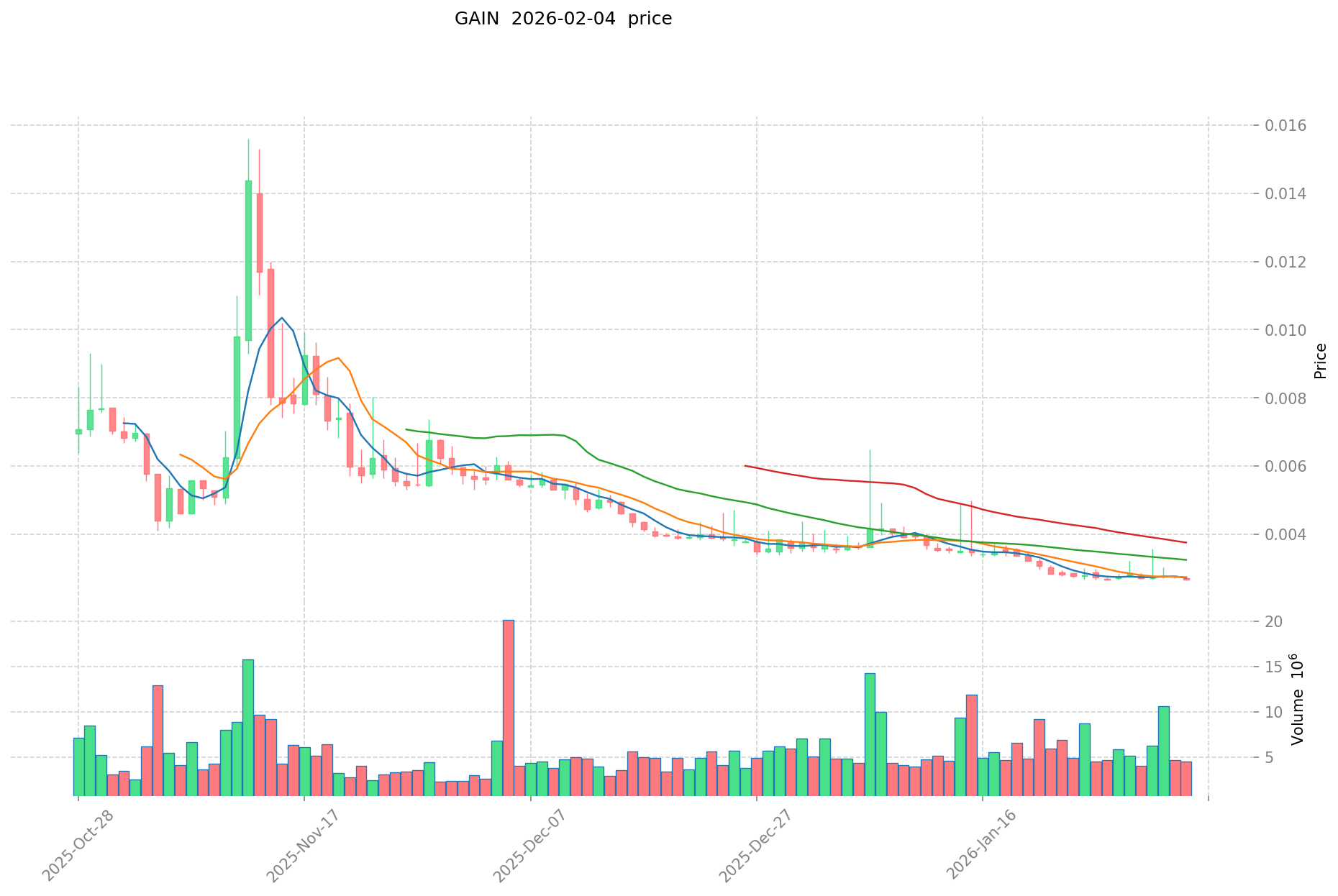
II. Core Factors Influencing Whether GAIN is a Good Investment
Supply Mechanism and Scarcity (GAIN Investment Scarcity)
- Fixed maximum supply of 1,000,000,000 tokens → potential impact on price and investment value
- Current circulating supply of 230,000,000 tokens (23% of total supply) → indicates controlled token release
- Investment significance: scarcity mechanism may support long-term investment considerations, though current trading price remains substantially below launch levels
Institutional Investment and Mainstream Adoption (Institutional Investment in GAIN)
- Integration partnerships: Griffin AI agents are integrated with BNB Chain, NEAR Protocol, Cardano Foundation, Arbitrum, 1inch, Uniswap, and Bithumb's Burrito Wallet
- Platform adoption: over 15,000 active agents deployed on the Griffin AI no-code builder platform
- Ecosystem expansion: additional tier-one projects reportedly joining the ecosystem, potentially enhancing investment value through broader adoption
- Market positioning: targeting a DeFi market segment where approximately 95% of projects reportedly lack AI capabilities
Macroeconomic Environment Impact on GAIN Investment
- Broader DeFi market conditions → influence investment attractiveness for AI-focused tokens
- Market volatility considerations: GAIN experienced significant price fluctuations, with current trading levels notably below launch price
- Risk factors: short-term price volatility remains a consideration for potential investors
Technology and Ecosystem Development (Technology & Ecosystem for GAIN Investment)
- Core product: Transaction Execution Agent (TEA) executes swaps and yield strategies across major chains and wallets
- No-code agent builder platform → enables accessible DeFi automation
- On-chain operation: agents operate directly on-chain, potentially supporting long-term value proposition
- DeFi application expansion: platform supports various DeFi strategies and integrations, contributing to ecosystem growth
- Leadership background: team led by Oliver Feldmeier, founder of a regulated digital asset exchange that completed a NASDAQ IPO
III. GAIN Future Investment Forecast and Price Outlook (Is Griffin AI(GAIN) worth investing in 2026-2031)
Short-term Investment Forecast (2026, short-term GAIN investment outlook)
- Conservative forecast: $0.00161 - $0.00227
- Neutral forecast: $0.00227 - $0.00317
- Optimistic forecast: $0.00317 - $0.00363
Mid-term Investment Outlook (2027-2029, mid-term Griffin AI(GAIN) investment forecast)
-
Market stage expectation: During this period, GAIN may demonstrate gradual growth as the platform continues to expand its agent ecosystem and strengthen integrations with major blockchain protocols. The project's position in the DeFi infrastructure space could support moderate price appreciation.
-
Investment return forecast:
- 2027: $0.00200 - $0.00375
- 2028: $0.00332 - $0.00388
- 2029: $0.00319 - $0.00415
-
Key catalysts: Expansion of active agent deployment, additional partnerships with tier-one blockchain projects, potential token buyback and burn mechanisms, broader adoption of AI-driven DeFi solutions, and developments in the no-code agent builder platform.
Long-term Investment Outlook (Is GAIN a good long-term investment?)
- Base scenario: $0.00257 - $0.00443 (assuming steady ecosystem development and sustained DeFi market interest)
- Optimistic scenario: $0.00390 - $0.00496 (assuming accelerated adoption and favorable regulatory environment for AI-integrated DeFi platforms)
- Risk scenario: Below $0.00200 (under conditions of prolonged market downturn or significant competitive pressure)
Click to view GAIN long-term investment and price forecast: Price Prediction
2026-02-05 - 2031 Long-term Outlook
- Base scenario: $0.00257 - $0.00391 (corresponding to steady progress and gradual mainstream application growth)
- Optimistic scenario: $0.00391 - $0.00496 (corresponding to large-scale adoption and favorable market conditions)
- Transformative scenario: Above $0.00496 (if ecosystem achieves breakthrough developments and mainstream adoption)
- 2031-12-31 forecast high: $0.00466 (based on optimistic development assumptions)
Disclaimer: The forecasts presented are based on technical analysis models and available market data. Cryptocurrency markets are highly volatile and subject to various risks including regulatory changes, technological developments, and macroeconomic factors. Past performance does not guarantee future results. These projections should not be considered as financial advice, and investors should conduct their own research and consult with financial professionals before making investment decisions.
| Year |
Predicted High Price |
Predicted Average Price |
Predicted Low Price |
Price Change |
| 2026 |
0.00362558 |
0.002726 |
0.00160834 |
0 |
| 2027 |
0.0037474322 |
0.00317579 |
0.0020007477 |
16 |
| 2028 |
0.003877004432 |
0.0034616111 |
0.003323146656 |
27 |
| 2029 |
0.00414631777558 |
0.003669307766 |
0.00319229775642 |
34 |
| 2030 |
0.004962922218903 |
0.00390781277079 |
0.003009015833508 |
43 |
| 2031 |
0.004657135869589 |
0.004435367494846 |
0.002572513147011 |
62 |
IV. GAIN Investment Strategy and Risk Management (How to invest in Griffin AI)
Investment Methodology (GAIN investment strategy)
Long-term Holding (HODL GAIN): Suitable for Conservative Investors
For investors who believe in the long-term potential of AI-powered DeFi infrastructure, a buy-and-hold strategy may be appropriate. This approach focuses on accumulating GAIN tokens during market corrections and holding through volatility cycles. Given Griffin AI's positioning in the no-code agent builder space and its integrations with established blockchain ecosystems including BNB Chain, NEAR Protocol, Cardano Foundation, and Arbitrum, long-term holders may view the project as a strategic bet on the convergence of AI and DeFi.
Active Trading: Relying on Technical Analysis and Swing Trading
Active traders may capitalize on GAIN's price volatility through technical analysis and swing trading strategies. With recent 24-hour volatility showing a -1.83% change and 7-day movement at -2.22%, traders can identify entry and exit points using chart patterns, volume indicators, and support/resistance levels. The token's trading range between $0.002677 (24h low) and $0.002742 (24h high) provides opportunities for short-term position management. However, traders should note the significant drawdown from the historical high of $0.24997, which requires careful risk assessment.
Risk Management (Risk management for GAIN investment)
Asset Allocation Ratio: Conservative / Aggressive / Professional Investors
- Conservative Investors: Allocate 1-3% of crypto portfolio to GAIN, treating it as a high-risk, speculative position within a diversified asset mix.
- Aggressive Investors: May allocate 5-10% of crypto holdings to GAIN, accepting higher volatility for potential upside in the AI-DeFi sector.
- Professional Investors: Could deploy 10-15% in GAIN as part of a thematic allocation to AI infrastructure projects, with active position management and hedging strategies.
Risk Hedging Solutions: Multi-asset Portfolio + Hedging Tools
Investors should consider diversifying across different crypto categories (large-cap assets, stablecoins, other AI/DeFi projects) to mitigate single-token risk. Portfolio construction may include pairing GAIN exposure with established assets to reduce overall volatility. Additionally, utilizing stop-loss orders and position sizing based on risk tolerance can help manage downside exposure.
Secure Storage: Hot/Cold Wallets + Hardware Wallet Recommendations
Given that GAIN operates on BSC (BEP-20 standard), investors should prioritize secure storage solutions:
- Cold Wallets: Hardware wallets such as Ledger or Trezor that support BSC network provide offline security for long-term holdings.
- Hot Wallets: For active trading, reputable wallets like Trust Wallet or MetaMask with BSC compatibility offer convenience while maintaining reasonable security standards.
- Exchange Storage: Only keep actively traded amounts on exchanges; transfer holdings to personal wallets for longer-term storage.
V. GAIN Investment Risks and Challenges (Risks of investing in Griffin AI)
Market Risk: High Volatility and Price Manipulation
GAIN exhibits significant price volatility, as evidenced by a 97.49% decline from its historical high of $0.24997 to current levels around $0.002681. The 30-day performance shows a -25.66% decline, indicating substantial short-term price fluctuations. With a relatively modest 24-hour trading volume of approximately $13,471, the token may be susceptible to lower liquidity conditions that can amplify price swings. The market capitalization of approximately $616,630 and ranking at #2872 suggest limited trading depth compared to major assets.
Regulatory Risk: Policy Uncertainty Across Different Countries
As an AI-powered DeFi platform, Griffin AI operates at the intersection of multiple regulatory domains including artificial intelligence governance, decentralized finance regulations, and cryptocurrency compliance frameworks. Different jurisdictions maintain varying approaches to crypto asset classification, AI system oversight, and DeFi protocol regulation. Changes in regulatory stance regarding algorithmic trading tools, AI-driven financial services, or token classifications could impact the project's operational model and token utility. Investors should monitor regulatory developments in key markets where Griffin AI's partner projects operate.
Technical Risk: Network Security Vulnerabilities and Upgrade Failures
While Griffin AI emphasizes its "agents that actually work" proposition and has established integrations with major blockchain ecosystems, technical risks remain inherent to the platform. Potential vulnerabilities in smart contract code, agent execution logic, or cross-chain interaction mechanisms could expose users to security incidents. The complexity of operating AI agents that execute on-chain transactions introduces additional attack surfaces compared to simpler token projects. Furthermore, the project's ambitious technical roadmap may face implementation challenges, delays, or unexpected complications during system upgrades.
VI. Conclusion: Is Griffin AI a Good Investment?
Investment Value Summary: GAIN presents potential long-term opportunities within the emerging AI-DeFi sector, but faces considerable short-term price volatility. The project's partnerships with established blockchain ecosystems and its positioning in the no-code agent builder market represent potential growth vectors. However, significant price decline from historical highs, modest trading volumes, and early-stage market presence introduce substantial risk factors.
Investor Recommendations:
✅ Beginners: Consider dollar-cost averaging with small position sizes + secure wallet storage. Start with minimal allocation (1-2% of crypto portfolio) to gain exposure while limiting downside risk.
✅ Experienced Investors: Implement swing trading strategies + diversified portfolio allocation. Monitor technical indicators and market sentiment while maintaining strict position sizing discipline.
✅ Institutional Investors: Evaluate strategic long-term allocation as part of thematic AI-infrastructure exposure. Conduct thorough due diligence on team credentials, partnership authenticity, and technical implementation progress.
⚠️ Notice: Cryptocurrency investment carries substantial risk. This content is for informational purposes only and does not constitute investment advice.
VII. FAQ
Q1: What is Griffin AI (GAIN) and what makes it unique in the DeFi space?
Griffin AI (GAIN) is a no-code agent builder platform for DeFi that enables users to create and deploy intelligent on-chain agents without programming knowledge. What distinguishes GAIN is its Transaction Execution Agent (TEA) that operates directly on-chain and executes automated DeFi strategies across multiple blockchain networks. The platform has powered over 15,000 live agents and established integrations with major ecosystems including BNB Chain, NEAR Protocol, Cardano Foundation, Arbitrum, 1inch, Uniswap, and Bithumb's Burrito Wallet. Led by Oliver Feldmeier, who previously founded a regulated digital asset exchange that completed a $100M NASDAQ IPO, the project targets the estimated 95% of DeFi projects that reportedly lack AI capabilities, positioning itself at the convergence of artificial intelligence and decentralized finance.
Q2: Why has GAIN's price declined 97.49% from its historical high?
GAIN experienced a significant price correction from its September 2025 launch price of $0.24997 to current levels around $0.002681, representing a 97.49% decline. This substantial drawdown reflects several factors common to early-stage cryptocurrency projects: post-launch profit-taking by early participants, broader market volatility affecting the DeFi sector during late 2025 and early 2026, relatively low trading volume ($13,471 daily) that amplifies price movements, and the project's early development stage with limited market capitalization ($616,630). Additionally, with only 23% of total supply currently circulating (230M of 1B tokens), future token releases may create additional selling pressure. Such dramatic price declines are not uncommon for newly launched tokens as they establish market equilibrium and develop sustainable trading patterns.
Q3: What are the key investment risks associated with GAIN?
GAIN presents multiple investment risk categories that potential investors should carefully evaluate. Market risk is substantial, evidenced by extreme price volatility and a -25.66% decline over 30 days, combined with relatively thin liquidity that may facilitate price manipulation. Regulatory risk stems from Griffin AI's operation at the intersection of AI governance, DeFi regulations, and cryptocurrency compliance frameworks across multiple jurisdictions, with potential policy changes impacting the platform's operational model. Technical risk includes potential smart contract vulnerabilities, agent execution logic flaws, and cross-chain interaction security concerns, particularly given the complexity of AI-driven on-chain transaction execution. The project's modest market capitalization ($616,630), ranking at #2872, and limited exchange listings (3 platforms) further indicate early-stage investment risk compared to established cryptocurrency assets.
Q4: What is the realistic price forecast for GAIN in 2026-2027?
Based on technical analysis models and current market conditions, GAIN's short-term forecast for 2026 ranges from conservative ($0.00161 - $0.00227), neutral ($0.00227 - $0.00317), to optimistic ($0.00317 - $0.00363) scenarios. For 2027, projections suggest a potential range of $0.00200 - $0.00375, representing possible appreciation as the platform expands its agent ecosystem and strengthens blockchain protocol integrations. These forecasts assume steady development progress, increased active agent deployment, successful partnership expansion with tier-one projects, and sustained interest in AI-driven DeFi solutions. However, cryptocurrency price predictions carry inherent uncertainty due to market volatility, regulatory developments, technological risks, and macroeconomic factors. Past performance does not guarantee future results, and these projections should not be interpreted as financial advice but rather as reference points for understanding potential price scenarios.
Q5: How should different investor types approach GAIN investment?
Investment approach should align with individual risk tolerance and experience level. Conservative investors may consider allocating 1-3% of their crypto portfolio to GAIN using dollar-cost averaging strategies and secure cold wallet storage, treating it as a speculative position within a diversified portfolio. Experienced investors might implement swing trading strategies with 5-10% allocation, actively monitoring technical indicators, volume patterns, and support/resistance levels while maintaining strict position sizing discipline. Professional investors could evaluate 10-15% thematic allocation as part of AI-infrastructure exposure, conducting thorough due diligence on team credentials, partnership authenticity, and technical implementation progress. Regardless of experience level, investors should prioritize secure storage using hardware wallets for BSC-compatible assets, employ risk management tools including stop-loss orders, and maintain diversification across different cryptocurrency categories to mitigate single-token exposure.
Q6: What are the long-term growth catalysts for GAIN?
Several factors could potentially drive GAIN's long-term value appreciation. Platform expansion through increased active agent deployment beyond the current 15,000 live agents would demonstrate growing utility and user adoption. Additional partnerships with tier-one blockchain projects beyond existing integrations with BNB Chain, NEAR Protocol, Cardano Foundation, and Arbitrum could expand the ecosystem's reach and credibility. Implementation of token buyback and burn mechanisms would affect supply dynamics and potentially support price appreciation. Broader mainstream adoption of AI-driven DeFi solutions as the sector matures could benefit early-mover projects like Griffin AI. Technical developments in the no-code agent builder platform that enhance accessibility and functionality may attract more users. The leadership background of founder Oliver Feldmeier, with experience in regulated digital asset exchanges and NASDAQ IPO processes, provides potential strategic advantages for navigating institutional partnerships and regulatory landscapes.
Q7: Where can GAIN be traded and how should it be stored securely?
GAIN is currently listed on 3 cryptocurrency exchanges and operates on the BSC (BEP-20) blockchain standard. For secure storage, investors should prioritize cold wallet solutions such as Ledger or Trezor hardware wallets that support BSC network, providing offline security optimal for long-term holdings. Hot wallets like Trust Wallet or MetaMask with BSC compatibility offer convenience for active trading while maintaining reasonable security standards for smaller amounts. Investors should follow best practices of storing only actively traded amounts on exchanges and transferring long-term holdings to personal wallet control. When selecting storage solutions, consider factors including ease of use, security features, backup and recovery options, and compatibility with BSC network transactions. Multi-signature wallets may provide additional security layers for larger holdings, while regular security audits of wallet software and careful management of private keys remain essential regardless of chosen storage method.
Q8: How does GAIN compare to other AI-DeFi projects in the market?
Griffin AI positions itself distinctively within the AI-DeFi landscape through its no-code agent builder approach that democratizes access to automated DeFi strategies. Unlike purely algorithmic trading platforms or AI analytics tools, GAIN's Transaction Execution Agent (TEA) operates directly on-chain with actual transaction execution capabilities across multiple blockchain networks. The project's 15,000 live agents represent tangible adoption metrics compared to purely conceptual AI-DeFi proposals. Established integrations with major ecosystems including BNB Chain, NEAR Protocol, Cardano Foundation, Arbitrum, and DEX platforms like 1inch and Uniswap demonstrate technical interoperability that many competitors lack. However, GAIN's current market capitalization ($616,630) and ranking (#2872) indicate early-stage market presence relative to more established projects. The competitive advantage potentially lies in accessibility through no-code functionality and breadth of blockchain integration, though market validation and sustained growth metrics remain necessary to confirm long-term competitive positioning within the evolving AI-DeFi sector.
* The information is not intended to be and does not constitute financial advice or any other recommendation of any sort offered or endorsed by Gate.