GTETH is a tokenized staking certificate backed by Ethereum Beacon Chain deposits, offering liquidity and automatic compounding benefits. As of January 2026, with a market cap of $531.64 million and current price of $3,311.54, GTETH presents interesting investment characteristics for yield-seeking investors. This comprehensive analysis examines GTETH's price history, revealing volatility ranging from $2,629.65 to $4,751.74, alongside recent positive momentum of 5.86% monthly gains. The article evaluates core investment factors including fixed supply mechanics, Ethereum ecosystem integration, and dynamic conversion rates that enable passive income accumulation. Investment forecasts range from conservative $3,000-$3,800 (2026) to optimistic $6,181.74-$7,665.36 (2031) scenarios. Critical examination of market risks, technical vulnerabilities, and regulatory uncertainties provides balanced perspective. Strategic recommendations address different investor profiles with allocation guidelines and risk management fra
Introduction: GTETH's Investment Position and Market Outlook
GTETH represents a significant asset in the cryptocurrency landscape, serving as a tokenized staking certificate for ETH deposited on Gate Exchange or Gate Web3 wallet. As of January 14, 2026, GTETH maintains a market capitalization of approximately $531.64 million, with a circulating supply of 160,540.82 tokens and a current price around $3,311.54. Backed by authentic on-chain staked ETH on the Ethereum Beacon Chain, GTETH has established itself as a native wrapped asset that bridges centralized and decentralized platforms. With its conversion rate dynamically pegged to Beacon Chain performance, the token offers automatic compounding mechanisms for staking rewards. Currently ranked 128th by market capitalization with a market dominance of 0.015%, GTETH has demonstrated notable price movements, including a 5.54% increase over the past 24 hours and a 5.86% gain over the past 30 days. This article provides a comprehensive analysis of GTETH's investment characteristics, historical price trends, future price projections, and associated risks to assist investors in their evaluation process.
I. GTETH (GTETH) Price History Review and Current Investment Value Status
- 2025: GTETH experienced notable price volatility → The token reached a price level of $4,751.74 in October 2025, followed by a subsequent decline to $2,629.65 in November 2025
- Recent Performance: Over the past 30 days, GTETH has shown upward movement → Price increased by approximately 5.86%, reflecting recovery momentum in recent trading periods
- Short-term Dynamics: Within the past 7 days, the token demonstrated positive movement → Price appreciated by around 3.26%, indicating sustained buying interest
Current GTETH Investment Market Status (January 2026)
- GTETH Current Price: $3,311.54
- 24-Hour Trading Volume: $54,219.47
- Market Capitalization: Approximately $531.64 million
- Circulating Supply: 160,540.82 GTETH tokens (representing 100% of total supply)
- Recent Price Range (24H): Between $3,139.19 and $3,363.00
Click to view real-time GTETH market price
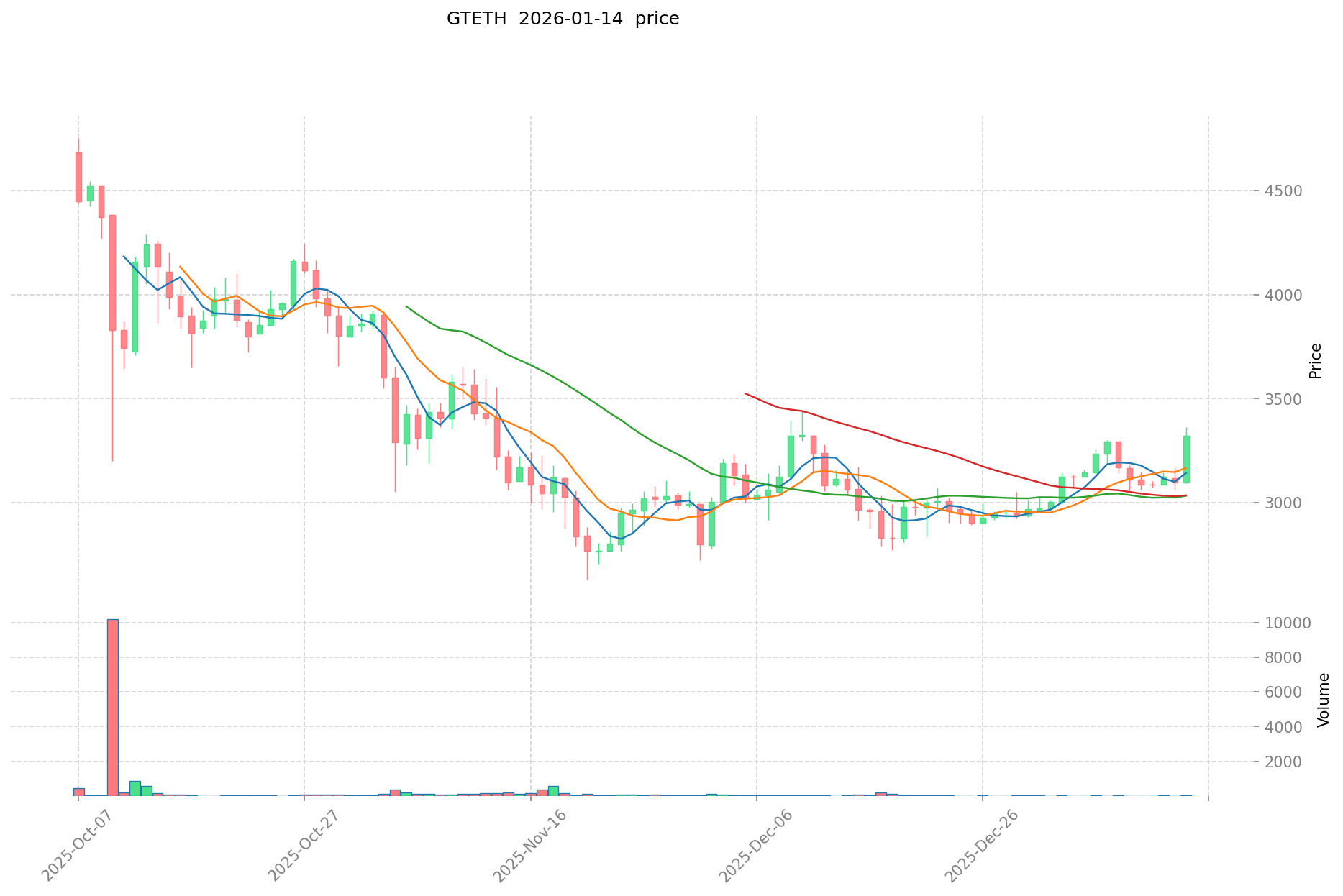
II. Core Factors Influencing Whether GTETH is a Good Investment (Is GTETH(GTETH) a Good Investment)
Supply Mechanism and Scarcity (GTETH investment scarcity)
- Fixed supply structure → impacts pricing and investment value
- Total supply and circulating supply both stand at 160,540.82 GTETH, with a circulation ratio of 100%, indicating full circulation of all tokens in the market
- Fully backed by on-chain staked ETH → provides tangible asset support, enhancing investment credibility
- Investment significance: GTETH's conversion rate is dynamically pegged to Ethereum Beacon Chain staking rewards, enabling automatic compounding over time, which may support long-term value retention
Institutional Investment and Mainstream Adoption (Institutional investment in GTETH)
- GTETH serves as a tokenized staking certificate issued by Gate Exchange and Gate Web3 wallet, representing users' staking rights on the Ethereum Beacon Chain
- The token is designed for interoperability across both centralized exchange platforms and decentralized Web3 environments, potentially broadening its application scenarios
- As a native wrapped asset from Gate, GTETH may benefit from the platform's existing user base and ecosystem, though specific institutional holding data remains unavailable
Macroeconomic Environment's Impact on GTETH Investment
- As an Ethereum staking derivative, GTETH's value is influenced by broader cryptocurrency market trends and Ethereum network performance
- Market volatility: Price fluctuations within 24 hours ranged from a low of 3,139.19 to a high of 3,363, reflecting notable short-term price movements
- The token's automatic compounding mechanism may offer potential yield in various economic conditions, though actual returns depend on Ethereum Beacon Chain staking performance
Technology & Ecosystem Development (Technology & Ecosystem for GTETH investment)
- Ethereum Beacon Chain integration: GTETH represents staking rights on Ethereum's proof-of-stake consensus mechanism, directly linked to network staking rewards
- Dynamic conversion rate: The token's value adjusts based on actual Beacon Chain staking returns, enabling holders to redeem increasing amounts of ETH over time through automatic compounding
- Cross-platform functionality: Compatible with both Gate Exchange and Gate Web3 wallet, providing flexibility in asset management and potential DeFi application scenarios
- The token's design aims to deliver passive income through effortless compounding, though specific ecosystem integrations beyond the Gate platform are not detailed in available information
III. GTETH Future Investment Prediction and Price Outlook (Is GTETH (GTETH) worth investing in 2026-2031)
Short-term Investment Prediction (2026, short-term GTETH investment outlook)
- Conservative Forecast: $1,760.13 - $3,321.00
- Neutral Forecast: $3,000.00 - $3,800.00
- Optimistic Forecast: $3,800.00 - $4,317.30
Mid-term Investment Outlook (2027-2029, mid-term GTETH (GTETH) investment forecast)
-
Market Stage Expectation: GTETH may experience gradual growth as the Ethereum staking ecosystem continues to mature. The token's conversion rate, dynamically pegged to Beacon Chain rewards, could support steady appreciation. Market participants may increasingly recognize the automatic compounding benefits inherent in holding GTETH.
-
Investment Return Prediction:
- 2027: $3,284.47 - $5,003.09
- 2028: $2,249.67 - $6,396.12
- 2029: $3,188.14 - $5,835.91
-
Key Catalysts: Expansion of Ethereum staking participation, improvements in Beacon Chain yields, wider adoption of tokenized staking solutions, and enhanced interoperability between centralized and decentralized platforms.
Long-term Investment Outlook (Is GTETH a good long-term investment?)
-
Base Scenario: $4,495.81 - $6,743.72 (Assumes stable Ethereum staking environment, consistent on-chain backing, and moderate growth in user adoption across Gate Exchange and Gate Web3 wallet platforms)
-
Optimistic Scenario: $6,181.74 - $7,665.36 (Assumes accelerated adoption of liquid staking derivatives, favorable regulatory developments, and sustained increases in Beacon Chain staking rewards)
-
Risk Scenario: $3,832.68 - $4,495.81 (Assumes adverse market conditions, including reduced staking participation, regulatory uncertainties, or technical challenges impacting the Ethereum network)
Click to view GTETH long-term investment and price prediction: Price Prediction
2026-01-14 - 2031 Long-term Outlook
- Base Scenario: $4,500 - $6,000 (Assumes steady progress in staking adoption and stable mainstream application growth)
- Optimistic Scenario: $6,200 - $7,700 (Assumes large-scale adoption and favorable market environment)
- Transformative Scenario: Above $8,000 (Subject to breakthrough ecosystem developments and mainstream integration)
- 2031-12-31 Predicted High: $7,665.36 (Based on optimistic development assumptions)
Disclaimer: The above predictions are for reference purposes only and do not constitute investment advice. Cryptocurrency markets are highly volatile, and actual outcomes may differ materially from projections. Investors should conduct independent research and consider their risk tolerance before making investment decisions.
| Year |
Predicted High Price |
Predicted Average Price |
Predicted Low Price |
Price Change |
| 2026 |
4317.3 |
3321 |
1760.13 |
0 |
| 2027 |
5003.0865 |
3819.15 |
3284.469 |
15 |
| 2028 |
6396.1214625 |
4411.11825 |
2249.6703075 |
33 |
| 2029 |
5835.90944475 |
5403.61985625 |
3188.1357151875 |
63 |
| 2030 |
6743.7175806 |
5619.7646505 |
4495.8117204 |
69 |
| 2031 |
7665.358983282 |
6181.74111555 |
3832.679491641 |
86 |
IV. GTETH Investment Strategy and Risk Management (How to invest in Liquid Staking Tokens)
Investment Methodology (GTETH investment strategy)
Long-term Holding (HODL GTETH): Suitable for Conservative Investors
Long-term holding GTETH may allow investors to benefit from the automatic compounding mechanism linked to Ethereum Beacon Chain staking rewards. As the conversion rate dynamically adjusts based on actual on-chain staking performance, extended holding periods could potentially result in the ability to redeem increasing amounts of ETH over time. This approach typically requires minimal active management and may align with investors seeking exposure to Ethereum staking yields without direct participation in validator operations.
Active Trading: Relying on Technical Analysis and Swing Trading
Active traders may monitor GTETH's price movements, which have shown fluctuations within a 24-hour range between $3,139.19 and $3,363.00 as of January 14, 2026. Short-term price changes included a 0.61% increase over 1 hour and a 5.54% gain over 24 hours. Traders employing technical analysis might consider these volatility patterns, support and resistance levels, and trading volume data (24-hour volume of 54,219.47 GTETH) when making entry and exit decisions. However, price volatility remains a significant consideration for this strategy.
Risk Management (Risk management for GTETH investment)
Asset Allocation Ratios: Conservative / Aggressive / Professional Investors
- Conservative Investors: May consider limiting GTETH exposure to a small percentage of their overall portfolio, potentially alongside more established crypto assets or traditional investments, to manage exposure to market volatility.
- Aggressive Investors: Could allocate a larger portion to GTETH while maintaining awareness of the token's price fluctuations and the inherent risks associated with liquid staking derivatives.
- Professional Investors: Might employ strategic positioning based on detailed analysis of Ethereum staking yields, market conditions, and GTETH's conversion rate dynamics, while maintaining diversified exposure across multiple asset classes.
Investors may consider diversifying across multiple crypto assets to reduce concentration risk. Portfolio construction could include a mix of liquid staking tokens, base layer cryptocurrencies, and stablecoins. Some investors might explore derivatives or options strategies where available to hedge against downside price movements, though availability of such instruments for GTETH may vary across platforms.
Secure Storage: Hot and Cold Wallets + Hardware Wallet Recommendations
GTETH can be held on the Gate Exchange platform or within Gate Web3 wallet. For enhanced security, investors holding significant amounts might consider:
- Hot Wallets: Suitable for smaller amounts needed for frequent trading or redemption activities
- Cold Storage Solutions: Hardware wallets or other offline storage methods for larger holdings intended for long-term investment
- Multi-Signature Wallets: For institutional or high-net-worth investors requiring additional security layers
Regular security practices such as enabling two-factor authentication, maintaining secure backups of recovery phrases, and verifying contract addresses before transactions remain important considerations.
V. GTETH Investment Risks and Challenges (Risks of investing in Liquid Staking Tokens)
Market Risk: High Volatility and Price Manipulation Concerns
GTETH has demonstrated significant price volatility. Historical data shows the token reached a high of $4,751.74 on October 7, 2025, and a low of $2,629.65 on November 21, 2025, representing substantial price swings. As of January 14, 2026, the current price of $3,311.54 reflects ongoing market fluctuations. With a relatively limited total supply of 160,540.82 tokens and 24-hour trading volume of 54,219.47 GTETH, liquidity conditions may vary, potentially affecting price stability during periods of increased trading activity. Market participants should be aware that liquid staking tokens can experience price movements that may not always directly correlate with the underlying staked asset.
Regulatory Risk: Policy Uncertainty Across Different Jurisdictions
The regulatory landscape for liquid staking derivatives continues to evolve globally. Different jurisdictions maintain varying approaches to classifying and regulating staking tokens and wrapped assets. Potential regulatory developments could impact:
- The operational framework for platforms offering liquid staking services
- Trading availability and accessibility across different regions
- Taxation treatment of staking rewards and token conversions
- Compliance requirements for centralized and decentralized platforms
Investors should remain informed about regulatory developments in their respective jurisdictions that may affect GTETH holdings and related activities.
Technical Risk: Network Security Vulnerabilities and Upgrade Failures
As a tokenized representation of staked ETH on the Ethereum Beacon Chain, GTETH's value proposition depends on:
- Smart Contract Security: The integrity of contracts managing the staking, wrapping, and redemption mechanisms
- Ethereum Network Performance: The successful operation of Beacon Chain validators and the broader Ethereum ecosystem
- Conversion Rate Accuracy: The proper functioning of mechanisms that peg GTETH's exchange rate to actual staking rewards
- Platform Infrastructure: The operational reliability of Gate Exchange and Gate Web3 wallet systems
While GTETH is backed by on-chain staked ETH, technical issues affecting any of these components could potentially impact token functionality, conversion rates, or redemption processes. Network upgrades, protocol changes, or unforeseen technical challenges within the Ethereum ecosystem may also introduce temporary or sustained operational considerations.
VI. Conclusion: Is Liquid Staking Token a Good Investment?
Investment Value Summary
GTETH presents characteristics that may appeal to investors seeking exposure to Ethereum staking yields through a tokenized wrapper. The token's conversion rate mechanism, dynamically linked to Beacon Chain staking performance, provides a potential avenue for gradual value accumulation over extended periods. With a market capitalization of approximately $531.64 million and full circulation of its total supply, GTETH demonstrates a certain level of market presence within the liquid staking sector.
However, the token has exhibited substantial price volatility, with movements ranging from $2,629.65 to $4,751.74 within recent months. Short-term price fluctuations remain pronounced, as evidenced by 24-hour price changes and varying percentage movements across different timeframes. These characteristics suggest that while long-term holding may align with the token's staking reward accumulation model, short-term price behavior involves considerable uncertainty.
Investor Recommendations
✅ Beginners: Consider a dollar-cost averaging approach combined with secure wallet storage practices. Familiarize yourself with the mechanics of liquid staking tokens, conversion rates, and redemption processes before committing significant capital. Start with smaller allocations to understand market dynamics and platform functionality.
✅ Experienced Investors: May explore swing trading opportunities while maintaining a core long-term position. Monitor conversion rate trends, Ethereum network developments, and broader market conditions. Implement portfolio diversification across multiple liquid staking solutions and asset classes to manage concentration risk.
✅ Institutional Investors: Could evaluate GTETH as part of a strategic allocation to Ethereum staking exposure. Conduct thorough due diligence on custody solutions, counterparty risks, and operational frameworks. Consider hedging strategies and portfolio construction approaches that account for liquidity profiles and market depth.
⚠️ Disclaimer: Cryptocurrency investments involve substantial risk, including the potential loss of principal. Market volatility, regulatory changes, technical vulnerabilities, and other factors may significantly impact asset values. This content is provided for informational purposes only and does not constitute investment advice, financial guidance, or a recommendation to buy, sell, or hold any cryptocurrency. Investors should conduct independent research, assess their risk tolerance, and consult with qualified financial professionals before making investment decisions.
VII. FAQ
Q1: What makes GTETH different from directly staking ETH on the Ethereum Beacon Chain?
GTETH offers liquidity and automatic compounding that traditional Beacon Chain staking lacks. When you stake ETH directly on the Beacon Chain, your assets remain locked with limited liquidity options. GTETH, as a tokenized staking certificate, allows you to maintain exposure to staking rewards while retaining the ability to trade, transfer, or utilize your position across both Gate Exchange and Gate Web3 wallet platforms. The token's conversion rate dynamically adjusts based on actual Beacon Chain performance, enabling automatic compounding of rewards without manual intervention. Additionally, GTETH provides interoperability between centralized and decentralized environments, offering flexibility that traditional staking positions cannot match.
Q2: How does GTETH's automatic compounding mechanism work?
GTETH's conversion rate increases over time based on Ethereum Beacon Chain staking rewards, allowing holders to redeem more ETH in the future. The mechanism functions by pegging GTETH's exchange rate to actual on-chain staking performance. As validators on the Beacon Chain earn rewards, these returns are reflected in GTETH's conversion rate rather than being distributed separately. This means that holding GTETH automatically captures the compounding effect of staking yields without requiring any action from token holders. The process is seamless and continuous, with the conversion rate adjusting dynamically to reflect accumulated rewards, providing effortless passive income potential for long-term holders.
Q3: What are the main risks associated with investing in GTETH?
Market volatility represents the primary risk, with GTETH demonstrating significant price swings between $2,629.65 and $4,751.74 in recent months. Beyond price fluctuations, investors face technical risks related to smart contract security, Ethereum network performance, and the accuracy of conversion rate mechanisms. The token's value depends on the proper functioning of multiple technical components, including Beacon Chain validators, Gate platform infrastructure, and wrapping/redemption contracts. Regulatory uncertainty across different jurisdictions poses additional challenges, as evolving policies may impact operational frameworks, trading availability, or taxation treatment. With a 24-hour trading volume of 54,219.47 GTETH against a total supply of 160,540.82 tokens, liquidity conditions may also vary, potentially affecting price stability during periods of increased market activity.
Q4: Is GTETH suitable for long-term investment strategies?
GTETH may align well with long-term holding strategies due to its automatic compounding mechanism and connection to Ethereum staking rewards. Price predictions suggest potential appreciation, with base scenarios estimating ranges of $4,495.81 - $6,743.72 by 2030, and optimistic scenarios reaching $6,181.74 - $7,665.36 by 2031. The token's fundamental structure—being fully backed by on-chain staked ETH with a fixed supply of 160,540.82 tokens—provides tangible asset support. Long-term holders can benefit from the dynamic conversion rate that increases over time without active management. However, the investment's success depends on sustained Ethereum network performance, continued platform reliability, and favorable market conditions. Investors should maintain realistic expectations and diversify their portfolios, as cryptocurrency markets remain inherently volatile regardless of long-term growth potential.
Q5: How liquid is GTETH compared to other liquid staking tokens?
GTETH demonstrates moderate liquidity characteristics within the liquid staking sector. With a current market capitalization of approximately $531.64 million and ranking 128th by market cap, the token has established a measurable market presence. The 24-hour trading volume of 54,219.47 GTETH (valued at approximately $180 million USD equivalent) indicates active trading activity, though liquidity depth may vary compared to larger-cap liquid staking alternatives. The token's full circulation status—with 100% of total supply (160,540.82 GTETH) already in circulation—eliminates concerns about future supply inflation. GTETH's availability across both Gate Exchange and Gate Web3 wallet provides multiple venues for trading and redemption. However, investors should monitor liquidity conditions during periods of market stress, as thinner order books could result in wider bid-ask spreads or temporary price dislocations compared to more established liquid staking products.
Q6: What factors could drive GTETH's price appreciation in 2026-2027?
Several catalysts could support GTETH's near-term price performance. Expansion of Ethereum staking participation would increase demand for liquid staking solutions, potentially benefiting GTETH as users seek ways to maintain liquidity while earning staking rewards. Improvements in Beacon Chain yields would directly enhance GTETH's conversion rate, making the token more attractive to yield-seeking investors. The token has already shown positive momentum with a 5.86% gain over the past 30 days and recent price movements indicating recovery from November 2025 lows. Price forecasts suggest conservative ranges of $3,000-$3,800 for 2026, with optimistic scenarios reaching $4,317.30. For 2027, predictions extend to $3,284.47-$5,003.09 under base assumptions. Additional drivers include wider adoption of tokenized staking solutions, enhanced interoperability between centralized and decentralized platforms, and growing recognition of GTETH's automatic compounding benefits among market participants.
Q7: How should investors approach GTETH allocation within a cryptocurrency portfolio?
Portfolio allocation should reflect individual risk tolerance and investment objectives. Conservative investors might limit GTETH exposure to a small percentage (potentially 5-10%) of their overall cryptocurrency holdings, maintaining the majority in more established assets like Bitcoin or Ethereum. This approach balances the potential benefits of liquid staking yields against the token's demonstrated volatility. Aggressive investors could allocate a larger portion (15-25%) while acknowledging the higher risk profile and maintaining diversification across multiple liquid staking tokens and base layer cryptocurrencies. Professional investors might employ strategic positioning based on detailed analysis of staking yields, market conditions, and conversion rate dynamics, potentially allocating 10-20% with active hedging strategies. Regardless of allocation size, investors should implement proper risk management through portfolio diversification, secure storage solutions (hardware wallets for significant holdings), and regular rebalancing to maintain target exposure levels as market conditions evolve.
Q8: What security measures should GTETH holders implement?
Security practices should match the size and intended holding period of GTETH positions. For frequent traders or smaller holdings, hot wallets on Gate Exchange or Gate Web3 wallet with two-factor authentication enabled provide adequate security with convenient access. Long-term holders with significant positions should prioritize cold storage solutions, transferring GTETH to hardware wallets or other offline storage methods to minimize exposure to online threats. Institutional or high-net-worth investors might consider multi-signature wallet configurations requiring multiple approvals for transactions. Essential security protocols include maintaining secure backups of recovery phrases in physically separate locations, verifying contract addresses before any transaction to prevent phishing attacks, and regularly updating wallet software to incorporate security patches. Investors should also monitor their accounts for unauthorized access attempts, use unique strong passwords for each platform, and avoid sharing sensitive information about holdings publicly. Given GTETH's connection to on-chain staked ETH, understanding the smart contract mechanics and redemption processes helps identify potential security vulnerabilities in the overall ecosystem.
* The information is not intended to be and does not constitute financial advice or any other recommendation of any sort offered or endorsed by Gate.