Guild of Guardians (GOG) is an ERC-20 token powering a mobile Squad RPG within the blockchain gaming ecosystem, currently trading at $0.003016 with a market cap of $2.41 million. This comprehensive analysis examines GOG's investment viability by reviewing historical price movements—from its April 2024 peak of $0.3273 to current levels—and evaluating core investment factors including fixed supply mechanisms and GameFi ecosystem integration. The article presents detailed price predictions through 2031 across conservative, neutral, and optimistic scenarios, alongside practical investment strategies suited for beginners, experienced traders, and institutional investors. A thorough risk assessment addresses market volatility, regulatory uncertainty, technical vulnerabilities, and project-specific challenges inherent in gaming tokens. The analysis concludes that GOG offers blockchain gaming sector opportunities but carries substantial risks requiring careful portfolio allocation, secure storage practices, and indep
Introduction: Guild of Guardians (GOG) Investment Position and Market Outlook
Guild of Guardians (GOG) is a digital asset in the cryptocurrency sector, launched in December 2021, focusing on the mobile gaming and blockchain gaming ecosystem. As of February 2026, GOG maintains a market capitalization of approximately $2.41 million with a circulating supply of around 800.13 million tokens, currently trading at $0.003016. With its positioning as a mobile Squad RPG that combines roguelike dungeon crawling with collection building, GOG has gradually attracted attention from investors exploring gaming-related crypto assets. The token operates on the Ethereum blockchain following the ERC-20 standard and holds approximately 0.00010% market dominance. This article provides a comprehensive analysis of GOG's investment characteristics, historical price movements, future price considerations, and associated risks to offer reference insights for interested observers.
I. Guild of Guardians (GOG) Price History Review and Current Investment Value
- 2024: Price volatility period → The token experienced significant fluctuations, with notable price movements throughout the year
- April 2024: Market peak milestone → GOG reached $0.3273 during this period
- October 2024: Market adjustment phase → Price declined to $0.002, reflecting broader market conditions
Current GOG Investment Market Status (February 2026)
- Current GOG Price: $0.003016
- 24-hour Trading Volume: $27,354.19
- Market Capitalization: $2,413,204.14
- Circulating Supply: 800,133,999.299 GOG (80.01% of total supply)
- Total Supply: 1,000,000,000 GOG
Click to view real-time GOG market price
II. Core Factors Affecting Whether GOG is a Good Investment
Supply Mechanism and Scarcity (GOG Investment Scarcity)
- Total supply capped at 1,000,000,000 GOG with current circulating supply of 800,133,999.299 tokens (80.01% of maximum supply) → influences price dynamics and investment considerations
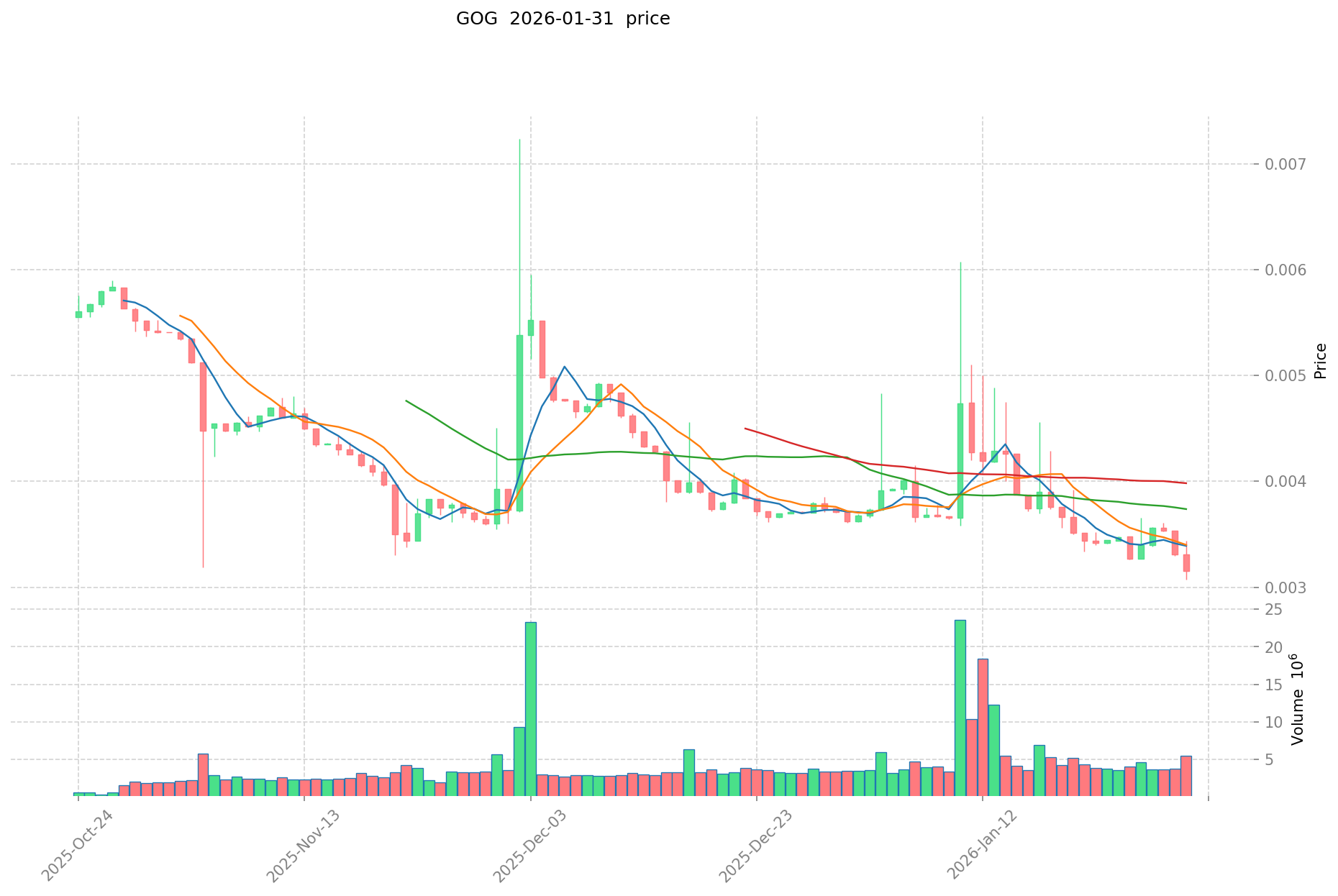
- Historical price patterns show GOG reached $0.3273 on April 28, 2024, and declined to $0.002 on October 14, 2024, reflecting significant volatility
- Investment significance: the fixed maximum supply represents a defined scarcity model, though current high circulation ratio may limit scarcity-driven price appreciation potential
Technology & Ecosystem Building (Technology & Ecosystem for GOG Investment)
- Mobile Squad RPG game combining roguelike dungeon crawling with collection building mechanics → provides gaming utility foundation
- Integration with GameFi ecosystem, with reported community exceeding 500,000 members across social media platforms → indicates user engagement
- Token deployed on Ethereum (ERC-20 standard at contract address 0x9ab7bb7fdc60f4357ecfef43986818a2a3569c62) → enables DeFi compatibility and broader ecosystem participation
- Gaming application design focuses on truly ownable rewards for players → aligns token utility with gameplay experience
III. GOG Future Investment Prediction and Price Outlook (Is Guild of Guardians(GOG) worth investing in 2026-2031)
Short-term Investment Prediction (2026, short-term GOG investment outlook)
- Conservative prediction: $0.00244377 - $0.003017
- Neutral prediction: $0.003017 - $0.00328853
- Optimistic prediction: $0.00328853 - $0.00356006
Mid-term Investment Outlook (2027-2029, mid-term Guild of Guardians(GOG) investment forecast)
- Market stage expectation: GOG may experience gradual price fluctuations as the blockchain gaming sector continues to evolve. The token's performance appears tied to the broader adoption of play-to-earn mechanisms and the development of its gaming ecosystem.
- Investment return prediction:
- 2027: $0.0026637093 - $0.004275089
- 2028: $0.00340362855 - $0.00393308188
- 2029: $0.0029316587244 - $0.0040888924314
- Key catalysts: Ecosystem development progress, user adoption rate within the gaming platform, broader market sentiment toward blockchain gaming tokens, and overall cryptocurrency market conditions.
Long-term Investment Outlook (Is GOG a good long-term investment?)
- Base scenario: $0.003416925392202 - $0.005403509922552 (assuming steady ecosystem growth and maintained user engagement through 2030)
- Optimistic scenario: $0.004172622147547 - $0.006001074549281 (assuming accelerated adoption, expanded gaming features, and favorable market conditions through 2031)
- Risk scenario: Below $0.003 (under conditions of diminished user interest, competitive pressure from alternative gaming tokens, or adverse market environment)
View GOG long-term investment and price prediction: Price Prediction
2026-2031 Long-term Outlook
- Base scenario: $0.00244377 - $0.0039731690607 (corresponding to steady progress and gradual mainstream application growth)
- Optimistic scenario: $0.004172622147547 - $0.006001074549281 (corresponding to large-scale adoption and favorable market environment)
- Transformative scenario: Above $0.006001074549281 (if the ecosystem achieves breakthrough progress and mainstream popularization)
- 2031-12-31 predicted high: $0.006001074549281 (based on optimistic development assumptions)
Disclaimer: The above predictions are based on historical data analysis and market trend projections and do not constitute investment advice. Cryptocurrency markets involve substantial risks, and actual prices may differ significantly from predictions due to various unpredictable factors. Investors should conduct thorough research and consider their risk tolerance before making any investment decisions.
| Year |
Predicted High Price |
Predicted Average Price |
Predicted Low Price |
Price Change |
| 2026 |
0.00356006 |
0.003017 |
0.00244377 |
0 |
| 2027 |
0.004275089 |
0.00328853 |
0.0026637093 |
9 |
| 2028 |
0.00393308188 |
0.0037818095 |
0.00340362855 |
25 |
| 2029 |
0.0040888924314 |
0.00385744569 |
0.0029316587244 |
27 |
| 2030 |
0.005403509922552 |
0.0039731690607 |
0.003416925392202 |
31 |
| 2031 |
0.006001074549281 |
0.004688339491626 |
0.004172622147547 |
55 |
IV. GOG Investment Strategy and Risk Management (How to invest in Guild of Guardians)
Investment Strategy (GOG investment strategy)
Long-term Holding (HODL GOG)
Long-term holding may be suitable for conservative investors who believe in the project's fundamental value. This strategy involves purchasing GOG tokens and holding them through market fluctuations, focusing on the potential growth of the Guild of Guardians ecosystem over an extended period. Investors adopting this approach typically conduct thorough research on the project's roadmap, team, and gaming platform development.
Active Trading
Active trading strategies rely on technical analysis and swing trading opportunities. Traders may utilize price chart patterns, volume indicators, and market sentiment analysis to identify entry and exit points. Given GOG's price volatility, with 24-hour changes of -4.4% and 7-day changes of -12.4%, active traders should maintain strict discipline and risk management protocols.
Risk Management (Risk management for GOG investment)
Asset Allocation Ratio
- Conservative investors: May allocate 1-3% of their crypto portfolio to GOG, balancing it with established cryptocurrencies
- Aggressive investors: Could allocate 5-10% to gaming tokens like GOG, accepting higher risk for potential rewards
- Professional investors: May implement dynamic allocation strategies based on market conditions and project milestones
Risk Hedging Solutions
- Multi-asset portfolio: Diversify across different cryptocurrency categories, including major coins, stablecoins, and other gaming tokens
- Hedging tools: Consider using stop-loss orders and position sizing to manage downside risk
- Rebalancing: Regularly adjust portfolio weights based on performance and risk tolerance
Secure Storage
- Cold wallets: Hardware wallets such as Ledger or Trezor provide offline storage for long-term holdings
- Hot wallets: Use reputable software wallets for active trading, ensuring two-factor authentication is enabled
- Security practices: Never share private keys, verify contract addresses (0x9ab7bb7fdc60f4357ecfef43986818a2a3569c62 for ETH), and be cautious of phishing attempts
V. GOG Investment Risks and Challenges (Risks of investing in Guild of Guardians)
Market Risk
GOG exhibits significant price volatility, with 24-hour fluctuations ranging from $0.003 to $0.003536. The token has experienced a substantial decline of -89.64% over one year, demonstrating the high-risk nature of gaming token investments. Price movements may be influenced by trading volume ($27,354.19 in 24 hours), which is relatively modest and could result in liquidity challenges during large transactions.
Regulatory Risk
Cryptocurrency regulations vary significantly across jurisdictions and remain subject to change. Gaming tokens like GOG may face additional scrutiny as regulators examine the intersection of gaming, virtual assets, and blockchain technology. Policy uncertainty in major markets could impact token utility, exchange listings, and overall project viability.
Technical Risk
- Smart contract vulnerabilities: As an ERC-20 token on Ethereum, GOG depends on the security of its smart contract implementation
- Network congestion: Ethereum network congestion may result in higher transaction fees and slower processing times
- Platform dependency: The token's value is closely tied to the success and user adoption of the Guild of Guardians gaming platform
- Competition: The blockchain gaming sector features numerous competitors, which may affect GOG's market position
Project-Specific Risks
With a market cap of approximately $2.41 million and ranking #1947, GOG represents a smaller-cap project with inherent risks. The circulating supply of 800,133,999 tokens (80.01% of total supply) indicates that additional tokens may enter circulation, potentially affecting price dynamics.
VI. Conclusion: Is Guild of Guardians a Good Investment?
Investment Value Summary
GOG presents opportunities within the blockchain gaming sector, combining roguelike dungeon crawling with collection building in a mobile Squad RPG format. However, the token has experienced significant price depreciation, declining from its historical high of $0.3273 (April 28, 2024) to its current price of $0.003016, representing substantial losses for early investors. The project's long-term potential depends on successful game development, user adoption, and the broader growth of blockchain gaming.
Investor Recommendations
✅ Beginners: Consider dollar-cost averaging (DCA) with small amounts to minimize timing risk, and prioritize secure wallet storage. Start with educational resources about the project before investing.
✅ Experienced investors: May explore swing trading opportunities based on technical analysis, while maintaining diversified portfolio allocation across multiple gaming projects and cryptocurrency categories.
✅ Institutional investors: Could evaluate strategic long-term allocation as part of a broader blockchain gaming thesis, conducting comprehensive due diligence on the development team, roadmap execution, and competitive positioning.
⚠️ Disclaimer: Cryptocurrency investments carry substantial risk, and the information presented in this article is for reference purposes only and does not constitute investment advice. Investors should conduct independent research and consider their financial situation, risk tolerance, and investment objectives before making any investment decisions. Past performance does not guarantee future results.
VII. FAQ
Q1: What is Guild of Guardians (GOG) and how does it work?
Guild of Guardians (GOG) is an ERC-20 token deployed on the Ethereum blockchain that powers a mobile Squad RPG game combining roguelike dungeon crawling with collection building mechanics. The token serves as the in-game economy currency, enabling players to earn truly ownable rewards through gameplay. With a total supply capped at 1 billion tokens and approximately 800.13 million currently in circulation, GOG operates within the GameFi ecosystem, integrating blockchain technology with mobile gaming to create a play-to-earn experience. The project maintains a community exceeding 500,000 members across social media platforms and uses the contract address 0x9ab7bb7fdc60f4357ecfef43986818a2a3569c62 on the Ethereum network.
Q2: Is Guild of Guardians (GOG) a good investment in 2026?
Whether GOG represents a suitable investment depends on individual risk tolerance and investment objectives. Currently trading at $0.003016 with a market cap of approximately $2.41 million, the token has experienced significant volatility, declining -89.64% over one year from its April 2024 peak of $0.3273. Short-term predictions for 2026 range from $0.00244377 to $0.00356006 under various scenarios. Conservative investors may consider limiting GOG allocation to 1-3% of their crypto portfolio, while more aggressive investors might allocate 5-10%. The token's future performance depends on ecosystem development, user adoption rates, and broader market conditions affecting blockchain gaming tokens.
Q3: What are the main risks associated with investing in GOG?
GOG investment carries multiple risk categories including substantial market risk due to high price volatility (24-hour fluctuations from $0.003 to $0.003536), regulatory uncertainty surrounding gaming tokens and cryptocurrency regulations across jurisdictions, technical risks related to smart contract vulnerabilities and Ethereum network dependency, and project-specific risks stemming from its relatively small market cap ($2.41 million) and ranking (#1947). Additionally, the token faces competitive pressure from numerous blockchain gaming projects, modest trading volume ($27,354.19 in 24 hours) that could create liquidity challenges, and uncertainty regarding the success of the Guild of Guardians gaming platform itself, upon which token utility heavily depends.
Q4: How can I purchase and securely store GOG tokens?
GOG tokens can be purchased on cryptocurrency exchanges that support the token, with trading pairs available for major cryptocurrencies. For secure storage, long-term holders should utilize hardware wallets (cold storage) such as Ledger or Trezor to maintain assets offline. Active traders may use reputable software wallets (hot wallets) with two-factor authentication enabled for convenience. When handling GOG, always verify the correct contract address (0x9ab7bb7fdc60f4357ecfef43986818a2a3569c62 on Ethereum), never share private keys, implement strong security practices including backup procedures, and remain vigilant against phishing attempts. Consider distributing holdings across multiple storage methods based on trading frequency and security requirements.
Q5: What is the long-term price prediction for GOG through 2031?
Long-term price projections for GOG through 2031 vary significantly based on development scenarios. The base scenario predicts prices ranging from $0.003416925392202 to $0.005403509922552 by 2030, assuming steady ecosystem growth and maintained user engagement. The optimistic scenario forecasts $0.004172622147547 to $0.006001074549281 by 2031, contingent upon accelerated adoption, expanded gaming features, and favorable market conditions. The risk scenario suggests prices could fall below $0.003 under conditions of diminished user interest or adverse market environment. These predictions assume continued project development, increasing mainstream blockchain gaming adoption, and overall positive cryptocurrency market sentiment, though actual results may differ substantially due to unpredictable market factors.
Q6: What investment strategies work best for GOG tokens?
GOG investment strategies should align with individual risk profiles and market expertise. Long-term holding (HODL) suits conservative investors who believe in the project's fundamental value and are willing to hold through volatility, focusing on ecosystem development and multi-year growth potential. Active trading strategies leverage technical analysis, chart patterns, volume indicators, and market sentiment to identify short-term opportunities, capitalizing on price volatility while maintaining strict risk management protocols including stop-loss orders. Dollar-cost averaging (DCA) benefits beginners by spreading purchases over time to minimize timing risk. Professional investors may implement dynamic allocation strategies, adjusting positions based on project milestones, market conditions, and portfolio rebalancing requirements while maintaining diversification across multiple cryptocurrency categories.
Q7: How does GOG compare to other blockchain gaming tokens?
GOG operates within the competitive blockchain gaming sector with a current market cap of approximately $2.41 million and ranking #1947, positioning it as a smaller-cap gaming token compared to industry leaders. The token's differentiation lies in its mobile-first approach, combining Squad RPG mechanics with roguelike dungeon crawling and collection building, targeting the mobile gaming market which represents a significant segment of global gaming. With 80.01% of total supply already in circulation and a fixed maximum supply of 1 billion tokens, GOG's tokenomics differ from many competitors with more conservative release schedules. The project's community engagement exceeds 500,000 members across platforms, though actual user adoption and retention metrics remain critical factors. Investors should evaluate GOG relative to alternative gaming tokens based on development progress, user metrics, market positioning, and overall risk-reward profiles.
Q8: What factors could drive GOG price appreciation in the future?
Several catalysts could potentially drive GOG price appreciation including successful launch and expansion of the Guild of Guardians gaming platform with demonstrated user adoption and retention metrics, integration of innovative gaming features that enhance player engagement and token utility, strategic partnerships with established gaming or blockchain entities, expansion of the token's use cases beyond the core game ecosystem, positive momentum in the broader blockchain gaming sector attracting mainstream attention, favorable regulatory developments for gaming tokens and cryptocurrency markets, significant marketing campaigns increasing project visibility, development team execution on roadmap milestones, and overall positive sentiment in cryptocurrency markets driving capital into gaming tokens. However, these potential catalysts involve substantial uncertainty and do not guarantee price appreciation.
* The information is not intended to be and does not constitute financial advice or any other recommendation of any sort offered or endorsed by Gate.