This comprehensive analysis evaluates whether Haedal Protocol (HAEDAL) represents a viable investment opportunity within the liquid staking sector on Sui blockchain. The article examines HAEDAL's current market position with a $7.52 million market cap, 195 million circulating tokens (19.5% of total supply), and trading price of $0.03855 as of January 2026, alongside detailed price history showing significant volatility from its $0.3059 peak in July 2025. It explores core investment factors including tokenomics, institutional adoption across 30 exchanges, and technology infrastructure for SUI and Walrus token staking. The guide presents multi-scenario price forecasts through 2031, provides differentiated investment strategies for conservative to professional investors, identifies key risks including market volatility and regulatory uncertainty, and offers practical recommendations through FAQ section. Designed for cryptocurrency investors evaluating exposure to emerging DeFi liquid staking protocols on Gate ex
Introduction: Haedal Protocol (HAEDAL) Investment Position and Market Outlook
Haedal Protocol (HAEDAL) represents a notable asset within the liquid staking sector of the cryptocurrency ecosystem. As a protocol natively built on the Sui blockchain, HAEDAL has established itself in the decentralized finance landscape by providing liquid staking infrastructure for SUI and Walrus tokens. As of January 27, 2026, HAEDAL holds a market capitalization of approximately $7.52 million, with a circulating supply of 195 million tokens and a current trading price around $0.03855. The token is listed on 30 exchanges and accounts for roughly 0.0012% of the total cryptocurrency market share.
The protocol's positioning as a liquid staking solution on Sui has drawn attention from those evaluating "Is Haedal Protocol (HAEDAL) a good investment?" The project's ecosystem includes complementary products such as Haedal Market Maker and haeVault, which aim to capture value from on-chain trading activities within the Sui network. With a circulating supply representing 19.5% of its maximum supply of 1 billion tokens, HAEDAL's tokenomics reflect an early-stage distribution model.
Recent price movements show fluctuations across multiple timeframes: a decline of 0.33% over one hour, 3.57% over 24 hours, 8.89% over seven days, and 11.08% over 30 days. This article provides a comprehensive analysis of HAEDAL's investment characteristics, historical price trends, future price projections, and associated investment risks to serve as a reference for potential investors.
I. Haedal Protocol (HAEDAL) Price History Review and Current Investment Value
- 2025 Q2: Token launch and initial market entry → HAEDAL reached $0.3059 in July 2025
- 2025 Q4: Market correction phase → Price declined from peak levels to $0.03495 in December 2025
- 2026 Q1: Market consolidation period → HAEDAL trading at $0.03855 with continued volatility
Current HAEDAL Investment Market Status (January 2026)
- HAEDAL current price: $0.03855
- 24-hour trading volume: $274,501.42
- Market capitalization: $7,517,250
- Circulating supply: 195,000,000 HAEDAL (19.5% of total supply)
- 24-hour price change: -3.57%
- 7-day price change: -8.89%
Click to view real-time HAEDAL market price
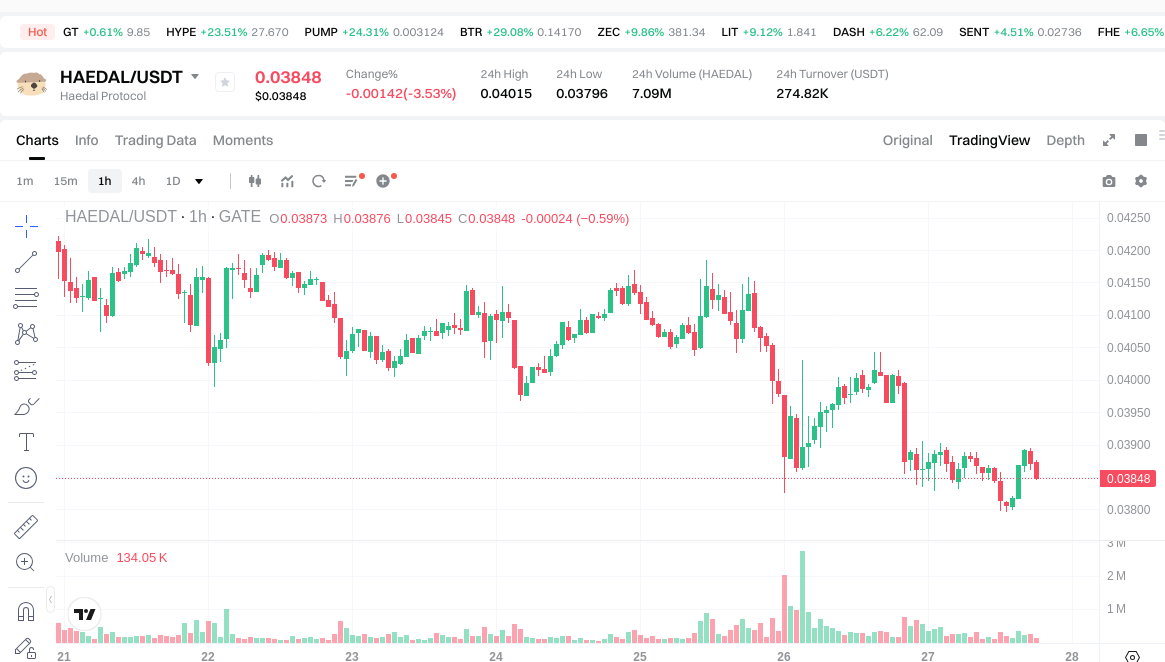
II. Core Factors Affecting Whether HAEDAL is a Good Investment (Is Haedal Protocol(HAEDAL) a Good Investment)
Supply Mechanism and Scarcity (HAEDAL investment scarcity)
- Total Supply: 1,000,000,000 HAEDAL with a maximum supply capped at the same level → affects price dynamics and investment value
- Current Circulation: 195,000,000 tokens (19.5% of total supply) are in circulation as of January 27, 2026, indicating controlled token release
- Investment Significance: The circulating supply represents less than one-fifth of total supply, suggesting potential future dilution that investors should consider when evaluating long-term scarcity dynamics
Institutional Investment and Mainstream Adoption (Institutional investment in HAEDAL)
- Listing Status: HAEDAL is listed on 30 exchanges as of January 2026, indicating growing market accessibility
- User Growth: The protocol surpassed 900,000 total accounts in July 2025, demonstrating expanding adoption within the Sui ecosystem
- Platform Position: Haedal aims to become a primary staking and yield-earning platform on Sui, contributing to blockchain security and decentralization
Macroeconomic Environment's Impact on HAEDAL Investment
- Market Performance Context: HAEDAL has experienced notable price volatility, with the token price at $0.03855 as of January 27, 2026
- Historical Price Range: The token has traded between $0.03495 (December 18, 2025) and $0.3059 (July 17, 2025), reflecting significant market dynamics
- Broader Market Positioning: With a market dominance of 0.0012%, HAEDAL remains a smaller-cap asset that may be influenced by general crypto market sentiment and macroeconomic factors
Technology and Ecosystem Development (Technology & Ecosystem for HAEDAL investment)
- Liquid Staking Infrastructure: Haedal provides robust liquid staking infrastructure allowing users to stake SUI and Walrus tokens to validators for consensus rewards while maintaining liquidity through LST tokens
- Product Matrix Expansion: The protocol is building complementary products including Haedal Market Maker and haeVault to capture value from on-chain trading flows on Sui
- DeFi Integration: The veHAEDAL mechanism rewards long-term token holders, creating incentive structures that support ecosystem participation and potentially enhance long-term value proposition
III. HAEDAL Future Investment Forecast and Price Outlook (Is Haedal Protocol(HAEDAL) worth investing in 2026-2031)
Short-term Investment Forecast (2026, short-term HAEDAL investment outlook)
- Conservative forecast: $0.0208 - $0.0385
- Neutral forecast: $0.0385 - $0.0402
- Optimistic forecast: $0.0402 - $0.0419
Mid-term Investment Outlook (2027-2028, mid-term Haedal Protocol(HAEDAL) investment forecast)
- Market stage expectations: The project may experience gradual growth as its liquid staking infrastructure on Sui continues to develop, with potential expansion in DeFi integrations and complementary product offerings such as Haedal Market Maker and haeVault.
- Investment return forecast:
- 2027: $0.0237 - $0.0579
- 2028: $0.0461 - $0.0721
- Key catalysts: Expansion of liquid staking adoption on Sui blockchain, development of ecosystem products, potential increases in on-chain trading volumes, and broader DeFi integration opportunities.
Long-term Investment Outlook (Is HAEDAL a good long-term investment?)
- Base scenario: $0.0411 - $0.0830 (assuming steady protocol development and moderate growth in Sui ecosystem adoption)
- Optimistic scenario: $0.0661 - $0.0998 (assuming significant expansion in liquid staking market share and successful product matrix deployment)
- Risk scenario: $0.0208 - $0.0461 (under conditions of intensified competition, technical challenges, or unfavorable market dynamics)
Click to view HAEDAL long-term investment and price forecast: Price Prediction
2026-01-27 to 2031 Long-term Outlook
- Base scenario: $0.0411 - $0.0830 (corresponding to steady progress and gradual mainstream application growth)
- Optimistic scenario: $0.0661 - $0.0998 (corresponding to large-scale adoption and favorable market environment)
- Transformative scenario: Above $0.0998 (if ecosystem achieves breakthrough progress and mainstream penetration)
- 2031-12-31 forecast high: $0.0998 (based on optimistic development assumptions)
Disclaimer: Price forecasts are based on historical data analysis and market modeling. Cryptocurrency markets involve substantial volatility and risk. These projections should not be construed as investment advice, and actual results may differ materially from forecasts.
| Year |
Predicted High Price |
Predicted Average Price |
Predicted Low Price |
Price Change |
| 2026 |
0.0419432 |
0.03848 |
0.0207792 |
0 |
| 2027 |
0.057904704 |
0.0402116 |
0.023724844 |
4 |
| 2028 |
0.07211548344 |
0.049058152 |
0.04611466288 |
27 |
| 2029 |
0.0830039402764 |
0.06058681772 |
0.0411990360496 |
57 |
| 2030 |
0.099795576807498 |
0.0717953789982 |
0.066051748678344 |
86 |
| 2031 |
0.092659116135076 |
0.085795477902849 |
0.080647749228678 |
122 |
IV. HAEDAL Investment Strategy and Risk Management (How to invest in liquid staking tokens)
Investment Methodology (HAEDAL investment strategy)
-
Long-term Holding (HODL HAEDAL): Suitable for conservative investors
For investors seeking steady exposure to the Sui ecosystem's liquid staking sector, long-term holding may align with their investment horizons. This approach involves accumulating HAEDAL tokens during market dips and holding through volatility cycles, anticipating gradual adoption of Haedal Protocol's liquid staking infrastructure and its complementary products like Haedal Market Maker and haeVault.
-
Active Trading: Relying on technical analysis and swing trading
Active traders may leverage technical indicators to identify entry and exit points based on HAEDAL's price movements. Given the token's 24-hour trading volume of approximately $274,501 and recent price fluctuations (ranging from $0.03796 to $0.04015 within 24 hours), short-term trading opportunities exist, though liquidity considerations should inform position sizing.
Risk Management (Risk management for HAEDAL investment)
-
Asset Allocation Ratios: Conservative / Aggressive / Professional investors
- Conservative investors: Allocate 1-3% of crypto portfolio to HAEDAL, given its emerging status and market cap of approximately $7.52 million.
- Aggressive investors: May allocate 5-10% to capture potential upside from Sui ecosystem growth and liquid staking adoption.
- Professional investors: Could incorporate HAEDAL as part of a diversified DeFi infrastructure thesis, with strategic positioning based on protocol metrics and ecosystem developments.
-
Risk Hedging Solutions: Multi-asset portfolio + hedging instruments
Diversification across different blockchain ecosystems, liquid staking protocols, and asset classes can help mitigate concentration risk. Investors may consider pairing HAEDAL exposure with stablecoin allocations or other Sui-native assets to balance portfolio volatility.
-
Secure Storage: Cold and hot wallets + hardware wallet recommendations
Given HAEDAL's deployment on the Sui blockchain, investors should utilize Sui-compatible wallets. Cold storage solutions like hardware wallets provide enhanced security for long-term holdings, while hot wallets may facilitate active trading. Ensure wallet compatibility with Sui network standards before transferring assets.
V. HAEDAL Investment Risks and Challenges (Risks of investing in liquid staking tokens)
-
Market Risk: High volatility and price manipulation concerns
HAEDAL has demonstrated substantial price volatility, with a 7-day decline of approximately 8.89% and a 30-day decline of around 11.08%. The token's relatively modest market cap and trading volume may expose it to heightened volatility and potential liquidity constraints during adverse market conditions.
-
Regulatory Risk: Policy uncertainty across different jurisdictions
Liquid staking protocols operate in an evolving regulatory landscape. Changes in cryptocurrency regulations, particularly those affecting staking mechanisms or DeFi protocols, could impact Haedal Protocol's operations and HAEDAL token utility across various jurisdictions.
-
Technical Risk: Network security vulnerabilities and upgrade failures
As a protocol built on Sui blockchain infrastructure, HAEDAL faces technical dependencies on the underlying network's security and performance. Smart contract vulnerabilities, protocol upgrade complications, or network-level issues could affect token functionality and user assets staked through the platform.
VI. Conclusion: Is liquid staking tokens a Good Investment?
-
Investment Value Summary: HAEDAL presents exposure to the growing liquid staking sector within the Sui ecosystem, with the protocol offering infrastructure for SUI and Walrus token staking alongside developing complementary products. The token's relatively low circulation ratio of 19.5% (195 million circulating supply against 1 billion maximum supply) suggests significant future token releases that could influence price dynamics.
-
Investor Recommendations:
✅ Beginners: Consider dollar-cost averaging strategies combined with secure wallet storage. Start with minimal allocations to understand protocol mechanics and market behavior.
✅ Experienced Investors: Employ swing trading strategies based on technical analysis while maintaining core positions. Monitor protocol development milestones and Sui ecosystem growth indicators.
✅ Institutional Investors: Evaluate strategic long-term allocation as part of broader DeFi infrastructure exposure, with thorough due diligence on protocol fundamentals and competitive positioning.
⚠️ Disclaimer: Cryptocurrency investments carry substantial risk due to high volatility and market uncertainties. This content is provided for informational purposes only and does not constitute investment advice. Investors should conduct independent research and consider their risk tolerance before making investment decisions.
VII. FAQ
Q1: What is Haedal Protocol and how does its liquid staking mechanism work?
Haedal Protocol is a liquid staking infrastructure built natively on the Sui blockchain that enables users to stake SUI and Walrus tokens while maintaining liquidity. The protocol allows users to delegate their tokens to validators for consensus rewards and receive liquid staking tokens (LST) in return, which can be used in DeFi applications while the underlying assets continue earning staking rewards. This dual-benefit approach solves the traditional staking liquidity problem by allowing token holders to participate in network security without locking up their capital.
Q2: How volatile has HAEDAL's price been historically?
HAEDAL has experienced significant price volatility since its launch in 2025. The token reached a peak of $0.3059 in July 2025, but declined to $0.03495 by December 2025—representing approximately an 88.6% decline from its all-time high. As of January 27, 2026, the token trades at $0.03855, showing continued volatility with recent declines of 3.57% (24 hours), 8.89% (7 days), and 11.08% (30 days). This volatility is characteristic of smaller-cap cryptocurrency assets and reflects both market sentiment shifts and the protocol's early-stage development.
Q3: What percentage of HAEDAL's total supply is currently in circulation?
Only 19.5% of HAEDAL's total supply is currently circulating, with 195 million tokens in circulation out of a maximum supply of 1 billion tokens. This means approximately 80.5% of tokens have yet to enter the market, which represents a significant factor for investors to consider. Future token releases could create selling pressure and impact price dynamics, making it essential to understand the token distribution schedule and vesting timelines when evaluating investment potential.
Q4: What are the main risk factors associated with investing in HAEDAL?
HAEDAL investment carries several key risks: (1) Market Risk—the token exhibits high volatility with a relatively small market cap of $7.52 million and modest trading volume of approximately $274,501 daily, which may limit liquidity during adverse conditions; (2) Supply Dilution Risk—with only 19.5% of tokens circulating, substantial future releases could create downward price pressure; (3) Technical Risk—as a protocol dependent on Sui blockchain infrastructure, smart contract vulnerabilities or network issues could affect functionality; and (4) Regulatory Risk—evolving regulations around liquid staking and DeFi protocols could impact operations across different jurisdictions.
Q5: What is the long-term price forecast for HAEDAL through 2031?
Based on market modeling and historical data analysis, HAEDAL's long-term forecast through 2031 presents multiple scenarios: the base scenario projects a range of $0.0411 to $0.0830, assuming steady protocol development and moderate Sui ecosystem growth; the optimistic scenario forecasts $0.0661 to $0.0998, contingent on significant liquid staking market share expansion and successful product deployment; while the risk scenario suggests $0.0208 to $0.0461 under conditions of intensified competition or unfavorable market dynamics. The 2031 forecasted high reaches $0.0998 under optimistic assumptions, though actual results may differ materially due to cryptocurrency market volatility.
Q6: How should different investor types approach HAEDAL allocation?
Investment approach varies by investor profile: Conservative investors should allocate only 1-3% of their crypto portfolio to HAEDAL given its emerging status and small market cap, focusing on dollar-cost averaging and secure cold storage. Aggressive investors may allocate 5-10% to capture potential upside from Sui ecosystem growth, employing active trading strategies based on technical analysis. Professional investors could incorporate HAEDAL as part of a diversified DeFi infrastructure thesis, conducting thorough due diligence on protocol metrics, competitive positioning, and ecosystem developments while maintaining strategic long-term positions balanced with appropriate risk hedging instruments.
Q7: What complementary products is Haedal Protocol developing beyond liquid staking?
Haedal Protocol is expanding its ecosystem beyond core liquid staking functionality by developing complementary products designed to capture value from on-chain trading activities within the Sui network. These include Haedal Market Maker, which aims to provide liquidity solutions for trading pairs, and haeVault, designed to optimize yield generation strategies. Additionally, the protocol implements the veHAEDAL mechanism to reward long-term token holders through enhanced incentive structures, creating alignment between protocol development and sustained ecosystem participation that could potentially enhance the token's long-term value proposition.
Q8: On how many exchanges is HAEDAL currently available for trading?
As of January 2026, HAEDAL is listed on 30 exchanges, indicating growing market accessibility and distribution channels for the token. This multi-exchange presence provides investors with various options for acquiring HAEDAL tokens and contributes to overall market liquidity, though the token's 24-hour trading volume of approximately $274,501 suggests that liquidity remains concentrated rather than evenly distributed across all listing venues. Investors should evaluate exchange-specific liquidity metrics and trading pairs when determining optimal platforms for executing HAEDAL transactions.
* The information is not intended to be and does not constitute financial advice or any other recommendation of any sort offered or endorsed by Gate.