This comprehensive analysis evaluates whether Hana Network (HANA) represents a viable investment opportunity within the social crypto sector. As of January 2026, HANA trades at $0.028289 with a $6.79 million market cap, demonstrating significant volatility alongside institutional backing of $9 million in funding and 400,000 unique wallet users. The article examines HANA's tokenomics structure, including its 24% circulating supply ratio and growth catalysts, while analyzing price forecasts ranging from $0.026-$0.029 (conservative 2026) to $0.080 (optimistic 2031). Key investment considerations include market risks from extreme volatility, regulatory uncertainties affecting social-earning platforms, and technical dependencies on BSC infrastructure. Recommended strategies include dollar-cost averaging for beginners on Gate and other major exchanges, swing trading for experienced investors, and position sizing of 1-10% depending on risk tolerance, supported by comprehensive risk management frameworks and secure B
Introduction: Hana Network (HANA) Investment Status and Market Outlook
Hana Network (HANA) represents a cryptocurrency asset positioned in the social engagement and casual earning space within the digital asset ecosystem. As of January 28, 2026, HANA maintains a market capitalization of approximately $6.79 million, with a circulating supply of 240 million tokens and a current trading price around $0.028289. The project has secured $9 million in funding and has demonstrated notable on-chain activity with 40 million transactions and 400,000 unique wallet addresses. With its positioning as a livestreaming and social platform in the crypto space, HANA has become a subject of interest when investors consider "Is Hana Network (HANA) a good investment?" This analysis examines HANA's investment characteristics, historical performance, price outlook, and associated risks to provide reference material for market participants.
I. Hana Network (HANA) Price History Review and Investment Value Status
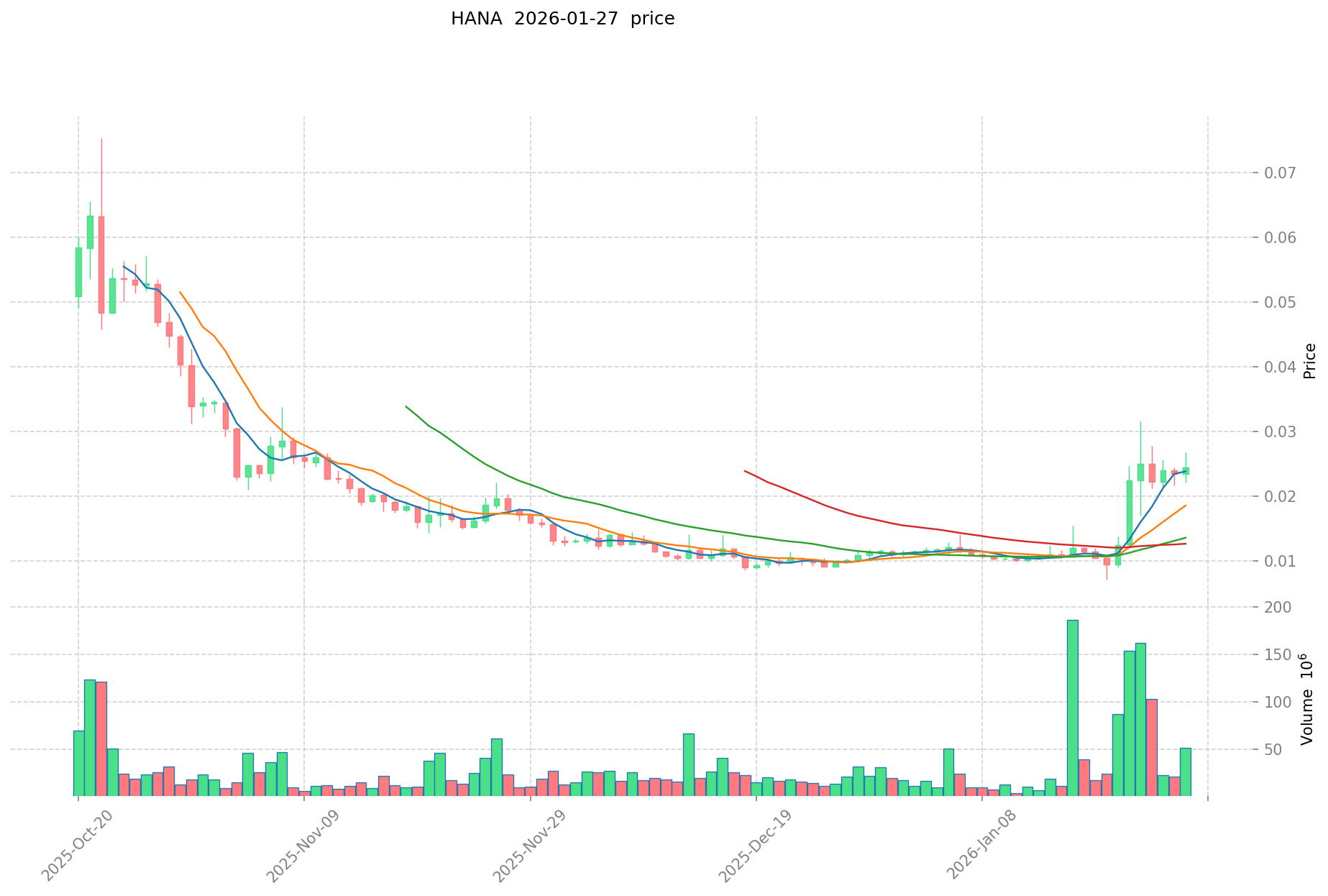
HANA Historical Price Trends and Investment Returns
- October 2025: Reached a price of $0.10334 → Market sentiment showed elevated optimism as the token approached its peak valuation
- January 2026: Experienced significant price movement → HANA declined to $0.00712 during a market correction phase
- Recent Period: Price volatility between $0.022925 and $0.031185 → Trading range demonstrates ongoing market uncertainty with price fluctuations reflecting changing investor sentiment
Current HANA Investment Market Status (January 2026)
- HANA current price: $0.028289
- 24-hour price change: +16.89%
- 24-hour trading volume: $806,965.99
- Market capitalization: $6,789,360
- Circulating supply: 240,000,000 HANA (24% of total supply)
- Holder count: 6,767 addresses
Click to view real-time HANA market price
II. Core Factors Influencing Whether HANA Is a Good Investment
Supply Mechanism and Scarcity (HANA Investment Scarcity)
- Supply Structure: HANA has a maximum supply of 1,000,000,000 tokens, with a current circulating supply of 240,000,000 tokens, representing a 24% circulation ratio.
- Supply Impact: The token's fully diluted market cap stands at approximately $28.29 million, while the current market cap is around $6.79 million, indicating substantial unreleased supply that may affect future price dynamics.
- Investment Implications: The controlled release of circulating supply could influence scarcity dynamics, though the large portion of uncirculated tokens (76%) represents a consideration for long-term investment planning.
Institutional Investment and Mainstream Adoption (Institutional Investment in HANA)
- Funding Background: Hana Network has completed a $9 million funding round, demonstrating institutional confidence in the project's potential.
- User Adoption Metrics: The platform has recorded 40 million transactions and attracted 400,000 unique wallet users, indicating growing mainstream engagement.
- Market Position: HANA is listed on 13 exchanges and has accumulated over 6,700 token holders, suggesting expanding market accessibility and adoption.
Macroeconomic Environment's Impact on HANA Investment
- Market Performance Context: As of January 28, 2026, HANA is trading at $0.028289, showing significant volatility with a 24-hour high of $0.031185 and low of $0.022925.
- Recent Price Trends: The token has demonstrated notable short-term volatility, with a 16.89% increase over 24 hours, a 121.10% gain over 7 days, and a 157.71% increase over 30 days.
- Broader Market Dynamics: HANA's market share of 0.00089% positions it as an emerging asset within the cryptocurrency ecosystem, subject to broader market sentiment and macroeconomic conditions affecting digital assets.
Technology and Ecosystem Development (Technology & Ecosystem for HANA Investment)
- Platform Positioning: Hana Network positions itself as a social-focused cryptocurrency platform, integrating livestreaming, casual earning mechanisms, and user-friendly onboarding experiences.
- Technical Infrastructure: The token operates on the BSC (Binance Smart Chain) network using the BEP-20 standard, with contract address 0x6261963ebe9ff014aad10ecc3b0238d4d04e8353.
- Ecosystem Growth: The platform's emphasis on social interaction and earning features aims to differentiate it within the competitive SocialFi and decentralized application landscape, potentially supporting long-term value through ecosystem expansion.
III. HANA Future Investment Forecast and Price Outlook (Is Hana Network(HANA) worth investing in 2026-2031)
Short-term Investment Forecast (2026, short-term HANA investment outlook)
- Conservative forecast: $0.026 - $0.029
- Neutral forecast: $0.028 - $0.032
- Optimistic forecast: $0.032 - $0.036
Mid-term Investment Outlook (2027-2028, mid-term Hana Network(HANA) investment forecast)
-
Market stage expectation: HANA may experience gradual growth as the project continues to develop its livestreaming and casual earning features. The token showed notable volatility in its early trading phase, with recovery potential dependent on sustained community engagement and platform adoption.
-
Investment return forecast:
- 2027: $0.026 - $0.035
- 2028: $0.022 - $0.049
-
Key catalysts: Community growth, trading volume expansion, platform feature development, and overall cryptocurrency market sentiment may influence price movements.
Long-term Investment Outlook (Is HANA a good long-term investment?)
- Base scenario: $0.025 - $0.046 (assuming moderate platform growth and steady user acquisition)
- Optimistic scenario: $0.033 - $0.066 (assuming strong ecosystem development and increased mainstream adoption)
- Risk scenario: Below $0.025 (in case of adverse market conditions or reduced platform engagement)
Click to view HANA long-term investment and price forecast: Price Prediction
2026-01-28 - 2031 Long-term Outlook
- Base scenario: $0.025 - $0.046 USD (corresponding to steady progress and gradual mainstream application growth)
- Optimistic scenario: $0.033 - $0.080 USD (corresponding to large-scale adoption and favorable market conditions)
- Transformative scenario: Above $0.080 USD (in case of breakthrough ecosystem developments and mainstream popularization)
- 2031-12-31 forecast high: $0.080 USD (based on optimistic development assumptions)
Disclaimer: Cryptocurrency investments carry substantial risk. Price forecasts are based on historical data and market analysis tools, and should not be considered as financial advice. Past performance does not guarantee future results. Investors should conduct their own research and assess their risk tolerance before making investment decisions.
| Year |
Predicted High Price |
Predicted Average Price |
Predicted Low Price |
Price Change |
| 2026 |
0.03614814 |
0.028689 |
0.02610699 |
1 |
| 2027 |
0.0353362413 |
0.03241857 |
0.025934856 |
14 |
| 2028 |
0.048783464136 |
0.03387740565 |
0.0220203136725 |
19 |
| 2029 |
0.05083643491839 |
0.041330434893 |
0.03347765226333 |
46 |
| 2030 |
0.0663601462642 |
0.046083434905695 |
0.025345889198132 |
62 |
| 2031 |
0.080397160536475 |
0.056221790584947 |
0.033170856445119 |
98 |
IV. HANA Investment Strategy and Risk Management (How to invest in cryptocurrency)
Investment Strategy (HANA investment strategy)
-
Long-term Holding (HODL HANA): Suitable for conservative investors
Long-term holding involves purchasing HANA tokens and maintaining positions through market cycles. This approach may be suitable for investors who believe in the project's vision of becoming a mainstream crypto gateway through livestreaming and casual earning features. Given the token's current circulating supply of 240,000,000 HANA (24% of max supply) and fully diluted market cap, investors should consider the potential impact of future token unlocks on price dynamics.
-
Active Trading: Relies on technical analysis and swing trading
Active traders may leverage HANA's price volatility for short-term opportunities. The token has demonstrated significant price movements, with 7-day growth reaching 121.10% and 30-day growth at 157.71%. However, traders should note the 1-hour decline of -1.9% and high volatility between the 24-hour high ($0.031185) and low ($0.022925), indicating rapid price fluctuations that require careful timing and risk management.
Risk Management (Risk management for HANA investment)
-
Asset Allocation Ratio: Conservative / Aggressive / Professional investors
Conservative investors may consider limiting HANA exposure to 1-3% of their total crypto portfolio, given its market cap ranking of 1390 and market dominance of 0.00089%. Aggressive investors comfortable with higher volatility might allocate 5-10%, while professional investors with advanced risk management capabilities could consider larger positions based on their strategic objectives. The token's 24-hour trading volume of $806,965.99 should be considered when determining position sizes to ensure adequate liquidity.
-
Risk Hedging Solutions: Multi-asset portfolio + hedging tools
Investors may consider diversifying across multiple blockchain assets to mitigate concentration risk. HANA operates on the BSC (BEP-20 standard), so portfolio diversification across different blockchain ecosystems may help reduce platform-specific risks. Position sizing strategies and stop-loss orders can help manage downside exposure, particularly given the token's historical price range from an all-time low of $0.00712 (January 19, 2026) to an all-time high of $0.10334 (October 6, 2025).
-
Secure Storage: Hot/cold wallets + hardware wallet recommendations
HANA tokens require BSC-compatible wallets for storage. Cold storage solutions such as hardware wallets provide enhanced security for long-term holdings, while hot wallets may be suitable for active trading. Investors should ensure their chosen wallet solution supports BEP-20 tokens and maintain proper backup procedures for recovery phrases. The project's existing user base of 400,000 unique wallets demonstrates active on-chain participation.
V. HANA Investment Risks and Challenges (Risks of investing in cryptocurrency)
-
Market Risk: High volatility and potential price manipulation
HANA exhibits substantial price volatility, with annual performance showing a decline of -72.88% while shorter timeframes show significant gains (121.10% over 7 days, 157.71% over 30 days). The token's relatively low market dominance (0.00089%) and ranking (1390) may contribute to price instability. Daily price ranges can be wide, as evidenced by the 24-hour range of $0.022925 to $0.031185, representing potential swings that could impact portfolio values.
-
Regulatory Risk: Policy uncertainty across different jurisdictions
Cryptocurrency regulatory frameworks vary significantly across countries and continue to evolve. As a project combining social features with crypto functionality, HANA may face regulatory scrutiny related to financial services, social media, and digital assets. Changes in regulatory approaches toward cryptocurrencies, particularly those involving earning mechanisms and user engagement, could affect the project's operations and token utility.
-
Technical Risk: Network security vulnerabilities and upgrade failures
As a BEP-20 token operating on BSC, HANA inherits both the benefits and risks of the underlying blockchain infrastructure. Smart contract vulnerabilities, potential network congestion, and dependency on BSC's operational stability represent technical considerations. The project's trading volume of 40 million transactions and 400,000 unique wallets indicate active usage, which could amplify the impact of any technical issues.
VI. Conclusion: Is cryptocurrency a Good Investment?
-
Investment Value Summary: HANA presents potential long-term opportunities within the social crypto space, though short-term price movements demonstrate considerable volatility.
The project's positioning as a TikTok-style platform for crypto, combined with $9 million in funding and significant on-chain activity (40 million transactions, 400,000 unique wallets), indicates market traction. However, the token's -72.88% annual performance and ranking of 1390 suggest elevated risk levels. The 24% circulating supply ratio indicates substantial future token releases that could affect price dynamics.
-
Investor Recommendations:
✅ Beginners: Dollar-cost averaging + secure wallet storage
New investors should consider gradual accumulation through dollar-cost averaging to mitigate timing risk, given HANA's volatility. Prioritize secure storage using BSC-compatible wallets with proper backup procedures. Start with small allocations (1-2% of crypto portfolio) while learning about the project's development and market dynamics.
✅ Experienced Investors: Swing trading + portfolio allocation
Experienced traders may explore swing trading opportunities based on technical analysis, leveraging HANA's volatility patterns. Maintain disciplined position sizing (3-5% of crypto portfolio) and implement stop-loss strategies. Monitor trading volume and market depth for optimal entry and exit points.
✅ Institutional Investors: Strategic long-term allocation
Institutional participants evaluating exposure to social crypto platforms may consider HANA as part of a diversified portfolio approach. Conduct thorough due diligence on the project's roadmap, token economics, and competitive positioning. Consider the 76% unreleased token supply in long-term valuation models.
⚠️ Notice: Cryptocurrency investments carry high risk. This content is for informational purposes only and does not constitute investment advice.
VII. FAQ
Q1: Is Hana Network (HANA) a good investment in 2026?
HANA presents both opportunities and significant risks for 2026 investors. The token has demonstrated substantial volatility with recent gains of 121.10% over 7 days and 157.71% over 30 days, but also shows an annual decline of -72.88%. With a market capitalization of approximately $6.79 million and ranking of 1390, HANA occupies a relatively small position in the cryptocurrency market. The project's $9 million funding round, 40 million on-chain transactions, and 400,000 unique wallets indicate growing adoption within its niche. However, the 24% circulating supply ratio means 76% of tokens remain unreleased, which could impact future price dynamics. Conservative investors might consider limiting exposure to 1-3% of their crypto portfolio, while those with higher risk tolerance could allocate 5-10%. The investment suitability ultimately depends on individual risk tolerance, investment horizon, and portfolio diversification strategy.
Q2: What are the main risks of investing in HANA tokens?
HANA investment carries three primary risk categories that investors should carefully evaluate. Market risk manifests through extreme price volatility, with daily price swings between $0.022925 and $0.031185, and the token's low market dominance (0.00089%) potentially exposing it to manipulation or liquidity constraints. Regulatory risk stems from evolving cryptocurrency policies across jurisdictions, particularly affecting social-earning platforms that combine financial services with user engagement mechanisms. Technical risk includes smart contract vulnerabilities, dependency on BSC network stability, and potential security issues that could impact the project's 400,000 wallet users. Additionally, the substantial unreleased token supply (760 million tokens, or 76% of maximum supply) represents a significant dilution risk that could pressure prices as tokens enter circulation. Investors should implement comprehensive risk management strategies including position sizing, stop-loss orders, and portfolio diversification to mitigate these exposure factors.
Q3: How does HANA's tokenomics affect its long-term investment value?
HANA's tokenomics structure significantly influences its investment profile through several mechanisms. The maximum supply of 1,000,000,000 tokens with only 240,000,000 (24%) currently circulating creates a substantial supply overhang that may constrain price appreciation as additional tokens unlock. The fully diluted market cap of approximately $28.29 million compared to the current market cap of $6.79 million illustrates this potential dilution impact. Operating on BSC as a BEP-20 token provides cost-efficiency for transactions but ties the project's technical performance to Binance Smart Chain infrastructure. The project's focus on livestreaming and casual earning features positions it within the competitive SocialFi sector, where token utility derives from platform engagement and user retention. Long-term value creation depends on the project's ability to grow its user base beyond the current 400,000 unique wallets while managing token supply increases responsibly. Investors should monitor vesting schedules, unlock events, and ecosystem development milestones when evaluating long-term holding strategies.
Q4: What trading strategies work best for HANA given its volatility?
HANA's high volatility profile, demonstrated by its 121.10% seven-day gain and 157.71% thirty-day surge against a -72.88% annual decline, requires tailored trading approaches for different investor types. Dollar-cost averaging suits beginners and conservative investors, allowing systematic accumulation while mitigating timing risk during price fluctuations between $0.022925 and $0.031185. Active traders may pursue swing trading strategies, capitalizing on HANA's frequent price oscillations using technical analysis indicators to identify entry and exit points. The 24-hour trading volume of $806,965.99 provides sufficient liquidity for short-term trading, though position sizes should account for potential slippage. Long-term holders focusing on the project's social platform vision should implement stop-loss orders to protect against adverse movements while maintaining exposure to potential upside. Portfolio rebalancing strategies help maintain target allocation percentages as HANA's price movements can significantly alter position weights. Regardless of strategy, investors should avoid over-concentration, with recommended allocations ranging from 1-3% for conservative investors to 5-10% for aggressive traders, depending on individual risk tolerance and market conditions.
Q5: How does HANA compare to other social cryptocurrency projects?
HANA positions itself as a TikTok-style social platform within the cryptocurrency ecosystem, differentiating through its livestreaming and casual earning features. With 40 million recorded transactions and 400,000 unique wallet users, the project has achieved meaningful early adoption within its niche. However, its market capitalization of $6.79 million and ranking of 1390 places it significantly below established social crypto projects in terms of market presence. The $9 million funding round demonstrates institutional confidence, though this represents relatively modest backing compared to major competitors in the SocialFi space. HANA's BSC infrastructure provides transaction cost advantages over Ethereum-based alternatives, potentially lowering barriers to user participation in platform activities. The project's current adoption metrics suggest emerging market traction, but its 0.00089% market dominance indicates limited mainstream awareness compared to leading social crypto platforms. Investors comparing HANA to alternatives should evaluate the project's unique value proposition, competitive moat sustainability, team execution capability, and roadmap milestones relative to more established projects with longer track records and larger user bases.
Q6: What factors could drive HANA's price in 2026-2027?
Multiple catalysts could influence HANA's price trajectory over the near-to-medium term investment horizon. Ecosystem expansion through increased platform features, enhanced livestreaming capabilities, and improved casual earning mechanisms may attract additional users beyond the current 400,000 unique wallets, potentially driving demand for tokens. Exchange listings beyond the current 13 platforms could improve liquidity and accessibility, exposing HANA to broader investor audiences. Token unlock schedules significantly impact supply dynamics—the current 24% circulating supply means future releases of the remaining 760 million tokens will affect scarcity perceptions and price action. Partnership announcements, particularly those expanding HANA's utility or mainstream adoption pathways, could generate positive sentiment. Broader cryptocurrency market trends will influence HANA's performance, as its low market dominance (0.00089%) makes it susceptible to overall digital asset sector movements. Technical developments such as network upgrades, security enhancements, or integration with additional blockchain ecosystems could strengthen fundamentals. Community growth metrics including transaction volume, active addresses, and holder retention rates serve as leading indicators for organic demand. Regulatory clarity or favorable policy developments affecting social crypto platforms may reduce uncertainty and support valuation expansion.
Q7: Should I buy HANA for short-term trading or long-term holding?
The optimal investment approach for HANA depends on individual circumstances, risk tolerance, and market outlook. Short-term trading strategies may suit experienced investors who can navigate HANA's extreme volatility, as evidenced by 24-hour price ranges spanning from $0.022925 to $0.031185 and week-over-week gains exceeding 121%. Active traders with technical analysis capabilities and disciplined risk management practices may find opportunities in these price swings, though the relatively modest 24-hour trading volume of $806,965.99 requires careful attention to liquidity and slippage risks. Long-term holding approaches align with investors who believe in HANA's vision of becoming a mainstream crypto gateway through social engagement features, accepting the project's early-stage nature and execution risks in exchange for potential upside from ecosystem growth. However, the -72.88% annual performance and substantial unreleased token supply (76%) present headwinds that long-term holders must consider. A hybrid approach combining core long-term holdings with tactical trading positions may offer balanced exposure, allowing investors to maintain strategic allocation while capturing volatility-driven opportunities. Regardless of chosen strategy, position sizing should reflect HANA's risk profile, with conservative allocations (1-3% of crypto portfolio) recommended for most investors, and secure BSC-compatible wallet storage essential for all holding periods.
Q8: What wallet should I use to store HANA tokens securely?
HANA tokens require BSC-compatible storage solutions as BEP-20 standard assets with contract address 0x6261963ebe9ff014aad10ecc3b0238d4d04e8353. Hardware wallets such as Ledger and Trezor offer maximum security for long-term holdings, providing cold storage protection against online threats while supporting BSC networks through integrated applications. Software wallets like MetaMask, Trust Wallet, and Binance Chain Wallet provide convenient hot storage options for active trading, offering quick access to HANA tokens for transactions while maintaining user control of private keys. Exchange wallets on platforms listing HANA provide immediate trading access but involve custody risks and reduced control over assets—these should primarily serve trading purposes rather than long-term storage. Multi-signature wallets offer enhanced security for larger holdings through distributed key management, though setup complexity may exceed requirements for smaller positions. Regardless of chosen solution, investors must implement proper security practices including secure backup of recovery phrases, enabling two-factor authentication where available, verifying contract addresses before transactions, and testing with small amounts before major transfers. Given HANA's user base of 400,000 unique wallets and 40 million recorded transactions, proven wallet solutions with strong community adoption provide additional confidence for storage decisions.
* The information is not intended to be and does not constitute financial advice or any other recommendation of any sort offered or endorsed by Gate.