This comprehensive analysis evaluates HAQQ Network (ISLM) as an investment opportunity, examining its unique position as a Shariah-compliant cryptocurrency serving the global Muslim community. ISLM operates on an ethics-first, Proof-of-Stake blockchain launched in October 2023, currently trading at $0.03929 with a market cap of $93.61 million. The article covers ISLM's historical price performance, tokenomics with only 2.38% circulating supply, and technological innovations including the Ethiq Layer 2 mainnet. Price forecasts through 2031 range from base scenarios of $0.0329-$0.0491 to optimistic projections of $0.0491-$0.0639. Key considerations include market volatility, regulatory uncertainties, and supply expansion risks. Suitable for diverse investor profiles on Gate, offering strategies from conservative dollar-cost averaging to active trading approaches, with comprehensive risk management frameworks essential for decision-making.
Introduction: HAQQ Network (ISLM) Investment Position and Market Prospects
ISLM represents a notable asset within the cryptocurrency sector, having been launched in October 2023 as the native currency of the HAQQ blockchain. As of January 2026, ISLM maintains a market capitalization of approximately $93.61 million, with a circulating supply of around 2.38 billion tokens and a current price near $0.03929. Positioned as a Shariah-compliant digital currency designed to serve the global Muslim community, ISLM operates on an ethics-first, Proof-of-Stake blockchain infrastructure that emphasizes scalability and interoperability. With its market ranking at position 369 and a market dominance of 0.023%, the asset has demonstrated notable price volatility, including a 30-day performance shift of 486.04% and an annual change of -5.83%. These characteristics have made ISLM a subject of discussion among investors considering "Is HAQQ Network (ISLM) a good investment?" This article provides a comprehensive analysis of ISLM's investment fundamentals, historical price trends, future price projections, and associated investment risks to serve as a reference for potential investors.
I. ISLM Price History Review and Investment Value Status
- October 2023: ISLM launched at a publish price of $0.25, marking the beginning of its market presence
- November 2024: Price reached $0.08178 during market peak period
- December 2025: Market experienced significant correction, with price declining to $0.005333
- January 2026: Price recovered to $0.03929, showing approximately 637% growth from the low point
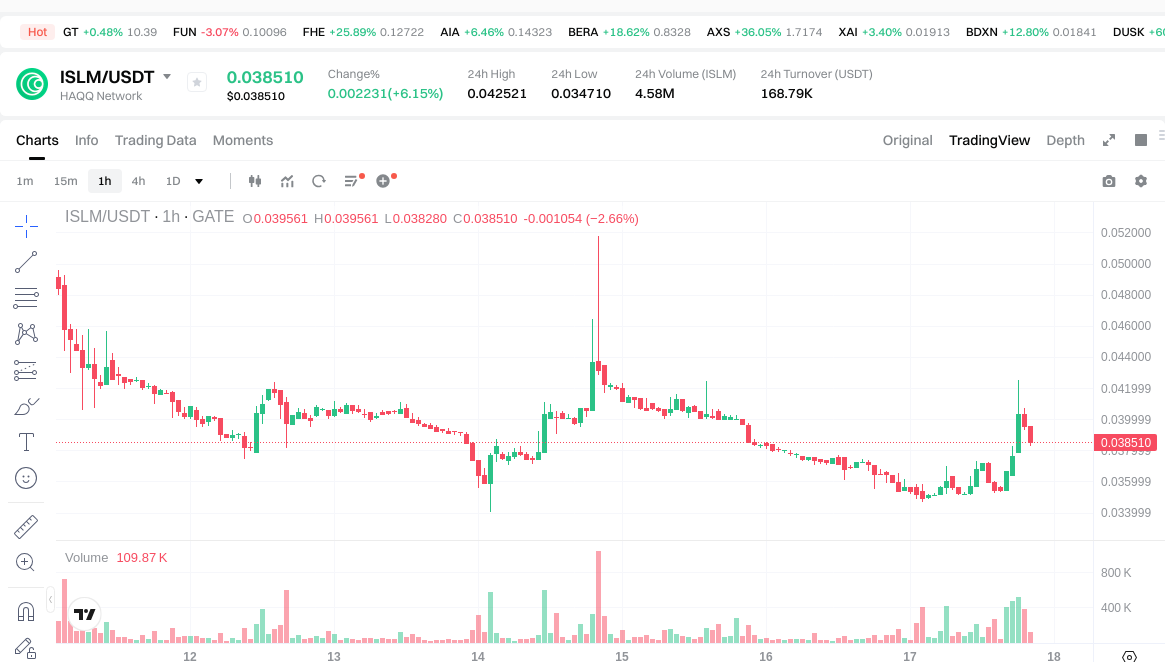
Current ISLM Investment Market Status (January 2026)
- ISLM Current Price: $0.03929
- 24-hour Trading Volume: $165,736.80
- Market Capitalization: $93.61 million
- Circulating Supply: 2.38 billion ISLM (2.38% of maximum supply)
- Fully Diluted Market Cap: $791.02 million
- Price Change (24H): +7.34%
- Price Change (7D): -22.11%
- Price Change (30D): +486.04%
Click to view real-time ISLM market price
II. Core Factors Influencing Whether ISLM is a Good Investment (Is HAQQ Network(ISLM) a Good Investment)
Supply Mechanism and Scarcity (ISLM investment scarcity)
- Supply structure and circulation dynamics influence price formation and investment valuation
- ISLM features a total supply of 20,132,844,304 tokens, with a maximum supply capped at 100,000,000,000 tokens, and a circulating supply of approximately 2,382,624,340 tokens as of January 17, 2026
- The current circulating supply represents approximately 2.38% of the total supply, indicating substantial future unlocking potential that may impact supply-side pressure
- Investment consideration: The low circulation ratio suggests that future token releases could affect price stability, and investors should monitor vesting schedules and unlock events
Institutional Investment and Mainstream Adoption (Institutional investment in ISLM)
- ISLM is designed to integrate with Islamic financial institutions through smart contracts that enforce Shariah compliance automatically
- The cryptocurrency targets the global Muslim community, positioning itself within the growing market for halal and ethically compliant digital assets
- The HAQQ Network's ethics-first approach and Shariah-compliant framework may attract institutions seeking investments aligned with Islamic finance principles, including the prohibition of riba (interest), gharar (uncertainty), and maysir (gambling)
- Broader market trends indicate growing interest in Shariah-compliant cryptocurrency, which may support adoption within Islamic finance sectors
Macroeconomic Environment's Impact on ISLM Investment
- Cryptocurrency markets, including ISLM, remain sensitive to shifts in monetary policy, interest rate adjustments, and global liquidity conditions
- Periods of economic uncertainty or inflation may drive interest in alternative digital assets as potential hedges, though regulatory and market sentiment factors also play significant roles
- Geopolitical developments and policy changes affecting digital asset regulation can influence investor demand for niche projects such as ISLM
Technology and Ecosystem Development (Technology & Ecosystem for ISLM investment)
- ISLM operates as the native currency of the HAQQ Network, an ethics-first blockchain built on Proof-of-Stake with fast finality, designed for scalability and interoperability
- The HAQQ Network launched the Ethiq Layer 2 mainnet, a development that has been associated with recent price volatility and increased market attention
- ISLM includes a staking feature, allowing holders to delegate tokens to validators and earn staking rewards, providing a mechanism for passive income generation
- The staking system contributes to network security and decentralization, and careful selection of validators is recommended to mitigate risks such as reward slashing due to validator underperformance
- Expansion of DeFi applications, payment use cases, and ecosystem partnerships within the HAQQ Network may provide long-term value support, though such developments depend on continued technical and community engagement
III. ISLM Future Investment Forecast and Price Outlook (Is HAQQ Network(ISLM) worth investing in 2026-2031)
Short-term Investment Forecast (2026, short-term ISLM investment outlook)
- Conservative forecast: $0.0228 - $0.0327
- Neutral forecast: $0.0297 - $0.0386
- Optimistic forecast: $0.0386 - $0.0440
Mid-term Investment Outlook (2027-2028, mid-term HAQQ Network(ISLM) investment forecast)
- Market stage expectation: The token may experience a recovery phase following the 2026 consolidation period, with potential growth driven by increased adoption within its target community
- Investment return forecast:
- 2027: $0.0293 - $0.0517
- 2028: $0.0316 - $0.0497
- Key catalysts: Expansion of Shariah-compliant DeFi ecosystem, enhanced network scalability, and growing adoption among Muslim-majority regions
Long-term Investment Outlook (Is HAQQ Network a good long-term investment?)
- Base scenario: $0.0329 - $0.0499 (Assuming steady ecosystem development and moderate adoption growth)
- Optimistic scenario: $0.0499 - $0.0639 (Assuming accelerated mainstream adoption and favorable regulatory environment for ethics-first blockchain solutions)
- Risk scenario: Below $0.0228 (In case of prolonged market downturn or failure to achieve planned network upgrades)
For detailed ISLM long-term investment and price prediction: Price Prediction
2026-2031 Long-term Outlook
- Base scenario: $0.0329 - $0.0491 (Corresponding to steady progress and gradual mainstream application growth)
- Optimistic scenario: $0.0491 - $0.0639 (Corresponding to large-scale adoption and favorable market conditions)
- Transformative scenario: Above $0.0639 (Subject to breakthrough ecosystem developments and mainstream penetration)
- 2031-12-31 predicted high: $0.0639 (Based on optimistic development assumptions)
Disclaimer: The forecasts presented are based on historical data patterns and current market analysis. Cryptocurrency investments carry substantial risks, and past performance does not guarantee future results. This information should not be construed as financial advice. Investors should conduct thorough research and consider their risk tolerance before making investment decisions.
| Year |
Predicted High Price |
Predicted Average Price |
Predicted Low Price |
Price Change |
| 2026 |
0.04406556 |
0.038654 |
0.02280586 |
-1 |
| 2027 |
0.051699725 |
0.04135978 |
0.0293654438 |
5 |
| 2028 |
0.049786835175 |
0.0465297525 |
0.0316402317 |
18 |
| 2029 |
0.050084625591 |
0.0481582938375 |
0.02985814217925 |
22 |
| 2030 |
0.057472107865672 |
0.04912145971425 |
0.032911378008547 |
25 |
| 2031 |
0.063956140547953 |
0.053296783789961 |
0.041571491356169 |
35 |
IV. ISLM Investment Strategy and Risk Management (How to invest in HAQQ Network)
Investment Methodology (ISLM investment strategy)
Long-term Holding (HODL ISLM)
Long-term holding may suit investors who believe in the fundamental value proposition of HAQQ Network and its mission to serve the global Muslim community. This approach involves acquiring ISLM tokens and maintaining positions through market cycles, reducing exposure to short-term volatility. Investors adopting this strategy typically focus on the project's technological development, community growth, and adoption metrics rather than daily price movements.
Active Trading
Active trading of ISLM requires careful technical analysis and understanding of market dynamics. With 24-hour trading volume of approximately $165,737 and price fluctuations between $0.03471 and $0.042521 within a single day, traders may identify opportunities through:
- Technical chart patterns and indicators
- Volume analysis and liquidity assessment
- Support and resistance level identification
- Correlation with broader crypto market trends
Given ISLM's volatility characteristics, including a 7-day decline of 22.11% and a 30-day surge of 486.04%, active traders must maintain strict discipline and risk parameters.
Risk Management (Risk management for ISLM investment)
Asset Allocation Ratios
Conservative Investors: May consider limiting ISLM exposure to 1-3% of total investment portfolio, prioritizing capital preservation while maintaining limited exposure to potential upside.
Moderate Investors: Could allocate 3-7% to ISLM within a diversified crypto portfolio, balancing risk-reward considerations with other established digital assets.
Aggressive Investors: Might allocate 7-15% to ISLM, accepting higher volatility in exchange for potential growth opportunities, particularly given the project's niche market positioning.
Risk Hedging Strategies
Implementing a multi-asset portfolio approach can help mitigate ISLM-specific risks:
- Diversification across different blockchain networks and use cases
- Combining volatile assets with stablecoins for liquidity management
- Geographic and regulatory jurisdiction diversification
- Periodic rebalancing based on predetermined thresholds
Secure Storage Solutions
Cold Wallet Storage: For long-term holdings, cold wallets provide enhanced security by keeping private keys offline. Hardware wallets such as Ledger and Trezor offer robust protection against online threats.
Hot Wallet Management: For active trading positions, secure hot wallets with multi-factor authentication should be utilized. Only maintain necessary amounts for trading purposes in exchange accounts.
Best Practices:
- Verify contract addresses before transactions
- Implement multi-signature requirements for large holdings
- Maintain secure backup of recovery phrases in multiple physical locations
- Regular security audits of wallet configurations
V. ISLM Investment Risks and Challenges (Risks of investing in HAQQ Network)
Market Risks
High Volatility: ISLM demonstrates significant price fluctuations, with recent data showing a 22.11% decline over 7 days followed by a 486.04% increase over 30 days. Such volatility presents both opportunity and substantial downside risk.
Liquidity Considerations: With a 24-hour trading volume of approximately $165,737 and market capitalization of $93.61 million, ISLM may experience liquidity constraints during periods of high market stress, potentially leading to wider bid-ask spreads and slippage.
Price Discovery Challenges: The relatively limited exchange availability and trading volume may result in price inefficiencies and increased susceptibility to large order impacts.
Regulatory Risks
Jurisdictional Uncertainty: Cryptocurrency regulations vary significantly across countries and continue to evolve. ISLM's focus on Shariah compliance adds an additional layer of regulatory consideration, as interpretations of Islamic financial principles may differ across jurisdictions.
Compliance Evolution: Changes in regulatory frameworks regarding digital assets, particularly those with religious or cultural positioning, could impact ISLM's accessibility and adoption in key markets.
Cross-border Transaction Restrictions: Varying international regulations may affect the ability to transfer, trade, or utilize ISLM across different regions.
Technical Risks
Network Security: As a Proof-of-Stake blockchain, HAQQ Network faces potential vulnerabilities including validator centralization risks, consensus mechanism attacks, and smart contract exploits.
Upgrade and Governance Risks: Blockchain upgrades and protocol changes carry inherent risks of implementation errors, network forks, or community disagreements that could impact token value and network stability.
Interoperability Challenges: While HAQQ Network emphasizes interoperability, technical integration with other blockchain ecosystems presents ongoing development and security considerations.
Validator Concentration: The security and decentralization of the network depend on an adequately distributed validator set, and concentration risks could emerge.
VI. Conclusion: Is HAQQ Network a Good Investment?
Investment Value Summary
ISLM presents a unique value proposition as a Shariah-compliant digital asset serving the global Muslim community. The project operates on HAQQ Network, an ethics-focused, scalable blockchain utilizing Proof-of-Stake consensus with fast finality. With a current circulating supply of approximately 2.38 billion tokens out of a maximum supply of 100 billion, representing 2.38% of the fully diluted market cap, ISLM maintains a significant potential supply expansion pathway.
The token's recent performance demonstrates substantial volatility, with price fluctuations ranging from recent lows to significant percentage gains over 30-day periods. This volatility profile suggests both opportunities and considerable risks for investors across different time horizons.
Investor Recommendations
✅ Beginners: Consider dollar-cost averaging (DCA) strategies to mitigate timing risks, combined with secure cold wallet storage for long-term holdings. Focus on understanding the project fundamentals, Shariah compliance framework, and blockchain technology basics before committing significant capital.
✅ Experienced Investors: May explore tactical trading opportunities based on technical analysis while maintaining core positions. Implement structured portfolio allocation within broader crypto diversification strategies, utilizing both fundamental and technical analysis frameworks.
✅ Institutional Investors: Could evaluate ISLM as part of strategic allocation to niche market segments, particularly for exposure to Islamic finance digital asset sectors. Conduct comprehensive due diligence on governance structures, tokenomics, and long-term sustainability models.
⚠️ Disclaimer: Cryptocurrency investments carry substantial risk, including potential complete loss of capital. This analysis is for informational purposes only and does not constitute financial, investment, or trading advice. Market conditions, regulatory landscapes, and project fundamentals can change rapidly. Conduct independent research and consult qualified financial advisors before making investment decisions.
VII. FAQ
Q1: What is HAQQ Network (ISLM) and what makes it different from other cryptocurrencies?
HAQQ Network (ISLM) is a Shariah-compliant blockchain platform launched in October 2023, designed specifically to serve the global Muslim community through an ethics-first, Proof-of-Stake infrastructure. ISLM distinguishes itself through its adherence to Islamic financial principles, which automatically enforce compliance with Shariah law through smart contracts—prohibiting riba (interest), gharar (uncertainty), and maysir (gambling). Unlike conventional cryptocurrencies, ISLM operates on the HAQQ Network blockchain that emphasizes ethical considerations alongside technical scalability and interoperability, positioning itself uniquely within the growing market for halal and ethically compliant digital assets. The project includes staking capabilities and has recently launched the Ethiq Layer 2 mainnet to enhance network functionality.
Q2: What are the current investment metrics and market performance of ISLM?
As of January 2026, ISLM trades at approximately $0.03929 with a market capitalization of $93.61 million and ranks at position 369 in the cryptocurrency market with 0.023% market dominance. The token has demonstrated significant volatility, showing a 30-day performance increase of 486.04% while experiencing a 7-day decline of 22.11%. The circulating supply stands at approximately 2.38 billion tokens, representing only 2.38% of the maximum supply of 100 billion tokens. Daily trading volume registers around $165,736.80, indicating relatively limited liquidity compared to major cryptocurrencies. Since launching at $0.25 in October 2023, ISLM has experienced considerable price fluctuations, including a peak at $0.08178 in November 2024 and a low of $0.005333 in December 2025.
Q3: What is the price forecast for ISLM from 2026 to 2031?
Short-term forecasts for 2026 range from conservative estimates of $0.0228-$0.0327 to optimistic projections of $0.0386-$0.0440. Mid-term predictions suggest potential recovery phases, with 2027 estimates ranging from $0.0293 to $0.0517 and 2028 projections between $0.0316 and $0.0497. Long-term outlook through 2031 presents base scenarios of $0.0329-$0.0491, optimistic scenarios of $0.0491-$0.0639, and transformative scenarios potentially exceeding $0.0639. The 2031 predicted high reaches $0.0639 under optimistic development assumptions. These forecasts assume continued ecosystem development, increased adoption within Muslim-majority regions, expansion of Shariah-compliant DeFi applications, and favorable regulatory environments. However, investors should note that cryptocurrency price predictions carry substantial uncertainty and past performance does not guarantee future results.
Q4: What are the primary risks associated with investing in ISLM?
Investing in ISLM involves multiple risk categories requiring careful consideration. Market risks include extreme volatility—demonstrated by a 486.04% increase over 30 days followed by a 22.11% decline over 7 days—and liquidity constraints with daily trading volume of approximately $165,737, potentially leading to wider spreads and slippage during high market stress. Regulatory risks encompass jurisdictional uncertainty around cryptocurrency compliance and the additional complexity of Shariah compliance interpretations across different regions. Technical risks involve potential network security vulnerabilities in the Proof-of-Stake consensus mechanism, validator centralization concerns, smart contract exploits, and challenges associated with protocol upgrades. Additionally, the low circulation ratio of 2.38% indicates substantial future token unlocking potential, which may create supply-side pressure affecting price stability.
Q5: What investment strategies are suitable for different types of ISLM investors?
Conservative investors may consider limiting ISLM exposure to 1-3% of total portfolio allocation, employing dollar-cost averaging (DCA) strategies to mitigate timing risks and prioritizing cold wallet storage for enhanced security. Moderate investors could allocate 3-7% to ISLM within a diversified crypto portfolio, balancing risk-reward considerations through periodic rebalancing and combining volatile assets with stablecoins for liquidity management. Aggressive investors might allocate 7-15% to ISLM, accepting higher volatility for potential growth opportunities while implementing strict risk parameters and stop-loss mechanisms. Active traders should focus on technical analysis, volume assessment, and support-resistance identification given ISLM's significant daily fluctuations. Long-term holders (HODL strategy) should concentrate on fundamental value propositions including technological development, community growth metrics, and adoption progress within the target Muslim community rather than short-term price movements.
Q6: How does ISLM's tokenomics and supply structure impact investment decisions?
ISLM's tokenomics feature a maximum supply cap of 100 billion tokens with approximately 2.38 billion tokens currently in circulation as of January 2026, representing only 2.38% of the total supply. This low circulation ratio indicates substantial future unlocking potential that may significantly impact supply-side dynamics and price stability. The fully diluted market capitalization stands at approximately $791.02 million compared to the current market cap of $93.61 million, suggesting considerable dilution risk as tokens are released according to vesting schedules. Investors should carefully monitor unlock events and distribution timelines, as large-scale token releases could create downward price pressure. The staking mechanism provides passive income opportunities for holders who delegate tokens to validators, contributing to network security while generating rewards, though this also requires careful validator selection to mitigate risks such as reward slashing due to validator underperformance.
Q7: What role does institutional adoption play in ISLM's investment prospects?
Institutional adoption represents a critical factor for ISLM's long-term investment viability, particularly given its positioning within Islamic finance sectors. The cryptocurrency is designed to integrate with Islamic financial institutions through smart contracts that automatically enforce Shariah compliance, potentially attracting organizations seeking investments aligned with Islamic finance principles. The growing interest in Shariah-compliant cryptocurrency within global Muslim markets, which represent a substantial demographic with increasing digital asset engagement, may support institutional adoption. However, current metrics indicate limited institutional participation, as evidenced by relatively low trading volumes and market capitalization. Expansion of partnerships with Islamic banks, halal certification bodies, and Muslim-majority government entities would provide significant validation and potentially drive mainstream adoption, though such developments remain speculative and depend on continued project execution and regulatory clarity.
Q8: How should investors approach secure storage and risk management for ISLM holdings?
Secure storage requires a multi-layered approach based on investment horizon and holding size. Long-term investors should prioritize cold wallet storage using hardware wallets such as Ledger or Trezor, maintaining private keys offline to protect against online threats. Active traders may use secure hot wallets with multi-factor authentication but should only maintain necessary trading amounts in exchange accounts to minimize exposure. Best practices include verifying contract addresses before transactions, implementing multi-signature requirements for large holdings, maintaining secure backups of recovery phrases in multiple physical locations, and conducting regular security audits of wallet configurations. Risk management should incorporate appropriate asset allocation ratios based on risk tolerance, diversification across different blockchain networks and use cases, combining volatile assets with stablecoins for liquidity management, and periodic portfolio rebalancing based on predetermined thresholds to maintain desired exposure levels while managing downside risk.
* The information is not intended to be and does not constitute financial advice or any other recommendation of any sort offered or endorsed by Gate.