This comprehensive analysis evaluates Hashkey Platform Token (HSK) as an investment opportunity, examining its dual utility as both an ecosystem token for HashKey Group's licensed financial services and the native gas token for HashKey Chain Layer 2 infrastructure. The article reviews HSK's market performance since its November 2024 launch, current valuation at $0.1601 with a $17.61 million market cap, and historical price volatility ranging from $2.5936 to $0.1581. The analysis covers supply mechanics with 11% circulating supply, institutional backing through licensed operations, and multiple use cases across exchanges, asset management, and tokenization services. Investment strategies include long-term holding and active trading approaches with risk management recommendations for different investor profiles. Long-term price forecasts through 2031 project scenarios ranging from $0.160-$0.366 under favorable conditions, while highlighting significant volatility risks, regulatory uncertainties, and technical c
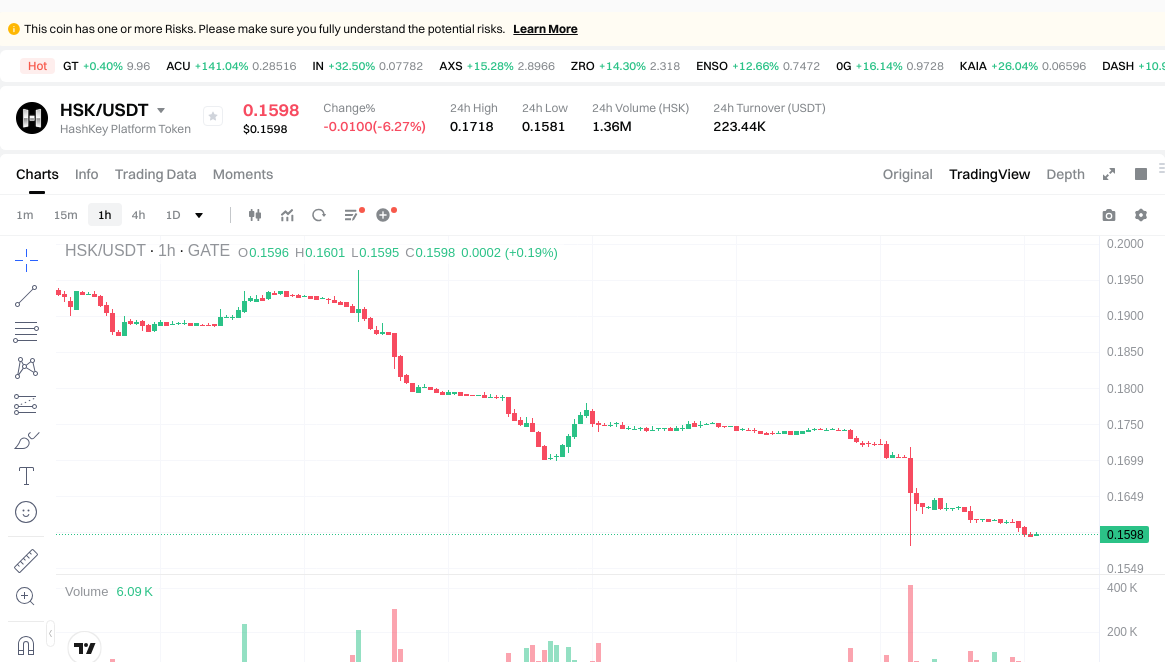
Hashkey Platform Token (HSK) represents a notable asset within the cryptocurrency ecosystem, serving as the ecosystem token of HashKey Group since its launch in November 2024. HSK is designed for utilization across HashKey's comprehensive business portfolio, which encompasses global licensed exchanges, investment and asset management, tokenization, and infrastructure services. Additionally, HSK functions as the native and gas token of HashKey Chain, a Layer 2 public blockchain infrastructure. As of January 24, 2026, HSK maintains a market capitalization of approximately $17.61 million, with a circulating supply of 110 million tokens out of a maximum supply of 1 billion tokens. The current trading price stands at $0.1601, with a 24-hour trading volume of $223,395.54. Ranked at position 932 in the cryptocurrency market, HSK holds a market dominance of 0.0049%. The token has experienced notable price fluctuations, recording a previous notable price level of $2.5936 on December 20, 2024, while more recently trading near $0.1581 on January 22, 2026. With its positioning as an ecosystem token connecting multiple business verticals and blockchain infrastructure, HSK has become a subject of analysis among investors evaluating "Is Hashkey Platform Token (HSK) a good investment?" This article examines HSK's investment characteristics, historical performance trends, future price considerations, and associated risk factors to provide informational context for market participants.
I. Historical Price Review and Current Investment Value of HSK
- 2024: Token launched in November 2024 → Initial market entry phase with price discovery
- December 2024: Price reached $2.5936 on December 20, 2024 → Significant early volatility observed
- 2025-2026: Market correction phase → Price declined from previous levels to $0.1581
Current HSK Investment Market Status (January 2026)
- Current HSK Price: $0.1601
- 24-hour Trading Volume: $223,395.54
- Market Capitalization: $17,611,000
- Circulating Supply: 110,000,000 HSK (11% of total supply)
- Market Cap to Fully Diluted Valuation Ratio: 11%
- Number of Holders: 4,173
- Trading Venues: Available on 10 exchanges
Click to view real-time HSK market price
Supply Mechanism and Scarcity (HSK investment scarcity)
- Total supply capped at 1,000,000,000 tokens with a maximum supply of 1,000,000,000 HSK → creates a defined supply framework that may influence price dynamics and investment value
- Current circulating supply stands at 110,000,000 tokens, representing 11% of total supply → indicating controlled token release and potential scarcity dynamics
- Historical price data shows HSK reached $2.5936 in December 2024 and experienced a low of $0.1581 in January 2026 → demonstrating significant price volatility
- Investment consideration: the controlled circulation ratio and capped supply structure may be relevant factors for evaluating long-term investment potential
Institutional Investment and Mainstream Adoption (Institutional investment in HSK)
- HSK serves as the ecosystem token for HashKey Group, which operates across global licensed exchanges, investment and asset management, tokenization, and infrastructure services → provides institutional backing through established financial services framework
- Current holder count stands at 4,173 addresses → indicates growing adoption within the ecosystem
- Listed on 10 exchanges with Gate.com support → demonstrates accessibility for institutional and retail participation
Macroeconomic Environment Impact on HSK Investment
- As an ecosystem token tied to regulated financial services infrastructure, HSK's investment attractiveness may be influenced by broader regulatory developments in digital asset markets
- Market conditions and monetary policy changes could affect capital flows into tokenized ecosystem projects
- HSK's integration within licensed exchange operations may position it differently compared to purely speculative tokens during periods of regulatory uncertainty
Technology and Ecosystem Development (Technology & Ecosystem for HSK investment)
- HSK functions as the native and gas token for HashKey Chain, an L2 public blockchain → provides fundamental utility within the network infrastructure
- Integration across HashKey Group's full business scenarios including licensed exchanges, investment, asset management, and tokenization services → creates multiple use cases that may support long-term value
- ERC-20 standard implementation on Ethereum network → ensures interoperability and established technical framework
- The ecosystem's focus on regulated services and infrastructure may provide differentiated positioning in the broader digital asset landscape
Short-term Investment Forecast (2026, short-term HSK investment outlook)
- Conservative forecast: $0.131 - $0.146
- Neutral forecast: $0.146 - $0.160
- Optimistic forecast: $0.160 - $0.173
-
Market stage expectations: Following a period of consolidation in early 2026, HSK may enter a recovery phase as HashKey Group continues to expand its ecosystem across licensed exchanges, asset management, and tokenization services. The integration of HSK as the native token for HashKey Chain L2 could potentially drive increased utility and adoption.
-
Investment return forecast:
- 2027: $0.111 - $0.239
- 2028: $0.191 - $0.223
-
Key catalysts: Expansion of HashKey Group's business operations, increased adoption of HashKey Chain infrastructure, potential regulatory developments in licensed crypto exchanges, and broader integration across the HashKey ecosystem.
Long-term Investment Outlook (Is HSK a good long-term investment?)
- Base scenario: $0.191 - $0.239 (assuming steady ecosystem development and maintained regulatory compliance)
- Optimistic scenario: $0.257 - $0.366 (assuming accelerated adoption of HashKey Chain and significant expansion of HashKey Group's licensed services)
- Risk scenario: $0.111 - $0.158 (under challenging market conditions or slower-than-expected ecosystem growth)
For detailed HSK long-term investment and price forecasts: Price Prediction
2026-2031 Long-term Outlook
- Base scenario: $0.160 - $0.240 USD (corresponding to steady progress and gradual mainstream application growth)
- Optimistic scenario: $0.240 - $0.366 USD (corresponding to large-scale adoption and favorable market environment)
- Transformative scenario: Above $0.366 USD (in case of breakthrough ecosystem developments and mainstream adoption)
- 2031-12-31 projected high: $0.366 USD (based on optimistic development assumptions)
Disclaimer: Price predictions are subject to significant uncertainty and should not be considered as investment advice. Actual results may vary substantially due to market volatility, regulatory changes, technological developments, and other unforeseen factors.
| Year |
Predicted High Price |
Predicted Average Price |
Predicted Low Price |
Price Change |
| 2026 |
0.172584 |
0.1598 |
0.131036 |
0 |
| 2027 |
0.23931648 |
0.166192 |
0.11134864 |
3 |
| 2028 |
0.223029664 |
0.20275424 |
0.1905889856 |
26 |
| 2029 |
0.26398602048 |
0.212891952 |
0.11070381504 |
32 |
| 2030 |
0.2765892240384 |
0.23843898624 |
0.1287570525696 |
48 |
| 2031 |
0.365670029297664 |
0.2575141051392 |
0.211161566214144 |
60 |
Investment Methodology (HSK investment strategy)
Long-term Holding (HODL HSK)
This approach is generally suitable for conservative investors who prefer to minimize frequent trading activities. Long-term holding of HSK may allow investors to participate in the potential growth of HashKey Group's expanding ecosystem, which spans licensed exchanges, investment services, asset management, tokenization, and infrastructure development. As HSK serves as both an ecosystem token across HashKey's business verticals and the native gas token for HashKey Chain (an L2 blockchain), holders may benefit from the utility demand generated across these platforms over an extended period.
Given HSK's relatively recent launch in November 2024 and its current market capitalization position, long-term holders should be prepared for substantial price fluctuations during the ecosystem's development phases.
Active Trading Strategy
Active trading of HSK relies heavily on technical analysis and swing trading techniques. Traders typically monitor price movements, volume patterns, and key support/resistance levels to identify entry and exit points. Based on available data, HSK has demonstrated considerable volatility, with recent price changes showing variations across different timeframes (positive movement over 1-hour periods contrasted with declines over 7-day and 30-day windows).
Traders should consider factors such as:
- Daily trading volume fluctuations
- Price range movements between intraday highs and lows
- Correlation with broader market trends
- Ecosystem development announcements from HashKey Group
Risk Management (Risk management for HSK investment)
Asset Allocation Ratios
Conservative Investors: May consider allocating a smaller percentage (1-3%) of their cryptocurrency portfolio to HSK, maintaining larger positions in established assets with longer track records.
Moderate/Active Investors: Might allocate 3-8% to HSK as part of a diversified approach that includes exposure to ecosystem tokens and Layer 2 solutions.
Professional/Specialized Investors: Could consider higher allocations (8-15%) if conducting thorough due diligence on HashKey Group's business development and maintaining active portfolio management practices.
Risk Hedging Solutions
A multi-asset portfolio approach can help mitigate concentration risk. Investors might consider:
- Diversification across different blockchain ecosystems and use cases
- Balancing HSK holdings with established cryptocurrencies
- Maintaining exposure to various sectors within the digital asset space
- Implementing stop-loss mechanisms for active trading positions
Secure Storage Recommendations
Cold and Hot Wallet Strategy:
- Hot wallets (software-based) for active trading portions
- Cold storage (offline) for long-term holdings
Hardware Wallet Options:
For HSK tokens deployed on Ethereum (ERC-20 standard), hardware wallet solutions that support Ethereum-based assets can provide enhanced security through offline private key storage.
Market Risks
High Volatility: HSK has experienced significant price fluctuations since its launch. Recent data indicates substantial percentage changes across different time periods, demonstrating the token's susceptibility to rapid price movements. The relatively low circulating supply compared to total supply (11% circulation ratio) may contribute to price sensitivity.
Liquidity Considerations: While HSK is available on multiple exchanges, trading volume and market depth should be evaluated when planning larger transactions, as lower liquidity can impact execution prices.
Regulatory Risks
As HSK is connected to HashKey Group's licensed financial services operations, regulatory developments in key jurisdictions may influence the token's utility and adoption. Different countries maintain varying approaches to cryptocurrency regulation, creating uncertainty around:
- Licensing requirements for token usage in financial services
- Potential restrictions on ecosystem token models
- Cross-border transaction regulations
- Tax treatment in different jurisdictions
Technical Risks
Network Security: As HSK functions as the native and gas token for HashKey Chain (a Layer 2 solution), the security and stability of the underlying blockchain infrastructure are critical factors. Potential concerns include:
- Smart contract vulnerabilities in the token implementation or related protocols
- Security of the Layer 2 network infrastructure
- Risks associated with bridge mechanisms between different chains
Upgrade and Development Risks: The HashKey Chain ecosystem is in development stages, and technical upgrades or protocol changes could introduce unforeseen complications or temporary disruptions to network operations.
Investment Value Summary
HSK represents an ecosystem token with utility across HashKey Group's diverse business operations, including licensed exchanges, asset management, and Layer 2 blockchain infrastructure. The token's dual role as both an ecosystem utility token and the native gas token for HashKey Chain provides multiple potential value drivers. However, investors should recognize that HSK has exhibited considerable short-term price volatility since its launch, with significant percentage declines observed over recent 30-day and longer-term periods.
The token's relatively early stage (launched in November 2024) and low circulating supply ratio (11% of total supply) indicate an evolving market structure that may continue to experience substantial price movements.
Investor Recommendations
✅ Beginners:
- Consider dollar-cost averaging (DCA) to reduce timing risk exposure
- Prioritize secure storage using hardware wallets or reputable cold storage solutions
- Start with conservative allocation percentages
- Focus on understanding HashKey Group's ecosystem development before increasing position sizes
✅ Experienced Investors:
- Implement swing trading strategies based on technical analysis and ecosystem developments
- Maintain diversified portfolio allocation across multiple asset categories
- Monitor HashKey Group's business announcements and ecosystem expansion progress
- Utilize risk management tools including stop-loss orders
✅ Institutional Investors:
- Evaluate HSK within the context of broader ecosystem token and Layer 2 sector allocations
- Consider strategic long-term positioning aligned with HashKey Group's licensed operations expansion
- Conduct comprehensive due diligence on regulatory compliance and business model sustainability
- Implement structured entry and exit frameworks
⚠️ Important Notice: Cryptocurrency investment involves substantial risk and potential for significant loss. Price volatility in digital assets can be extreme, and past performance does not indicate future results. This content is provided for informational purposes only and does not constitute financial advice, investment recommendation, or solicitation to buy or sell any asset. Investors should conduct independent research and consult with qualified financial advisors before making investment decisions.
VII. FAQ
Q1: What is HSK and what role does it play in the HashKey ecosystem?
HSK (Hashkey Platform Token) is the native ecosystem token of HashKey Group, launched in November 2024. It serves a dual function: first, as a utility token across HashKey Group's comprehensive business portfolio including global licensed exchanges, investment and asset management, tokenization services, and infrastructure operations; second, as the native gas token for HashKey Chain, a Layer 2 public blockchain infrastructure. This dual-purpose design enables HSK to capture value from multiple business verticals while providing essential network functionality for transaction processing on HashKey Chain. The token operates on the ERC-20 standard, ensuring interoperability within the Ethereum ecosystem.
Q2: How has HSK performed since its launch and what is its current market position?
Since launching in November 2024, HSK has experienced significant price volatility. The token reached a notable high of $2.5936 on December 20, 2024, before entering a correction phase. As of January 24, 2026, HSK trades at approximately $0.1601 with a market capitalization of $17.61 million, ranking #932 in the cryptocurrency market with 0.0049% market dominance. The circulating supply stands at 110 million tokens (11% of the maximum 1 billion supply), with 4,173 holders and availability on 10 exchanges. The 24-hour trading volume of $223,395.54 reflects the token's current liquidity levels.
Q3: What are the primary factors influencing HSK's investment potential?
HSK's investment characteristics are shaped by several key factors: (1) Supply dynamics - with only 11% of total supply currently circulating and a capped maximum of 1 billion tokens, the controlled release schedule may influence price behavior; (2) Institutional backing - HSK benefits from HashKey Group's established presence in licensed financial services, including regulated exchange operations; (3) Utility expansion - integration across HashKey's business verticals and its role as HashKey Chain's gas token provides fundamental use cases; (4) Regulatory positioning - connection to licensed operations may differentiate HSK during periods of regulatory uncertainty; (5) Ecosystem development - ongoing expansion of HashKey Group's services could drive increased token demand.
Q4: What investment strategies are suitable for HSK holders?
Two primary approaches exist for HSK investment: Long-term holding may suit conservative investors seeking exposure to HashKey Group's ecosystem growth across licensed exchanges and Layer 2 infrastructure, though substantial volatility should be expected during development phases. Active trading strategies involve technical analysis and swing trading based on price patterns, volume fluctuations, and ecosystem announcements. Asset allocation recommendations vary by investor profile: conservative investors might allocate 1-3% of cryptocurrency portfolios to HSK; moderate investors 3-8%; and professional investors 8-15% with active management. Risk management should include diversification across blockchain sectors, implementation of stop-loss mechanisms, and secure storage using hardware wallets for long-term holdings.
Q5: What are the main risks associated with investing in HSK?
HSK investment carries several significant risks: Market volatility - the token has demonstrated substantial price fluctuations, with movements from $2.5936 to $0.1581 indicating high sensitivity to market conditions. The low circulating supply ratio (11%) may amplify price swings. Liquidity risks - while available on 10 exchanges, trading volume should be evaluated for larger transactions. Regulatory uncertainty - as HSK connects to licensed financial services, regulatory developments across jurisdictions could impact token utility and adoption. Technical risks - potential smart contract vulnerabilities, Layer 2 network security concerns, and development-related complications could affect operations. Ecosystem dependency - HSK's value proposition relies heavily on HashKey Group's continued business expansion and successful ecosystem development.
Q6: What are realistic price projections for HSK through 2031?
Price forecasts for HSK vary significantly based on ecosystem development scenarios. Short-term (2026): conservative estimates range $0.131-$0.173. Mid-term (2027-2028): projections span $0.111-$0.239, dependent on HashKey Chain adoption and business expansion. Long-term (2029-2031): base scenario suggests $0.160-$0.240; optimistic scenario projects $0.240-$0.366; with transformative developments potentially exceeding $0.366. The highest projection for December 2031 reaches $0.366 under optimistic assumptions. These forecasts assume continued ecosystem development, regulatory compliance maintenance, and favorable market conditions. However, actual performance may vary substantially due to market volatility, regulatory changes, technological developments, and unforeseen factors. These projections should not be interpreted as guaranteed outcomes or investment advice.
Q7: Is HSK suitable for beginner cryptocurrency investors?
HSK presents a complex investment opportunity that may pose challenges for beginners. The token's high volatility, relatively recent launch (November 2024), and connection to specific ecosystem developments require careful evaluation. Beginners considering HSK should implement risk mitigation strategies: utilize dollar-cost averaging (DCA) to reduce timing risks; maintain conservative allocation percentages (1-3% of crypto portfolio); prioritize secure storage using hardware wallets; and thoroughly research HashKey Group's business model and ecosystem roadmap before increasing positions. Understanding the token's dual functionality as both an ecosystem utility token and Layer 2 gas token is essential. Given the significant price fluctuations observed since launch and the early-stage nature of the ecosystem, beginners should approach HSK with caution and ensure they understand the substantial risks involved, including potential for significant loss.
Q8: How does HSK's utility as a Layer 2 gas token affect its investment characteristics?
HSK's function as the native gas token for HashKey Chain significantly influences its investment profile. As a gas token, HSK is required for transaction processing on the HashKey Chain Layer 2 network, creating fundamental demand tied to network usage and adoption. This utility provides baseline value support distinct from purely speculative tokens, as increased activity on HashKey Chain directly drives HSK consumption. The Layer 2 positioning addresses Ethereum scaling challenges, potentially benefiting from broader industry trends toward Layer 2 adoption. However, this utility also exposes HSK to technical risks including network security vulnerabilities, smart contract issues, and competition from other Layer 2 solutions. The gas token function combined with ecosystem integration across HashKey Group's business verticals creates multiple demand drivers, but also introduces complexity in value assessment, as HSK's performance becomes tied to both HashKey Chain's technical success and HashKey Group's business expansion across licensed financial services.
* The information is not intended to be and does not constitute financial advice or any other recommendation of any sort offered or endorsed by Gate.