This comprehensive guide evaluates whether Hedera (HBAR) represents a viable investment opportunity by analyzing the token's technical architecture, market performance, and adoption potential. HBAR, trading at $0.116 with a $4.97 billion market cap, utilizes hashgraph consensus technology offering over 10,000 TPS and enterprise-grade security features. The analysis covers HBAR's price history from its 2021 peak of $0.569 to current levels, projects multiple scenarios through 2031 with potential highs reaching $0.263, and examines critical factors including institutional governance involvement from companies like Google and IBM. The article addresses investment strategies suitable for different investor profiles—from conservative long-term holding to active trading—while emphasizing market volatility risks, regulatory uncertainties, and technical vulnerabilities. Comprehensive risk management frameworks including asset allocation, portfolio diversification, and secure storage solutions are provided to guide in
Introduction: Hedera (HBAR)'s Investment Position and Market Prospects
HBAR is a significant asset in the cryptocurrency space. As of 2026, Hedera holds a market capitalization of approximately $4.97 billion, with a circulating supply of around 42.79 billion tokens. The current price is maintained at approximately $0.116. Positioned as a fast, secure, and fair public ledger network utilizing hashgraph consensus technology, HBAR has gradually become a focal point for investors discussing "Is Hedera (HBAR) a good investment?" With its technical characteristics including high throughput (exceeding 10,000 TPS) and asynchronous Byzantine Fault Tolerance (aBFT) security features, Hedera serves as the native cryptocurrency supporting decentralized applications, peer-to-peer payment models, and network security mechanisms. This article will comprehensively analyze HBAR's investment characteristics, historical price movements, future price outlook, and associated investment risks to provide reference for investors.
I. Hedera (HBAR) Price History Review and Investment Value Status
- 2021: HBAR reached a notable price level of $0.569229 on September 15, 2021 → The token experienced significant price appreciation during the broader crypto market rally
- 2020: During the early market phase, HBAR traded at relatively low levels, with a recorded price of $0.00986111 on January 3, 2020 → The token was in its initial market establishment period
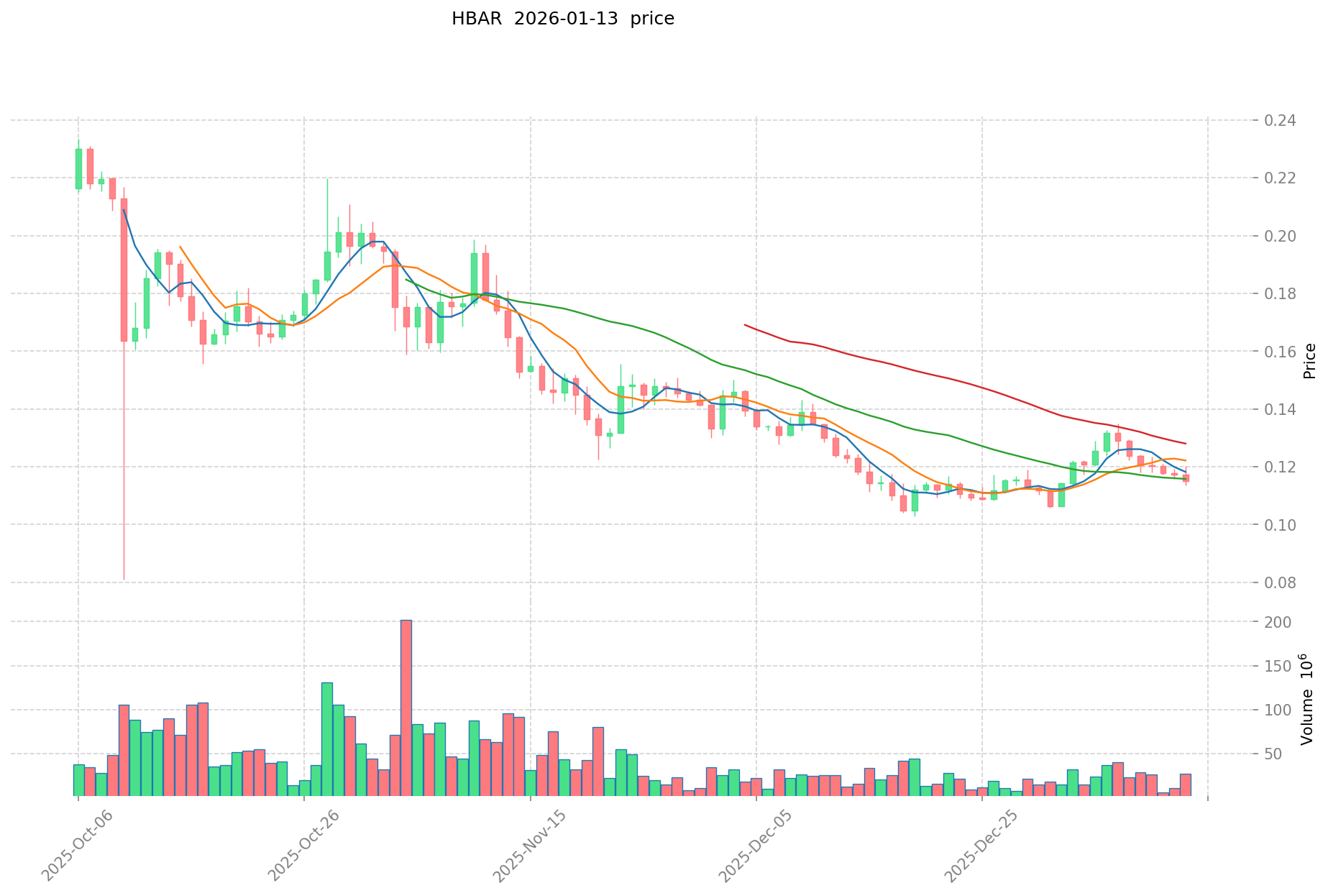
- 2024-2025: Market cycle transition phase → HBAR price declined from higher levels to the current range, with the token experiencing a yearly decline of approximately 58.26% as of January 13, 2026
Current HBAR Investment Market Status (January 2026)
- HBAR current price: $0.11607 USD (as of January 13, 2026, 20:17:49)
- 24-hour price change: +0.5%
- 24-hour trading volume: $272.11 million USD
- Current market capitalization: Approximately $4.97 billion USD
- Circulating supply: 42.79 billion HBAR (85.59% of total supply)
- Total supply: 50 billion HBAR
Click to view real-time HBAR market price
II. Core Factors Influencing Whether HBAR is a Good Investment
Supply Mechanism and Scarcity (HBAR Investment Scarcity)
- Supply Structure → Impacts price and investment value: Hedera has a maximum supply of 50 billion HBAR tokens, with approximately 42.79 billion tokens currently in circulation, representing an 85.59% circulation ratio. This defined supply ceiling provides a degree of predictability for long-term holders.
- Historical Context: HBAR reached a price point of $0.569229 in September 2021, while its lowest recorded price was $0.00986111 in January 2020, demonstrating substantial price variability over its trading history.
- Investment Significance: The fixed maximum supply framework may contribute to scarcity considerations as circulation approaches the total cap, though actual scarcity effects depend on demand dynamics and token release schedules.
Institutional Investment and Mainstream Adoption (Institutional Investment in HBAR)
- Governance Structure: Hedera operates under a council governance model that includes major corporations such as Google, IBM, and LG, providing institutional credibility to the network.
- Enterprise Focus: The network is designed for enterprise-scale adoption, targeting corporate applications rather than primarily retail users. The success of this strategy depends on converting pilot programs into measurable, real-world implementations.
- Investment Implications: Institutional involvement through governance may enhance network stability, though actual adoption metrics and on-chain activity volumes remain critical factors for evaluating investment prospects.
Macroeconomic Environment's Impact on HBAR Investment
- Monetary Policy Considerations: Some market observers note that monetary policy adjustments, including potential interest rate changes, may influence risk appetite for digital assets like HBAR.
- Market Positioning: As a utility token for a distributed ledger network rather than a store-of-value asset, HBAR's investment profile differs from assets positioned as inflation hedges.
- Regulatory Environment: Discussions around regulatory compliance, including references to SEC compliance in available materials, may affect investor sentiment and institutional participation.
Technology and Ecosystem Development (Technology & Ecosystem for HBAR Investment)
- Hashgraph Consensus Mechanism: Hedera utilizes a hashgraph consensus structure that differs from traditional blockchain architectures, claiming transaction throughput exceeding 10,000 TPS and asynchronous Byzantine Fault Tolerance (aBFT) for security.
- Network Functionality: HBAR serves dual roles within the Hedera network, supporting decentralized applications and facilitating peer-to-peer payment models while contributing to network security mechanisms.
- Ecosystem Applications: The network's utility model is oriented toward supporting various applications, though the breadth and depth of actual ecosystem activity remain important factors for assessing long-term investment value. The conversion of enterprise pilots into production-level deployments will likely influence the token's utility and demand dynamics.
III. HBAR Future Investment Forecast and Price Outlook (Is Hedera(HBAR) worth investing in 2026-2031)
Short-term HBAR investment outlook (2026)
- Conservative forecast: $0.081 - $0.116
- Neutral forecast: $0.116 - $0.123
- Optimistic forecast: $0.123 - $0.141
Mid-term Hedera(HBAR) investment forecast (2027-2029)
-
Market phase expectation: Hedera is anticipated to undergo gradual network expansion with increasing enterprise adoption across supply chain, tokenization, and payment sectors. The mid-term period may witness moderate price appreciation driven by growing on-chain activity and staking participation.
-
Investment return forecast:
- 2027: $0.061 - $0.166
- 2028: $0.113 - $0.177
- 2029: $0.118 - $0.184
-
Key catalysts: Enterprise adoption momentum, expansion of Hedera Token Service utilization, regulatory clarity favoring compliant distributed ledger solutions, and carbon-negative network positioning attracting sustainability-focused institutions.
Long-term investment outlook (Is HBAR a good long-term investment?)
- Baseline scenario: $0.134 - $0.186 by 2031 (assumes steady ecosystem development and sustained enterprise engagement)
- Optimistic scenario: $0.186 - $0.263 by 2031 (assumes accelerated institutional adoption and favorable macroeconomic conditions)
- Risk scenario: Below $0.081 (under conditions of prolonged market downturn, intensified competition, or regulatory headwinds)
For long-term HBAR investment analysis and price forecasts: Price Prediction
2026-2031 Long-term Outlook
- Baseline scenario: $0.08 - $0.20 (corresponding to steady progress and gradual mainstream application growth)
- Optimistic scenario: $0.18 - $0.26 (corresponding to large-scale adoption and favorable market environment)
- Transformative scenario: Above $0.26 (if the ecosystem achieves breakthrough developments and widespread mainstream adoption)
- Predicted high by December 31, 2031: $0.263 (based on optimistic development assumptions)
Disclaimer: All price forecasts are speculative and subject to inherent market volatility. Predictions are derived from historical data, technical analysis, and market sentiment, but do not guarantee future performance. Cryptocurrency investments carry significant risk, and investors should conduct independent research and consider their risk tolerance before making investment decisions. This content does not constitute financial advice.
| Year |
Predicted High Price |
Predicted Average Price |
Predicted Low Price |
Price Change |
| 2026 |
0.1231296 |
0.11616 |
0.081312 |
0 |
| 2027 |
0.166306272 |
0.1196448 |
0.061018848 |
3 |
| 2028 |
0.17728966464 |
0.142975536 |
0.11295067344 |
23 |
| 2029 |
0.184152490368 |
0.16013260032 |
0.1184981242368 |
37 |
| 2030 |
0.2237853089472 |
0.172142545344 |
0.13427118536832 |
48 |
| 2031 |
0.263292023103648 |
0.1979639271456 |
0.186086091516864 |
70 |
IV. HBAR Investment Strategy and Risk Management (How to invest in HBAR)
Investment Methodology (HBAR investment strategy)
Long-term Holding (HODL HBAR): Suitable for conservative investors
Long-term holding represents a strategy where investors acquire HBAR tokens and maintain positions over extended periods, regardless of short-term price fluctuations. This approach may be appropriate for investors who have confidence in Hedera's underlying technology and long-term adoption potential. The hashgraph consensus mechanism and the network's focus on enterprise-grade applications could potentially provide fundamental support for long-term value, though market conditions remain inherently unpredictable.
Active Trading: Relying on technical analysis and swing trading
Active trading involves utilizing technical analysis tools and market indicators to identify potential entry and exit points for HBAR positions. Given the token's price movements (24-hour range: $0.11357 - $0.11831, with a 7-day change of -11.70%), traders may seek to capitalize on price volatility. This strategy requires substantial time commitment, analytical skills, and understanding of market dynamics. Traders should monitor trading volume ($2,721,101.24 in 24-hour volume) and market sentiment indicators when executing trades.
Risk Management (Risk management for HBAR investment)
Asset Allocation Ratio: Conservative / Aggressive / Professional investors
- Conservative investors: May consider allocating 1-5% of their cryptocurrency portfolio to HBAR, maintaining majority holdings in more established assets
- Aggressive investors: Could allocate 10-20% to HBAR as part of a growth-oriented cryptocurrency portfolio
- Professional investors: May implement dynamic allocation strategies based on market conditions, fundamental analysis, and risk tolerance parameters
With HBAR representing 0.17% of the total cryptocurrency market and ranking #30 by market capitalization ($4.97 billion), investors should consider position sizing relative to overall portfolio objectives.
Risk Hedging Solutions: Multi-asset portfolio + hedging instruments
Risk mitigation strategies for HBAR investments may include:
- Portfolio diversification across different cryptocurrency categories and blockchain protocols
- Correlation analysis with traditional financial assets
- Utilization of stablecoins for temporary capital preservation during volatile periods
- Implementation of stop-loss orders to limit potential downside exposure
Secure Storage: Hot and cold wallets + hardware wallet recommendations
Proper storage of HBAR tokens is essential for investment security:
- Cold wallets: Hardware wallets provide offline storage solutions, offering enhanced security against online threats
- Hot wallets: Online wallets offer convenience for active trading but require robust security practices
- Hardware wallet options: Investors should research compatible hardware wallet solutions that support HBAR storage
- Security best practices: Multi-factor authentication, regular software updates, and secure backup of recovery phrases
V. HBAR Investment Risks and Challenges (Risks of investing in HBAR)
Market Risk: High volatility and price manipulation
HBAR exhibits significant price volatility, as evidenced by its 1-year performance showing a -58.26% change. The token has experienced substantial price movements from its all-time high of $0.569229 (September 15, 2021) to its current price of $0.11607. Such volatility can result in rapid capital appreciation or significant losses. The cryptocurrency market's relatively lower liquidity compared to traditional financial markets may create conditions where price movements can be influenced by large transactions or coordinated trading activities.
Regulatory Risk: Policy uncertainty across different jurisdictions
The regulatory environment for cryptocurrencies varies substantially across jurisdictions and continues to evolve. Hedera and HBAR face potential regulatory developments that could impact:
- Token classification and securities law implications
- Taxation frameworks for cryptocurrency transactions
- Compliance requirements for network participants and service providers
- Cross-border transaction regulations and restrictions
Changes in regulatory frameworks may affect HBAR's accessibility, trading venues, and adoption trajectory in different markets.
Technical Risk: Network security vulnerabilities and upgrade failures
While Hedera employs hashgraph consensus technology with aBFT (asynchronous Byzantine Fault Tolerance) security properties, technical risks remain:
- Potential undiscovered vulnerabilities in the protocol or implementation
- Risks associated with network upgrades and protocol changes
- Dependencies on the Hedera Governing Council and network governance decisions
- Smart contract vulnerabilities in applications built on the Hedera network
- Interoperability challenges with other blockchain ecosystems
With a circulating supply of 42.79 billion HBAR (85.59% of maximum supply) and network operations supporting applications, technical stability remains an ongoing consideration.
VI. Conclusion: Is HBAR a Good Investment?
Investment Value Summary
HBAR presents characteristics that may appeal to different investor profiles, though substantial uncertainty remains. The Hedera network's hashgraph consensus technology, claimed transaction throughput capacity (>10,000 TPS), and focus on enterprise applications represent potential technical differentiators. However, the token has experienced significant price volatility, declining -58.26% over the past year while maintaining a market capitalization ranking of #30 among cryptocurrencies.
The network's governance structure, circulating supply dynamics (85.59% of maximum supply already in circulation), and adoption trajectory will likely influence long-term value prospects, though outcomes remain uncertain.
Investor Recommendations
✅ Beginners: Consider dollar-cost averaging (DCA) strategies combined with secure wallet storage solutions. Focus on understanding the technology and market dynamics before committing substantial capital.
✅ Experienced Investors: May evaluate swing trading opportunities based on technical analysis while maintaining diversified portfolio allocations. Consider fundamental analysis of network adoption metrics and ecosystem development.
✅ Institutional Investors: Could assess strategic long-term allocation potential based on comprehensive due diligence, regulatory compliance requirements, and portfolio management objectives.
⚠️ Disclaimer: Cryptocurrency investments involve substantial risk, including possible loss of principal. This content is for informational purposes only and does not constitute investment advice. Market conditions, regulatory environments, and technological factors may change. Investors should conduct independent research and consider consulting with qualified financial advisors before making investment decisions.
VII. FAQ
Q1: What is the current price of HBAR and how has it performed historically?
As of January 13, 2026, HBAR is trading at approximately $0.116 USD with a 24-hour trading volume of $272.11 million. Historically, HBAR reached its all-time high of $0.569229 on September 15, 2021, during the broader crypto market rally. The token has experienced significant volatility, declining approximately 58.26% over the past year from higher levels. Its historical low was recorded at $0.00986111 in January 2020 during its initial market establishment period. The token currently maintains a market capitalization of approximately $4.97 billion, ranking #30 among cryptocurrencies.
Q2: What makes Hedera's technology different from traditional blockchain networks?
Hedera utilizes hashgraph consensus technology rather than traditional blockchain architecture, which represents a fundamental technical difference. The network claims transaction throughput exceeding 10,000 TPS (transactions per second) and employs asynchronous Byzantine Fault Tolerance (aBFT) for security. HBAR serves as the native cryptocurrency supporting decentralized applications, peer-to-peer payment models, and network security mechanisms. The network is governed by a council that includes major corporations such as Google, IBM, and LG, distinguishing it from purely decentralized blockchain projects. This enterprise-focused governance structure aims to support large-scale commercial applications.
Q3: What are the price predictions for HBAR from 2026 to 2031?
Short-term forecasts for 2026 range from $0.081 (conservative) to $0.141 (optimistic). Mid-term projections show potential price ranges of $0.061-$0.166 for 2027, $0.113-$0.177 for 2028, and $0.118-$0.184 for 2029. Long-term outlook by 2031 presents three scenarios: baseline ($0.134-$0.186), optimistic ($0.186-$0.263), and risk scenario (below $0.081). The predicted high by December 31, 2031, is $0.263 based on optimistic development assumptions. However, these forecasts are speculative and subject to market volatility, regulatory changes, and adoption rates. All predictions do not guarantee future performance and should not be considered financial advice.
Q4: What investment strategies are suitable for HBAR?
Two primary strategies exist for HBAR investment. Long-term holding (HODL) suits conservative investors who believe in Hedera's technology and enterprise adoption potential, despite short-term price fluctuations. Active trading involves utilizing technical analysis to capitalize on price volatility, monitoring indicators like the 24-hour trading volume ($272.11 million) and price movements. Asset allocation recommendations vary by investor type: conservative investors may allocate 1-5% of their cryptocurrency portfolio to HBAR, aggressive investors 10-20%, while professional investors may implement dynamic allocation strategies based on market conditions and fundamental analysis.
Q5: What are the major risks associated with investing in HBAR?
HBAR faces three primary risk categories. Market risk includes high volatility evidenced by the -58.26% decline over the past year and potential price manipulation in relatively lower liquidity conditions. Regulatory risk encompasses policy uncertainty across jurisdictions, token classification implications, taxation frameworks, and compliance requirements that vary substantially by region and continue evolving. Technical risk involves potential undiscovered protocol vulnerabilities, network upgrade failures, governance dependencies, smart contract vulnerabilities in applications built on Hedera, and interoperability challenges with other blockchain ecosystems. These risks require careful consideration and appropriate risk management strategies.
Q6: How should investors securely store their HBAR tokens?
Proper storage of HBAR tokens involves multiple security layers. Cold wallets, particularly hardware wallets, provide offline storage solutions offering enhanced security against online threats and are recommended for long-term holdings. Hot wallets offer convenience for active trading but require robust security practices including multi-factor authentication and regular software updates. Investors should research compatible hardware wallet solutions that support HBAR storage and implement security best practices such as secure backup of recovery phrases, avoiding phishing attempts, and keeping wallet software updated. The choice between hot and cold storage depends on trading frequency and security priorities.
Q7: What factors could drive HBAR's future value appreciation?
Several factors may influence HBAR's potential value growth. Enterprise adoption momentum across supply chain, tokenization, and payment sectors represents a key catalyst, as the network's design targets corporate applications. Expansion of Hedera Token Service utilization and growth in on-chain activity could increase token demand. Regulatory clarity favoring compliant distributed ledger solutions may enhance institutional participation. The network's carbon-negative positioning could attract sustainability-focused institutions. The Hedera Governing Council's institutional credibility and the network's claimed technical advantages (>10,000 TPS, aBFT security) may support adoption, though actual implementation metrics and mainstream integration remain critical determinants of long-term value.
Q8: Is HBAR suitable for beginners or should only experienced investors consider it?
HBAR can accommodate different investor experience levels with appropriate strategies. Beginners should consider dollar-cost averaging (DCA) strategies to mitigate timing risk, combined with secure wallet storage solutions, while focusing on understanding the technology and market dynamics before committing substantial capital. Experienced investors may evaluate swing trading opportunities based on technical analysis while maintaining diversified portfolio allocations and conducting fundamental analysis of network adoption metrics. Institutional investors could assess strategic long-term allocation potential through comprehensive due diligence. However, all investor categories must recognize that cryptocurrency investments involve substantial risk, including possible loss of principal, requiring independent research and potentially consultation with qualified financial advisors.
* The information is not intended to be and does not constitute financial advice or any other recommendation of any sort offered or endorsed by Gate.