Heima (HEI) is a Layer 1 blockchain evolved from Litentry Network, designed for multi-chain and cross-chain interoperability with advanced security modules. As of January 2026, HEI trades at $0.1459 with a $9.87 million market cap, showing recent 21.66% gains over 7 days despite a 75.36% one-year decline. This comprehensive analysis examines HEI's historical price trends, current market status, and core investment factors including supply mechanisms, institutional adoption, and technology development. The article provides detailed price forecasts from 2026 to 2031, ranging from conservative to optimistic scenarios, while addressing critical investment risks such as high volatility, liquidity concerns, and regulatory uncertainties. Investment strategies are tailored for different investor types on Gate exchange, with risk management recommendations and allocation guidelines. The analysis concludes that HEI represents an early-stage project suitable for risk-tolerant investors willing to conduct thorough due di
Introduction: Heima (HEI)'s Investment Position and Market Outlook
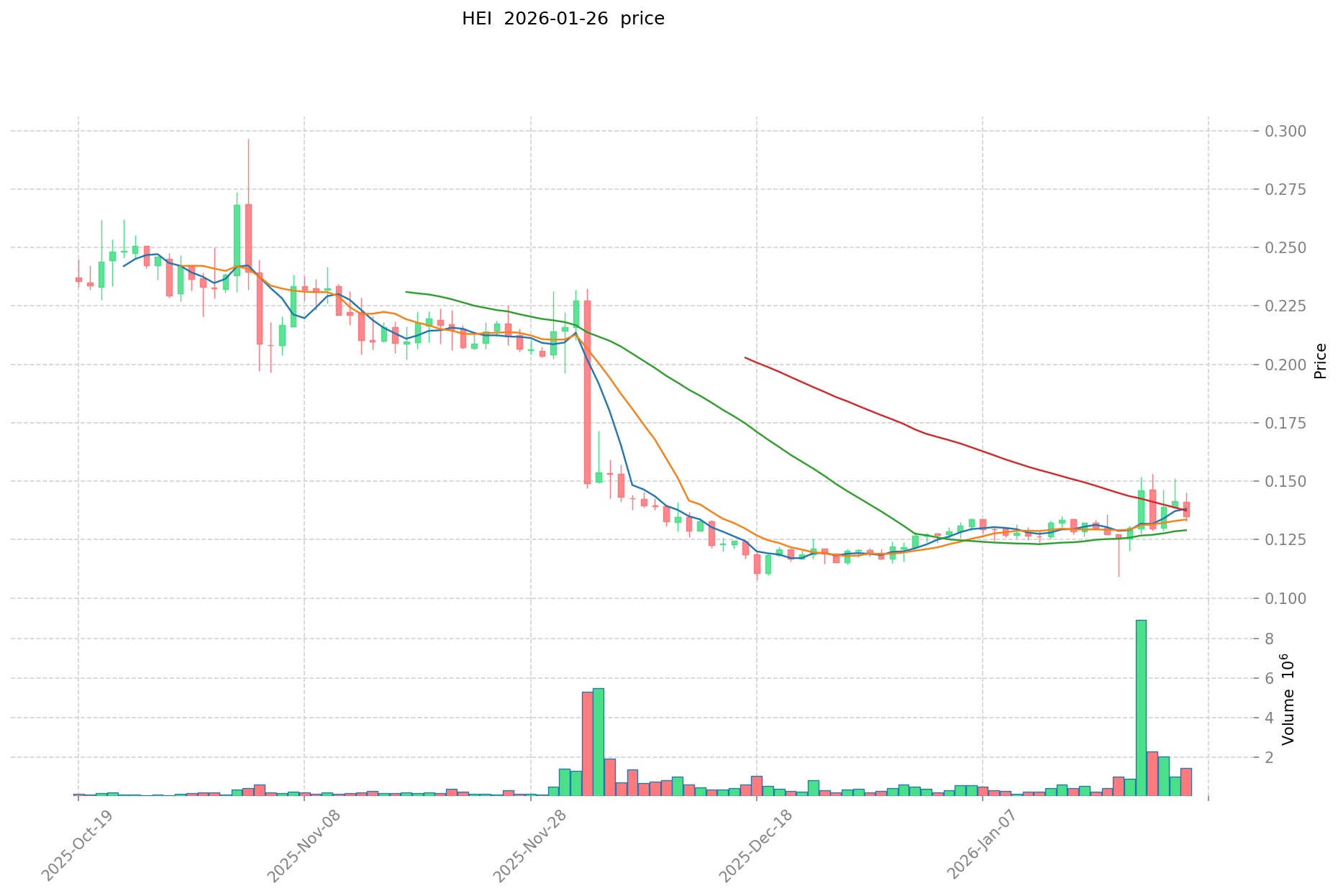
HEI is a notable asset in the cryptocurrency space. As of January 26, 2026, Heima holds a market capitalization of approximately $9.87 million, with a circulating supply of around 67.62 million tokens and a current price maintained at approximately $0.1459. The token has demonstrated recent price momentum, with a 21.66% increase over the past 7 days and a 22.37% gain over the past 30 days. Heima Network is characterized as a Layer 1 blockchain evolved from the Litentry Network, designed to enable multi-chain and cross-chain interoperability with integrated advanced security modules and exchange chain abstraction support. As investors explore the question "Is Heima (HEI) a good investment?", this article will comprehensively analyze HEI's investment value, historical price trends, future price predictions, and investment risks to provide reference for investors.
I. Heima (HEI) Price History Review and Current Investment Value
- 2025 February: Token launch and early trading phase → HEI reached a notable price level of $1.25 during initial market activity
- 2025 October: Market correction period → Price experienced significant adjustment, declining to lower valuation levels
- 2025-2026: Market volatility cycle → Price fluctuated from higher valuation ranges to current trading levels, reflecting broader market dynamics
Current HEI Investment Market Status (January 2026)
- HEI Current Price: $0.1459
- Market Sentiment (Fear & Greed Index): Data not available in provided materials
- 24-hour Trading Volume: $202,145.36
- Institutional Investor Holdings: Data not available in provided materials
Click to view real-time HEI market price
II. Core Factors Affecting Whether HEI is a Good Investment (Is Heima(HEI) a Good Investment)
Supply Mechanism and Scarcity (HEI investment scarcity)
- Maximum supply capped at 92,859,274 HEI → influences price and investment value
- Current circulating supply stands at 67,616,329 HEI, representing approximately 72.82% of total supply
- Historical performance: HEI reached a notable price level of $1.25 in February 2025, later declining to $0.04755675 in October 2025
- Investment significance: the defined supply cap may support long-term scarcity considerations
Institutional Investment and Mainstream Adoption (Institutional investment in HEI)
- Current holder count: 842 addresses
- Trading availability: listed on 21 exchanges as of January 2026
- Market capitalization represents 0.00043% of total crypto market share
Macroeconomic Environment's Impact on HEI Investment
- Monetary policy and interest rate changes → may alter investment attractiveness
- Inflationary environment considerations → potential digital asset positioning
- Geopolitical uncertainties → could influence demand for crypto assets
Technology and Ecosystem Development (Technology & Ecosystem for HEI investment)
- Layer 1 blockchain architecture: designed for multi-chain and cross-chain interoperability
- Evolution from Litentry Network: integrates advanced security modules and exchange chain abstraction support
- Contract deployment: available on both ETH and BSC networks via ERC-20 standard
- Current trading volume: $202,145.36 over 24 hours as of January 26, 2026
III. HEI Future Investment Forecast and Price Outlook (Is Heima(HEI) worth investing in 2026-2031)
Short-term Investment Forecast (2026, short-term HEI investment outlook)
- Conservative forecast: $0.08658 - $0.1443
- Neutral forecast: $0.1443 - $0.150072
- Optimistic forecast: $0.150072 and above
Mid-term Investment Outlook (2027-2029, mid-term Heima(HEI) investment forecast)
- Market stage expectation: The HEI token may experience gradual growth as the Heima Network develops its multi-chain and cross-chain interoperability infrastructure. The period could see increased adoption of the Layer 1 blockchain's security modules and chain abstraction features.
- Investment return forecast:
- 2027: $0.09272718 - $0.18839808
- 2028: $0.1459790748 - $0.2231634132
- 2029: $0.140743963152 - $0.271714039974
- Key catalysts: Network expansion, technical upgrades, ecosystem development, and broader adoption of cross-chain solutions.
Long-term Investment Outlook (Is HEI a good long-term investment?)
- Base scenario: $0.197365161789186 - $0.32236231893606 (assuming steady development and moderate market conditions)
- Optimistic scenario: $0.32236231893606 - $0.408629278633949 (assuming accelerated adoption and favorable market environment)
- Risk scenario: Below $0.197365161789186 (under challenging market conditions or technical setbacks)
Click to view HEI long-term investment and price forecast: Price Prediction
2026-01-26 to 2031 Long-term Outlook
- Base scenario: $0.197365161789186 - $0.32236231893606 (corresponding to steady progress and gradual mainstream application growth)
- Optimistic scenario: $0.32236231893606 - $0.408629278633949 (corresponding to large-scale adoption and favorable market conditions)
- Transformative scenario: Above $0.408629278633949 (if the ecosystem achieves breakthrough development and mainstream adoption)
- 2031-12-31 predicted high: $0.408629278633949 (based on optimistic development assumptions)
Disclaimer: Cryptocurrency investments carry significant risks. Price predictions are based on historical data and market analysis, and actual results may vary substantially. This analysis does not constitute investment advice. Investors should conduct thorough research and consider their risk tolerance before making investment decisions.
| Year |
Predicted High Price |
Predicted Average Price |
Predicted Low Price |
Price Change |
| 2026 |
0.150072 |
0.1443 |
0.08658 |
-1 |
| 2027 |
0.18839808 |
0.147186 |
0.09272718 |
0 |
| 2028 |
0.2231634132 |
0.16779204 |
0.1459790748 |
15 |
| 2029 |
0.271714039974 |
0.1954777266 |
0.140743963152 |
33 |
| 2030 |
0.32236231893606 |
0.233595883287 |
0.22425204795552 |
60 |
| 2031 |
0.408629278633949 |
0.27797910111153 |
0.197365161789186 |
90 |
IV. Heima (HEI) Investment Strategy and Risk Management (How to invest in Layer 1 blockchain)
Investment Methodology (Heima investment strategy)
Long-term Holding (HODL Heima)
Long-term holding may be suitable for steady investors who believe in the project's multi-chain and cross-chain interoperability vision. Given Heima's evolution from Litentry Network and its focus on advanced security modules, investors with a longer time horizon might consider this approach. However, it's important to note that HEI has experienced significant price volatility, with a one-year decline of 75.36% as of January 26, 2026.
Active Trading
Active trading relies on technical analysis and swing trading strategies. Traders may monitor HEI's price movements across different timeframes - the token showed a 0.21% change in 1 hour, 2.82% in 24 hours, and 21.66% over 7 days. The 24-hour trading range between $0.1328 and $0.1477 provides potential opportunities for short-term traders, though such strategies require constant market monitoring and carry higher risk.
Risk Management (Risk management for Heima investment)
Asset Allocation Ratio
- Conservative investors: May consider allocating 1-3% of their crypto portfolio to HEI, given its smaller market capitalization of approximately $9.87 million and ranking of 1210
- Aggressive investors: Could allocate 5-10% while maintaining diversification across multiple assets
- Professional investors: May adjust allocation based on detailed project analysis and risk tolerance, typically not exceeding 15% in a single Layer 1 project
Risk Hedging Solutions
Investors might consider:
- Maintaining a diversified portfolio across different blockchain categories
- Setting stop-loss orders to limit potential downside
- Monitoring the market capitalization to fully diluted valuation ratio (currently 72.82%)
Secure Storage
- Cold wallet: Recommended for long-term holdings
- Hot wallet: For active trading purposes only, keeping minimal amounts
- Hardware wallet: Consider reputable options for enhanced security when storing significant amounts
- Note: HEI operates on both BSC and ETH chains (contract address: 0xf8f173e20e15f3b6cb686fb64724d370689de083), so ensure wallet compatibility
V. Heima (HEI) Investment Risks and Challenges (Risks of investing in Layer 1 blockchain)
Market Risk
- High volatility: HEI demonstrated significant price fluctuations, with a 75.36% decline over one year while showing a 21.66% increase over 7 days, indicating substantial short-term volatility
- Price manipulation potential: With a relatively small 24-hour trading volume of approximately $202,145 and 842 holders, the token may be susceptible to price manipulation
- Liquidity concerns: Lower trading volumes compared to major cryptocurrencies may result in wider bid-ask spreads
Regulatory Risk
- Policy uncertainty: Different jurisdictions maintain varying approaches to cryptocurrency regulation, which could impact project operations and token accessibility
- Compliance requirements: Changes in regulatory frameworks may affect the project's ability to operate across multiple chains
- Exchange listings: Currently available on 21 exchanges, but regulatory changes could impact listing status
Technical Risk
- Network security: As a Layer 1 blockchain focused on cross-chain interoperability, the project faces complex security challenges
- Upgrade implementation: Technical upgrades and protocol changes carry execution risks
- Smart contract vulnerabilities: The token's deployment on multiple chains (BSC and ETH) increases the complexity of maintaining security across platforms
- Project evolution: As Heima evolved from Litentry Network, transition-related technical challenges may emerge
VI. Conclusion: Is Layer 1 blockchain a Good Investment?
Investment Value Summary
Heima (HEI) presents a project focused on multi-chain and cross-chain interoperability, a relevant sector in the blockchain ecosystem. However, the token has experienced considerable price volatility, with a 75.36% decline over the past year despite recent short-term gains. The relatively small market capitalization, limited holder base, and trading volume suggest early-stage project characteristics with associated risks.
Investor Recommendations
✅ Beginners:
- Consider starting with educational research about Layer 1 blockchains and cross-chain technology
- If investing, use dollar-cost averaging to reduce timing risk
- Store assets in secure wallets (hardware wallet recommended)
- Start with minimal allocation within overall crypto portfolio
✅ Experienced investors:
- Monitor price action and trading volumes for swing trading opportunities
- Maintain diversified portfolio allocation across multiple blockchain projects
- Stay updated on project developments and technical milestones
- Set clear entry and exit strategies
✅ Institutional investors:
- Conduct comprehensive due diligence on technology and team
- Consider strategic long-term allocation only after thorough risk assessment
- Monitor market capitalization trends and holder distribution
- Evaluate cross-chain interoperability sector competitiveness
⚠️ Disclaimer: Cryptocurrency investment carries high risk. This content is for informational purposes only and does not constitute investment advice. Past performance does not guarantee future results. Investors should conduct their own research and consider their risk tolerance before making investment decisions.
VII. FAQ
Q1: What is Heima (HEI) and what makes it different from other Layer 1 blockchains?
Heima (HEI) is a Layer 1 blockchain that evolved from the Litentry Network, designed specifically for multi-chain and cross-chain interoperability with integrated advanced security modules and exchange chain abstraction support. What distinguishes Heima from other Layer 1 projects is its focus on seamless cross-chain functionality, allowing different blockchain networks to interact efficiently. The project operates on both BSC and ETH networks via ERC-20 standard, providing flexibility for users across multiple ecosystems. As of January 2026, HEI has a market capitalization of approximately $9.87 million with 67.62 million tokens in circulation, representing about 72.82% of its maximum supply of 92.86 million tokens.
Q2: How has Heima (HEI) performed historically, and is it currently a good investment?
Historically, HEI has experienced significant price volatility. The token launched in February 2025 at a notable price level of $1.25 but subsequently declined to $0.04755675 by October 2025. As of January 26, 2026, HEI trades at approximately $0.1459, showing recent positive momentum with a 21.66% increase over 7 days and 22.37% gain over 30 days, though it remains down 75.36% over one year. Whether HEI is a good investment depends on your risk tolerance and investment horizon. Conservative investors might allocate 1-3% of their crypto portfolio, while more aggressive investors could consider 5-10%. The project's small market cap, limited trading volume ($202,145 in 24 hours), and 842 holder base suggest it's an early-stage project with both growth potential and significant risks.
Q3: What are the price predictions for Heima (HEI) from 2026 to 2031?
Short-term (2026), HEI is forecasted to trade between $0.08658 (conservative) and $0.150072 (optimistic). Mid-term projections show potential growth: 2027 ($0.09272718-$0.18839808), 2028 ($0.1459790748-$0.2231634132), and 2029 ($0.140743963152-$0.271714039974). Long-term outlook for 2030-2031 ranges from a base scenario of $0.197365161789186 to an optimistic high of $0.408629278633949 by December 31, 2031. These predictions assume steady network development, increased adoption of cross-chain solutions, and favorable market conditions. However, it's crucial to understand that cryptocurrency price predictions are highly speculative and actual performance may differ significantly due to market volatility, regulatory changes, technical challenges, and competition in the Layer 1 blockchain space.
Q4: What are the main risks associated with investing in Heima (HEI)?
Investing in HEI carries several significant risks. Market risk includes high volatility (75.36% one-year decline despite recent gains), potential price manipulation due to relatively low trading volume and small holder base (842 addresses), and liquidity concerns compared to major cryptocurrencies. Regulatory risk involves policy uncertainty across different jurisdictions, potential compliance requirement changes, and possible impacts on exchange listings (currently available on 21 exchanges). Technical risks encompass network security challenges inherent to cross-chain interoperability, smart contract vulnerabilities across multiple chains (BSC and ETH), and potential issues related to the project's evolution from Litentry Network. The token's small market capitalization ($9.87 million) and ranking (1210) also indicate higher risk compared to established projects.
Q5: How should different types of investors approach Heima (HEI) investment?
Investment approach should vary based on experience level and risk tolerance. Beginners should start with educational research about Layer 1 blockchains and cross-chain technology, use dollar-cost averaging to reduce timing risk, allocate only minimal amounts within their overall crypto portfolio, and store assets in secure hardware wallets. Experienced investors can monitor price action for swing trading opportunities (noting the 24-hour range of $0.1328-$0.1477), maintain diversified portfolio allocation across multiple blockchain projects, stay updated on technical milestones, and set clear entry/exit strategies. Institutional investors should conduct comprehensive due diligence on technology and team, evaluate the project's competitiveness in the cross-chain interoperability sector, monitor market capitalization trends and holder distribution, and consider strategic long-term allocation only after thorough risk assessment. Regardless of experience level, investors should never invest more than they can afford to lose.
Q6: What investment strategies work best for Heima (HEI)?
Two primary strategies exist for HEI investment. Long-term holding (HODL) may suit steady investors who believe in the project's multi-chain and cross-chain interoperability vision, particularly given Heima's evolution from Litentry Network and focus on advanced security modules. This approach requires patience through volatility cycles and faith in the project's long-term development. Active trading relies on technical analysis and swing trading strategies, with traders monitoring HEI's price movements across different timeframes (the token showed 0.21% change in 1 hour, 2.82% in 24 hours, and 21.66% over 7 days). The 24-hour trading range provides opportunities for short-term traders, though this requires constant market monitoring and carries higher risk. For risk management, conservative investors should allocate 1-3% of their crypto portfolio to HEI, aggressive investors 5-10%, and professional investors up to 15% after detailed analysis. Implementing stop-loss orders, maintaining portfolio diversification, and using appropriate wallet storage (cold wallet for long-term, hot wallet for minimal trading amounts) are essential risk management practices.
Q7: What key factors should I monitor to evaluate Heima (HEI)'s investment potential?
Several core factors influence HEI's investment value. Supply mechanism and scarcity considerations include the maximum supply cap of 92,859,274 HEI with current circulation at 67,616,329 HEI (72.82% of total supply), which may support long-term scarcity considerations. Technology and ecosystem development factors encompass the Layer 1 blockchain architecture designed for multi-chain and cross-chain interoperability, integration of advanced security modules, and deployment on both ETH and BSC networks. Market adoption metrics to track include the current 842 holder count, availability on 21 exchanges, and 24-hour trading volume of $202,145. Additionally, monitor macroeconomic factors such as monetary policy changes, inflationary environment impacts on digital asset positioning, and geopolitical uncertainties affecting crypto demand. The project's evolution from Litentry Network and progress in implementing cross-chain solutions are also critical indicators of long-term viability and investment potential.
Q8: Where can I safely buy and store Heima (HEI) tokens?
HEI tokens are currently available on 21 exchanges as of January 2026, providing multiple purchasing options for investors. When selecting an exchange, consider factors such as trading volume, security features, regulatory compliance, and fee structures. For storage, security practices vary based on investment approach and amount. Long-term holders should utilize cold wallet storage for maximum security, keeping private keys completely offline. Active traders may use hot wallets for convenience but should maintain only minimal amounts necessary for trading activities. For significant holdings, hardware wallets from reputable manufacturers offer an optimal balance of security and accessibility. Since HEI operates on both BSC and ETH chains with contract address 0xf8f173e20e15f3b6cb686fb64724d370689de083, ensure your chosen wallet supports the appropriate blockchain network. Never share private keys or seed phrases, enable two-factor authentication where available, and regularly update wallet software to maintain security. Always verify contract addresses before transactions to avoid scams.
* The information is not intended to be and does not constitute financial advice or any other recommendation of any sort offered or endorsed by Gate.