This comprehensive analysis examines Heima (HEI), a Layer 1 blockchain focused on multi-chain interoperability trading at $0.1438 with a $9.72M market cap. The article evaluates HEI's investment potential by analyzing historical price performance, supply dynamics, technological fundamentals, and macro factors. It provides price forecasts across multiple scenarios through 2031, ranging from $0.107-$0.266, and presents differentiated investment strategies for conservative, aggressive, and institutional investors. Risk management recommendations emphasize portfolio allocation limits (1-10% based on risk profile) and diversification strategies. The analysis identifies three primary risks: market volatility, regulatory uncertainty, and technical vulnerabilities. Suitable for investors evaluating Layer 1 blockchain opportunities, this guide combines technical analysis with practical investment guidance on Gate exchange trading.
Introduction: Heima (HEI) Investment Position and Market Outlook
Heima (HEI) represents a noteworthy asset in the cryptocurrency sector, operating as a Layer 1 blockchain focused on multi-chain and cross-chain interoperability. As of January 26, 2026, HEI maintains a market capitalization of approximately $9.72 million with a circulating supply of 67.62 million tokens, trading at around $0.1438. The project evolved from the Litentry Network, integrating advanced security modules and chain abstraction capabilities. With a market ranking of 1,215 and trading across 21 exchanges, HEI has established a presence in the blockchain infrastructure space. The token holds a circulating supply ratio of 72.82% relative to its total supply of 92.86 million tokens. This analysis examines HEI's investment characteristics, historical performance patterns, future outlook considerations, and associated risk factors to provide informational context for market participants evaluating "Is Heima (HEI) a good investment?"
I. Heima (HEI) Price History Review and Current Investment Value
- February 2025: HEI reached a notable price level of $1.25 → subsequent price adjustments followed market dynamics
- October 2025: Market correction phase → HEI experienced downward pressure to lower price ranges
- 2025-2026 Market Cycle: Price fluctuated from higher valuation levels to more moderate positions, reflecting broader market conditions
Current HEI Investment Market Status (January 2026)
- HEI Current Price: $0.1438
- Market Sentiment (Fear & Greed Index): Data not available in provided materials
- 24-hour Trading Volume: $232,048.34
- Institutional Investor Holdings: Data not available in provided materials
Click to view real-time HEI market price
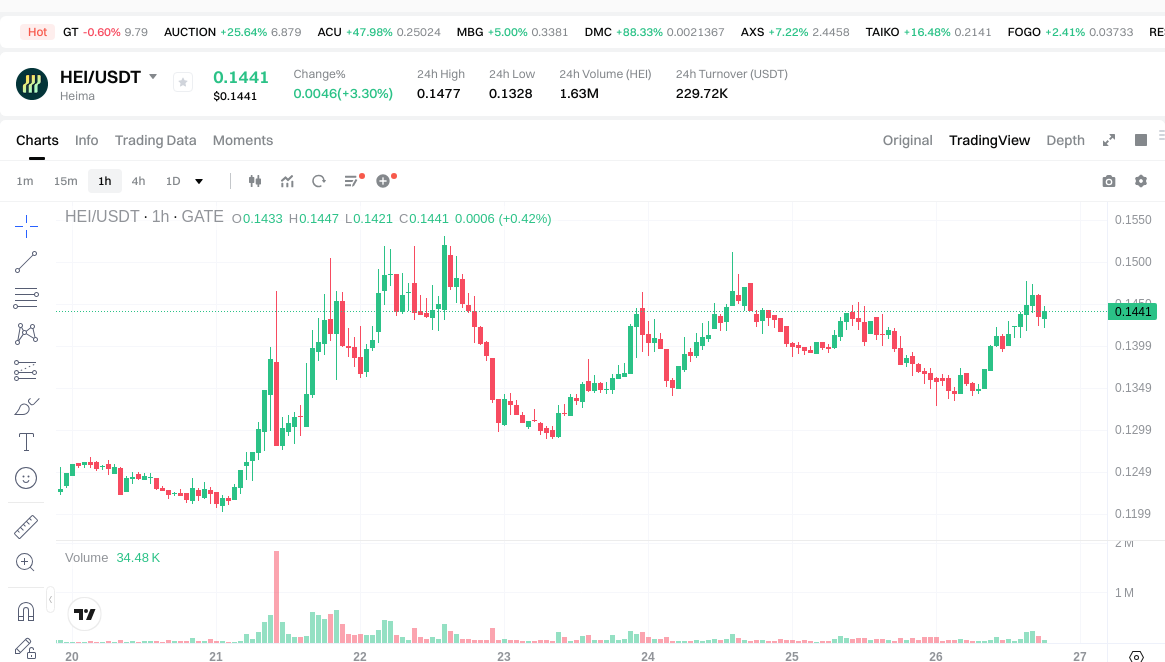
II. Core Factors Affecting Whether HEI is a Good Investment (Is Heima(HEI) a Good Investment)
Supply Mechanism and Scarcity (HEI investment scarcity)
- Maximum Supply Cap → Influencing price and investment value
- Historical Pattern: HEI reached a peak price of $1.25 on February 13, 2025, and declined to $0.04755675 by October 11, 2025, demonstrating significant price volatility
- Investment Significance: With a circulating supply of 67,616,329 HEI tokens representing approximately 72.82% of the maximum supply of 92,859,274 tokens, the supply dynamics present a moderately limited scarcity profile
Macro-Economic Environment's Impact on HEI Investment
- Monetary policy and interest rate changes → Altering investment attractiveness
- HEI's current market capitalization of approximately $9.72 million represents a 0.00042% market share, positioning it as a small-cap digital asset vulnerable to broader market conditions
- Market performance shows mixed signals: positive 7-day growth of 18.08% and 30-day growth of 21.06%, contrasted with a 1-year decline of 75.82%
Technology & Ecosystem Development (Technology & Ecosystem for HEI investment)
- Multi-chain and Cross-chain Interoperability: Heima Network operates as a Layer 1 blockchain designed to enable seamless multi-chain and cross-chain interoperability
- Evolution from Litentry Network: Heima integrates advanced security modules and exchange chain abstraction support
- Token deployment: HEI is deployed as an ERC-20 token on both Ethereum and Binance Smart Chain networks, expanding accessibility across multiple blockchain ecosystems
- Holder base: The token has 842 holders as of January 26, 2026
- Trading availability: Listed on 21 exchanges with a 24-hour trading volume of approximately $232,048
III. HEI Future Investment Forecast and Price Outlook (Is Heima(HEI) worth investing in 2026-2031)
Short-term Investment Forecast (2026, short-term HEI investment outlook)
- Conservative forecast: $0.088 - $0.144
- Neutral forecast: $0.144 - $0.182
- Optimistic forecast: $0.182 - $0.200
Mid-term Investment Outlook (2027-2028, mid-term Heima(HEI) investment forecast)
-
Market stage expectation: The HEI token may experience moderate growth during this period as the Heima Network's Layer 1 blockchain infrastructure continues to develop its multi-chain and cross-chain interoperability capabilities. Market performance could be influenced by technological adoption rates and broader cryptocurrency market conditions.
-
Investment return forecast:
- 2027: $0.116 - $0.202
- 2028: $0.106 - $0.188
-
Key catalysts: Development of cross-chain interoperability features, expansion of security modules, potential ecosystem partnerships, and overall Layer 1 blockchain market dynamics.
Long-term Investment Outlook (Is Heima a good long-term investment?)
- Base scenario: $0.107 - $0.236 (assuming steady development of the network's infrastructure and moderate market adoption)
- Optimistic scenario: $0.174 - $0.266 (assuming successful implementation of advanced security modules and increased adoption of chain abstraction technology)
- Risk scenario: Below $0.088 (under adverse market conditions or significant technological challenges)
Check HEI long-term investment and price forecast: Price Prediction
2026-01-26 - 2031 Long-term Outlook
- Base scenario: $0.107 - $0.245 USD (corresponding to steady progress and gradual mainstream application growth)
- Optimistic scenario: $0.174 - $0.266 USD (corresponding to large-scale adoption and favorable market environment)
- Transformational scenario: Above $0.266 USD (in case of breakthrough ecosystem developments and mainstream popularization)
- 2031-12-31 predicted high: $0.266 USD (based on optimistic development assumptions)
Disclaimer: This analysis is for informational purposes only and does not constitute investment advice. Cryptocurrency markets are highly volatile and unpredictable. Past performance does not guarantee future results. Investors should conduct their own research and consider their risk tolerance before making any investment decisions.
| Year |
Predicted High Price |
Predicted Average Price |
Predicted Low Price |
Price Change |
| 2026 |
0.181818 |
0.1443 |
0.088023 |
0 |
| 2027 |
0.20219316 |
0.163059 |
0.11577189 |
13 |
| 2028 |
0.1881048624 |
0.18262608 |
0.1059231264 |
27 |
| 2029 |
0.224292220152 |
0.1853654712 |
0.174243542928 |
28 |
| 2030 |
0.2662774993788 |
0.204828845676 |
0.10651099975152 |
42 |
| 2031 |
0.244975299428496 |
0.2355531725274 |
0.186087006296646 |
63 |
IV. Heima (HEI) Investment Strategy and Risk Management (How to invest in Layer 1 Blockchain)
Investment Methodology (Heima investment strategy)
-
Long-term Holding (HODL HEI): Suitable for conservative investors who believe in the long-term potential of cross-chain interoperability solutions. Given Heima's evolution from Litentry Network and its focus on multi-chain integration, investors with a multi-year horizon may consider accumulating positions during market corrections.
-
Active Trading: Suitable for experienced traders who can leverage technical analysis and market cycles. With a 24-hour trading volume of approximately $232,048 and price volatility showing a 7-day increase of 18.08% and 30-day increase of 21.06%, swing trading opportunities may present themselves. However, traders should note the relatively lower liquidity compared to major cryptocurrencies.
Risk Management (Risk management for Heima investment)
V. Heima (HEI) Investment Risks and Challenges (Risks of investing in Layer 1 Blockchain)
-
Market Risk: HEI exhibits significant price volatility with a historical high of $1.25 (February 13, 2025) and historical low of $0.04755675 (October 11, 2025). The current price of $0.1438 represents substantial distance from both extremes. With relatively limited liquidity (21 exchanges, 842 holders), the asset may experience pronounced price swings during periods of market stress.
-
Regulatory Risk: As a Layer 1 blockchain project focused on cross-chain interoperability, Heima may face evolving regulatory frameworks across different jurisdictions. Policy uncertainty regarding blockchain infrastructure and cross-chain protocols could impact project development and token valuation.
-
Technical Risk: Network security vulnerabilities represent inherent risks in blockchain infrastructure projects. Protocol upgrade failures, smart contract bugs, or cross-chain bridge exploits could compromise the network's integrity. Additionally, the competitive landscape of Layer 1 blockchains requires continuous technological innovation to maintain relevance.
VI. Conclusion: Is Layer 1 Blockchain a Good Investment?
-
Investment Value Summary: Heima (HEI) presents an interesting opportunity in the Layer 1 blockchain and cross-chain interoperability sector. The project's evolution from Litentry Network provides a foundation of established technology. However, investors should weigh the long-term potential against significant short-term price volatility, evidenced by the 75.82% decline over the past year despite recent positive momentum (18.08% increase over 7 days).
-
Investor Recommendations:
- ✅ Beginners: Consider dollar-cost averaging (DCA) with small amounts to minimize timing risk. Prioritize secure wallet storage and only invest amounts you can afford to lose entirely.
- ✅ Experienced Investors: May employ swing trading strategies to capitalize on volatility while maintaining a core long-term position. Diversify across multiple Layer 1 projects and maintain proper position sizing.
- ✅ Institutional Investors: Can evaluate HEI as a strategic long-term allocation within a broader blockchain infrastructure thesis, conducting thorough due diligence on technology roadmap and competitive positioning.
⚠️ Disclaimer: Cryptocurrency investment carries substantial risk. This content is for informational purposes only and does not constitute investment advice. Always conduct your own research and consider consulting with financial professionals before making investment decisions.
VII. FAQ
Q1: What is the main purpose of Heima (HEI) as a blockchain project?
Heima (HEI) operates as a Layer 1 blockchain designed primarily for multi-chain and cross-chain interoperability. The project evolved from the Litentry Network and integrates advanced security modules along with chain abstraction capabilities. HEI is deployed as an ERC-20 token on both Ethereum and Binance Smart Chain networks, enabling seamless interaction across multiple blockchain ecosystems. The network's core focus is facilitating cross-chain communication and asset transfers while maintaining security standards across different blockchain protocols.
Q2: How has HEI performed price-wise since its peak in 2025?
HEI has experienced significant price volatility since its historical high. The token reached a peak price of $1.25 on February 13, 2025, but subsequently declined to a low of $0.04755675 by October 11, 2025 - representing a substantial drawdown. As of January 26, 2026, HEI trades at approximately $0.1438, showing a 75.82% decline over the one-year period. However, recent performance indicates recovery momentum with an 18.08% increase over 7 days and a 21.06% increase over 30 days, suggesting potential stabilization after the correction phase.
Q3: What percentage of portfolio allocation should investors consider for HEI?
Portfolio allocation recommendations for HEI vary based on investor risk profile. Conservative investors should limit allocation to 1-2% of their cryptocurrency portfolio, given the token's relatively small market capitalization of approximately $9.72 million and ranking at #1215. Aggressive investors may allocate 3-5% as part of their crypto holdings, accepting the higher risk-reward profile. Professional investors with expertise in Layer 1 blockchains might consider up to 5-10% allocation within a diversified blockchain infrastructure strategy. These recommendations account for HEI's market dominance of 0.00042% and inherent volatility characteristics.
Q4: What are the primary risks associated with investing in Heima (HEI)?
Three main risk categories affect HEI investment: (I) Market Risk - significant price volatility with limited liquidity across 21 exchanges and only 842 holders may result in pronounced price swings during market stress; (II) Regulatory Risk - evolving frameworks regarding blockchain infrastructure and cross-chain protocols across different jurisdictions could impact development; (III) Technical Risk - potential vulnerabilities including network security issues, smart contract bugs, or cross-chain bridge exploits could compromise network integrity. Additionally, intense competition in the Layer 1 blockchain space requires continuous innovation to maintain market relevance.
Q5: What is the predicted price range for HEI by 2031?
Long-term price forecasts for HEI by 2031 present multiple scenarios based on development progress and market conditions. The base scenario projects a range of $0.107 - $0.245, assuming steady infrastructure development and gradual adoption growth. The optimistic scenario forecasts $0.174 - $0.266, contingent upon successful implementation of security modules and increased adoption of chain abstraction technology. Under this optimistic projection, the predicted high for December 31, 2031 reaches $0.266. However, a risk scenario exists where prices could fall below $0.088 under adverse market conditions or significant technological challenges.
Q6: How does HEI's supply mechanism affect its investment value?
HEI maintains a maximum supply cap of 92,859,274 tokens with a current circulating supply of 67,616,329 tokens, representing approximately 72.82% of total supply. This moderately limited scarcity profile suggests that approximately 27% of tokens remain locked or reserved for future distribution. The relatively high circulating ratio compared to maximum supply means most tokens are already in market circulation, which can provide greater price stability but potentially limits the scarcity premium compared to projects with lower circulation ratios. The supply dynamics should be considered alongside the project's technological development and adoption metrics when evaluating investment potential.
Q7: What are the recommended trading strategies for different types of HEI investors?
Two primary trading approaches suit different investor profiles. (I) Long-term Holding (HODL): Conservative investors believing in cross-chain interoperability's long-term potential may accumulate positions during market corrections, given Heima's evolution from Litentry Network and multi-year development horizon. (II) Active Trading: Experienced traders can leverage technical analysis to capitalize on volatility, considering the 7-day and 30-day positive momentum indicators. With a 24-hour trading volume of approximately $232,048, swing trading opportunities may emerge, though traders must account for relatively lower liquidity versus major cryptocurrencies and implement appropriate risk management through stop-loss orders.
Q8: Which wallets are compatible with HEI tokens and what storage options are recommended?
HEI operates as an ERC-20 token on both Ethereum (ETH) and Binance Smart Chain (BSC) networks, requiring wallets that support these blockchain standards. For long-term holdings, cold storage solutions such as Ledger or Trezor hardware wallets provide maximum security against online threats. For active trading portions, reputable exchange wallets or software wallets compatible with ERC-20 tokens offer convenient access. Critical considerations include ensuring wallet compatibility with both Ethereum and BSC networks, maintaining secure backup of recovery phrases, and separating long-term holdings (cold storage) from trading allocations (hot wallets) to balance security with accessibility.
* The information is not intended to be and does not constitute financial advice or any other recommendation of any sort offered or endorsed by Gate.