This comprehensive analysis examines whether HOLDSTATION (HOLDSTATION), a zkSync-based smart contract wallet and perpetual DEX, represents a sound investment opportunity. Launched in November 2024, HOLDSTATION currently trades at $0.5567 with a $4.40 million market capitalization and 7.9 million circulating tokens. The platform integrates Account Abstraction technology, DeFutures trading with up to 500x leverage, and zkStarter launchpad services across multiple chains including Berachain and Worldchain. The article evaluates HOLDSTATION's investment merit through tokenomics analysis, price forecasts projecting $0.84-$1.59 by 2031, and risk assessment covering market volatility, regulatory uncertainty, and technical vulnerabilities. While the project demonstrates innovative DeFi features and ecosystem expansion potential, investors face substantial risks including high price volatility, limited liquidity with $55,343 daily volume on 4 exchanges, and early-stage market positioning. Tailored recommendations guid
Introduction: Holdstation (HOLDSTATION) Investment Status and Market Prospects
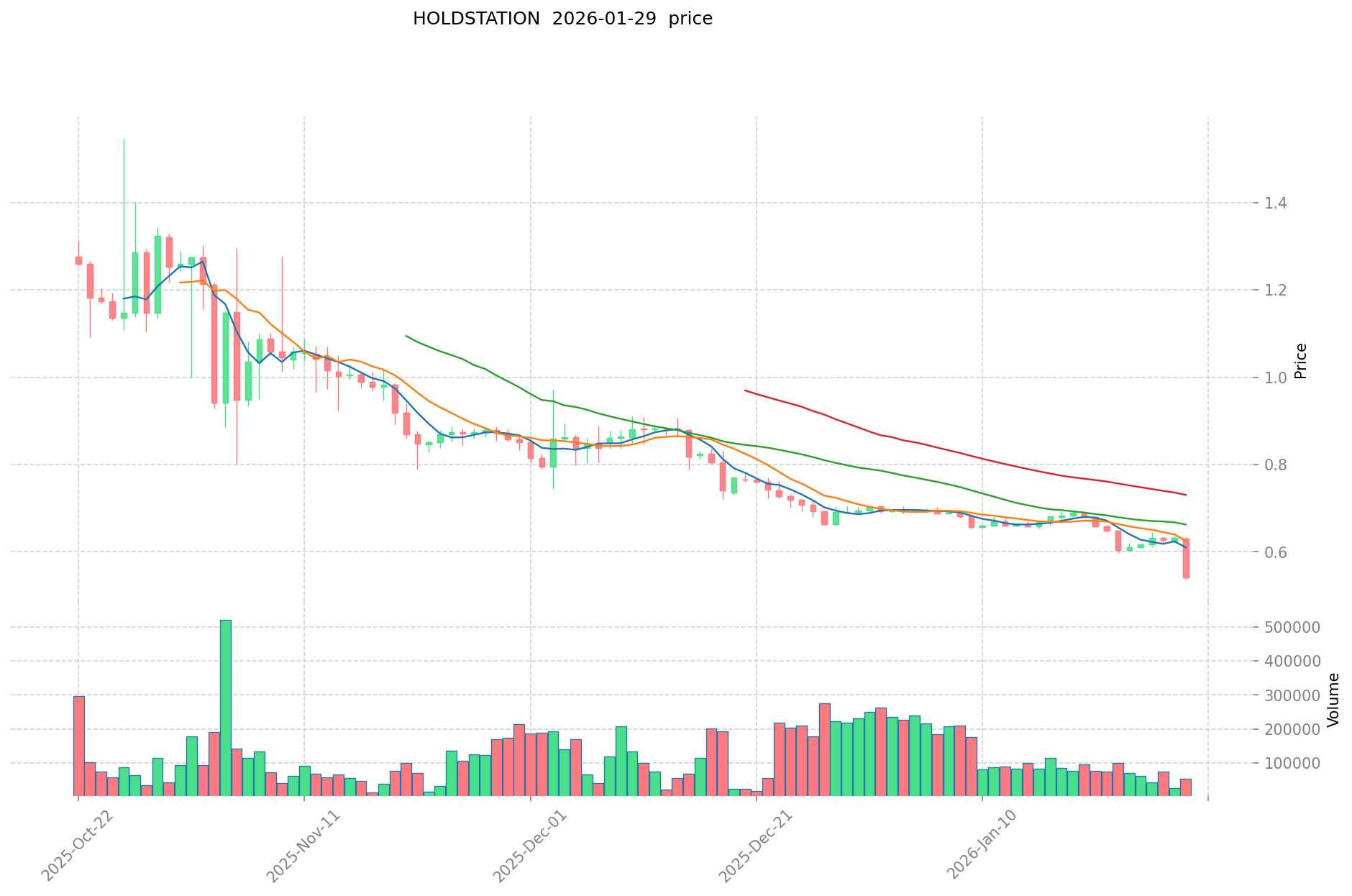
Holdstation (HOLDSTATION) represents a notable asset within the cryptocurrency sector, launched in November 2024 as an innovative smart contract wallet and trading platform. As of January 29, 2026, HOLDSTATION maintains a market capitalization of approximately $4.40 million, with a circulating supply of 7.90 million tokens out of a total supply of 30 million tokens. The current trading price stands at $0.5567, reflecting recent market volatility with a 24-hour decline of 11.56% and a 30-day decrease of 20.8%. Positioned as a "Product-Fit Community" platform for seamless trading and asset management, Holdstation has established itself within the zkSync ecosystem as a perpetual DEX with account abstraction capabilities. The platform integrates wallet functionality, DeFutures trading with leverage options, and zkStarter launchpad services, while expanding to additional networks including Berachain and Worldchain. With 622 token holders and listing on 4 exchanges, HOLDSTATION has garnered attention among investors examining "Is Holdstation (HOLDSTATION) a good investment?" This analysis provides a comprehensive examination of HOLDSTATION's investment characteristics, historical price movements, future price projections, and associated risks to support informed decision-making.
I. Holdstation (HOLDSTATION) Price History Review and Current Investment Value
- 2024: Official launch on zkSync Era → HOLDSTATION experienced significant price volatility, with the token reaching $16.445 on December 27, 2024, representing substantial gains for early participants
- 2025: Market adjustment phase → Price declined from higher levels to approximately $0.5567, reflecting broader market dynamics and profit-taking activities
- Current period: Continued price fluctuation → Token trading between $0.4838 and $0.6336 within recent periods
Current HOLDSTATION Investment Market Status (January 2026)
- HOLDSTATION current price: $0.5567
- 24-hour trading volume: $55,343.40
- Circulating supply: 7,903,700 tokens (26.35% of total supply)
- Market capitalization: $4,399,989.79
- Total supply: 30,000,000 tokens
- Holder addresses: 622
Click to view real-time HOLDSTATION market price
II. Core Factors Affecting Whether HOLDSTATION is a Good Investment (Is Holdstation(HOLDSTATION) a Good Investment)
Supply Mechanism and Scarcity (HOLDSTATION investment scarcity)
- Maximum supply capped at 30,000,000 tokens with 26.35% currently in circulation (7,903,700 tokens) → This limited supply structure may influence price dynamics and investment considerations
- Current circulating supply represents approximately one-quarter of total supply → The relatively low circulation ratio suggests potential future supply releases may affect market dynamics
- Investment consideration: The controlled supply release mechanism represents one factor among many that market participants evaluate when assessing long-term positioning
Institutional Investment and Mainstream Adoption (Institutional investment in HOLDSTATION)
- Platform serves 622 holders as of January 29, 2026
- Listed on 4 exchanges including Gate.com → Provides accessibility for various market participants
- The platform's integration with zkSync Era and expansion to Berachain and Worldchain represents ongoing ecosystem development efforts
Macroeconomic Environment's Impact on HOLDSTATION Investment
- The token experienced price fluctuations with a -11.56% change over 24 hours and -67.22% over one year as of January 29, 2026
- Market volatility reflects broader cryptocurrency sector dynamics and changing economic conditions
- Trading volume of $55,343.40 over 24 hours indicates ongoing market participation levels
Technology and Ecosystem Development (Technology & Ecosystem for HOLDSTATION investment)
- Account Abstraction implementation: The platform integrates native Account Abstraction features on zkSync, including Paymaster, Batch Transactions, Spending Limit, and Social Recovery → These technical features aim to enhance user experience
- A(i)gentFi launchpad: Provides infrastructure for AI agent deployment on zkSync and Berachain → Represents the platform's expansion into emerging technology sectors
- DeFutures platform: Supports leveraged futures trading up to 500x and facilitates dApp interactions and token swaps across Layer 2 and EVM chains → Offers diverse functionality for platform users
- zkStarter launchpad integration: Combines multiple product offerings within the platform ecosystem → Aims to provide comprehensive DeFi services
III. HOLDSTATION Future Investment Forecast and Price Outlook (Is Holdstation(HOLDSTATION) worth investing in 2026-2031)
Short-term Investment Forecast (2026, short-term HOLDSTATION investment outlook)
- Conservative Forecast: $0.37 - $0.56
- Neutral Forecast: $0.56 - $0.68
- Optimistic Forecast: $0.68 - $0.81
Based on available market data as of January 29, 2026, HOLDSTATION's current price stands at $0.5567, reflecting an 11.56% decline over the past 24 hours. The token's circulating supply represents approximately 26.35% of its maximum supply of 30 million tokens. Technical analysis signals suggest a cautious near-term outlook, with the 24-hour trading range between $0.4838 and $0.6336 indicating notable volatility.
Mid-term Investment Outlook (2027-2029, mid-term Holdstation(HOLDSTATION) investment forecast)
- Market Phase Expectation: Gradual recovery and ecosystem development phase, contingent on broader DeFi market conditions and platform adoption metrics
- Investment Return Forecast:
- 2027: $0.63 - $1.00
- 2028: $0.52 - $1.08
- 2029: $0.72 - $1.06
- Key Catalysts: Platform functionality expansion across zkSync and Berachain ecosystems, Account Abstraction feature adoption rates, competitive positioning within decentralized perpetual trading markets, and overall DeFi sector momentum
The mid-term outlook reflects projected annual growth rates averaging 5% under baseline scenarios, though actual performance may vary substantially based on technological developments, market liquidity conditions, and competitive dynamics within the Layer 2 DeFi space.
Long-term Investment Outlook (Is HOLDSTATION a good long-term investment?)
- Baseline Scenario: $0.84 - $1.19 (assuming steady ecosystem growth and moderate market conditions through 2031)
- Optimistic Scenario: $1.37 - $1.59 (contingent upon successful cross-chain expansion, increased trading volumes, and favorable regulatory developments)
- Risk Scenario: Below $0.50 (under conditions of prolonged bear market cycles, security incidents, or significant competitive displacement)
Click to view HOLDSTATION long-term investment and price forecast: Price Prediction
2026-2031 Long-term Outlook
- Base Scenario: $0.84 - $1.19 (corresponding to steady progress and gradual mainstream application adoption)
- Optimistic Scenario: $1.37 - $1.59 (corresponding to large-scale adoption and favorable market conditions)
- Transformative Scenario: Above $1.59 (contingent upon breakthrough ecosystem developments and mainstream adoption)
- December 31, 2031 Projected High: $1.59 (based on optimistic development assumptions)
Disclaimer: These forecasts are derived from historical data patterns, technical analysis, and publicly available project information. Cryptocurrency markets exhibit high volatility and unpredictability. Price projections should not be construed as investment advice, and actual outcomes may differ materially from estimates. Investors should conduct independent research and consider their risk tolerance before making investment decisions.
| Year |
Predicted High Price |
Predicted Average Price |
Predicted Low Price |
Price Change |
| 2026 |
0.814388 |
0.5578 |
0.373726 |
0 |
| 2027 |
1.00169724 |
0.686094 |
0.63120648 |
23 |
| 2028 |
1.0801863936 |
0.84389562 |
0.5232152844 |
51 |
| 2029 |
1.05824510748 |
0.9620410068 |
0.7215307551 |
72 |
| 2030 |
1.363693127139 |
1.01014305714 |
0.5959844037126 |
81 |
| 2031 |
1.59047024346693 |
1.1869180921395 |
0.842711845419045 |
113 |
IV. Holdstation Investment Strategy and Risk Management (How to invest in DeFi tokens)
Investment Methodology (Holdstation investment strategy)
Long-term Holding (HODL Holdstation)
For conservative investors seeking stable exposure to zkSync ecosystem assets, a long-term holding strategy may be considered. This approach focuses on accumulating HOLDSTATION tokens during market corrections and maintaining positions through market cycles. Given the platform's integration with Account Abstraction technology and expansion into multiple chains including Berachain and Worldchain, patient investors may benefit from potential ecosystem growth over extended periods.
Active Trading
Active traders may leverage technical analysis and momentum strategies when engaging with HOLDSTATION. The token has demonstrated significant price volatility, with 24-hour fluctuations reaching double-digit percentages. Traders utilizing this approach should monitor:
- Support and resistance levels based on recent price ranges
- Volume patterns during trading sessions
- Correlation with broader Layer 2 ecosystem movements
- News catalysts related to zkSync and Berachain developments
Risk Management (Risk management for Holdstation investment)
Asset Allocation Guidelines
Conservative Investors: Consider limiting exposure to HOLDSTATION and similar DeFi governance tokens to 1-3% of total crypto portfolio allocation. This allocation acknowledges the project's early-stage nature and market volatility while maintaining diversification.
Aggressive Investors: May allocate 5-10% of crypto holdings to HOLDSTATION, accepting higher volatility in exchange for potential upside from ecosystem expansion and product adoption.
Professional Investors: Could implement dynamic allocation strategies ranging from 3-15% based on technical indicators, fundamental developments, and overall market conditions. This approach requires active monitoring and periodic rebalancing.
Risk Hedging Solutions
Multi-Asset Portfolio Construction: Combine HOLDSTATION exposure with:
- Established Layer 1 tokens (reduced correlation)
- Stablecoins for liquidity management
- Other zkSync ecosystem projects for diversified exposure
- Traditional crypto assets for portfolio stability
Hedging Instruments: Advanced investors may consider:
- Setting stop-loss orders to limit downside exposure
- Utilizing dollar-cost averaging to reduce timing risk
- Maintaining stablecoin reserves for opportunistic entries
Secure Storage Solutions
Cold Storage Options:
- Hardware wallets such as Ledger or Trezor for long-term holdings
- Multi-signature wallets for institutional-grade security
- Offline paper wallet generation for maximum security
Hot Wallet Considerations:
- Use Holdstation's native wallet with Account Abstraction features including Social Recovery
- Enable all available security features (Spending Limit, Batch Transactions)
- Maintain only trading amounts in hot wallets, transferring excess to cold storage
- Regularly update wallet software and verify security settings
V. Holdstation Investment Risks and Challenges (Risks of investing in DeFi tokens)
Market Risks
High Volatility: HOLDSTATION has experienced substantial price swings, with the token showing a 24-hour decline of 11.56% and a 7-day decrease of 12.57% as of the last update. The 30-day performance indicates a 20.8% decline, demonstrating the elevated volatility characteristic of emerging DeFi tokens. Such price movements can result in rapid portfolio value changes.
Liquidity Considerations: With a 24-hour trading volume of approximately $55,343, the token may experience periods of reduced liquidity. This can lead to wider bid-ask spreads and potential difficulty executing large orders without significant price impact. The limited number of exchanges listing the token (4 exchanges) may further constrain liquidity during stress periods.
Price Discovery Challenges: The token's market capitalization of approximately $4.4 million represents a relatively small market presence, which can make prices more susceptible to large individual transactions or coordinated trading activities.
Regulatory Risks
Jurisdictional Uncertainty: Different countries maintain varying approaches to DeFi token regulation. Investors should be aware that:
- Regulatory frameworks for DeFi platforms continue to evolve globally
- Changes in securities classification could impact token trading and holding
- Cross-border regulatory coordination may introduce new compliance requirements
- Tax treatment of DeFi tokens varies significantly by jurisdiction
Compliance Evolution: As regulatory bodies develop clearer frameworks for decentralized finance, platforms like Holdstation may need to implement additional compliance measures, potentially affecting token utility or platform operations.
Technical Risks
Smart Contract Vulnerabilities: Despite security measures, DeFi platforms remain susceptible to:
- Undiscovered smart contract bugs or exploits
- Flash loan attacks targeting platform liquidity
- Oracle manipulation affecting price feeds
- Cross-chain bridge vulnerabilities during multi-chain operations
Network Dependencies: Holdstation's operations across zkSync, Berachain, and Worldchain create dependencies on multiple network infrastructures. Issues affecting these underlying blockchains could impact platform functionality and token value.
Technology Integration Risks: The platform's implementation of Account Abstraction and integration with various DeFi protocols introduces complexity that may result in:
- Unexpected interaction failures between different protocol layers
- Upgrade coordination challenges across multiple chains
- Potential incompatibilities with future network updates
Security Infrastructure: While features like Social Recovery and Batch Transactions enhance user security, they also introduce additional attack surfaces that require ongoing monitoring and updates.
VI. Conclusion: Is DeFi tokens a Good Investment?
Investment Value Summary
HOLDSTATION presents characteristics of an emerging DeFi infrastructure project with notable technical features including Account Abstraction implementation and multi-chain expansion. The platform's integration of trading, wallet functionality, and launchpad services addresses multiple user needs within the zkSync ecosystem. However, the token has experienced substantial price volatility, with declines across multiple timeframes indicating challenging market conditions.
The project's relatively modest market presence, with a circulating supply of approximately 7.9 million tokens (26.35% of maximum supply) and a market capitalization around $4.4 million, suggests it remains in early development stages. The expansion to additional chains including Berachain and Worldchain indicates growth ambitions, though execution risks remain present.
Investor Recommendations
✅ Beginners
- Dollar-Cost Averaging: Consider systematic, small purchases rather than lump-sum investments to reduce timing risk
- Secure Storage Priority: Utilize hardware wallets or the platform's Account Abstraction features with Social Recovery enabled
- Education First: Thoroughly understand zkSync ecosystem dynamics and DeFi mechanics before investing
- Position Sizing: Limit initial exposure to amounts comfortable for total loss scenarios
- Avoid Leverage: Refrain from using the platform's futures trading features until gaining substantial experience
✅ Experienced Investors
- Technical Analysis Integration: Monitor key support and resistance levels given recent volatility patterns
- Ecosystem Monitoring: Track developments across zkSync, Berachain, and Worldchain for catalysts
- Portfolio Integration: Consider HOLDSTATION as part of broader Layer 2 and DeFi token allocation
- Active Risk Management: Implement stop-loss strategies and regular portfolio rebalancing
- Due Diligence: Continuously assess platform development progress and competitive positioning
✅ Institutional Investors
- Strategic Allocation: Evaluate HOLDSTATION within broader DeFi infrastructure investment thesis
- Risk-Adjusted Sizing: Account for liquidity constraints and volatility in position sizing decisions
- Multi-Metric Analysis: Incorporate on-chain metrics, holder distribution, and development activity into assessment framework
- Custodial Solutions: Implement institutional-grade custody arrangements with appropriate insurance
- Regulatory Compliance: Ensure investment aligns with applicable regulatory requirements and internal policies
⚠️ Important Disclaimer
Cryptocurrency investments involve substantial risk, including potential complete loss of principal. HOLDSTATION's price volatility, limited liquidity, and emerging market position amplify these risks. This analysis provides informational content only and does not constitute financial advice, investment recommendations, or endorsements. Investors should conduct independent research, assess personal risk tolerance, and consult qualified financial advisors before making investment decisions. Past performance does not indicate future results, and all forward-looking statements involve uncertainty.
VII. FAQ
Q1: What is Holdstation (HOLDSTATION) and what makes it different from other DeFi platforms?
Holdstation is a comprehensive smart contract wallet and decentralized trading platform built on zkSync Era that integrates Account Abstraction technology with perpetual futures trading capabilities. Unlike traditional DeFi platforms, Holdstation combines multiple functionalities including a non-custodial wallet with advanced features (Paymaster, Batch Transactions, Social Recovery), DeFutures trading with up to 500x leverage, and zkStarter launchpad services within a single ecosystem. The platform distinguishes itself through native Account Abstraction implementation, which simplifies user experience while maintaining security, and its expansion to multiple chains including Berachain and Worldchain. Additionally, the platform has introduced A(i)gentFi launchpad for AI agent deployment, positioning itself at the intersection of DeFi and emerging AI technologies.
Q2: How has HOLDSTATION's price performed since launch and what is its current market status?
HOLDSTATION launched in November 2024 and experienced significant early volatility, reaching a peak of $16.445 on December 27, 2024. As of January 29, 2026, the token trades at $0.5567, representing a substantial decline from its all-time high. Recent performance shows a 24-hour decline of 11.56%, a 7-day decrease of 12.57%, and a 30-day drop of 20.8%. The token currently maintains a market capitalization of approximately $4.40 million with 7.9 million tokens in circulation (26.35% of the 30 million maximum supply). Trading volume stands at $55,343.40 over 24 hours across 4 exchanges, indicating modest liquidity levels. The token has 622 holders, reflecting its early-stage adoption status within the zkSync ecosystem.
Q3: What are the primary risks associated with investing in HOLDSTATION?
HOLDSTATION investments carry multiple risk categories that potential investors should carefully evaluate. Market risks include high price volatility, with double-digit percentage swings occurring within 24-hour periods, and limited liquidity with relatively modest trading volumes that may result in wider bid-ask spreads during execution. Technical risks encompass potential smart contract vulnerabilities despite security measures, dependencies on multiple blockchain networks (zkSync, Berachain, Worldchain) that could experience operational issues, and complexity arising from Account Abstraction and cross-chain integrations. Regulatory risks involve evolving DeFi frameworks globally, potential changes in securities classification, and varying tax treatment across jurisdictions. Additionally, the project's small market capitalization of approximately $4.4 million makes it more susceptible to large individual transactions or coordinated trading activities affecting price discovery.
Q4: What is the long-term price forecast for HOLDSTATION through 2031?
Based on technical analysis and historical data patterns, HOLDSTATION's long-term price projections through 2031 vary significantly depending on market conditions and ecosystem adoption rates. Under baseline scenarios assuming steady ecosystem growth, the token may range between $0.84 and $1.19 by December 2031. Optimistic forecasts contingent upon successful cross-chain expansion, increased trading volumes, and favorable regulatory developments suggest potential prices between $1.37 and $1.59. The projected high for December 31, 2031 stands at $1.59 under optimistic assumptions. However, risk scenarios involving prolonged bear markets, security incidents, or significant competitive displacement could result in prices below $0.50. These forecasts should be viewed as estimates with substantial uncertainty, as cryptocurrency markets exhibit high unpredictability and actual outcomes may differ materially from projections.
Q5: How should different investor types approach HOLDSTATION investment?
Investment strategies for HOLDSTATION should align with experience levels and risk tolerance. Beginners should prioritize education about zkSync ecosystem dynamics, implement dollar-cost averaging to reduce timing risk, limit initial exposure to amounts comfortable for potential total loss, utilize secure storage solutions like hardware wallets or platform's Social Recovery features, and avoid leveraged trading until gaining substantial experience. Experienced investors may integrate technical analysis monitoring key support and resistance levels, track developments across zkSync, Berachain, and Worldchain ecosystems, implement active risk management including stop-loss strategies, and consider HOLDSTATION within broader Layer 2 and DeFi token allocations. Institutional investors should evaluate strategic allocation within DeFi infrastructure investment theses, account for liquidity constraints in position sizing, incorporate comprehensive on-chain metrics and development activity assessments, implement institutional-grade custody with appropriate insurance, and ensure regulatory compliance with applicable requirements.
Q6: What security features does Holdstation offer to protect user assets?
Holdstation implements multiple security layers through its native Account Abstraction technology, providing enhanced protection beyond traditional wallet solutions. Key security features include Paymaster functionality for flexible transaction fee management, Batch Transactions enabling multiple operations in single transactions to reduce exposure time, Spending Limit controls allowing users to set maximum transaction amounts, and Social Recovery mechanisms enabling account access restoration through trusted contacts without seed phrase dependency. For optimal security, users should combine hot wallet functionality for active trading with cold storage solutions (hardware wallets like Ledger or Trezor) for long-term holdings, enable all available platform security features, maintain only necessary trading amounts in hot wallets while transferring excess to cold storage, and regularly update wallet software while verifying security settings. Multi-signature wallet options provide additional institutional-grade security for larger holdings.
Q7: What factors could drive HOLDSTATION's value appreciation in the mid-term (2027-2029)?
Several catalysts could potentially influence HOLDSTATION's mid-term performance between 2027 and 2029. Platform functionality expansion across zkSync and Berachain ecosystems may increase utility and user adoption. Growing adoption rates of Account Abstraction features could differentiate Holdstation's user experience advantage. Competitive positioning within decentralized perpetual trading markets and the platform's ability to capture market share from centralized alternatives represents another key factor. Overall DeFi sector momentum and broader cryptocurrency market conditions will significantly impact performance. The platform's integration of A(i)gentFi launchpad for AI agent deployment could attract users at the intersection of DeFi and AI technologies. Projected annual growth rates average approximately 5% under baseline scenarios, with price ranges estimated between $0.52 and $1.08 during this period, though actual performance may vary substantially based on technological developments, market liquidity conditions, and competitive dynamics.
Q8: What portfolio allocation is recommended for HOLDSTATION investment?
Portfolio allocation for HOLDSTATION should reflect individual risk profiles and investment objectives. Conservative investors may consider limiting exposure to 1-3% of total cryptocurrency portfolio allocation, acknowledging the project's early-stage nature while maintaining diversification across established assets. Aggressive investors accepting higher volatility for potential upside from ecosystem expansion might allocate 5-10% of crypto holdings to HOLDSTATION. Professional investors could implement dynamic allocation strategies ranging from 3-15% based on technical indicators, fundamental developments, and overall market conditions, requiring active monitoring and periodic rebalancing. Effective risk management should incorporate multi-asset portfolio construction combining HOLDSTATION with established Layer 1 tokens for reduced correlation, stablecoins for liquidity management, other zkSync ecosystem projects for diversified exposure, and traditional crypto assets for portfolio stability. All allocations should account for liquidity constraints and individual circumstances.
* The information is not intended to be and does not constitute financial advice or any other recommendation of any sort offered or endorsed by Gate.