Hord (HORD) is a deflationary utility token launched in April 2021 that enables cryptocurrency professionals to tokenize influence while facilitating dynamic ETF-style investments. Currently trading at approximately $0.0009296 with a market capitalization of $236,791, HORD has experienced significant volatility, declining from $1.79 in 2021 to present levels. The token features a fixed maximum supply of 320 million (79.6% currently circulating), providing scarcity mechanics, though with a modest holder base of approximately 2,651 users. Price projections through 2031 range from $0.001429 (base scenario) to $0.002524 (optimistic scenario) depending on platform adoption and market conditions. HORD investment carries substantial risks including high volatility, limited liquidity ($19,944 daily volume), and platform dependency, making it suitable only as a small allocation (1-10% based on risk tolerance) for experienced cryptocurrency investors through Gate exchange.
Introduction: Hord (HORD)'s Investment Position and Market Outlook
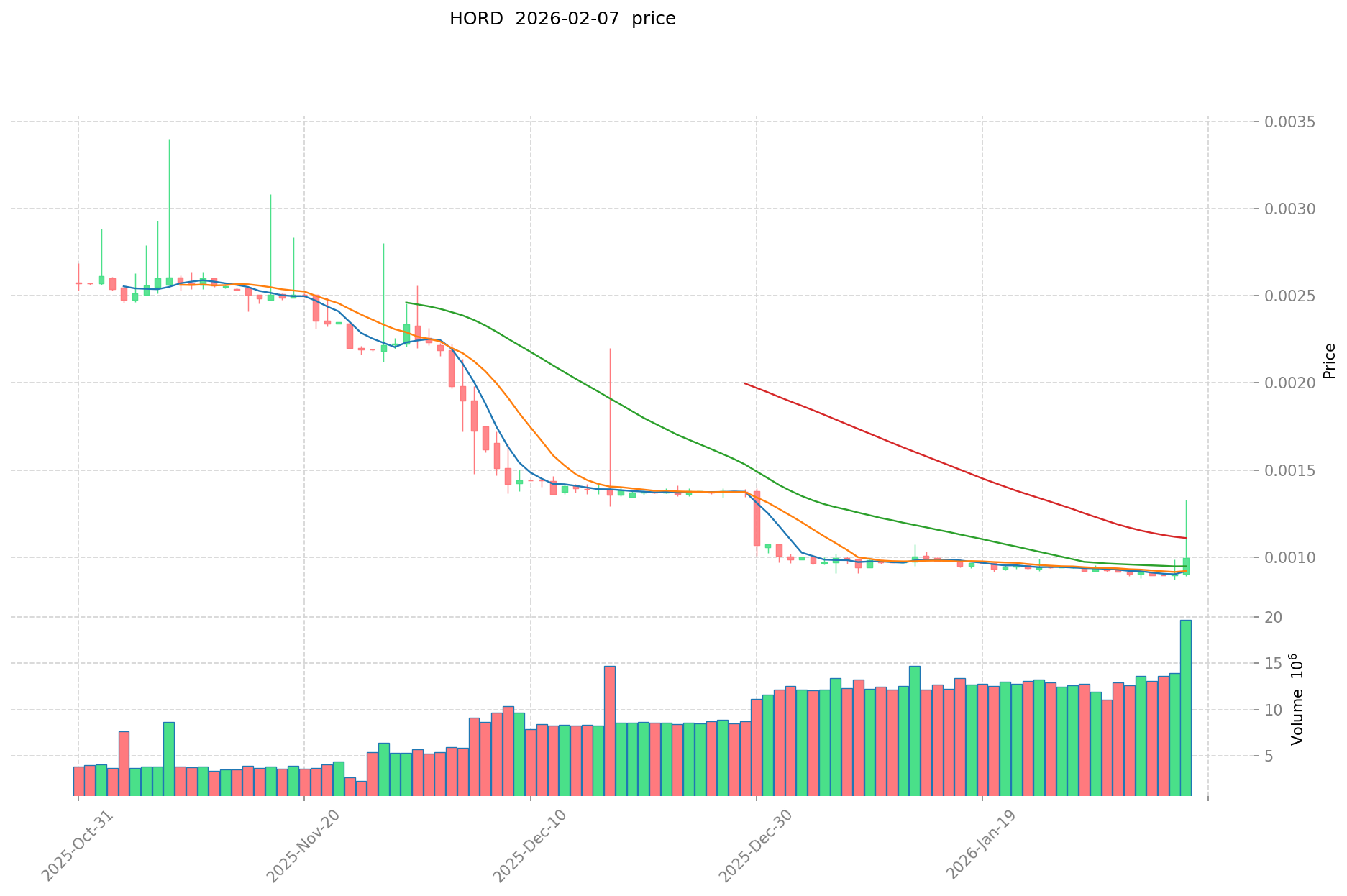
Hord (HORD) represents a utility token in the cryptocurrency sector, launched in April 2021. The platform enables cryptocurrency professionals to tokenize and monetize their influence while allowing enthusiasts to trade and invest through dynamic ETF-style mechanisms. As of February 8, 2026, HORD maintains a market capitalization of approximately $236,791, with a circulating supply of around 254.72 million tokens out of a maximum supply of 320 million tokens. The current trading price stands at approximately $0.0009296. With its positioning as a deflationary utility token designed to operate the Hord platform, HORD has become a subject of discussion among investors evaluating "Is Hord (HORD) a good investment?" This article provides a comprehensive analysis of HORD's investment characteristics, historical price movements, future price projections, and associated investment risks to serve as a reference for investors.
I. Hord (HORD) Price History and Current Investment Value
HORD Historical Price Trends and Investment Returns
- 2021: Hord (HORD) recorded a notable price level of $1.79 → Early investors experienced significant returns during this period
- 2025: Current price stands at approximately $0.002191 → The token has experienced considerable price correction from previous levels
- 2021-2025: Market cycle reflected substantial volatility → Price movement from $1.79 to current levels indicates a substantial decline over the multi-year period
Current HORD Investment Market Status (February 2026)
- HORD current price: $0.0009296
- 24-hour trading volume: $19,944.49
- Market capitalization: $236,791.04
- Circulating supply: 254,723,582.71 HORD
- Total supply: 320,000,000 HORD
- 24-hour price change: -6.23%
Click to view real-time HORD market price
II. Core Factors Affecting Whether HORD is a Good Investment (Is Hord(HORD) a Good Investment)
Supply Mechanism and Scarcity (HORD investment scarcity)
- Max Supply and Circulation → Influence on Price and Investment Value
- HORD has a maximum supply of 320,000,000 tokens, with approximately 254,723,582.71 tokens currently in circulation, representing a circulating ratio of 79.60%. This defined supply cap introduces a degree of scarcity into the token economics.
- Investment Significance: The fixed supply structure may serve as one of the factors supporting long-term value assessment, as it limits the potential for unlimited token issuance.
Institutional Investment and Mainstream Adoption (Institutional investment in HORD)
- Holder Distribution Trends: As of February 2026, HORD has approximately 2,651 holders, indicating a relatively modest holder base compared to more established crypto assets.
- Mainstream Adoption: The platform's design aims to enable cryptocurrency professionals to tokenize and monetize their influence, while allowing enthusiasts to engage in trading and investment through dynamic ETF-like structures. However, specific data on institutional holdings or notable enterprise adoption was not available in the provided materials.
Macroeconomic Environment's Impact on HORD Investment
- Monetary Policy and Interest Rate Changes → May affect investor appetite for risk assets, including crypto assets like HORD.
- Inflationary Environment: While some crypto assets are discussed in the context of inflation hedging, HORD's specific role in this regard has not been established in available materials.
- Geopolitical Uncertainty: Broader market sentiment influenced by geopolitical factors may indirectly impact demand for alternative digital assets, though direct correlation with HORD requires further observation.
Technology and Ecosystem Development (Technology & Ecosystem for HORD investment)
- Platform Utility: HORD token is described as a deflationary utility token designed to operate the Hord platform, which focuses on enabling influence tokenization and simplified trading mechanisms.
- Ecosystem Expansion: The platform's concept revolves around connecting professionals with enthusiasts through dynamic investment structures. However, specific technical upgrades, integration with DeFi protocols, NFT applications, or payment system adoptions were not detailed in the available materials.
- Long-term Value Support: The ongoing development and expansion of the platform's ecosystem, if realized, may contribute to sustained utility and potential investment interest over time.
III. HORD Future Investment Forecast and Price Outlook (Is Hord(HORD) worth investing in 2026-2031)
Short-term Investment Forecast (2026, short-term HORD investment outlook)
Based on current market dynamics and platform development trajectory, HORD presents the following short-term price scenarios for 2026:
- Conservative Forecast: $0.00060554 - $0.0009316
- Neutral Forecast: $0.0009316 - $0.001034076
- Optimistic Forecast: $0.001034076 - $0.001136552
The token's price action in early 2026 reflects broader market uncertainty, with technical indicators showing mixed signals across different timeframes. The platform's ability to maintain user engagement and expand its ETF product offerings may influence price movements throughout the year.
Mid-term Investment Outlook (2027-2029, mid-term Hord(HORD) investment forecast)
Market Stage Expectation: The mid-term period may see HORD navigating through consolidation phases while potentially benefiting from increased adoption of tokenized investment products in the cryptocurrency sector.
Investment Return Forecast:
- 2027: $0.00096169068 - $0.00150975096 (representing potential growth of 11% from 2026 baseline)
- 2028: $0.0006868332792 - $0.0013863856932 (with projected growth of 36% under favorable conditions)
- 2029: $0.001116485652744 - $0.00192726690057 (potential growth of 42% if platform metrics improve)
Key Catalysts: Platform adoption rates, expansion of the dynamic ETF ecosystem, broader cryptocurrency market sentiment, and regulatory developments affecting tokenized investment products could serve as primary drivers during this period.
Long-term Investment Outlook (Is HORD a good long-term investment?)
The extended forecast through 2031 suggests varied scenarios based on multiple development pathways:
- Base Scenario: $0.001429241196218 - $0.002084106551788 (corresponding to steady platform development and moderate user growth)
- Optimistic Scenario: $0.002084106551788 - $0.002524374060854 (aligned with accelerated adoption and favorable market conditions)
- Risk Scenario: Below $0.001429241196218 (under challenging market environments or platform development setbacks)
Click to view HORD long-term investment and price forecast: Price Prediction
2026-02-08 to 2031 Long-term Outlook
- Base Scenario: $0.001429241196218 - $0.001856157397686 (corresponding to steady progress and gradual mainstream application enhancement)
- Optimistic Scenario: $0.001856157397686 - $0.002524374060854 (corresponding to large-scale adoption and favorable market environment)
- Transformative Scenario: Above $0.002524374060854 (if ecosystem achieves breakthrough development and mainstream popularization)
- 2031-12-31 Forecast High: $0.002524374060854 (based on optimistic development assumptions)
Disclaimer: These forecasts are based on historical data analysis and current market conditions. Cryptocurrency investments involve substantial risk, and actual prices may differ materially from projections due to market volatility, regulatory changes, technological developments, and unforeseen events. This information does not constitute investment advice, and investors should conduct thorough due diligence before making investment decisions.
| Year |
Predicted High Price |
Predicted Average Price |
Predicted Low Price |
Price Change |
| 2026 |
0.001136552 |
0.0009316 |
0.00060554 |
0 |
| 2027 |
0.00150975096 |
0.001034076 |
0.00096169068 |
11 |
| 2028 |
0.0013863856932 |
0.00127191348 |
0.0006868332792 |
36 |
| 2029 |
0.00192726690057 |
0.0013291495866 |
0.001116485652744 |
42 |
| 2030 |
0.002084106551788 |
0.001628208243585 |
0.001546797831405 |
75 |
| 2031 |
0.002524374060854 |
0.001856157397686 |
0.001429241196218 |
99 |
IV. Hord Investment Strategy and Risk Management (How to invest in Hord)
Investment Methodology (Hord investment strategy)
Long-term Holding (HODL Hord)
This approach may suit conservative investors who focus on the project's long-term utility within the Hord platform ecosystem. Holding HORD tokens could potentially align with participation in the platform's dynamic ETF features and influence tokenization mechanisms.
Active Trading
Traders may utilize technical analysis and swing trading strategies based on HORD's price movements. With 24-hour volatility showing a -6.23% change and trading volume of approximately $19,944, active traders should monitor support levels around $0.0009001 and resistance near $0.0009955.
Risk Management (Risk management for Hord investment)
Asset Allocation Ratios
- Conservative investors: Allocate 1-3% of crypto portfolio to HORD, focusing on established assets for the remaining allocation
- Aggressive investors: May consider 5-10% allocation while maintaining diversified exposure
- Professional investors: Conduct thorough due diligence on platform utility and tokenomics before determining position sizing
Risk Hedging Solutions
- Implement multi-asset portfolio construction alongside stablecoin positions
- Consider stop-loss mechanisms given HORD's price volatility patterns
- Monitor correlation with broader crypto market movements
Secure Storage
- Cold wallets: Hardware wallets such as Ledger or Trezor for long-term holdings
- Hot wallets: Limited amounts for trading purposes on exchanges
- Contract verification: HORD operates on Ethereum (contract address: 0x43A96962254855F16b925556f9e97BE436A43448)
V. Hord Investment Risks and Challenges (Risks of investing in Hord)
Market Risks
- High volatility: HORD has experienced significant price fluctuations, with 1-year performance showing -72.22% change
- Liquidity considerations: With a 24-hour trading volume of approximately $19,944 and market capitalization around $236,791, liquidity may impact larger transactions
- Price range: Trading between a 24-hour low of $0.0009001 and high of $0.0009955
Regulatory Risks
- Policy uncertainty across different jurisdictions may affect platform operations and token utility
- Evolving regulatory frameworks for DeFi platforms and tokenized investment products
- Compliance requirements may vary significantly between regions
Technical Risks
- Smart contract vulnerabilities: As an Ethereum-based token, exposure to potential smart contract exploits
- Platform dependency: Token utility is tied to Hord platform adoption and functionality
- Network congestion: Ethereum gas fees may impact transaction costs during peak periods
VI. Conclusion: Is Hord a Good Investment?
Investment Value Summary
HORD presents as a utility token designed for the Hord platform ecosystem, enabling cryptocurrency professionals to tokenize influence and facilitating ETF-style investment mechanisms. The token has experienced substantial volatility, with current circulating supply at approximately 254.7 million tokens (79.6% of maximum supply) and market capitalization of around $236,791.
Investor Recommendations
✅ Beginners:
- Consider dollar-cost averaging to mitigate timing risks
- Utilize secure wallet storage (hardware wallets recommended)
- Allocate only risk capital given volatility patterns
✅ Experienced Investors:
- Evaluate swing trading opportunities based on technical indicators
- Maintain diversified portfolio allocation
- Monitor platform development and adoption metrics
✅ Institutional Investors:
- Conduct comprehensive due diligence on platform utility and tokenomics
- Assess strategic fit within broader digital asset allocation
- Consider liquidity constraints given current market depth
⚠️ Disclaimer: Cryptocurrency investments carry substantial risk. This content is for informational purposes only and does not constitute investment advice. Conduct thorough research and consider consulting financial professionals before making investment decisions.
VII. FAQ
Q1: What is Hord (HORD) and what makes it different from other cryptocurrency investments?
Hord (HORD) is a deflationary utility token launched in April 2021 that powers the Hord platform, enabling cryptocurrency professionals to tokenize and monetize their influence while allowing enthusiasts to trade and invest through dynamic ETF-style mechanisms. What distinguishes HORD from typical crypto investments is its dual-purpose design: it serves both as a platform utility token and as an infrastructure for influence tokenization. With a fixed maximum supply of 320 million tokens and approximately 254.7 million currently in circulation (79.6% circulating ratio), HORD incorporates built-in scarcity mechanics. However, investors should note that the token has experienced significant volatility since its launch, declining from $1.79 in 2021 to approximately $0.0009296 as of February 2026.
Q2: Is Hord (HORD) suitable for long-term investment in 2026-2031?
Long-term suitability depends on multiple factors and investor risk tolerance. The token's maximum supply cap of 320 million provides theoretical scarcity benefits, and price projections suggest potential growth scenarios ranging from $0.001429 to $0.002524 by 2031 under optimistic conditions. However, HORD currently maintains a relatively modest market capitalization of approximately $236,791 and a holder base of around 2,651 users, indicating limited mainstream adoption. The 1-year performance shows a -72.22% decline, reflecting substantial volatility. Conservative investors might consider allocating only 1-3% of their crypto portfolio to HORD, while recognizing that the token's value ultimately depends on the platform's ability to expand its ecosystem, increase user adoption, and deliver on its influence tokenization and ETF product offerings.
Q3: What are the primary risks associated with investing in HORD?
HORD investment carries several significant risks. Market risk is paramount, with the token demonstrating high volatility and a 24-hour trading volume of approximately $19,944, which may impact liquidity for larger transactions. The token's 72% decline over the past year illustrates substantial downside potential. Technical risks include smart contract vulnerabilities as an Ethereum-based token and dependency on Ethereum network conditions, which may result in elevated gas fees during congestion. Regulatory uncertainty surrounding tokenized investment products and DeFi platforms presents another challenge. Additionally, HORD's utility is intrinsically tied to the Hord platform's adoption and development—if the platform fails to achieve meaningful user growth or ecosystem expansion, token utility and value may remain constrained. The relatively small holder base and limited liquidity further amplify these risks.
Q4: How should different types of investors approach HORD investment?
Investment approaches should vary based on experience and risk tolerance. Beginners should consider dollar-cost averaging to mitigate timing risks, utilize secure hardware wallet storage (such as Ledger or Trezor), and only allocate risk capital they can afford to lose. For experienced traders, HORD may present swing trading opportunities based on technical indicators, with current support around $0.0009001 and resistance near $0.0009955, though they should maintain diversified portfolios with HORD representing no more than 5-10% of crypto holdings. Institutional investors should conduct comprehensive due diligence on platform utility, tokenomics, and liquidity constraints before determining position sizing. All investor categories should monitor key metrics including platform adoption rates, holder growth, trading volume trends, and broader cryptocurrency market sentiment, while implementing appropriate risk management through stop-loss mechanisms and portfolio diversification.
Q5: What are the realistic price expectations for HORD through 2031?
Price projections for HORD reflect varying scenarios based on platform development and market conditions. For 2026, forecasts suggest a range of $0.0006055 (conservative) to $0.001137 (optimistic). Mid-term projections for 2027-2029 anticipate potential growth of 11-42% annually under favorable conditions, with 2029 estimates ranging from $0.001116 to $0.001927. Long-term forecasts through 2031 present a base scenario of $0.001429 to $0.001856, with an optimistic scenario reaching $0.002524 if the platform achieves significant ecosystem expansion and mainstream adoption. However, these projections carry substantial uncertainty—a risk scenario below $0.001429 remains possible if the platform encounters development setbacks or adverse market conditions. Investors should note that these forecasts are based on historical data analysis and current conditions, while actual prices may differ materially due to market volatility, regulatory changes, technological developments, and unforeseen events.
Q6: What factors could positively or negatively impact HORD's investment value?
Several factors may influence HORD's trajectory. Positive catalysts include successful expansion of the Hord platform's ETF product offerings, increased adoption of influence tokenization features, growth in the holder base beyond the current 2,651 users, broader cryptocurrency market bullishness, and favorable regulatory developments for tokenized investment products. The token's fixed supply structure and deflationary mechanics could support value appreciation if demand increases. Negative factors include continued low trading volume and liquidity constraints, failure to achieve meaningful platform adoption, competitive pressure from alternative DeFi platforms, adverse regulatory actions affecting tokenized products, technical vulnerabilities or security incidents, and broader cryptocurrency market downturns. Additionally, Ethereum network congestion and high gas fees may deter platform usage. The token's historical 72% decline over the past year suggests that negative factors have recently outweighed positive developments.
Q7: How does HORD compare to other cryptocurrency investment opportunities?
HORD occupies a specialized niche within the cryptocurrency ecosystem, focusing on influence tokenization and ETF-style investment mechanisms rather than competing directly with major cryptocurrencies like Bitcoin or Ethereum. Compared to established digital assets, HORD presents higher risk due to its smaller market capitalization ($236,791), limited liquidity ($19,944 24-hour volume), and modest holder base. While Bitcoin and Ethereum benefit from widespread institutional adoption and established network effects, HORD's value proposition depends primarily on the success of its specific platform utility. The token's 79.6% circulating supply ratio is comparable to many established projects, providing defined scarcity. However, unlike broadly adopted assets, HORD lacks significant institutional investment data or mainstream adoption indicators. For investors seeking higher-risk, higher-potential-reward opportunities within specialized DeFi applications, HORD may warrant consideration as a small portfolio allocation, but it cannot serve as a core digital asset holding given its current market position and volatility profile.
Q8: What security measures should HORD investors implement?
Security implementation is critical for HORD investors due to its Ethereum-based infrastructure. For long-term holdings, hardware wallets (Ledger or Trezor) provide optimal security by storing private keys offline, minimizing exposure to online threats. Investors engaging in active trading should maintain only limited amounts in hot wallets or exchange accounts for operational purposes. Before transacting, verify HORD's contract address (0x43A96962254855F16b925556f9e97BE436A43448) to prevent interaction with fraudulent tokens. Enable two-factor authentication on all exchange accounts and utilize strong, unique passwords. Given Ethereum's smart contract nature, investors should stay informed about potential vulnerabilities or security audits related to HORD's contract. Consider portfolio diversification with stablecoin positions as hedging mechanisms, and implement stop-loss orders to limit downside exposure given HORD's demonstrated volatility. Regular monitoring of wallet activity and staying updated on platform security announcements from the Hord team are essential practices for risk mitigation.
* The information is not intended to be and does not constitute financial advice or any other recommendation of any sort offered or endorsed by Gate.