The article offers a thorough evaluation of Huma Finance (HUMA), focusing on tokenomics, use cases, and market potential as of 2024. It addresses key investment challenges including price volatility, token dilution risks, and evolving market adoption. HUMA, built on Solana blockchain, aims to revolutionize global payment financing by bridging real-world financial activities with decentralized systems. Readers are guided through historical performance, technical infrastructure, use cases, and strategic market positioning, facilitating informed investment decisions. Current data on HUMA’s ecosystem and future outlook are provided to assist investors in gauging its merits.
Introduction: The Investment Position and Market Prospects of Huma Finance (HUMA)
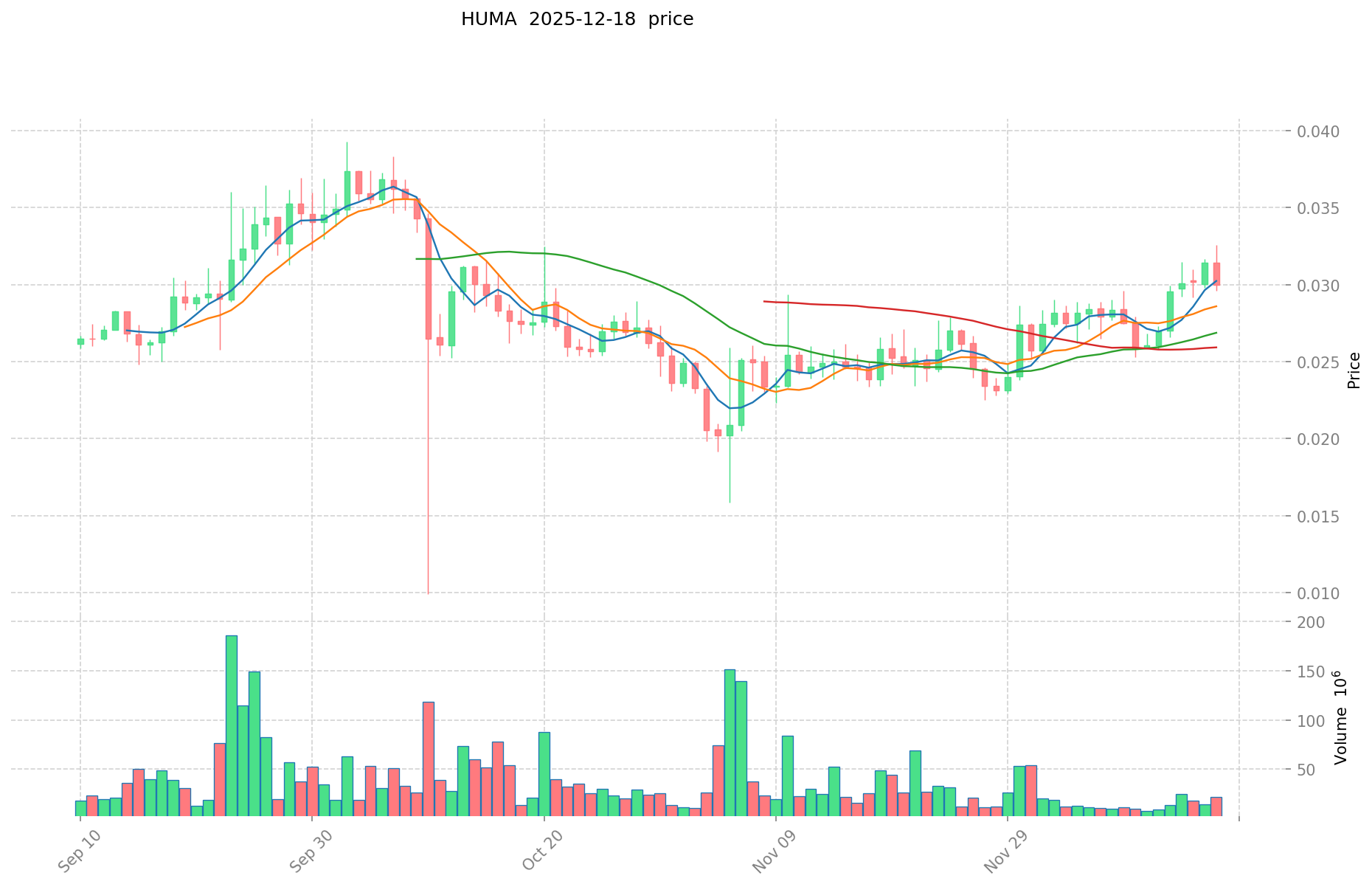
Huma Finance (HUMA) is an emerging asset in the cryptocurrency field, positioned as a PayFi network that supports global payment financing by providing instant access to liquidity. As of December 18, 2025, HUMA has achieved a market capitalization of $52.28 million with a fully diluted valuation of $301.6 million, commanding a market ranking of 486. The circulating supply stands at approximately 1.73 billion tokens out of a total supply of 10 billion, with the current price maintained at $0.03016. Since its launch on May 26, 2025, HUMA has recorded an all-time high of $0.112 and demonstrated volatile market dynamics typical of emerging payment finance infrastructure tokens.
Built on the Solana blockchain, HUMA addresses a critical gap in payment financing infrastructure by offering immediate access to liquidity for global transactions. With 25,222 token holders and trading activity across 37 exchanges, the project has established a foundational ecosystem despite its nascent market presence. The token has shown a 24-hour decline of -5.39%, yet demonstrated stronger performance over the 7-day (+13.94%) and 30-day (+24.16%) periods, reflecting evolving market sentiment around its PayFi proposition.
As investors increasingly evaluate whether Huma Finance represents a sound investment opportunity, this comprehensive analysis examines the project's investment value proposition, historical price trajectory, future price forecasts, and associated risk factors. The following sections provide detailed insights to support informed investment decision-making regarding HUMA.
Huma Finance (HUMA) Research Report
HUMA Historical Price Trajectory and Investment Returns
Key Price Milestones:
- All-Time High (ATH): $0.112 (May 26, 2025)
- All-Time Low (ATL): $0.00989 (October 10, 2025)
- Current Price (December 18, 2025): $0.03016
Recent Price Performance:
- 1-hour change: -0.36%
- 24-hour change: -5.39%
- 7-day change: +13.94%
- 30-day change: +24.16%
The token demonstrates significant volatility, having declined approximately 73% from its peak in May 2025 to the current price point. However, the 30-day positive performance of +24.16% indicates recent recovery momentum following the October 2025 low.
Current HUMA Market Status (December 2025)
Price and Valuation Metrics:
- Current Price: $0.03016 USD
- Market Capitalization: $52,277,333.32 USD
- Fully Diluted Valuation (FDV): $301,600,000.00 USD
- 24-hour Trading Volume: $574,769.58 USD
- Market Dominance: 0.0097%
Token Supply Information:
- Circulating Supply: 1,733,333,333 HUMA (17.33% of total supply)
- Total Supply: 10,000,000,000 HUMA
- Market Cap to FDV Ratio: 17.33%
Market Sentiment:
- Market Sentiment Score: 1 (positive indicator)
- Current Trading Range (24h): $0.02962 - $0.03251
Click to view real-time HUMA market price
II. Project Overview and Technical Architecture
Project Definition
Huma Finance is a PayFi (Payment Finance) network designed to support global payment financing by providing instant access to liquidity. The protocol utilizes income and accounts receivable as collateral to facilitate lending and borrowing, thereby connecting real-world financial activities with decentralized infrastructure.
Token Utility and Governance
HUMA is the utility and governance token of the Huma Finance ecosystem, serving multiple functions:
- Protocol Operations: Supporting core protocol functionality
- Governance Participation: Enabling token holders to participate in protocol governance decisions
- Advanced Features: Facilitating programmable payments, real-time liquidity access, and on-chain underwriting
Blockchain Infrastructure
- Primary Network: Solana (SOL)
- Contract Address: HUMA1821qVDKta3u2ovmfDQeW2fSQouSKE8fkF44wvGw
III. Use Cases and Ecosystem Applications
Huma Finance supports diverse applications across multiple sectors:
- Emerging Markets: Remittance-based lending solutions for developing economies
- Enterprise Solutions: Invoice-based liquidity for business receivables
- Salary Advances: Tokenized payroll enabling early wage access
- Service Sector Financing: Deferred payment systems for education and healthcare services
Operational Achievement (as of November 2025):
- Total Transaction Volume Processed: Over $8 billion USD
- Credit Default Rate: Zero recorded credit defaults (remarkable achievement)
- Active Token Holders: 25,222
- Exchange Listings: 37 trading pairs
Trading Availability:
- Listed on Binance and 37 other exchanges
- Trading enabled on Gate.com
Key Resources:
VI. Disclaimer
This report is for informational purposes only and does not constitute investment advice. Cryptocurrency markets are highly volatile and subject to significant price fluctuations. The information presented reflects data current as of December 18, 2025. Market participants should conduct independent research and consult with qualified financial advisors before making investment decisions.
Huma Finance (HUMA) Investment Analysis Report
Report Date: December 18, 2025
I. Executive Summary
Huma Finance (HUMA) is a PayFi network designed to support global payment financing by providing instant access to liquidity. As of the report date, HUMA is trading at $0.03016, with a market capitalization of $52.28 million and a fully diluted valuation of $301.6 million. The token operates on the Solana blockchain and has demonstrated notable price volatility since its launch in May 2025.
II. Core Factors Influencing HUMA as an Investment
Supply Mechanism and Scarcity
- Total Supply: 10 billion tokens
- Circulating Supply: 1.73 billion tokens (17.33% of total supply)
- Current Circulation Ratio: 17.33%
The significant portion of tokens still locked in the supply structure creates substantial dilution risk as more tokens enter circulation. With only 17.33% of total supply currently circulating, future token releases could exert downward pressure on price dynamics. This high percentage of unvested tokens represents a key risk factor for long-term investors.
Market Position and Adoption
- Market Ranking: 486th by market capitalization
- Exchange Listings: 37 exchanges
- Token Holders: 25,222 addresses
Strategic partnerships announced in December 2025 include collaboration with Obligate and TradeFlow, connecting Huma's liquidity pools to the $4.5 trillion trade finance market. This integration into established trade finance infrastructure represents a significant expansion of use cases and potential addressable market.
Technology and Ecosystem Development
Huma Finance operates on the Solana blockchain, leveraging its high-speed and low-cost transaction capabilities. The platform focuses on cross-border payment financing, enabling instant settlement of cross-border payments without pre-funding requirements. This addresses key pain points in global payment infrastructure by:
- Eliminating delays in settlement processes
- Reducing capital lockups for payment intermediaries
- Minimizing unnecessary transaction costs
Recent Price Movement
| Time Period |
Price Change |
Amount |
| 1 Hour |
-0.36% |
-$0.000109 |
| 24 Hours |
-5.39% |
-$0.001718 |
| 7 Days |
+13.94% |
+$0.003690 |
| 30 Days |
+24.16% |
+$0.005869 |
Historical Price Range:
- All-Time High: $0.112 (May 26, 2025)
- All-Time Low: $0.00989 (October 10, 2025)
- 24-Hour Range: $0.02962 - $0.03251
The token exhibits significant volatility, with 24-hour trading volume of $574,769.58. The positive 7-day and 30-day returns contrast with near-term weakness, suggesting ongoing price discovery in this newly launched asset.
Market Sentiment
Current market sentiment indicator: Positive (value: 1)
IV. Risk Factors
-
High Token Dilution Risk: With 82.67% of total supply not yet circulating, substantial future dilution is anticipated.
-
Recent Price Volatility: The token has experienced extreme price swings, trading from all-time highs of $0.112 to lows of $0.00989 within its operational period.
-
Limited Adoption History: As a token launched in May 2025, long-term operational performance and actual ecosystem utility remain unproven.
-
Small Market Capitalization: At $52.28 million in circulating market cap, liquidity may be limited during periods of high trading volume.
-
Concentration Risk: 25,222 token holders for a 10 billion token supply suggests potential concentration among early investors and contributors.
Official Channels:
Contract Address (Solana):
- HUMA1821qVDKta3u2ovmfDQeW2fSQouSKE8fkF44wvGw
VI. Conclusion
Huma Finance presents a specialized use case in payment financing infrastructure with strategic positioning in the PayFi sector. The December 2025 partnerships with Obligate and TradeFlow connecting to the $4.5 trillion trade finance market demonstrate potential for significant market expansion. However, prospective investors should carefully evaluate the substantial token dilution ahead, price volatility, and the early-stage nature of the project before making any investment decisions.
III. HUMA Future Investment Predictions and Price Outlook (Is Huma Finance (HUMA) worth investing in 2025-2030)
Short-term Investment Prediction (2025, short-term HUMA investment outlook)
- Conservative Forecast: $0.016621 - $0.03022
- Neutral Forecast: $0.03022 - $0.037775
- Optimistic Forecast: $0.037775 - $0.050656
Mid-term Investment Outlook (2026-2028, mid-term Huma Finance (HUMA) investment forecast)
- Market Stage Expectation: Huma Finance demonstrates gradual growth trajectory across the mid-term period, with increasing volatility as the PayFi network expands its liquidity access capabilities globally.
- Investment Return Forecast:
- 2026: $0.03195765 - $0.050656275
- 2027: $0.038517467625 - $0.043596694125
- 2028: $0.033939814741875 - $0.053702238515625
- Key Catalysts: Enhanced payment financing adoption, increased institutional participation, improved blockchain infrastructure on Solana ecosystem, and expanded liquidity protocols
Long-term Investment Outlook (Is HUMA a good long-term investment?)
- Base Case Scenario: $0.035379034734093 - $0.073116671783793 (Assumes steady ecosystem development and moderate market adoption through 2030)
- Optimistic Scenario: $0.058965057890156 - $0.095616 (Assumes significant DeFi integration, 100%-200% APY yields, and heightened market enthusiasm)
- Risk Scenario: $0.034303 - $0.04 (Assumes minimal adoption, market consolidation, and competitive pressures)
For detailed HUMA long-term investment and price forecasts: Price Prediction
2025-12-18 to 2030-12-31 Long-term Outlook
- Base Case Scenario: $0.035 - $0.073 USD (corresponds to steady development and mainstream application growth)
- Optimistic Scenario: $0.059 - $0.096 USD (corresponds to large-scale adoption and favorable market conditions)
- Transformative Scenario: $0.25+ USD (contingent upon breakthrough ecosystem progress and mainstream PayFi adoption)
- 2030-12-31 Predicted High: $0.073 USD (based on optimistic development assumptions)
Disclaimer: The above price forecasts are derived from available market data and prediction sources and do not constitute investment recommendations. Cryptocurrency markets carry substantial volatility and risk. Investors should conduct independent research and consult qualified financial advisors before making investment decisions.
| 年份 |
预测最高价 |
预测平均价格 |
预测最低价 |
涨跌幅 |
| 2025 |
0.037775 |
0.03022 |
0.016621 |
0 |
| 2026 |
0.050656275 |
0.0339975 |
0.03195765 |
12 |
| 2027 |
0.043596694125 |
0.0423268875 |
0.038517467625 |
40 |
| 2028 |
0.053702238515625 |
0.0429617908125 |
0.033939814741875 |
42 |
| 2029 |
0.06959810111625 |
0.048332014664062 |
0.042048852757734 |
60 |
| 2030 |
0.073116671783793 |
0.058965057890156 |
0.035379034734093 |
95 |
Huma Finance (HUMA) Investment Analysis Report
I. Project Overview
Huma Finance is a PayFi network that supports global payment financing by providing instant access to liquidity. The project operates on the Solana blockchain, with the native token HUMA serving as the network's utility asset.
Key Metrics (as of December 18, 2025):
- Current Price: $0.03016
- Market Cap: $52,277,333.32
- Fully Diluted Valuation: $301,600,000.00
- Circulating Supply: 1,733,333,333 HUMA
- Total Supply: 10,000,000,000 HUMA
- Circulating Supply Ratio: 17.33%
- Market Ranking: #486
- Number of Holders: 25,222
- Trading Exchanges: 37
- All-Time High: $0.112 (May 26, 2025)
- All-Time Low: $0.00989 (October 10, 2025)
- 24-Hour High: $0.03251
- 24-Hour Low: $0.02962
II. Price Movement Analysis
Short-Term Price Trends
| Time Period |
Price Change |
Change Amount |
| 1 Hour |
-0.36% |
-$0.000109 |
| 24 Hours |
-5.39% |
-$0.001718 |
| 7 Days |
+13.94% |
+$0.003690 |
| 30 Days |
+24.16% |
+$0.005869 |
Analysis:
- HUMA experienced a short-term decline over the past 24 hours, with a -5.39% decrease.
- Medium-term momentum remains positive, with gains of 13.94% over 7 days and 24.16% over 30 days.
- 24-hour trading volume stands at $574,769.58, indicating moderate liquidity.
- Market sentiment indicator shows positive positioning.
III. Technical Specifications
Blockchain Infrastructure
- Network: Solana (SOL)
- Contract Address: HUMA1821qVDKta3u2ovmfDQeW2fSQouSKE8fkF44wvGw
- Token Standard: SPL (Solana Program Library)
Network Status
- Total market dominance: 0.0097%
- Market cap to FDV ratio: 17.33%
IV. Investment Strategy and Risk Management
Investment Methodology
Long-Term Holding (HODL Strategy):
Suitable for conservative investors seeking exposure to the PayFi sector. This approach leverages HUMA's position within the emerging payment finance ecosystem, allowing investors to benefit from potential long-term adoption and network growth.
Active Trading:
Dependent on technical analysis and momentum trading. Recent 30-day gains of 24.16% indicate potential swing trading opportunities for experienced traders. The current 24-hour decline presents potential entry points for tactical positions.
Risk Management
Portfolio Allocation Guidelines:
- Conservative Investors: 1-3% of crypto allocation
- Intermediate Investors: 3-5% of crypto allocation
- Aggressive Investors: 5-10% of crypto allocation
Risk Mitigation Strategies:
- Diversification: Combine HUMA with established cryptocurrencies (Bitcoin, Ethereum) and stablecoins
- Position Sizing: Implement strict position size limits relative to overall portfolio
- Stop-Loss Orders: Set predetermined exit points to limit downside exposure
Secure Storage Solutions:
- Hot wallets: Phantom, Solflare (for active trading)
- Cold Storage: Hardware wallets supporting Solana tokens (Ledger, Trezor)
- Best Practice: Store majority holdings in cold storage, maintain only trading amounts in hot wallets
V. Investment Risks and Challenges
Market Risk
- High Volatility: HUMA exhibits significant price volatility, with a 112x difference between all-time high ($0.112) and all-time low ($0.00989).
- Liquidity Risk: Moderate trading volume relative to market cap may result in slippage during large transactions.
- Market Concentration: Limited number of holders (25,222) suggests potential concentration risk.
Regulatory Risk
- PayFi sector faces evolving regulatory frameworks across jurisdictions.
- Changes in cryptocurrency regulations could impact payment finance protocols.
- Solana ecosystem regulatory developments may affect the project.
Technology Risk
- Smart Contract Risk: Potential vulnerabilities in PayFi protocol architecture.
- Solana Network Risk: HUMA's dependence on Solana ecosystem stability.
- Protocol Adoption Risk: Technology viability dependent on market adoption of PayFi solutions.
Project Risk
- Early-stage project in nascent PayFi category.
- Limited track record compared to established payment protocols.
- Competitive pressure from alternative payment finance solutions.
VI. Conclusion: Is Huma Finance a Good Investment?
Investment Value Summary
Huma Finance represents an investment opportunity within the emerging PayFi sector, which addresses a significant gap in global payment financing. The project's positioning on the Solana blockchain provides access to a developed ecosystem and lower transaction costs. However, recent price volatility and early-stage project status warrant cautious consideration.
Strengths:
- Novel PayFi market positioning
- Solana blockchain foundation
- Positive 30-day price momentum (+24.16%)
- Active market participation (37 exchanges)
Weaknesses:
- High historical volatility
- Low circulating supply ratio (17.33%)
- Limited historical track record
- Concentrated holder base
Investor Recommendations
✅ Beginners:
- Implement dollar-cost averaging strategy to mitigate timing risk
- Start with minimal allocation (0.5-1% of crypto portfolio)
- Use secure storage solutions from day one
- Educate yourself on PayFi fundamentals
✅ Experienced Traders:
- Utilize technical analysis for swing trading opportunities
- Maintain 3-5% allocation within diversified crypto portfolio
- Employ stop-loss orders to manage downside risk
- Monitor Solana ecosystem developments
✅ Institutional Investors:
- Strategic allocation following comprehensive due diligence
- Implement custody solutions compliant with institutional standards
- Monitor regulatory developments in payment finance sector
- Consider correlation with broader Solana ecosystem
⚠️ Critical Disclaimer:
Cryptocurrency investments carry substantial risk, including potential total loss of capital. This report is for informational purposes only and does not constitute investment advice, financial advice, or a recommendation to buy or sell HUMA. Investors should conduct independent research, consult qualified financial advisors, and assess their risk tolerance before making investment decisions. Market conditions, regulatory environments, and project fundamentals can change rapidly.
Report generated: December 18, 2025
Data accuracy subject to market conditions at time of publication
Huma Finance (HUMA) Frequently Asked Questions
I. FAQ
Q1: What is Huma Finance (HUMA) and what problem does it solve?
A: Huma Finance is a PayFi (Payment Finance) network built on the Solana blockchain that provides instant access to liquidity for global payment financing. It addresses a critical gap in payment infrastructure by enabling immediate settlement of cross-border payments without pre-funding requirements. The protocol utilizes income and accounts receivable as collateral to facilitate lending and borrowing, connecting real-world financial activities with decentralized infrastructure. This eliminates delays in settlement processes, reduces capital lockups for payment intermediaries, and minimizes unnecessary transaction costs.
Q2: What is the current price and market position of HUMA as of December 18, 2025?
A: As of December 18, 2025, HUMA is trading at $0.03016 USD with a market capitalization of $52,277,333.32 and a fully diluted valuation of $301,600,000. The token ranks #486 by market capitalization, with 1.73 billion tokens circulating out of a total supply of 10 billion (17.33% circulation ratio). HUMA is listed on 37 exchanges including Binance, with 25,222 active token holders and a 24-hour trading volume of $574,769.58.
Q3: What are the major price volatility risks associated with HUMA?
A: HUMA exhibits significant price volatility, having declined approximately 73% from its all-time high of $0.112 (May 26, 2025) to the current price of $0.03016. The all-time low reached $0.00989 on October 10, 2025, representing a 112x difference between peak and trough. Additionally, with only 17.33% of total supply circulating, the token faces substantial dilution risk as the remaining 82.67% of tokens enter circulation, which could exert downward pressure on future price dynamics. This combination of historical volatility and pending supply dilution requires careful risk management for investors.
Q4: What is the price forecast for HUMA in the coming years?
A: Price forecasts (not investment recommendations) for HUMA through 2030 are:
- 2025 (Short-term): Conservative: $0.016621–$0.03022; Neutral: $0.03022–$0.037775; Optimistic: $0.037775–$0.050656
- 2026: $0.03195765–$0.050656275
- 2027: $0.038517467625–$0.043596694125
- 2028: $0.033939814741875–$0.053702238515625
- 2030 (Long-term): Base Case: $0.035–$0.073; Optimistic: $0.059–$0.096; Transformative: $0.25+ USD
These forecasts assume varying levels of ecosystem development, institutional participation, and PayFi market adoption, though actual outcomes may differ significantly from projections.
Q5: What are the key risks associated with investing in HUMA?
A: Major investment risks include: (1) High token dilution risk due to 82.67% of supply not yet circulating; (2) Extreme price volatility with historical swings from $0.112 to $0.00989; (3) Limited adoption history as a May 2025 launch; (4) Small market capitalization potentially limiting liquidity during high trading volume; (5) Concentration risk with only 25,222 holders for 10 billion tokens; (6) Regulatory uncertainty in the evolving PayFi sector; (7) Solana ecosystem dependency; (8) Smart contract and protocol adoption risks.
Q6: What are the recommended portfolio allocation percentages for HUMA?
A: Portfolio allocation guidelines depend on investor risk tolerance: Conservative investors should allocate 1-3% of their crypto allocation to HUMA; Intermediate investors should consider 3-5%; Aggressive investors may allocate 5-10%. Beginners are advised to implement dollar-cost averaging strategies with minimal initial allocation (0.5-1% of crypto portfolio) and use secure storage solutions. HUMA should be combined with established cryptocurrencies (Bitcoin, Ethereum) and stablecoins as part of a diversified portfolio. Strict position sizing and predetermined stop-loss orders are recommended for all investor types.
Q7: What storage solutions are recommended for holding HUMA tokens?
A: For HUMA storage on Solana: Hot wallets such as Phantom and Solflare are suitable for active trading and frequent transactions. Cold storage using hardware wallets supporting Solana tokens (Ledger, Trezor) is recommended for long-term holdings. Best practice dictates storing the majority of holdings in cold storage while maintaining only trading amounts in hot wallets. This approach balances accessibility for active traders with security for long-term investors, significantly reducing exposure to hacking or exchange-related risks.
Q8: What catalysts could drive HUMA's future growth?
A: Key catalysts for potential HUMA growth include: (1) Enhanced payment financing adoption across emerging markets and enterprise solutions; (2) December 2025 strategic partnerships with Obligate and TradeFlow, connecting Huma's liquidity pools to the $4.5 trillion trade finance market; (3) Increased institutional participation in the PayFi sector; (4) Improved blockchain infrastructure within the Solana ecosystem; (5) Expanded liquidity protocols and DeFi integration; (6) Network milestone achievements (Huma has processed over $8 billion USD in transaction volume with zero credit defaults as of November 2025); (7) Regulatory clarity in the payment finance sector. However, these catalysts remain speculative and actual outcomes cannot be guaranteed.
Disclaimer: This FAQ is for informational purposes only and does not constitute investment advice, financial advice, or a recommendation to buy or sell HUMA. Cryptocurrency investments carry substantial risk, including potential total loss of capital. Market conditions, regulatory environments, and project fundamentals can change rapidly. Investors should conduct independent research and consult qualified financial advisors before making investment decisions.
* The information is not intended to be and does not constitute financial advice or any other recommendation of any sort offered or endorsed by Gate.