This comprehensive guide examines whether Ice Open Network (ICE) represents a viable investment opportunity within the Web3 infrastructure sector. As a Layer 1 blockchain with decentralized identity, social media, and content delivery services, ICE maintains a market cap of $13.55 million and trades at $0.00199496 as of January 2026. The article analyzes ICE's price history showing 61.91% decline over one year, evaluates core investment factors including supply scarcity (32.12% circulation ratio) and ecosystem potential through its drag-and-drop dApp builder, and presents multi-scenario price forecasts through 2031. It provides differentiated investment strategies for beginners, experienced traders, and institutional investors, while highlighting critical risks including market volatility, regulatory uncertainty, and technical competition from established Layer 1 platforms. The analysis concludes that ICE offers speculative potential for risk-tolerant investors but requires careful portfolio allocation and se
Introduction: Ice Open Network (ICE) Investment Position and Market Outlook
Ice Open Network (ICE) represents a notable digital asset within the cryptocurrency ecosystem. As a Layer 1 blockchain project, ICE has been designed to transform how users and developers engage with Web3 technologies. As of January 25, 2026, ICE maintains a market capitalization of approximately $13.55 million, with a circulating supply of around 6.79 billion tokens and a current price of $0.00199496. The project positions itself within the Web3 infrastructure space, offering decentralized services including digital identity verification, social media interaction, content delivery, and secure data storage.
With its drag-and-drop dApp builder aimed at lowering technical barriers for blockchain application development, ICE has attracted a holder base of over 440,000 addresses. The asset is listed on 3 exchanges and holds a market ranking of 1058. As market participants consider questions such as "Is Ice Open Network (ICE) a good investment?", understanding its investment characteristics, historical performance, price dynamics, and associated risks becomes essential. This article provides a comprehensive analysis of ICE's investment value, historical trends, future price considerations, and risk factors to support informed decision-making.
I. ICE Price History Review and Current Investment Value Status
- 2024: ICE reached a price peak in January → The token traded at notable levels during early market activity
- 2025: Market correction phase → Price experienced downward movement throughout the year
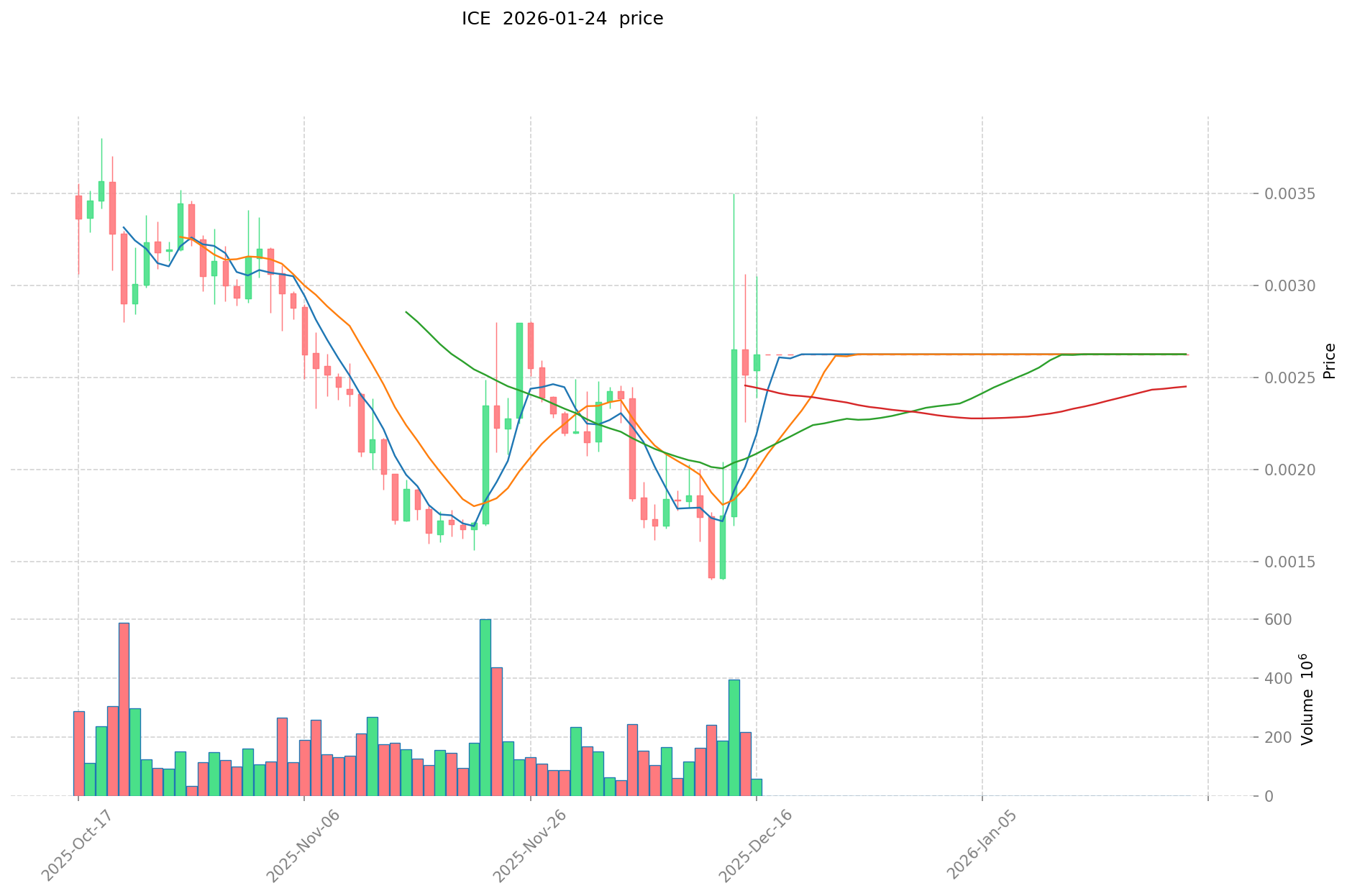
- Recent Period: Price fluctuated between various levels → The token showed volatility from higher price points to lower ranges
Current ICE Investment Market Status (January 2026)
- ICE Current Price: $0.00199496
- 24-hour Trading Volume: Data not available in current market conditions
- Market Cap: $13,551,324.40
- Circulating Supply: 6,792,780,005.41 ICE
- Holder Count: 440,639 addresses
- Price Changes: -1.80% (1H), -8.39% (7D), +12.64% (30D), -61.91% (1Y)
Click to view real-time ICE market price
II. Core Factors Affecting Whether ICE is a Good Investment (Is Ice Open Network(ICE) a Good Investment)
Supply Mechanism and Scarcity (ICE investment scarcity)
- Supply Structure → Impacts Price and Investment Value
- ICE has a maximum supply of 21.15 billion tokens, with approximately 6.79 billion tokens currently in circulation (as of January 25, 2026), representing a circulation ratio of about 32.12%.
- The limited supply structure may contribute to potential price appreciation as demand increases and more tokens enter circulation through the predefined issuance mechanism.
- Investment Significance: Scarcity remains a key element supporting long-term investment considerations, though the relatively low current circulation ratio suggests significant future token releases could impact supply dynamics.
Institutional Investment and Mainstream Adoption (Institutional investment in ICE)
- Market Position: As of January 25, 2026, ICE holds a market capitalization ranking of 1,058 with a market dominance of approximately 0.0013%, indicating it remains in the early stages of mainstream adoption.
- Accessibility: ICE is available on 3 exchanges and has attracted approximately 440,639 token holders, suggesting a growing but still developing user base.
- Ecosystem Development: The Ice Open Network features an intuitive drag-and-drop dApp builder designed to simplify decentralized application creation, potentially lowering barriers to entry for developers and users, which may support broader ecosystem adoption over time.
Macroeconomic Environment's Impact on ICE Investment
- Market Volatility Context: ICE has experienced considerable price fluctuations, with a 1-year price change of approximately -61.91% and a 30-day price change of +12.64% (as of January 25, 2026), reflecting sensitivity to broader market conditions and investor sentiment.
- Monetary Policy Considerations: Changes in global monetary policy and interest rate environments can influence investor appetite for alternative assets, including blockchain projects like ICE, as capital flows adjust between traditional and digital asset markets.
Technology and Ecosystem Development (Technology & Ecosystem for ICE investment)
- Layer 1 Blockchain Infrastructure: Ice Open Network operates as a Layer 1 blockchain designed to facilitate Web3 interactions, offering integrated decentralized services including digital identity verification, social media interaction, content delivery, and secure data storage.
- Technical Accessibility: The platform's drag-and-drop dApp builder aims to make decentralized application development accessible to users with minimal technical knowledge, potentially expanding the developer ecosystem and supporting long-term utility.
- Ecosystem Expansion Potential: The integrated suite of decentralized services is designed to enhance user empowerment, privacy protection, and facilitate digital interactions, which could contribute to broader blockchain technology adoption and support the project's long-term value proposition.
III. ICE Future Investment Forecast and Price Outlook (Is Ice Open Network(ICE) worth investing in 2026-2031)
Short-term Investment Forecast (2026, short-term ICE investment outlook)
- Conservative forecast: $0.00133926 - $0.002626
- Neutral forecast: $0.002626
- Optimistic forecast: $0.002626 - $0.00375518
Mid-term Investment Outlook (2027-2029, mid-term Ice Open Network(ICE) investment forecast)
-
Market stage expectation: During this period, ICE is anticipated to experience gradual growth as the Layer 1 blockchain ecosystem continues to mature. The expansion of decentralized services and the accessibility of the drag-and-drop dApp builder may attract more developers and users to the platform.
-
Investment return forecast:
- 2027: $0.0019462599 - $0.0037648962
- 2028: $0.001843203843 - $0.004277624013
- 2029: $0.003063370009635 - $0.00558386432136
-
Key catalysts: Potential catalysts include increased adoption of Web3 technologies, expansion of the decentralized identity verification and social media interaction services, growth in the number of dApps built on the platform, and broader market acceptance of Layer 1 blockchain solutions.
Long-term Investment Outlook (Is ICE a good long-term investment?)
- Base scenario: $0.003216926278472 - $0.005061928114655 (assuming steady development of the ecosystem and continued integration of decentralized services)
- Optimistic scenario: $0.005061928114655 - $0.006378029424465 (assuming accelerated adoption of the ION platform, significant growth in user base and developer activity, and favorable market conditions for blockchain technologies)
- Risk scenario: Below $0.001843203843 (in case of adverse market conditions, increased competition from other Layer 1 blockchains, or challenges in user and developer adoption)
Click to view ICE long-term investment and price forecast: Price Prediction
2026-01-25 - 2031 Long-term Outlook
- Base scenario: $0.003216926278472 - $0.005061928114655 (corresponding to steady progress and gradual increase in mainstream application)
- Optimistic scenario: $0.005061928114655 - $0.006378029424465 (corresponding to large-scale adoption and favorable market environment)
- Transformative scenario: Above $0.006378029424465 (if the ecosystem achieves breakthrough progress and mainstream popularization)
- 2031-12-31 forecast high: $0.006378029424465 (based on optimistic development assumptions)
Disclaimer: The forecasts provided are based on historical data and market trends and should not be considered as investment advice. Cryptocurrency markets are highly volatile and unpredictable. Investors should conduct their own research and consider their risk tolerance before making any investment decisions.
| Year |
Predicted High Price |
Predicted Average Price |
Predicted Low Price |
Price Change |
| 2026 |
0.00375518 |
0.002626 |
0.00133926 |
31 |
| 2027 |
0.0037648962 |
0.00319059 |
0.0019462599 |
59 |
| 2028 |
0.004277624013 |
0.0034777431 |
0.001843203843 |
74 |
| 2029 |
0.00558386432136 |
0.0038776835565 |
0.003063370009635 |
94 |
| 2030 |
0.00539308229038 |
0.00473077393893 |
0.003216926278472 |
137 |
| 2031 |
0.006378029424465 |
0.005061928114655 |
0.003796446085991 |
153 |
IV. ICE Investment Strategy and Risk Management (How to invest in Ice Open Network)
Investment Methodology (ICE investment strategy)
Investors interested in Ice Open Network (ICE) may consider different approaches based on their risk tolerance and investment goals:
-
Long-term Holding (HODL ICE): This strategy suits conservative investors who believe in the long-term potential of ION's Layer 1 blockchain infrastructure and its suite of decentralized services. Given the project's focus on digital identity verification, social media interaction, and accessible dApp creation tools, long-term holders may benefit from the platform's adoption growth over time. However, investors should note that ICE has experienced significant price fluctuations, with the token currently trading at $0.00199496, approximately 98.67% below its all-time high of $0.15 recorded on January 19, 2024.
-
Active Trading: This approach relies on technical analysis and swing trading strategies. Traders may capitalize on ICE's price volatility, though the token has shown considerable downward pressure with a 61.91% decline over the past year. Recent performance indicates a 1.80% decrease over 1 hour and an 8.39% decline over 7 days, while showing a 12.64% gain over 30 days. Active traders should monitor these short-term movements carefully.
Risk Management (Risk management for ICE investment)
-
Asset Allocation Ratios:
- Conservative investors: Limit ICE exposure to 1-3% of total crypto portfolio
- Aggressive investors: May allocate 5-10% based on higher risk tolerance
- Professional investors: Strategic positioning with appropriate hedging mechanisms
-
Risk Hedging Solutions: Diversify across multiple blockchain assets and consider correlation with major cryptocurrencies. ICE's current market dominance stands at just 0.0013%, indicating limited market influence. The circulating supply represents 32.12% of the maximum supply (6.79 billion out of 21.15 billion tokens), suggesting significant future dilution potential.
-
Secure Storage:
- Hot wallets: Suitable for active trading portions
- Cold wallets: Recommended for long-term holdings
- Hardware wallets: Optimal security for significant investments
- Note: ICE operates on the BSC (BNB Smart Chain) network with contract address 0xc335df7c25b72eec661d5aa32a7c2b7b2a1d1874, requiring BEP-20 compatible wallet solutions
V. ICE Investment Risks and Challenges (Risks of investing in Ice Open Network)
-
Market Risks: ICE exhibits substantial volatility, with price fluctuations ranging from an all-time low of $0.0014 (December 12, 2025) to an all-time high of $0.15 (January 19, 2024). The token's 24-hour trading volume data was not available in the provided information, which may indicate liquidity concerns. The current market capitalization of approximately $13.55 million and ranking of 1058 suggest limited market depth.
-
Regulatory Risks: As a blockchain project offering digital identity verification and social media interaction services, ION may face varying regulatory scrutiny across jurisdictions. Different countries maintain inconsistent policies regarding decentralized identity solutions and Web3 technologies, creating uncertainty for international adoption.
-
Technical Risks: As a Layer 1 blockchain, ION faces inherent technical challenges including:
- Network security vulnerabilities in smart contracts and infrastructure
- Potential upgrade failures or implementation issues
- Competition from established Layer 1 platforms
- The project's reliance on BEP-20 standard deployment on BSC may present centralization concerns
VI. Conclusion: Is Ice Open Network a Good Investment?
-
Investment Value Summary: Ice Open Network presents an interesting proposition in the Web3 infrastructure space with its integrated decentralized services and accessible dApp builder. However, the token has experienced significant price deterioration, declining 61.91% over the past year. While the 30-day performance shows a 12.64% gain, suggesting some recovery momentum, the overall market position remains relatively weak with a market cap of $13.55 million and ranking outside the top 1000 cryptocurrencies.
-
Investor Recommendations:
✅ Beginners: Consider dollar-cost averaging (DCA) strategies with small allocations, and prioritize secure BEP-20 compatible wallet storage. Given the high volatility and significant price decline from historical highs, new investors should approach with caution.
✅ Experienced Investors: May explore swing trading opportunities based on short-term price movements, while maintaining a diversified portfolio. The 32.12% circulating supply ratio indicates potential for future token releases that could impact price.
✅ Institutional Investors: Strategic long-term positioning should be evaluated against competing Layer 1 solutions and requires thorough due diligence on the project's technological differentiation and adoption metrics.
⚠️ Disclaimer: Cryptocurrency investments carry substantial risk. This content is provided for informational purposes only and does not constitute investment advice. Investors should conduct their own research and consult with financial advisors before making investment decisions.
VII. FAQ
Q1: Is Ice Open Network (ICE) a good investment for beginners in 2026?
For beginners, ICE presents a high-risk opportunity that requires careful consideration. The token has declined 61.91% over the past year and trades 98.67% below its all-time high of $0.15. With a small market cap of $13.55 million and ranking at 1058, ICE remains a speculative asset. Beginners should limit exposure to 1-3% of their crypto portfolio and consider dollar-cost averaging (DCA) strategies. The project's focus on Web3 infrastructure and accessible dApp development tools offers potential, but the significant price volatility and limited liquidity make it suitable only for those willing to accept substantial risk. Always store ICE in BEP-20 compatible wallets and never invest more than you can afford to lose.
Q2: What is the long-term price forecast for ICE through 2031?
Based on current market analysis, ICE's long-term price forecast shows gradual growth potential under multiple scenarios. The base scenario projects prices ranging from $0.003216926278472 to $0.005061928114655 by 2030-2031, representing steady ecosystem development. The optimistic scenario forecasts a potential high of $0.006378029424465 by December 31, 2031, assuming accelerated adoption of the ION platform and favorable market conditions. However, a risk scenario exists where prices could fall below $0.001843203843 if the project faces adoption challenges or increased competition from other Layer 1 blockchains. These forecasts assume continued development of decentralized services, growth in the developer ecosystem, and broader Web3 technology adoption, but remain subject to high uncertainty in the volatile cryptocurrency market.
Q3: How does ICE's circulating supply affect its investment value?
ICE's circulating supply represents a critical factor for investment consideration. Currently, only 6.79 billion tokens are in circulation out of a maximum supply of 21.15 billion tokens, representing a circulation ratio of approximately 32.12%. This means that nearly 68% of total tokens remain to be released into the market, which could create significant dilution pressure on the token price over time. As additional tokens enter circulation through the predefined issuance mechanism, the increasing supply may suppress price appreciation unless demand grows proportionally. Investors should monitor the token release schedule and understand that the limited current supply may not reflect the full long-term supply dynamics. This gradual token release could impact short-term price movements and should be factored into investment decisions, particularly for long-term holders.
Q4: What are the main technical advantages of Ice Open Network compared to other Layer 1 blockchains?
Ice Open Network differentiates itself through its integrated suite of decentralized Web3 services and user-friendly development tools. The platform's drag-and-drop dApp builder significantly lowers technical barriers, enabling users with minimal coding knowledge to create decentralized applications. This accessibility feature potentially expands the developer ecosystem beyond traditional blockchain developers. The platform integrates multiple decentralized services including digital identity verification, social media interaction, content delivery, and secure data storage within a single Layer 1 infrastructure. This comprehensive approach aims to provide an all-in-one solution for Web3 interactions, rather than requiring users to navigate multiple separate platforms. However, these technical advantages must be weighed against the project's current market position, as ICE competes with established Layer 1 blockchains that have larger ecosystems and greater network effects.
Q5: What security measures should investors take when storing ICE tokens?
Investors should implement a multi-layered security approach when storing ICE tokens. Since ICE operates on the BSC (BNB Smart Chain) network with contract address 0xc335df7c25b72eec661d5aa32a7c2b7b2a1d1874, investors must use BEP-20 compatible wallet solutions. For active trading, hot wallets connected to trusted exchanges provide convenient access but carry higher security risks. Long-term holders should transfer ICE to cold storage solutions, such as hardware wallets, which offer optimal security by keeping private keys offline and protected from online threats. Never share private keys or seed phrases, enable two-factor authentication on all accounts, and verify contract addresses before making transactions. For significant investments, consider distributing holdings across multiple secure storage solutions to minimize single-point failure risks. Always research wallet compatibility and security features before selecting storage methods.
Q6: How does the current macroeconomic environment affect ICE investment prospects?
The macroeconomic environment significantly influences ICE's investment outlook through multiple channels. Changes in global monetary policy and interest rate environments directly impact investor appetite for alternative assets, including blockchain projects like ICE. When traditional financial markets offer higher yields through rising interest rates, capital flows may shift away from speculative digital assets toward more stable investment options. ICE has demonstrated high sensitivity to broader market conditions, with a 61.91% price decline over the past year reflecting challenging market sentiment. However, the recent 12.64% gain over 30 days suggests some resilience during favorable conditions. Additionally, inflation concerns and currency devaluation in various regions may drive interest in decentralized financial solutions, potentially benefiting Web3 infrastructure projects. Investors should monitor Federal Reserve policies, global economic indicators, and cryptocurrency market cycles when evaluating ICE's investment timing, as these macro factors can trigger significant price volatility independent of the project's fundamental development.
Q7: What are the regulatory risks facing Ice Open Network investors?
Ice Open Network faces substantial regulatory uncertainty that investors must carefully consider. As a blockchain project offering digital identity verification and social media interaction services, ION operates in a regulatory gray area across multiple jurisdictions. Different countries maintain inconsistent and evolving policies regarding decentralized identity solutions, Web3 technologies, and blockchain-based social platforms. Some jurisdictions may impose strict compliance requirements for identity verification services, potentially limiting ION's operational flexibility or market access. The project's deployment on BSC (BNB Smart Chain) may also subject it to regulatory scrutiny associated with centralized exchange ecosystems. Future regulatory developments could impact token classification, taxation treatment, or trading accessibility on various exchanges. Additionally, data privacy regulations such as GDPR in Europe may affect how ION's decentralized services handle user information. Investors should monitor regulatory developments in their jurisdictions and understand that sudden policy changes could materially impact ICE's adoption prospects and token value. Geographic diversification of regulatory risk may be prudent for investors concerned about jurisdiction-specific restrictions.
Q8: What indicators should investors monitor to evaluate ICE's adoption and ecosystem growth?
Investors should track several key metrics to assess Ice Open Network's development trajectory and investment potential. Primary indicators include the growth rate of the holder base, which currently stands at 440,639 addresses—tracking whether this number increases consistently indicates expanding user adoption. Monitor the number and quality of dApps built using ION's drag-and-drop builder, as this reflects developer ecosystem engagement and platform utility. Exchange listings beyond the current 3 platforms would signal growing market acceptance and improved liquidity. On-chain transaction volume and active addresses provide insights into actual platform usage versus speculative trading. Track the token release schedule and circulating supply changes relative to the maximum 21.15 billion supply to anticipate potential dilution effects. Partnership announcements with established Web3 projects or enterprises would validate the platform's technological capabilities. Additionally, monitor social media engagement, GitHub development activity, and community growth across official channels. Compare these metrics against competing Layer 1 blockchains to evaluate relative performance. Regular assessment of these indicators helps investors distinguish between genuine ecosystem expansion and mere speculative price movements, enabling more informed long-term investment decisions.
* The information is not intended to be and does not constitute financial advice or any other recommendation of any sort offered or endorsed by Gate.