This comprehensive investment analysis examines Ice Open Network (ICE), a Layer 1 blockchain launched in January 2023 offering decentralized Web3 services including digital identity verification, social media integration, and secure data storage. The article evaluates ICE's current market position with a $13.77 million market capitalization, approximately 440,639 token holders, and trading at $0.002027 as of January 2026, alongside its historical volatility with a 61.91% annual decline from peaks of $0.15. Key investment factors include the token's finite supply structure (6.79 billion of 21.15 billion circulating), ecosystem accessibility through a drag-and-drop dApp builder, and positioning on Gate and other major exchanges. The analysis provides price forecasts ranging from conservative to optimistic scenarios through 2031, detailed risk assessments covering market volatility and regulatory uncertainties, and tailored investment strategies for different investor profiles. Comprehensive sections address tok
Introduction: Ice Open Network (ICE) Investment Position and Market Outlook
Ice Open Network (ICE) represents a notable asset in the cryptocurrency sector, having launched in January 2023 as a Layer 1 blockchain solution. As of January 25, 2026, ICE maintains a market capitalization of approximately $13.77 million with a circulating supply of about 6.79 billion tokens, trading at around $0.002027. With its positioning as a Web3 infrastructure provider offering decentralized services including digital identity verification, social media interaction, content delivery, and secure data storage, ICE has attracted attention from market participants evaluating "Is Ice Open Network (ICE) a good investment?" The project's drag-and-drop dApp builder aims to simplify decentralized application development for users with limited technical backgrounds. This article provides a comprehensive analysis of ICE's investment characteristics, historical price movements, future price projections, and associated risks to serve as a reference for market participants.
I. ICE Price Historical Review and Current Investment Value
- 2024: Token launch and initial trading activity → Initial price discovery phase with significant volatility
- 2024 (January 19): Price reached a notable level of $0.15 → Marked an early peak in trading activity
- 2025 (December 12): Market adjustment period → Price declined to $0.0014, representing a substantial correction from earlier levels
Current ICE Investment Market Status (January 2026)
- ICE current price: $0.00202657
- 24-hour trading volume: Data not available in current reporting period
- Token holder distribution: Approximately 440,639 holders recorded
- Market capitalization: $13,766,044.18 (circulating supply)
- Fully diluted valuation: $42,863,044.65
Click to view real-time ICE market price
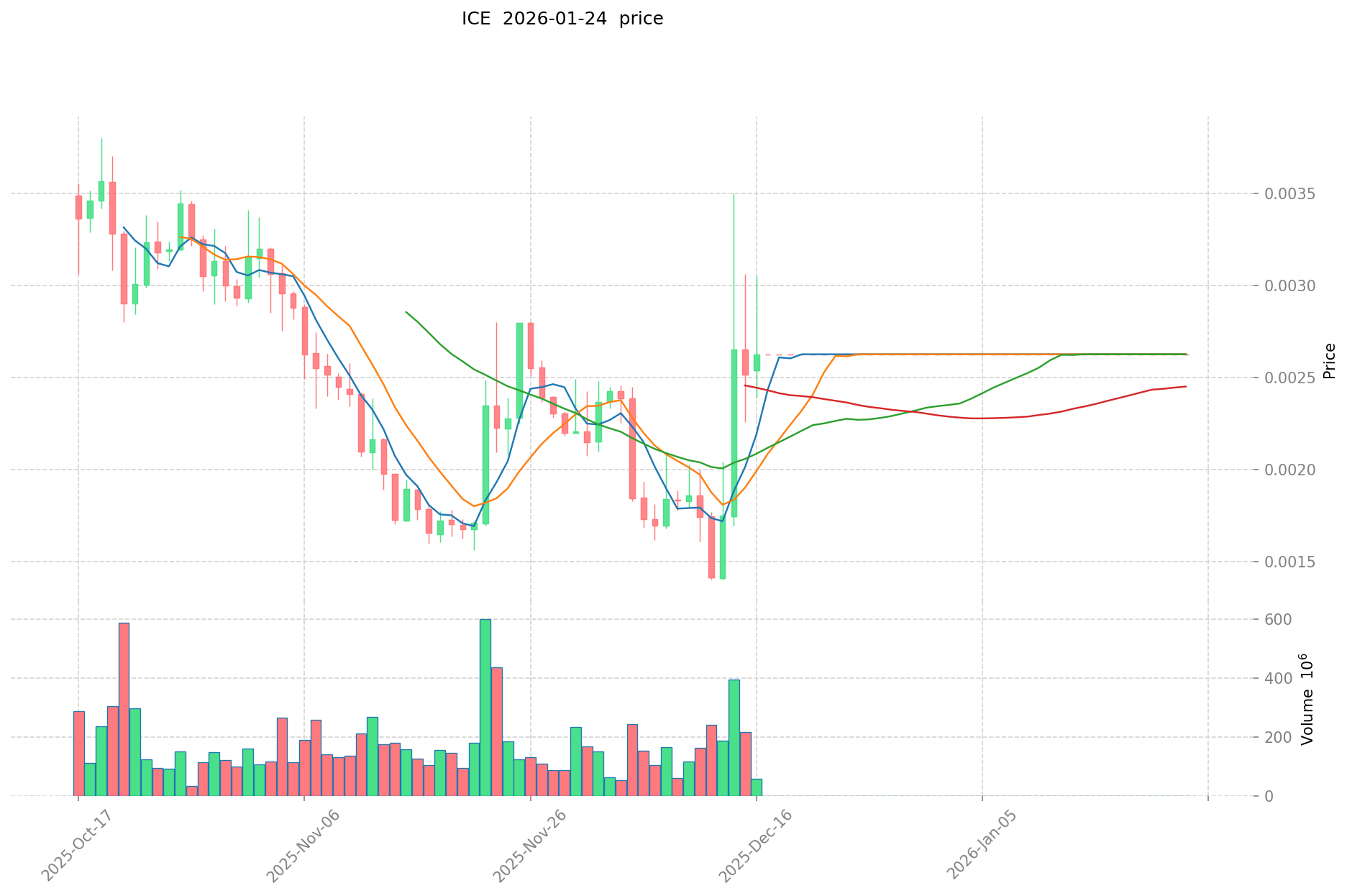
II. Core Factors Affecting Whether ICE is a Good Investment (Is Ice Open Network(ICE) a Good Investment)
Supply Mechanism and Scarcity (ICE investment scarcity)
- Supply Structure → Affects Price and Investment Value
- Ice Open Network (ICE) has a maximum supply of 21.15 billion tokens, with approximately 6.79 billion tokens currently in circulation (32.12% of total supply). This finite supply mechanism creates a structured scarcity model that may influence long-term valuation dynamics.
- The circulating supply represents less than one-third of the total supply, indicating significant token allocation remains locked or unvested, which could impact future supply dynamics and price movements.
- Historical Performance Context
- ICE reached a notable price level of $0.15 in January 2024, compared to the current price of approximately $0.002027 as of January 25, 2026. The token has experienced substantial price volatility, with recent annual performance showing a decline of approximately 61.91%.
- The market capitalization stands at approximately $13.77 million, with a fully diluted valuation of approximately $42.86 million, reflecting the potential market value if all tokens were in circulation.
- Investment Significance
- The token's scarcity model, combined with its allocation schedule, represents a structural element that may influence long-term investment considerations. The current market cap to fully diluted valuation ratio of 32.12% suggests significant future supply release potential.
Institutional Investment and Mainstream Adoption (Institutional investment in ICE)
- Holder Distribution
- Ice Open Network has attracted approximately 440,639 token holders, indicating a substantial user base and community engagement. This holder count reflects distribution across retail participants.
- The token is listed on 3 exchanges, with Gate.com being a confirmed trading venue, providing liquidity channels for market participants.
- Ecosystem Position
- Ice Open Network positions itself as a Layer 1 blockchain designed to revolutionize user and developer interactions with Web3 technologies. The platform offers decentralized services including digital identity verification, social media interaction, content delivery, and secure data storage.
- The project features an intuitive drag-and-drop dApp builder aimed at simplifying decentralized application creation for users with minimal technical knowledge, potentially expanding blockchain adoption accessibility.
Macroeconomic Environment Impact on ICE Investment
- Market Context and Performance Trends
- Short-term price movements show a 1-hour gain of 0.030% and a 7-day decline of 4.60%, while the 30-day performance indicates a gain of 16.80%. These metrics reflect ongoing price volatility within the broader cryptocurrency market environment.
- ICE's market dominance stands at 0.0013%, positioning it as a smaller-cap asset within the cryptocurrency ecosystem, which may correlate with higher volatility characteristics.
- Broader Market Positioning
- As a BEP20 token deployed on the Binance Smart Chain (BSC), ICE operates within an established blockchain infrastructure that provides network effects and interoperability with the broader BSC ecosystem.
Technology and Ecosystem Development (Technology & Ecosystem for ICE investment)
- Core Infrastructure
- Ice Open Network operates as a Layer 1 blockchain with integrated decentralized services designed to enhance user empowerment, privacy protection, and facilitate seamless digital interactions globally.
- The platform's technical architecture supports digital identity verification, social media integration, content delivery systems, and secure data storage solutions, representing a comprehensive Web3 service suite.
- Development Tools and Accessibility
- The drag-and-drop dApp builder represents a technical feature aimed at lowering barriers to entry for decentralized application development, potentially expanding the developer ecosystem and use case diversity.
- The project's focus on user-friendly interfaces and minimal technical knowledge requirements aligns with broader industry trends toward improving blockchain technology accessibility.
- Ecosystem Applications
- Ice Open Network's integrated service model encompasses multiple blockchain application categories, including identity solutions, social networking, content distribution, and data management, which may contribute to utility-driven value proposition development over time.
III. ICE Future Investment Forecast and Price Outlook (Is Ice Open Network(ICE) worth investing in 2026-2031)
Short-term Investment Forecast (2026, short-term ICE investment outlook)
- Conservative forecast: $0.00168 - $0.00263
- Neutral forecast: $0.00263 - $0.00326
- Optimistic forecast: $0.00326 - $0.00389
Mid-term Investment Outlook (2027-2028, mid-term Ice Open Network(ICE) investment forecast)
- Market stage expectations: Based on the provided data, ICE may experience gradual price appreciation during this period, with potential fluctuations influenced by broader market conditions and project developments.
- Investment return forecast:
- 2027: $0.00195 - $0.00479
- 2028: $0.00362 - $0.00559
- Key catalysts: Expansion of the decentralized services ecosystem, adoption of the drag-and-drop dApp builder, and increased user engagement with Web3 technologies may serve as potential drivers.
Long-term Investment Outlook (Is ICE a good long-term investment?)
- Base scenario: $0.00348 - $0.00659 (assuming steady development of the Layer 1 blockchain infrastructure and gradual market adoption)
- Optimistic scenario: $0.00514 - $0.00723 (contingent on successful ecosystem expansion, strategic partnerships, and favorable regulatory environment)
- Risk scenario: Below $0.00195 (under conditions of significant market downturn, technological challenges, or competitive pressures)
View ICE long-term investment and price forecast: Price Prediction
2026-01-25 - 2031 Long-term Outlook
- Base scenario: $0.00348 - $0.00659 (corresponding to steady progress and gradual mainstream application enhancement)
- Optimistic scenario: $0.00514 - $0.00723 (corresponding to large-scale adoption and favorable market conditions)
- Transformative scenario: Above $0.00723 (contingent on breakthrough ecosystem developments and mainstream adoption)
- 2031-12-31 forecast high: $0.00723 (based on optimistic development assumptions)
Disclaimer: The forecasts presented are based on historical data and predictive modeling. Cryptocurrency markets are highly volatile and subject to numerous unpredictable factors. These projections should not be construed as investment advice, and investors should conduct their own research and risk assessment before making investment decisions.
| Year |
Predicted High Price |
Predicted Average Price |
Predicted Low Price |
Price Change |
| 2026 |
0.00388648 |
0.002626 |
0.00168064 |
29 |
| 2027 |
0.0047866728 |
0.00325624 |
0.001953744 |
60 |
| 2028 |
0.005589824396 |
0.0040214564 |
0.00361931076 |
98 |
| 2029 |
0.00591093768954 |
0.004805640398 |
0.00365228670248 |
137 |
| 2030 |
0.006590695523837 |
0.00535828904377 |
0.00348288787845 |
164 |
| 2031 |
0.007229135663402 |
0.005974492283803 |
0.005138063364071 |
194 |
IV. ICE Investment Strategy and Risk Management (How to invest in cryptocurrency)
Investment Methodology (ICE investment strategy)
Long-term Holding (HODL ICE)
For conservative investors, a long-term holding strategy may be considered for ICE. This approach involves purchasing tokens and maintaining positions through market cycles, potentially benefiting from the project's development trajectory. Given ICE's current market position with a ranking of 1051 and a market capitalization of approximately $13.77 million, investors should carefully evaluate the project's long-term fundamentals.
Active Trading
Active traders may employ technical analysis and swing trading strategies with ICE. The token has demonstrated price movements with a 1-hour change of 0.030%, a 7-day decline of 4.60%, and a 30-day increase of 16.80%. These fluctuations may present opportunities for traders familiar with chart patterns and momentum indicators. However, the relatively limited trading volume requires careful attention to liquidity considerations.
Risk Management (Risk management for ICE investment)
Asset Allocation Ratios
- Conservative investors: Consider limiting ICE exposure to 1-3% of total crypto portfolio
- Moderate investors: May allocate 3-7% depending on risk tolerance
- Experienced investors: Could consider up to 10% allocation with appropriate risk controls
Risk Hedging Strategies
Implementing a diversified portfolio approach is essential when investing in lower market-cap assets like ICE. Consider:
- Diversification across multiple blockchain projects
- Allocation to established cryptocurrencies alongside smaller-cap positions
- Regular portfolio rebalancing based on predetermined thresholds
Secure Storage Solutions
Given that ICE operates on the BSC (BEP20) standard with contract address 0xc335df7c25b72eec661d5aa32a7c2b7b2a1d1874, investors should prioritize security:
- Hot wallets: Software wallets compatible with BSC for active trading
- Cold wallets: Hardware wallet solutions such as Ledger or Trezor for long-term storage
- Multi-signature wallets: For larger holdings requiring enhanced security protocols
V. ICE Investment Risks and Challenges (Risks of investing in cryptocurrency)
Market Risks
ICE faces significant market-related risks:
- High volatility: The token has experienced substantial price swings, with a 1-year decline of 61.91% from historical highs
- Price range: Historical data shows extreme fluctuation from an all-time high of $0.15 (January 19, 2024) to an all-time low of $0.0014 (December 12, 2025)
- Limited liquidity: With trading available on only 3 exchanges and 24-hour volume data currently at zero, liquidity constraints may impact trade execution
- Market depth concerns: The relatively small market capitalization may expose investors to price manipulation risks
Regulatory Risks
Cryptocurrency regulatory frameworks continue to evolve globally:
- Jurisdictional uncertainty: Different countries maintain varying approaches to digital asset regulation
- Compliance requirements: Potential changes in regulatory standards may affect ICE's operational capabilities
- Policy shifts: Sudden regulatory actions could impact token accessibility and trading availability
Technical Risks
Several technical considerations warrant attention:
- Network security: Blockchain projects face ongoing challenges related to potential vulnerabilities
- Smart contract risks: As a BEP20 token, ICE relies on smart contract functionality that may contain undiscovered issues
- Development execution: The project's ability to deliver on its roadmap and technical objectives remains a key consideration
- Infrastructure dependencies: Reliance on the BSC network means ICE's performance is tied to the underlying blockchain's stability
VI. Conclusion: Is Cryptocurrency a Good Investment?
Investment Value Summary
ICE presents a mixed investment profile. The project aims to provide Layer 1 blockchain infrastructure with integrated decentralized services, including digital identity verification, social media interaction, and secure data storage. With approximately 440,639 holders and a circulating supply representing 32.12% of maximum supply (6.79 billion of 21.15 billion tokens), the project demonstrates some level of community adoption.
However, significant considerations exist: the token has declined 61.91% over the past year, currently trades at $0.00202657 (substantially below its all-time high of $0.15), and maintains a relatively modest market ranking of 1051. The limited exchange availability (3 platforms) and current 24-hour trading volume data suggest liquidity challenges that may impact larger transactions.
Investor Recommendations
✅ Beginners: If considering ICE investment, implement dollar-cost averaging strategies with small, regular purchases rather than lump-sum investments. Prioritize secure storage solutions using hardware wallets compatible with BSC network. Limit exposure to a minimal percentage of overall portfolio and thoroughly research the project's fundamentals before committing capital.
✅ Experienced Investors: May explore swing trading opportunities based on technical analysis, while maintaining strict risk management protocols. Consider ICE as part of a diversified cryptocurrency portfolio rather than a concentrated position. Monitor project developments, partnership announcements, and ecosystem growth metrics for informed decision-making.
✅ Institutional Investors: Should conduct comprehensive due diligence including technical audits, team assessment, and competitive analysis before considering strategic allocation. Given the current market position and volatility profile, institutional exposure would typically require extensive risk assessment frameworks and may be more appropriate for venture-focused portfolios rather than conservative treasury management.
⚠️ Disclaimer: Cryptocurrency investments carry substantial risk, including potential loss of principal. ICE has demonstrated significant price volatility and faces various market, regulatory, and technical challenges. This analysis is provided for informational purposes only and does not constitute financial advice. Investors should conduct independent research and consult with qualified financial advisors before making investment decisions. Past performance does not guarantee future results.
VII. FAQ
Q1: What is Ice Open Network (ICE) and what makes it different from other blockchain projects?
Ice Open Network (ICE) is a Layer 1 blockchain launched in January 2023 that provides decentralized Web3 infrastructure services. ICE distinguishes itself through its integrated service suite encompassing digital identity verification, social media interaction, content delivery, and secure data storage, all accessible through a drag-and-drop dApp builder designed for users with minimal technical expertise. Operating on the Binance Smart Chain as a BEP20 token, ICE aims to simplify blockchain adoption by lowering technical barriers to decentralized application development while offering comprehensive Web3 services within a single ecosystem.
Q2: How has ICE performed historically, and what is its current market position?
ICE has experienced significant volatility since launch, reaching an all-time high of $0.15 in January 2024 before declining to its all-time low of $0.0014 in December 2025. As of January 25, 2026, ICE trades at approximately $0.002027 with a market capitalization of $13.77 million, ranking 1051 in the cryptocurrency market. The token shows a 61.91% decline over the past year, though recent 30-day performance indicates a 16.80% gain. With approximately 440,639 holders and trading available on 3 exchanges, ICE maintains a modest market presence with limited liquidity compared to larger-cap digital assets.
Q3: What are the key risk factors investors should consider before investing in ICE?
ICE presents several significant risk considerations: extreme price volatility evidenced by a 99% decline from all-time highs, limited liquidity with trading on only 3 exchanges and minimal 24-hour volume, regulatory uncertainty affecting cryptocurrency assets globally, and technical risks inherent to blockchain projects including smart contract vulnerabilities and network security challenges. Additionally, with 67.88% of total supply still locked or unvested, future token releases could create substantial selling pressure. The project's relatively small market capitalization of $13.77 million and ranking of 1051 also indicate higher volatility potential and lower liquidity compared to established cryptocurrencies.
Q4: What is ICE's tokenomics structure, and how does it affect investment value?
ICE has a maximum supply of 21.15 billion tokens, with approximately 6.79 billion tokens currently in circulation (32.12% of total supply). This structured release schedule means significant token allocation remains locked, which could impact future supply dynamics and price movements. The current market capitalization of $13.77 million contrasts with a fully diluted valuation of $42.86 million, representing the potential market value if all tokens were circulating. This 3.1x differential between current and fully diluted valuation suggests substantial future supply pressure that investors should factor into long-term investment considerations and price projection models.
Q5: What are realistic price expectations for ICE in the short and long term?
Based on analytical modeling, ICE's short-term forecast for 2026 ranges from $0.00168 (conservative) to $0.00389 (optimistic), with neutral expectations between $0.00263-$0.00326. Mid-term projections suggest potential ranges of $0.00195-$0.00479 for 2027 and $0.00362-$0.00559 for 2028. Long-term scenarios through 2031 project a base case of $0.00348-$0.00659, with optimistic conditions potentially reaching $0.00514-$0.00723. However, these forecasts carry significant uncertainty given ICE's historical volatility, limited market data, and dependence on project execution, ecosystem adoption, and broader cryptocurrency market conditions.
Q6: How should different types of investors approach ICE investment?
Conservative investors should limit ICE exposure to 1-3% of their cryptocurrency portfolio, implementing dollar-cost averaging strategies rather than lump-sum purchases and prioritizing secure cold storage solutions. Experienced investors may explore active trading opportunities using technical analysis while maintaining strict risk management protocols, treating ICE as a speculative small-cap allocation within a diversified portfolio. Institutional investors should conduct comprehensive due diligence including technical audits and competitive analysis, recognizing that ICE's current market position and volatility profile may be more suitable for venture-focused portfolios rather than conservative treasury management strategies.
Q7: What security measures should ICE investors implement?
Given ICE's BEP20 token standard (contract address: 0xc335df7c25b72eec661d5aa32a7c2b7b2a1d1874), investors should implement multi-layered security protocols. For active trading, use reputable hot wallets compatible with Binance Smart Chain with two-factor authentication enabled. For long-term holdings, hardware wallet solutions such as Ledger or Trezor provide optimal security against unauthorized access. Larger holdings may benefit from multi-signature wallet configurations requiring multiple approvals for transactions. Always verify contract addresses before transactions, avoid sharing private keys, and maintain backups of recovery phrases in secure, offline locations separate from digital storage.
Q8: What factors could positively or negatively influence ICE's future investment value?
Positive catalysts include successful expansion of the decentralized services ecosystem, increased adoption of the drag-and-drop dApp builder, strategic partnerships enhancing utility, favorable regulatory developments for blockchain infrastructure, and broader mainstream acceptance of Web3 technologies. Negative factors encompass continued market downturn affecting cryptocurrency sector sentiment, technological challenges or security vulnerabilities in the platform, increased competition from established Layer 1 blockchains, regulatory restrictions limiting operational capabilities, failure to achieve roadmap milestones, and significant token unlocks creating selling pressure. Investors should monitor project developments, partnership announcements, and ecosystem growth metrics for informed decision-making.
* The information is not intended to be and does not constitute financial advice or any other recommendation of any sort offered or endorsed by Gate.