This comprehensive analysis examines whether Infinity Ground (AIN) represents a viable investment opportunity within the AI-native blockchain infrastructure sector. Launched in 2025 with $2 million institutional backing from investors including Animoca Brands and Frachtis Ventures, AIN currently trades at $0.03994 with a market cap of $1.68 million across 14 exchanges including Gate. The article evaluates critical investment factors including tokenomics (42M circulating supply of 1B max), institutional adoption (20,523 holders), and price projections ranging from $0.0327-$0.1082 through 2031 depending on adoption scenarios. Infinity Ground's differentiation lies in its decentralized agentic IDE, AI App Store, and ING Network—enabling no-code blockchain development for non-technical users. However, significant risks include high volatility, concentration (top 5 addresses hold 73.92%), low trading liquidity, regulatory uncertainty, and technical execution challenges inherent to early-stage infrastructure projec
Introduction: Infinity Ground (AIN) Investment Position and Market Outlook
AIN is a notable asset in the cryptocurrency space, representing the Infinity Ground project that launched in 2025. As of February 2026, AIN maintains a market capitalization of approximately $1.68 million with a circulating supply of 42 million tokens, currently trading around $0.03994. Positioned as a blockchain infrastructure for AI-native development, Infinity Ground aims to facilitate decentralized application creation through its agent-driven environment. The project secured $2 million in seed funding in early 2025, backed by investors including Frachtis Ventures, MarbleX, MHVentures, Animoca Brands, KnightFury, and Presto Labs. With approximately 20,523 holders and listings across 14 exchanges, AIN has garnered attention in discussions regarding "Is Infinity Ground (AIN) a good investment?" This article examines AIN's investment characteristics, historical price movements, future price perspectives, and associated risks to provide reference for potential investors.
I. Infinity Ground (AIN) Price History Review and Current Investment Value Status
- July 2025: AIN reached a notable price level of $0.21613 → Early-stage investors observed potential returns
- July 2025: AIN traded at a lower range near $0.015 → Price exhibited considerable fluctuation
- 2025: Market cycle demonstrated volatility → Price movement ranged across multiple levels throughout the year
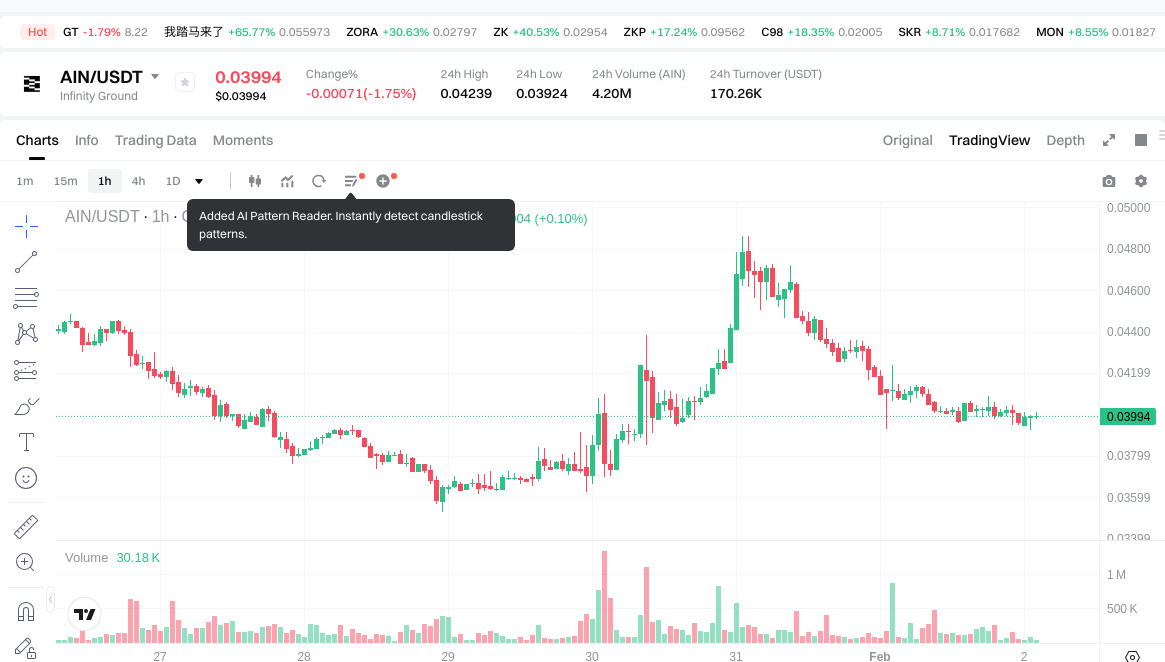
Current AIN Investment Market Status (February 2026)
- AIN current price: $0.03994
- Market sentiment (Fear & Greed Index): Data indicates cautious market conditions
- 24-hour trading volume: $170,244.97
- Institutional investor holdings: Top 5 addresses collectively hold approximately 73.92% of AIN supply, with the largest single address controlling 22.45%
Click to view real-time AIN market price
II. Core Factors Influencing Whether AIN is a Good Investment
Supply Mechanism and Scarcity (AIN Investment Scarcity)
- Total supply: 1,000,000,000 AIN; Max supply: 1,000,000,000 AIN
- Circulating supply: 42,000,000 AIN (4.2% of total supply)
- The project executed a 2.62M AIN token burn (valued at $340,000) in July 2025, reducing circulating supply and potentially enhancing scarcity
- Investment significance: The controlled circulating supply relative to total supply, combined with burn mechanisms, may contribute to long-term value support
Institutional Investment and Mainstream Adoption (Institutional Investment in AIN)
- In early 2025, Infinity Ground completed a $2 million seed funding round
- The project secured backing from multiple investment institutions, including Frachtis Ventures, MarbleX, MHVentures, Animoca Brands, KnightFury, Presto Labs, UFLY Labs, and PAKA
- The participation of established blockchain-focused investors may indicate institutional confidence in the project's development direction
- Current holder count: 20,523 addresses
Technology and Ecosystem Development (Technology & Ecosystem for AIN Investment)
- The project features a decentralized agentic IDE that enables users to build DApps (games, social apps, DeFi applications) using natural language without coding requirements
- An AI App Store provides a platform for publishing and monetizing user-created applications
- ING Network serves as a scalable public chain specifically designed for the platform's development environment
- The integration of AI-driven development tools and blockchain infrastructure may support the platform's ecosystem expansion and long-term value proposition
- Tiered staking mechanism introduced with APY ranging from 10% to 40%, with lock-up periods between 1 to 24 months
III. AIN Future Investment Predictions and Price Outlook (Is Infinity Ground (AIN) Worth Investing in 2026-2031)
Short-term Investment Prediction (2026, Short-term AIN Investment Outlook)
As of February 2, 2026, AIN is trading at $0.03994. Based on available market data and historical trends, short-term price predictions for 2026 suggest the following scenarios:
- Conservative Prediction: $0.0327 - $0.0399
- Neutral Prediction: $0.0399 - $0.0465
- Optimistic Prediction: $0.0465 - $0.0515
The short-term outlook reflects current market conditions, with the token showing recent volatility. The 24-hour price change of -2.68% and 7-day decline of -10.18% indicate near-term pressure. However, the conservative range accounts for potential stabilization, while the optimistic scenario considers possible recovery driven by broader market sentiment shifts or project-specific developments.
Mid-term Investment Outlook (2027-2029, Mid-term Infinity Ground (AIN) Investment Forecast)
-
Market Stage Expectation: During the 2027-2029 period, AIN may enter a consolidation and gradual growth phase, contingent upon the development progress of the Infinity Ground ecosystem and adoption of its decentralized agentic IDE platform.
-
Investment Return Prediction:
- 2027: $0.0402 - $0.0553
- 2028: $0.0374 - $0.0692
- 2029: $0.0401 - $0.0886
-
Key Catalysts: Mid-term price movements could be influenced by several factors, including expansion of the AI App Store, increased developer adoption of the ING Network, strategic partnerships within the blockchain and AI sectors, and overall cryptocurrency market conditions. The completion of the $2 million seed funding round and backing from investors such as Animoca Brands, Frachtis Ventures, and MarbleX may provide foundational support for ecosystem development.
Long-term Investment Outlook (Is AIN a Good Long-term Investment?)
- Baseline Scenario: $0.0554 - $0.1017 (assuming steady ecosystem development and moderate market conditions through 2030-2031)
- Optimistic Scenario: $0.0740 - $0.1082 (assuming accelerated adoption of Infinity Ground's platform, increased DApp creation via the decentralized IDE, and favorable regulatory and market environments)
- Risk Scenario: Below $0.0374 (under conditions of prolonged market downturns, delayed project milestones, or intensified competition in the blockchain infrastructure space)
Click to view AIN long-term investment and price prediction: Price Prediction
2026-2031 Long-term Outlook
- Baseline Scenario: $0.0554 - $0.1017 (corresponding to steady progress and gradual mainstream application adoption)
- Optimistic Scenario: $0.0740 - $0.1082 (corresponding to large-scale adoption and favorable market conditions)
- Transformative Scenario: Above $0.1082 (if the ecosystem achieves breakthrough developments and mainstream penetration)
- December 31, 2031 Predicted High: $0.1082 (based on optimistic development assumptions)
Disclaimer: This analysis is for informational purposes only and does not constitute investment advice. Cryptocurrency investments carry significant risks, and past performance does not guarantee future results. Investors should conduct thorough research and consider their risk tolerance before making investment decisions.
| Year |
Predicted High Price |
Predicted Average Price |
Predicted Low Price |
Price Change |
| 2026 |
0.0515097 |
0.03993 |
0.0327426 |
0 |
| 2027 |
0.0553210185 |
0.04571985 |
0.040233468 |
14 |
| 2028 |
0.0692129949225 |
0.05052043425 |
0.037385121345 |
26 |
| 2029 |
0.08860273758765 |
0.05986671458625 |
0.040110698772787 |
49 |
| 2030 |
0.101701574739121 |
0.07423472608695 |
0.057903086347821 |
85 |
| 2031 |
0.108200825008034 |
0.087968150413035 |
0.055419934760212 |
120 |
IV. AIN Investment Strategy and Risk Management (How to invest in AIN)
Investment Methodology (AIN investment strategy)
Long-term Holding (HODL AIN): This approach suits conservative investors who believe in the project's long-term vision of democratizing blockchain development through AI-native applications. Given Infinity Ground's backing from notable investors including Animoca Brands, Frachtis Ventures, and MarbleX, and its innovative positioning as blockchain infrastructure for "Vibe Coders," long-term holders may benefit from potential ecosystem growth as the platform develops its decentralized agentic IDE, AI App Store, and ING Network.
Active Trading: For traders employing technical analysis and swing trading strategies, AIN has demonstrated notable volatility. Recent price action shows a 24-hour range between $0.03924 and $0.04239, with a 24-hour trading volume of approximately $170,244. The token has experienced significant price movements, including a 1-year change of 32.79%, though recent trends show pullbacks of -2.68% (24H), -10.18% (7D), and -22.55% (30D). This volatility may present opportunities for experienced traders capable of managing short-term price fluctuations.
Risk Management (Risk management for AIN investment)
Asset Allocation Ratios:
- Conservative investors: Consider allocating no more than 1-3% of crypto portfolio to early-stage infrastructure projects like AIN
- Aggressive investors: May allocate 5-10% depending on risk tolerance and conviction in the AI-blockchain convergence thesis
- Professional investors: Should conduct thorough due diligence on tokenomics, noting the current circulating supply of 42 million tokens (4.2% of max supply of 1 billion)
Risk Hedging Strategies: Diversification across multiple blockchain infrastructure projects, established cryptocurrencies, and traditional assets can help mitigate concentration risk. Given AIN's correlation with broader crypto market movements, investors should monitor overall market sentiment and macroeconomic factors affecting digital assets.
Secure Storage:
- Hardware wallets (such as Ledger or Trezor) are recommended for long-term holdings
- For active traders, reputable exchanges with robust security measures and insurance coverage
- Note that AIN operates on the BSC (BEP-20) standard, requiring compatible wallet solutions
- Contract address verification is essential: 0x9558a9254890b2a8b057a789f413631b9084f4a3
V. AIN Investment Risks and Challenges (Risks of investing in AIN)
Market Risks: AIN demonstrates high volatility characteristic of lower market cap cryptocurrencies. With a current market capitalization of approximately $1.68 million and ranking around #2159, the token may be subject to significant price swings. The substantial difference between market cap and fully diluted valuation ($39.94 million) indicates potential dilution risk as additional tokens enter circulation. The 24-hour price movement of -2.68% and 30-day decline of -22.55% reflect recent negative momentum.
Regulatory Risks: As blockchain infrastructure facilitating decentralized application development, Infinity Ground may face regulatory scrutiny in various jurisdictions. The evolving regulatory landscape for AI-integrated blockchain platforms introduces uncertainty. Different countries maintain varying approaches to cryptocurrency regulation, which could impact the project's operations, token trading, or user adoption in specific markets.
Technical Risks: As an early-stage project (launched in 2025) building complex infrastructure including a decentralized IDE, AI App Store, and dedicated blockchain (ING Network), Infinity Ground faces significant technical execution risks. Potential vulnerabilities include:
- Smart contract security on the BSC network
- Integration challenges between the agentic IDE and blockchain components
- Scalability concerns for the ING Network as user base grows
- Dependency on AI model reliability and performance
- Competition from established blockchain development platforms
Liquidity Considerations: With a 24-hour trading volume of approximately $170,244 across 14 exchanges, AIN may experience liquidity constraints compared to major cryptocurrencies. Lower liquidity can lead to higher slippage during trades and increased price volatility.
VI. Conclusion: Is AIN a Good Investment?
Investment Value Summary: AIN represents an early-stage opportunity in the intersection of AI and blockchain infrastructure, backed by reputable investors and addressing the emerging market of no-code blockchain development. The project's positioning for "Vibe Coders" and its three-pillar approach (decentralized IDE, AI App Store, ING Network) demonstrate innovation in democratizing Web3 development. However, with only 4.2% of tokens currently circulating and recent price declines, the investment carries substantial volatility and execution risk typical of early-phase crypto projects.
Investor Recommendations:
✅ Beginners: Consider dollar-cost averaging (DCA) with small allocations rather than lump-sum investment. Prioritize secure storage using hardware wallets compatible with BSC network. Thoroughly research the project's development roadmap and team credentials before investing.
✅ Experienced Investors: May employ swing trading strategies around key development milestones and market catalysts. Maintain diversified portfolio allocation, limiting AIN exposure to a proportion commensurate with its risk profile. Monitor on-chain metrics including holder count (currently 20,523) and trading volume trends.
✅ Institutional Investors: Conduct comprehensive due diligence on tokenomics, vesting schedules, and unlock timelines given the low circulating supply ratio. Evaluate strategic positioning within broader AI-blockchain infrastructure thesis. Consider staged entry positions aligned with product development milestones.
⚠️ Disclaimer: Cryptocurrency investments involve high risk, including potential loss of principal. This analysis is for informational purposes only and does not constitute financial advice. Conduct independent research and consult qualified financial advisors before making investment decisions. Past performance does not guarantee future results.
VII. FAQ
Q1: What is Infinity Ground (AIN) and what makes it different from other blockchain projects?
Infinity Ground (AIN) is a blockchain infrastructure project designed for AI-native development, enabling users to build decentralized applications without coding knowledge. The platform distinguishes itself through three core components: a decentralized agentic IDE that allows natural language-based DApp creation, an AI App Store for publishing and monetizing applications, and the ING Network—a dedicated scalable blockchain. Unlike traditional development platforms requiring technical expertise, Infinity Ground targets "Vibe Coders" who can create games, social apps, and DeFi applications through intuitive AI-driven interfaces. Launched in 2025 with $2 million in seed funding from investors including Animoca Brands, Frachtis Ventures, and MarbleX, the project operates on the BSC (BEP-20) network with a maximum supply of 1 billion tokens and currently has approximately 20,523 holders across 14 exchanges.
Q2: What are the current tokenomics and supply dynamics of AIN?
As of February 2026, AIN has a total and maximum supply of 1 billion tokens, with only 42 million tokens (4.2%) currently in circulation. This creates a significant difference between the market capitalization ($1.68 million) and fully diluted valuation ($39.94 million), indicating potential future token releases. In July 2025, the project conducted a token burn of 2.62 million AIN (valued at $340,000) to enhance scarcity. The top 5 wallet addresses collectively control approximately 73.92% of the supply, with the largest single address holding 22.45%, demonstrating high concentration. The project has introduced a tiered staking mechanism offering APY between 10% and 40% with lock-up periods ranging from 1 to 24 months, providing utility for token holders while potentially reducing circulating supply.
Q3: What is the price prediction for AIN from 2026 to 2031?
Based on current market conditions and development trajectory, AIN price predictions vary across different timeframes. For 2026 (short-term), conservative estimates range from $0.0327 to $0.0399, neutral predictions span $0.0399 to $0.0465, and optimistic scenarios suggest $0.0465 to $0.0515. Mid-term projections (2027-2029) show gradual growth potential: 2027 ($0.0402-$0.0553), 2028 ($0.0374-$0.0692), and 2029 ($0.0401-$0.0886). Long-term outlook for 2030-2031 presents a baseline scenario of $0.0554-$0.1017 assuming steady ecosystem development, with an optimistic scenario reaching $0.0740-$0.1082 if platform adoption accelerates. The predicted high for December 31, 2031, stands at $0.1082. However, these predictions depend heavily on ecosystem development, developer adoption, market conditions, and execution of the project roadmap. A risk scenario exists below $0.0374 under prolonged market downturns or delayed milestones.
Q4: Who are the institutional investors backing Infinity Ground and what does this mean for the project?
Infinity Ground completed a $2 million seed funding round in early 2025, backed by prominent blockchain and gaming-focused investors including Animoca Brands, Frachtis Ventures, MarbleX, MHVentures, KnightFury, Presto Labs, UFLY Labs, and PAKA. Animoca Brands' involvement is particularly significant given their extensive portfolio in blockchain gaming and metaverse projects, suggesting confidence in Infinity Ground's vision for democratizing Web3 development. This institutional backing provides several potential advantages: financial resources for product development, strategic guidance from experienced blockchain investors, network effects through investor connections in the gaming and DeFi sectors, and enhanced credibility in the cryptocurrency ecosystem. However, investors should note that institutional backing, while positive, does not guarantee project success or token appreciation, as execution risks and market conditions remain critical factors.
Q5: What are the main risks associated with investing in AIN?
Investing in AIN carries multiple significant risks that potential investors should carefully consider. Market risk is substantial given the token's low market capitalization ($1.68 million), ranking around #2159, and recent negative price momentum (-2.68% in 24 hours, -22.55% in 30 days). The high concentration of holdings (73.92% controlled by top 5 addresses) creates potential for large sell-offs. Technical risks include smart contract vulnerabilities on the BSC network, integration challenges between AI and blockchain components, scalability concerns for the ING Network, and competition from established development platforms. Regulatory uncertainty affects AI-integrated blockchain projects as jurisdictions develop varying approaches to cryptocurrency oversight. Liquidity constraints exist with daily trading volume of approximately $170,244, which can lead to higher slippage and volatility. The large gap between circulating supply (4.2%) and maximum supply indicates potential dilution as tokens unlock. As an early-stage project launched in 2025, execution risk remains high despite institutional backing.
Q6: What investment strategies are recommended for different types of AIN investors?
Investment strategies should align with investor experience and risk tolerance. Conservative investors and beginners should consider limiting AIN exposure to 1-3% of their crypto portfolio, employing dollar-cost averaging (DCA) rather than lump-sum investments, and prioritizing secure storage using hardware wallets compatible with the BSC network. Experienced investors may allocate 5-10% depending on conviction in the AI-blockchain thesis and can employ swing trading strategies around development milestones, given AIN's volatility (24-hour range $0.03924-$0.04239). Active traders should leverage technical analysis while monitoring the 24-hour trading volume ($170,244) and recent price trends. Professional and institutional investors should conduct comprehensive due diligence on tokenomics, vesting schedules, and unlock timelines, considering staged entry positions aligned with product milestones. All investors should diversify across multiple blockchain infrastructure projects and traditional assets to mitigate concentration risk, and verify the contract address (0x9558a9254890b2a8b057a789f413631b9084f4a3) before transactions.
Q7: How does Infinity Ground's technology stack work and what is its competitive advantage?
Infinity Ground's technology architecture comprises three interconnected components designed to simplify blockchain development. The decentralized agentic IDE enables users to build DApps (games, social applications, DeFi protocols) using natural language commands without coding requirements, targeting the emerging "Vibe Coder" demographic. The AI App Store provides a marketplace for developers to publish, distribute, and monetize their creations, creating potential revenue streams within the ecosystem. The ING Network functions as a scalable public blockchain specifically optimized for the platform's development environment, addressing performance requirements for AI-driven applications. This integrated approach differentiates Infinity Ground from traditional blockchain development platforms that require technical expertise. The competitive advantage lies in accessibility—democratizing Web3 development for non-technical users while maintaining blockchain's core benefits of decentralization and transparency. However, the project faces competition from established platforms and must prove the reliability of AI-generated code, scalability of the ING Network, and market demand for no-code blockchain development tools.
Q8: What factors could drive AIN's price appreciation in the medium to long term?
Several catalysts could potentially drive AIN's value appreciation through 2031. Platform adoption metrics will be critical—increasing developer activity on the decentralized IDE, growing application submissions to the AI App Store, and expanding transaction volume on the ING Network would demonstrate ecosystem traction. Strategic partnerships within blockchain gaming, DeFi, and AI sectors could enhance utility and visibility, leveraging existing investor connections (Animoca Brands, MarbleX). The staking mechanism offering 10-40% APY may reduce circulating supply while incentivizing long-term holding. Mainstream adoption of no-code development tools could position Infinity Ground favorably as blockchain development democratizes. Positive cryptocurrency market conditions and increased institutional interest in AI-blockchain convergence projects may provide tailwinds. Token burn mechanisms, if continued, could enhance scarcity. Regulatory clarity for AI-integrated blockchain platforms would reduce uncertainty. Technical milestones including successful ING Network scaling, security audits, and feature launches could build investor confidence. However, these catalysts remain speculative, and price appreciation depends on successful execution, competitive positioning, and broader market dynamics. The low current circulating supply (4.2%) means future token unlocks could create selling pressure offsetting positive developments.
* The information is not intended to be and does not constitute financial advice or any other recommendation of any sort offered or endorsed by Gate.