This comprehensive guide evaluates whether Injective (INJ) represents a viable cryptocurrency investment opportunity. Positioned as a Layer-1 blockchain for DeFi and Web3 applications, INJ currently trades at $5.589 with institutional backing from Binance, Pantera Capital, and Jump Crypto. The article examines INJ's price evolution from its October 2020 launch through 2026, analyzing market capitalization of $558.9 million and historical volatility patterns. It presents detailed investment frameworks across conservative to aggressive strategies, including dollar-cost averaging and active trading approaches. The guide addresses critical investment considerations including supply mechanics, ecosystem development metrics, and technical infrastructure upgrades like the November 2024 EVM mainnet launch. Additionally, it provides transparent risk assessment covering market volatility, regulatory uncertainty, and technical vulnerabilities. Suitable for beginners through institutional investors seeking Layer-1 blockc
Introduction: Injective (INJ) Investment Position and Market Outlook
INJ is a significant asset in the cryptocurrency field. Since its launch in 2020, it has achieved notable progress in the DeFi and Web3 application sectors. As of 2026, Injective holds a market capitalization of approximately $558.9 million, with a circulating supply of 100 million tokens, and the current price is maintained around $5.589. Positioned as a Layer-1 blockchain platform, Injective has gradually become a focal point for investors when discussing "Is Injective (INJ) a good investment?" This article will comprehensively analyze the investment value, historical trends, future price predictions, and investment risks of INJ, providing reference for investors.
Injective is an interoperable Layer-1 blockchain designed for building DeFi and Web3 applications. It provides developers with plug-and-play modules for creating decentralized applications. INJ serves as the native asset powering the Injective ecosystem. The project was incubated by Binance and is supported by prominent investors including Jump Crypto, Pantera Capital, and Mark Cuban. As of January 14, 2026, INJ is listed on 57 exchanges and has approximately 23,977 holders, demonstrating certain market participation.
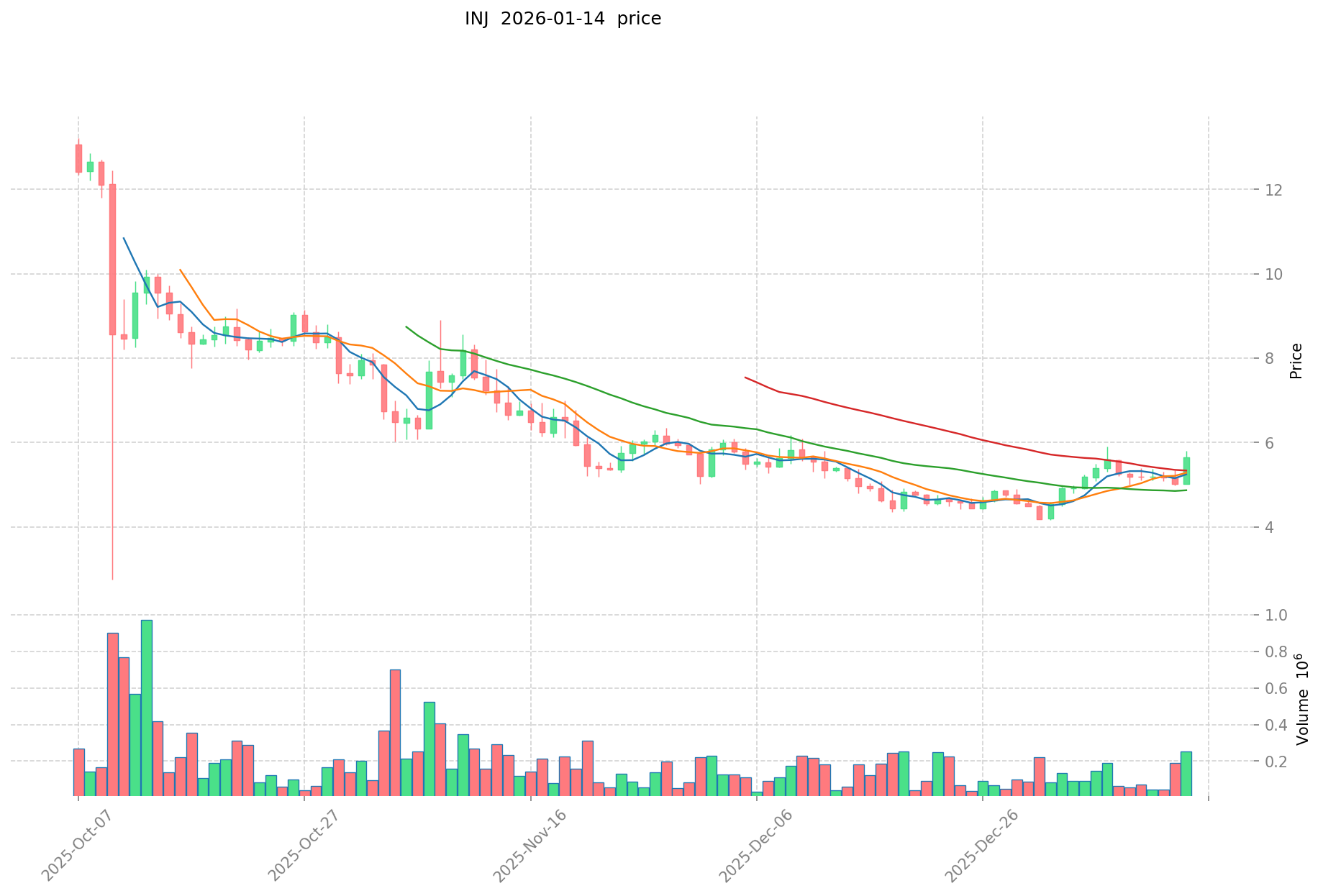
From a market performance perspective, INJ has experienced notable price volatility. The token recorded a price of $52.62 on March 14, 2024, while its lower price point was $0.657401 on November 4, 2020. Recent data shows a 6.07% increase over 24 hours and a 3.2% increase over 7 days, though the token experienced a decline of 72.14% over the past year. The circulating supply represents 100% of the total supply, with the market cap to fully diluted valuation ratio at 100%. INJ's market dominance stands at 0.016% as of the current reporting period.
I. Injective (INJ) Price History Review and Current Investment Value
- 2020: INJ entered the public market in October 2020 at approximately $0.75 → Early investors who entered at launch price witnessed subsequent price appreciation as the project gained traction
- 2021: The bull market cycle drove significant price momentum → INJ reached $25.01 in April 2021, representing substantial gains from its initial listing price. The year closed at $8.24 following market corrections
- 2022-2023: Market recovery phase → INJ trading activity showed renewed interest with price movements reflecting broader market sentiment shifts
- 2024: Notable price peak recorded → INJ reached $52.62 on March 14, 2024, demonstrating strong performance during this period before entering a correction phase
Current INJ Investment Market Status (January 2026)
- Current INJ Price: $5.589 (as of January 14, 2026)
- 24-Hour Trading Volume: Approximately $2.57 million
- Price Performance:
- 24-hour change: +6.07%
- 7-day change: +3.2%
- 30-day change: +6.29%
- 1-year change: -72.14%
- Market Capitalization: $558.9 million
- Circulating Supply: 100 million INJ (100% of total supply)
- Market Dominance: 0.016% of total crypto market cap
- Token Holder Base: Approximately 23,977 holders
- Exchange Listings: Available on 57 trading platforms globally
Click to view real-time INJ market price
II. Core Factors Influencing Whether INJ is a Good Investment
Supply Mechanism and Scarcity (INJ Investment Scarcity)
- Total supply: 100,000,000 INJ, with 100% currently in circulation
- Circulating supply equals total supply, indicating full token release
- Investment significance: The fixed supply structure may provide certain scarcity characteristics, which could be a factor supporting long-term valuation
Institutional Investment and Mainstream Adoption (Institutional Investment in INJ)
- Institutional backing: Injective is incubated by Binance and supported by prominent investors including Pantera Capital and Jump Crypto
- Infrastructure development: The EVM mainnet went live in November 2024, potentially enhancing ecosystem adoption
- Investment implication: Strong institutional support and continuous infrastructure development may contribute to the project's long-term viability
Macroeconomic Environment's Impact on INJ Investment
- Broader crypto market cycles influence INJ's price trajectory alongside other digital assets
- Market sentiment and capital rotation patterns affect INJ's relative performance within the Layer-1 blockchain sector
- Competitive landscape: The emergence of new Layer-1 competitors may impact INJ's market positioning
Technology and Ecosystem Development (Technology & Ecosystem for INJ Investment)
- Infrastructure upgrade: EVM mainnet launch in November 2024 expanded development capabilities
- DeFi modules: Injective provides plug-and-play modules designed for building DeFi and Web3 applications
- Interoperability: As an interoperable Layer-1 blockchain, Injective aims to facilitate cross-chain functionality
- Ecosystem application: The platform supports various DeFi protocols, potentially driving long-term utility and adoption
III. INJ Future Investment Forecast and Price Outlook (Is Injective(INJ) worth investing in 2026-2030)
Short-term Investment Forecast (2026, short-term INJ investment outlook)
Based on current market analysis, Injective (INJ) presents varied short-term scenarios as it consolidates within a descending triangle pattern near the $5.50-$6.00 support zone. Technical indicators suggest the asset is approaching a critical decision point.
- Conservative forecast: $4.30 - $5.50
- Neutral forecast: $5.50 - $6.80
- Optimistic forecast: $6.80 - $10.00
The short-term outlook hinges on whether INJ can break above the descending resistance line. Multiple tests of the support level have attracted buying interest, indicating sustained demand despite prolonged downward pressure. Technical analysis tools, including Simple Moving Averages (SMA) and Exponential Moving Averages (EMA), signal potential buy opportunities across multiple timeframes. However, failure to maintain support above $4.30 could invalidate bullish scenarios and reopen downside risks.
Mid-term Investment Outlook (2027-2028, mid-term Injective(INJ) investment forecast)
- Market phase expectation: Potential expansion phase following pattern breakout, with ecosystem growth supporting price development
- Investment return forecast:
- 2027: $5.33 - $8.12
- 2028: $5.15 - $9.80
- Key catalysts: Ecosystem expansion metrics, including new address growth (up 48.51% in recent analysis) and active address increases (up 33.44%), suggest strengthening fundamentals that may drive sustained momentum
The mid-term outlook reflects a growth trajectory supported by increasing network activity and user engagement. The ecosystem's development, coupled with technical indicators showing room for growth before reaching overbought conditions (RSI at 52.70), provides a foundation for potential appreciation. However, sustained adoption remains critical for maintaining long-term momentum.
Long-term Investment Outlook (Is INJ a good long-term investment?)
- Baseline scenario: $4.70 - $9.03 (2030) (assuming steady development and moderate market conditions)
- Optimistic scenario: $9.21 - $12.64 (2031) (assuming enhanced adoption and favorable market environment)
- Risk scenario: $2.85 - $4.70 (under adverse market conditions or sustained bearish pressure)
For detailed INJ long-term investment and price predictions: Price Prediction
2026-2031 Long-term Outlook
- Base scenario: $4.70 - $9.03 (corresponding to steady progress and mainstream application growth)
- Optimistic scenario: $9.21 - $12.64 (corresponding to large-scale adoption and favorable market environment)
- Transformational scenario: Above $12.64 (if ecosystem achieves breakthrough developments and mainstream adoption)
- 2031-12-31 predicted high: $12.64 (based on optimistic development assumptions)
Disclaimer: These forecasts are based on statistical models, technical analysis, and current market trends. Actual results may vary significantly due to broader market conditions, regulatory changes, technological developments, and unforeseen events. Cryptocurrency investments carry substantial risk, and past performance does not guarantee future results. This analysis does not constitute financial advice, and investors should conduct thorough research and consider their risk tolerance before making investment decisions.
| Year |
Predicted High Price |
Predicted Average Price |
Predicted Low Price |
Price Change |
| 2026 |
6.80882 |
5.581 |
2.84631 |
0 |
| 2027 |
8.1153321 |
6.19491 |
5.3276226 |
10 |
| 2028 |
9.8025158385 |
7.15512105 |
5.151687156 |
28 |
| 2029 |
9.5810648420025 |
8.47881844425 |
5.1720792509925 |
51 |
| 2030 |
12.64191830037675 |
9.02994164312625 |
4.69556965442565 |
61 |
| 2031 |
11.811163669209135 |
10.8359299717515 |
9.210540475988775 |
93 |
IV. Injective Investment Strategy and Risk Management (How to invest in Layer-1 blockchain)
Investment Methodology (Injective investment strategy)
-
Long-term Holding (HODL INJ): Suitable for conservative investors
Long-term holding strategies focus on accumulating INJ tokens during market corrections and holding through various market cycles. This approach aligns with the fundamental value proposition of Injective as a Layer-1 blockchain infrastructure supporting DeFi and Web3 applications. Investors adopting this strategy typically consider the project's technical development roadmap, ecosystem growth, and institutional backing from entities such as Binance, Pantera Capital, and Jump Crypto.
-
Active Trading: Relies on technical analysis and swing trading
Active traders may leverage INJ's price volatility to capture short-term gains. Technical analysis tools, including support and resistance levels, moving averages, and volume indicators, can inform entry and exit points. Given the 24-hour price range observed between $5.263 and $5.795, swing trading opportunities may present themselves during intraday fluctuations.
Risk Management (Risk management for Injective investment)
-
Asset Allocation Ratio: Conservative / Aggressive / Professional investors
- Conservative investors: Allocate 2-5% of crypto portfolio to INJ
- Aggressive investors: May allocate 10-15% for higher risk tolerance
- Professional investors: Dynamic allocation based on market conditions and portfolio rebalancing strategies
-
Risk Hedging Solutions: Multi-asset portfolio + hedging instruments
Diversification across multiple blockchain ecosystems and DeFi protocols can mitigate concentration risk. Investors may consider combining INJ holdings with stablecoins, Bitcoin, or other Layer-1 tokens to reduce portfolio volatility. Derivative products, where available, can provide additional hedging mechanisms.
-
Secure Storage: Hot/cold wallets + hardware wallet recommendations
- Cold storage solutions (hardware wallets such as Ledger or Trezor) for long-term holdings
- Hot wallets for active trading and DeFi participation on the Injective network
- Multi-signature wallets for institutional-grade security
- Regular security audits and backup procedures for private key management
V. Injective Investment Risks and Challenges (Risks of investing in Layer-1 blockchain)
-
Market Risk: High volatility and price manipulation concerns
INJ has demonstrated significant price fluctuations, with a 1-year performance showing a -72.14% change. The 24-hour volatility of 6.07% reflects the inherent price instability common in crypto assets. Market participants should be prepared for substantial drawdowns and rapid price movements that may not align with fundamental developments.
-
Regulatory Risk: Policy uncertainty across different jurisdictions
The regulatory landscape for blockchain platforms and DeFi applications remains evolving across various jurisdictions. Changes in regulatory frameworks, particularly concerning Layer-1 blockchains facilitating financial applications, could impact INJ's utility, adoption, and market valuation. Investors should monitor regulatory developments in key markets.
-
Technical Risk: Network security vulnerabilities and upgrade failures
As a Layer-1 blockchain infrastructure, Injective faces technical challenges including potential smart contract vulnerabilities, network congestion during high-demand periods, and risks associated with protocol upgrades. The interoperability features that enable cross-chain functionality may introduce additional complexity and security considerations. Network downtime or security breaches could negatively impact user confidence and token value.
VI. Conclusion: Is Layer-1 blockchain a Good Investment?
-
Investment Value Summary: INJ demonstrates notable long-term potential as a Layer-1 blockchain infrastructure for DeFi and Web3 applications, supported by institutional backing and a growing ecosystem. However, investors should anticipate substantial short-term price volatility, as evidenced by the significant price fluctuations over the past year.
-
Investor Recommendations:
✅ Beginners: Dollar-cost averaging (DCA) strategy combined with secure wallet storage. Focus on understanding the Injective ecosystem and DeFi fundamentals before significant capital allocation.
✅ Experienced Investors: Implement swing trading strategies while maintaining a core long-term position. Consider portfolio diversification across multiple Layer-1 protocols and DeFi platforms to optimize risk-adjusted returns.
✅ Institutional Investors: Strategic long-term allocation as part of blockchain infrastructure exposure. Conduct thorough due diligence on technical architecture, governance mechanisms, and competitive positioning within the Layer-1 landscape.
⚠️ Disclaimer: Cryptocurrency investments carry substantial risk, including the possibility of complete capital loss. This content is provided for informational purposes only and does not constitute investment advice. Investors should conduct independent research and consult with qualified financial advisors before making investment decisions.
VII. FAQ
Q1: Is Injective (INJ) a good investment in 2026?
INJ presents both opportunities and risks as a Layer-1 blockchain investment. The token currently trades at $5.589 with strong institutional backing from Binance, Pantera Capital, and Jump Crypto. Short-term forecasts suggest a potential range of $4.30-$10.00 in 2026, depending on market conditions. However, investors should note the significant 72.14% decline over the past year and consider their risk tolerance. Conservative investors may allocate 2-5% of their crypto portfolio to INJ, while more aggressive investors might consider 10-15%. The investment value depends on your time horizon, risk appetite, and belief in the project's long-term ecosystem development.
Q2: What is the price prediction for Injective (INJ) by 2030?
Based on technical analysis and market modeling, INJ's 2030 price forecast ranges from $4.70 to $9.03 under baseline scenarios, assuming steady ecosystem development and moderate market conditions. Optimistic scenarios project potential highs of $12.64 by 2031, contingent upon enhanced adoption and favorable market environments. These predictions factor in the project's fixed supply of 100 million tokens, ongoing EVM mainnet development launched in November 2024, and growing network metrics including a 48.51% increase in new addresses. However, adverse market conditions could result in prices falling to the $2.85-$4.70 range. These forecasts carry substantial uncertainty and should not be interpreted as guaranteed outcomes.
Q3: How does Injective (INJ) compare to other Layer-1 blockchains for investment?
Injective distinguishes itself as an interoperable Layer-1 blockchain specifically designed for DeFi and Web3 applications, offering plug-and-play modules for developers. With a market cap of approximately $558.9 million and 0.016% market dominance, INJ represents a mid-tier Layer-1 investment compared to larger networks. The platform's competitive advantages include strong institutional backing, EVM compatibility since November 2024, and specialized focus on decentralized finance infrastructure. However, investors should consider the intense competition within the Layer-1 sector, with numerous alternative blockchains vying for developer and user adoption. The project's success depends on its ability to attract and retain developers, maintain technical innovation, and expand its ecosystem applications relative to competitors.
Q4: What are the main risks of investing in Injective (INJ)?
INJ investments face three primary risk categories: Market risk includes high volatility demonstrated by a 72.14% annual decline and potential for further price manipulation. Regulatory risk stems from evolving global frameworks for blockchain platforms and DeFi applications, which could impact utility and adoption across jurisdictions. Technical risk encompasses network security vulnerabilities, potential smart contract exploits, protocol upgrade failures, and challenges associated with interoperability features. Additionally, investors face liquidity risk with approximately $2.57 million in 24-hour trading volume, ecosystem adoption risk dependent on developer and user growth, and competitive risk from alternative Layer-1 blockchains. Portfolio allocation should account for these multifaceted risks through appropriate position sizing and diversification strategies.
Q5: Should I buy Injective (INJ) now or wait?
The decision to enter an INJ position depends on your investment strategy and market analysis. Currently, INJ trades near the $5.50-$6.00 support zone within a descending triangle pattern, presenting a critical technical decision point. Short-term technical indicators, including RSI at 52.70, suggest the asset is neither overbought nor oversold. Conservative investors may consider dollar-cost averaging (DCA) to mitigate timing risk, accumulating positions gradually over several months. Active traders might wait for a confirmed breakout above resistance levels around $6.80 before entering positions. Long-term investors focused on the 2027-2030 horizon could view current price levels as potential accumulation opportunities, provided they accept substantial near-term volatility. Market conditions, personal financial circumstances, and risk tolerance should guide timing decisions.
Q6: How do I securely store my Injective (INJ) tokens?
INJ token security requires a multi-layered approach combining different storage solutions based on investment strategy. For long-term holdings, hardware wallets such as Ledger or Trezor provide cold storage security, protecting assets from online vulnerabilities. Active traders participating in DeFi applications on the Injective network may utilize hot wallets for operational convenience, though these carry higher security risks. Institutional investors should implement multi-signature wallet solutions requiring multiple authorization parties for transaction approval. Essential security practices include maintaining secure backup copies of private keys, implementing two-factor authentication, regularly updating wallet software, and avoiding sharing sensitive information. Never store significant holdings on centralized exchanges long-term, as exchange hacks remain a persistent industry risk.
Q7: What factors could drive Injective (INJ) price appreciation?
Several fundamental and technical factors may influence INJ price trajectory: Ecosystem growth metrics including new address increases (up 48.51%) and active address expansion (up 33.44%) indicate strengthening network fundamentals. The November 2024 EVM mainnet launch enhances development capabilities and potential adoption. Institutional backing from prominent investors provides credibility and potential capital inflows. Successful DeFi protocol launches built on Injective infrastructure could drive utility and demand. Broader cryptocurrency market bull cycles historically correlate with altcoin appreciation. Technical factors include breaking above the descending resistance pattern and maintaining support above $4.30. However, these positive catalysts must overcome competitive pressures from alternative Layer-1 platforms and potential regulatory challenges affecting the DeFi sector.
Q8: Is Injective (INJ) suitable for long-term holding (HODL)?
INJ demonstrates characteristics that may appeal to long-term holders, though with significant considerations. Positive factors include a fixed supply of 100 million tokens (100% circulating), providing scarcity characteristics, and strong institutional backing suggesting long-term commitment. The platform's specialized focus on DeFi and Web3 applications addresses a growing market segment. Technical infrastructure improvements, including EVM compatibility, position the network for potential ecosystem expansion. However, long-term holders must accept substantial volatility, evidenced by the recent 72.14% annual decline, and recognize the competitive Layer-1 landscape where multiple projects compete for market share. Successful long-term holding requires conviction in Injective's ability to execute its roadmap, attract developers, and achieve meaningful adoption over multi-year timeframes despite short-term price fluctuations.
* The information is not intended to be and does not constitute financial advice or any other recommendation of any sort offered or endorsed by Gate.