This comprehensive analysis examines io.net (IO), a decentralized GPU computing platform trading at $0.1577 with a $42.45 million market cap as of January 2026. The article evaluates IO's investment potential through multiple dimensions: historical price performance showing a 95.17% decline from its $6.5 all-time high, core investment factors including supply mechanisms and institutional partnerships with 21 established collaborations, and price forecasts ranging from $0.1478 to $0.3091 through 2031. The analysis addresses crucial investment strategies suitable for different investor profiles, comprehensive risk management protocols including asset allocation recommendations, and significant risks encompassing market volatility, regulatory uncertainty, and technical vulnerabilities. Designed for both novice and experienced investors, this guide provides actionable frameworks for evaluating IO as part of an AI infrastructure investment thesis, with detailed FAQ sections addressing common investment questions a
Introduction: io.net (IO) Investment Position and Market Outlook
IO is a significant asset in the cryptocurrency space, launched in 2024, and has achieved notable presence in the decentralized AI computing and cloud services sector. As of January 2026, IO maintains a market capitalization of approximately $42.45 million, with a circulating supply of around 269.19 million tokens, and the current price stands at approximately $0.1577. With its positioning as a decentralized GPU aggregation platform, IO has gradually become a focal point for investors exploring "Is io.net (IO) a good investment?" This article will comprehensively analyze IO's investment value, historical performance, future price forecasts, and investment risks to provide reference for investors.
IO.NET operates as a decentralized AI computing and cloud platform that aggregates underutilized GPU resources to create a network enabling machine learning startups to access substantial computing power at reduced costs compared to traditional cloud services. The token ranks 581st in the cryptocurrency market, with a market dominance of 0.0038%. Currently available on 43 exchanges, IO has attracted 84,802 holders since its launch. The circulating supply represents approximately 33.65% of the total supply of 800 million tokens, with a fully diluted valuation of $126.16 million.
Recent market data shows mixed performance across different timeframes: a 0.06% increase over the past hour, an 11.67% decline in the past 24 hours, a 1.22% gain over the past week, and a 0.44% increase over the past 30 days. The token has experienced significant price fluctuations since launch, with notable volatility observed across the past year. IO's contract is deployed on the Solana blockchain, positioning it within the growing ecosystem of decentralized infrastructure projects addressing computational resource accessibility challenges in the AI and machine learning sectors.
I. IO Price History Review and Current Investment Value
- 2024: IO reached approximately $6.00 during its early trading phase before experiencing significant corrections → Early investors who entered near launch faced substantial volatility
- 2025: Market downturn pushed IO to lower price levels → Price declined from previous levels to approximately $0.10 range
- Current Period: Following broader market cycles → Trading between $0.14 and $0.18 in recent sessions
Current IO Investment Market Status (January 2026)
- IO current price: $0.1577
- Market sentiment (Fear & Greed Index): Data indicates cautious market positioning
- 24-hour trading volume: $1,092,724.69
- Institutional investor holdings: Approximately 84,802 token holders tracked across the network
Click to view real-time IO market price
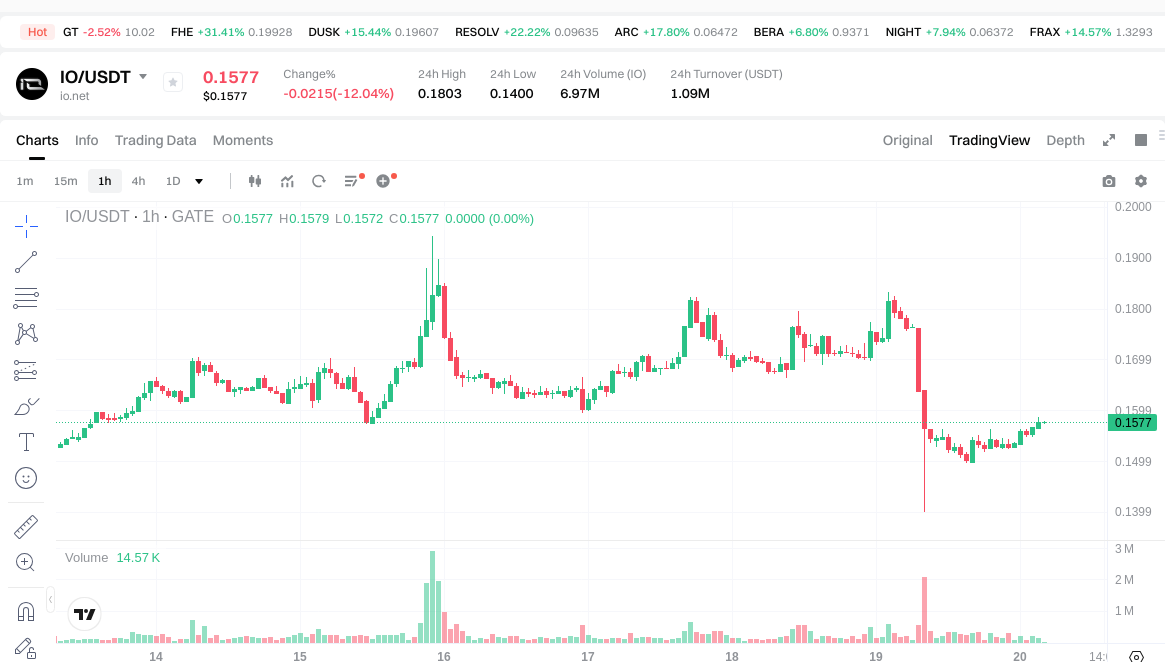
II. Core Factors Influencing Whether IO is a Good Investment
Supply Mechanism and Scarcity (IO Investment Scarcity)
-
Supply Structure → IO has a maximum supply of 800,000,000 tokens with approximately 269,194,237.99 tokens currently in circulation (33.65% of total supply). The controlled supply mechanism may influence long-term price dynamics and investment valuation.
-
Historical Context → IO has experienced notable price volatility since its launch in June 2024 at $2.00, with price movements ranging from $0.1003 to $6.5. Such fluctuations reflect market responses to supply dynamics and demand patterns within the decentralized GPU computing sector.
-
Investment Significance → The circulating supply ratio and maximum cap structure provide a framework for understanding potential scarcity effects, which may serve as one component in long-term investment considerations alongside other market factors.
Institutional Investment and Mainstream Adoption (Institutional Investment in IO)
-
Partnership Development → Throughout 2025, io.net established 21 strategic partnerships across the AI and Web3 ecosystem, including integrations with ai16zdao, Injective, Nexus Labs (January 2025), Vistara Labs, Orbofi (July 2025), and Allora Network (November 2025). These collaborations expanded io.net's infrastructure presence for decentralized AI applications.
-
Network Expansion → By the end of 2024, io.net's infrastructure spanned 139,000+ GPUs across 139 countries in over 6,000 clusters. Compute hours increased from 1,391,057 hours in September 2024 to 7,111,360 hours in January 2025, indicating growing operational utilization of the network.
-
Market Position → IO operates with approximately 84,802 holders and is listed on 43 exchanges as of January 2026, suggesting a developing level of market accessibility and community participation in the decentralized GPU computing sector.
Macroeconomic Environment's Impact on IO Investment
-
Market Volatility → After a strong Q4 2024 where IO's market cap rose 100.5% QoQ to $376 million, Q1 2025 saw a reversal with the market cap falling 71.4% QoQ. Such fluctuations illustrate the sensitivity of crypto assets to broader market conditions and investor sentiment shifts.
-
Current Valuation Context → As of January 2026, IO has a market cap of approximately $42.45 million (fully diluted valuation of $126.16 million) with a current price of $0.1577. The token has experienced a 95.17% decline from its launch price over the past year, reflecting significant market adjustment periods.
-
Economic Considerations → Investment decisions in crypto assets like IO may be influenced by broader macroeconomic factors including monetary policy shifts, inflation dynamics, and risk appetite in emerging technology sectors, though specific correlations require careful individual assessment.
Technology and Ecosystem Development (Technology & Ecosystem for IO Investment)
-
Core Infrastructure → IO.net provides decentralized GPU computing infrastructure for machine learning and AI applications, offering an alternative to traditional cloud computing services. The platform aggregates underutilized GPU resources to create accessible computational networks.
-
Staking Expansion → The introduction of staking mechanisms has enhanced IO's utility by allowing both hardware owners and token holders to participate in network security without requiring physical GPU ownership, potentially increasing total computational capacity and token functionality.
-
Use Case Validation → During 2025, io.net demonstrated operational viability for production AI workloads, with reported cases of cost efficiency compared to traditional cloud services. The platform's model of monetizing idle GPUs and providing low-cost AI compute has contributed to its positioning in the AI infrastructure market.
-
Ecosystem Activities → Community engagement expanded through events including an AI Hackathon in Osaka (October 2025), the Cybersecurity Business Convention in Toulouse, and educational initiatives at Gazi University, Turkey, focused on AI and DePIN (Decentralized Physical Infrastructure Networks) discussions.
III. IO Future Investment Forecast and Price Outlook (Is io.net(IO) worth investing in 2026-2031)
Short-term Investment Forecast (2026, short-term IO investment outlook)
- Conservative forecast: $0.1478 - $0.1572
- Neutral forecast: $0.1572 - $0.1871
- Optimistic forecast: $0.1871 - $0.2200
Mid-term Investment Outlook (2027-2028, mid-term io.net(IO) investment forecast)
-
Market stage expectation: The token may experience a period of volatility with potential growth as the decentralized AI computing sector develops. Price movements could reflect broader adoption patterns in machine learning infrastructure services.
-
Investment return forecast:
- 2027: $0.1084 - $0.2479
- 2028: $0.1806 - $0.2373
-
Key catalysts: Expansion of GPU network capacity, adoption by machine learning startups, competitive positioning in decentralized computing markets, and overall demand for cost-effective AI infrastructure solutions.
Long-term Investment Outlook (Is IO a good long-term investment?)
- Base scenario: $0.1478 - $0.2594 (assuming steady development of the platform and moderate market conditions)
- Optimistic scenario: $0.2594 - $0.3091 (assuming increased adoption of decentralized AI computing services and favorable market environment)
- Risk scenario: Below $0.1478 (in cases of significant market downturns or competitive disadvantages)
Click to view IO long-term investment and price forecast: Price Prediction
2026-2031 Long-term Outlook
- Base scenario: $0.1478 - $0.2594 (corresponding to steady progress and gradual mainstream application growth)
- Optimistic scenario: $0.2373 - $0.3091 (corresponding to large-scale adoption and favorable market conditions)
- Transformative scenario: Above $0.3091 (if the ecosystem achieves breakthrough developments and mainstream popularization)
- 2031-12-31 forecast high: $0.3091 (based on optimistic development assumptions)
Disclaimer: The forecasts presented are based on historical data analysis and market trends. Cryptocurrency investments carry significant risks, and past performance does not guarantee future results. Investors should conduct their own research and consider their risk tolerance before making investment decisions.
| Year |
Predicted High Price |
Predicted Average Price |
Predicted Low Price |
Price Change |
| 2026 |
0.187068 |
0.1572 |
0.147768 |
0 |
| 2027 |
0.24787296 |
0.172134 |
0.10844442 |
9 |
| 2028 |
0.2373039324 |
0.21000348 |
0.1806029928 |
33 |
| 2029 |
0.295222892184 |
0.2236537062 |
0.136428760782 |
41 |
| 2030 |
0.28278774611928 |
0.259438299192 |
0.21792817132128 |
64 |
| 2031 |
0.309068845827429 |
0.27111302265564 |
0.230446069257294 |
71 |
Investment Methodology (IO investment strategy)
Long-term Holding (HODL IO): Suitable for conservative investors
For investors with a long-term perspective, holding IO tokens may align with the growth trajectory of decentralized AI computing infrastructure. This approach typically involves:
- Accumulating tokens during market corrections
- Monitoring project development milestones and adoption metrics
- Evaluating the expansion of GPU supply network and user base
Active Trading: Relying on technical analysis and swing operations
Active traders may consider:
- Utilizing technical indicators to identify entry and exit points given IO's price volatility
- Monitoring 24-hour trading volume patterns (current volume: $1,092,724.69)
- Tracking price movements within established support and resistance levels (24H range: $0.14 - $0.1803)
- Observing correlation with broader AI and computing sector trends
Risk Management (Risk management for IO investment)
Asset Allocation Ratio: Conservative / Aggressive / Professional investors
- Conservative investors: Consider limiting exposure to 1-3% of total portfolio given the high volatility profile
- Aggressive investors: May allocate 5-10% while maintaining diversification across AI and infrastructure tokens
- Professional investors: Could implement dynamic allocation strategies based on market conditions and fundamental analysis
Risk Hedging Solutions: Multi-asset portfolio + hedging instruments
- Diversification across established cryptocurrencies and stablecoins
- Consideration of correlated and uncorrelated assets to AI computing sector
- Portfolio rebalancing strategies to manage concentration risk
- Monitoring of circulating supply ratio (currently 33.65%) and unlock schedules
Secure Storage: Hot and cold wallets + hardware wallet recommendations
- Hardware wallets for long-term holdings to minimize security risks
- Hot wallets for active trading with appropriate security measures
- Multi-signature solutions for larger allocations
- Regular security audits of storage solutions
Market Risks: High volatility and price manipulation
- Significant price fluctuations: IO has experienced substantial volatility, with 1-year performance showing -95.17% change
- Current price ($0.1577) represents a considerable distance from all-time high ($6.5 reached on June 12, 2024)
- 24-hour price change of -11.67% indicates ongoing market volatility
- Market capitalization of approximately $42.45 million may expose the token to liquidity risks
- Limited exchange listings (43 exchanges) compared to major cryptocurrencies
Regulatory Risks: Policy uncertainty across different jurisdictions
- Evolving regulatory frameworks for decentralized computing infrastructure
- Potential classification challenges regarding AI computing services
- Compliance requirements varying by jurisdiction
- Uncertainty surrounding cross-border data and computing regulations
Technical Risks: Network security vulnerabilities and upgrade failures
- Smart contract risks associated with Solana-based infrastructure
- Dependency on GPU provider network stability and quality
- Potential technical challenges in scaling decentralized computing operations
- Competition from established cloud computing providers and emerging decentralized alternatives
- Risk of technological obsolescence in rapidly evolving AI infrastructure sector
Investment Value Summary: IO demonstrates potential in the emerging decentralized AI computing sector, but exhibits considerable short-term price volatility.
The project addresses growing demand for cost-effective GPU computing resources for machine learning applications. However, investors should note the token's substantial decline from its all-time high and current market positioning.
Investor Recommendations:
✅ Beginners: Dollar-cost averaging strategy + secure wallet storage
- Start with small allocations to understand market dynamics
- Focus on secure storage solutions from the outset
- Avoid overexposure given high volatility characteristics
✅ Experienced Investors: Swing trading + portfolio allocation
- Consider technical analysis given price volatility patterns
- Implement risk management protocols
- Monitor project development and adoption metrics
✅ Institutional Investors: Strategic long-term allocation
- Evaluate as part of AI infrastructure thesis
- Assess competitive positioning within decentralized computing landscape
- Consider allocation size relative to liquidity and market maturity
⚠️ Disclaimer: Cryptocurrency investment carries high risk. This content is for informational purposes only and does not constitute investment advice. Investors should conduct thorough research and consider their risk tolerance before making investment decisions.
VII. FAQ
Q1: Is io.net (IO) a good investment for beginners in 2026?
IO may be suitable for beginners who are willing to accept high volatility and understand cryptocurrency risks, but it should represent only a small portion of a diversified portfolio. As a decentralized AI computing platform token, IO has experienced significant price fluctuations since its launch in 2024, declining approximately 95.17% from its all-time high of $6.5 to its current price of $0.1577. The token's market capitalization of $42.45 million and relatively limited liquidity compared to major cryptocurrencies suggest substantial risk exposure. Beginners should consider implementing a dollar-cost averaging strategy, allocating no more than 1-3% of their total investment portfolio to IO, and utilizing secure hardware wallet storage for long-term holdings.
Q2: What are the main factors that could drive IO's price growth in the future?
The primary growth catalysts for IO include expansion of its GPU network capacity, increased adoption by machine learning startups, and broader demand for cost-effective AI infrastructure solutions. As of January 2026, io.net has established 21 strategic partnerships across the AI and Web3 ecosystem and operates infrastructure spanning 139,000+ GPUs across 139 countries. The platform's compute hours increased from 1,391,057 hours in September 2024 to 7,111,360 hours in January 2025, demonstrating growing operational utilization. Additionally, the introduction of staking mechanisms has enhanced token utility, and the platform's competitive positioning in offering alternatives to traditional cloud computing services could contribute to long-term value appreciation if the decentralized AI computing sector continues to develop.
Q3: How does IO's supply mechanism affect its investment value?
IO has a maximum supply of 800,000,000 tokens with approximately 269,194,237.99 tokens currently in circulation, representing 33.65% of total supply. This controlled supply structure may influence long-term scarcity dynamics and price behavior as more tokens enter circulation over time. The circulating supply ratio indicates that approximately 66.35% of tokens remain locked or scheduled for future release, which could create selling pressure during unlock events. However, the defined maximum cap provides transparency for investors assessing potential dilution effects. The supply mechanism should be considered alongside other factors such as adoption rates, network growth, and market demand when evaluating IO's investment potential, as token economics alone do not determine value.
Q4: What are the key risks associated with investing in IO?
IO investment carries several significant risks that investors should carefully consider. Market risks include substantial price volatility, with the token experiencing a 95.17% decline from its all-time high and recent 24-hour price changes of -11.67%. The relatively small market capitalization of $42.45 million may expose investors to liquidity risks and potential price manipulation. Technical risks include smart contract vulnerabilities on the Solana blockchain, dependency on GPU provider network stability, and competition from both established cloud computing providers and emerging decentralized alternatives. Regulatory risks stem from evolving frameworks for decentralized computing infrastructure and uncertainty surrounding cross-border data regulations. Additionally, the token's availability on only 43 exchanges compared to major cryptocurrencies may limit trading options and market depth.
Q5: How does IO compare to traditional cloud computing investments?
IO represents a fundamentally different investment proposition compared to traditional cloud computing companies like AWS, Google Cloud, or Azure. While traditional cloud providers are established businesses with proven revenue streams and market dominance, IO operates in the emerging decentralized computing sector with unproven long-term viability at scale. The platform aims to offer cost-effective alternatives by aggregating underutilized GPU resources, potentially providing savings for machine learning startups. However, traditional cloud services offer enterprise-grade reliability, comprehensive support, and extensive infrastructure that decentralized alternatives currently cannot match. From an investment perspective, traditional cloud computing stocks offer equity in diversified technology companies with multiple revenue streams, whereas IO is a volatile cryptocurrency token tied specifically to adoption of decentralized AI computing services.
Q6: What investment strategy is most appropriate for IO tokens?
The appropriate investment strategy for IO depends on individual risk tolerance, investment horizon, and experience level. Conservative investors should consider limiting exposure to 1-3% of their total portfolio, implementing dollar-cost averaging to mitigate volatility impact, and focusing on long-term holding (HODL) strategy aligned with the development of decentralized AI infrastructure. Aggressive investors might allocate 5-10% while maintaining diversification across AI and infrastructure tokens, potentially engaging in active trading based on technical analysis given IO's price volatility patterns. Professional investors could implement dynamic allocation strategies, swing trading approaches, and comprehensive risk management protocols including portfolio rebalancing and hedging instruments. Regardless of strategy, all investors should utilize secure storage solutions such as hardware wallets for long-term holdings and maintain realistic expectations about volatility and risk exposure.
Q7: What milestones should investors monitor to assess IO's progress?
Investors should track several key performance indicators to evaluate IO's development trajectory. Network growth metrics include expansion of GPU supply (currently 139,000+ GPUs across 139 countries), increase in compute hours utilization (which grew from 1,391,057 hours in September 2024 to 7,111,360 hours in January 2025), and growth in active users and token holders (currently 84,802 holders). Partnership announcements and integration with AI and Web3 projects can signal ecosystem expansion and adoption. Technical developments such as platform upgrades, staking mechanism improvements, and security enhancements should be monitored. Market metrics including trading volume trends, exchange listings, and price stability patterns provide insight into liquidity and investor sentiment. Additionally, competitive positioning relative to other decentralized computing platforms and traditional cloud services can help assess long-term viability.
Q8: When is the best time to invest in IO tokens?
Determining optimal entry points for IO investment requires careful analysis of multiple factors rather than precise market timing. Historical data shows IO launched at $2.00 in June 2024, reached an all-time high of $6.5, and has since corrected to current levels around $0.1577. While the current price represents a significant discount from peak levels, this alone does not guarantee future appreciation. Potential entry strategies include dollar-cost averaging during periods of market stability, accumulating during broader cryptocurrency market corrections, or establishing positions following significant project milestones or partnership announcements. Technical analysis may identify support levels around $0.14-$0.15 based on recent trading patterns. However, given the high volatility and uncertain regulatory environment, investors should focus on their own investment timeline, risk tolerance, and overall portfolio strategy rather than attempting to perfectly time market entry points.
* The information is not intended to be and does not constitute financial advice or any other recommendation of any sort offered or endorsed by Gate.