This comprehensive analysis examines whether io.net (IO) is a good investment by evaluating its performance, technology, and market potential in the decentralized AI computing sector. IO currently trades at $0.1546 with a $41.62 million market cap, having launched in 2024 as a platform aggregating GPU resources for machine learning startups. The article addresses key investment considerations including IO's price history with significant volatility from $6.50 peak to current levels, the platform's 139,000+ GPUs across 139 countries, and 21 strategic partnerships established throughout 2025. Investment forecasts range from conservative to optimistic scenarios through 2031, with price projections varying based on adoption rates and market conditions. The analysis provides actionable strategies for different investor types—from dollar-cost averaging for beginners to swing trading for experienced traders—while highlighting substantial risks including market volatility, regulatory uncertainty, and technical vulner
Introduction: io.net (IO)'s Investment Position and Market Prospects
IO is a significant asset in the cryptocurrency sector, launched in 2024, and has achieved notable recognition in the decentralized AI computing and cloud infrastructure domain. As of January 20, 2026, IO maintains a market capitalization of approximately $41.62 million with a circulating supply of around 269.19 million tokens, currently priced at $0.1546. Positioned as a decentralized AI computing platform that aggregates underutilized GPU resources, IO has gradually become a focal point for investors exploring "Is io.net (IO) a good investment?" This article provides a comprehensive analysis of IO's investment value, historical price movements, future price projections, and associated investment risks to serve as a reference for potential investors.
IO.NET operates as a decentralized AI computing and cloud platform, creating a network that enables machine learning startups to access computing power by aggregating GPU supply from underutilized sources. With a fully diluted market cap of $123.68 million and a circulating supply representing approximately 33.65% of the maximum supply of 800 million tokens, IO is traded across 43 exchanges and holds over 84,802 holders. The token has experienced notable price fluctuations since its launch, with a recorded price range from $0.1003 to $6.5, reflecting the volatility characteristic of emerging crypto assets in the AI infrastructure sector.
I. io.net (IO) Price History Review and Investment Value Status
- June 2024: IO launched at $2.00 on June 11, 2024, reaching a peak of $6.50 on June 12, 2024 → early investors experienced significant price appreciation within the first days of trading.
- October 2025: Market correction phase → price declined to $0.1003, representing a substantial retracement from earlier levels.
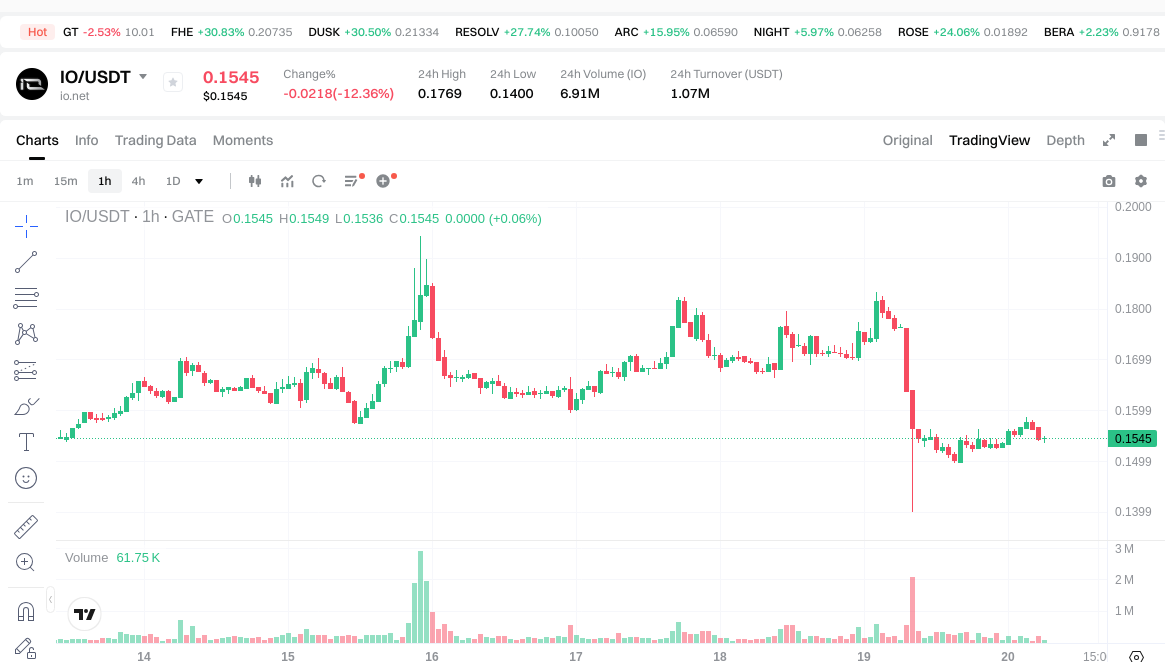
- January 2026: Current market cycle → IO traded at approximately $0.1546, showing a modest recovery of 1.51% over the past 7 days after the October 2025 period.
Current IO Investment Market Status (January 2026)
- IO current price: $0.1546
- Market sentiment (Fear & Greed Index): 2 (indicating cautious market conditions)
- 24-hour trading volume: $1,071,523.03
- Token holders: 84,802 addresses holding IO tokens
- Market capitalization: $41.62 million with a circulating supply of 269.19 million tokens (33.65% of total supply)
- Available trading venues: Listed on 43 cryptocurrency exchanges
Click to view real-time IO market price
II. Core Factors Affecting Whether IO is a Good Investment
Supply Mechanism and Scarcity
- IO.net implements a demand-driven tokenomics model through the Incentive Dynamic Engine (IDE), which proposes cutting 50% of IO tokens by Q2 2026 → potentially affecting price dynamics and investment value
- Token supply management: Maximum supply capped at 800,000,000 IO tokens, with current circulating supply of approximately 269,194,238 tokens (33.65% of total supply)
- Historical context: IO token reached a notable price level of $6.5 in June 2024, with subsequent market adjustments reflecting evolving supply-demand dynamics
- Investment significance: The proposed token reduction mechanism and controlled supply release could support long-term scarcity considerations
Institutional Investment and Mainstream Adoption
- Partnership expansion: IO.net established 21 strategic partnerships throughout 2025, including integrations with ai16zdao, Injective, Nexus Labs, Vistara Labs, Orbofi, and Allora Network
- Enterprise adoption: Companies transitioning to io.net for cost-efficient GPU compute, with some organizations reducing monthly compute costs from over $10,000 to $200 through decentralized infrastructure
- Network growth metrics: As of late 2024, io.net operated 139,000+ GPUs across 139 countries in over 6,000 clusters, with total compute hours increasing from 1,391,057 hours in September 2024 to 7,111,360 hours in January 2025
- Market positioning: The project has solidified its standing in the AI infrastructure market through its model of monetizing idle GPUs and offering low-cost AI compute services
Technology and Ecosystem Development
- Infrastructure capabilities: IO.net provides decentralized GPU computing power for machine learning and AI applications, serving as critical infrastructure for production AI workloads
- Platform expansion: The ecosystem includes io.cloud for decentralized GPUs and io.intelligence for inference and agent services
- Technical integration: Recent additions include GLM-4.7 model deployment on io.intelligence, featuring advanced agentic coding, planning, tool usage, web interaction, and enhanced complex reasoning capabilities
- DeFi integration: Launch of staking mechanisms enhances IO token utility while increasing network computational power, lowering barriers for hardware owners and token holders to participate in network security
- Ecosystem applications: Support for AI startups, machine learning projects, and decentralized applications requiring flexible, cost-efficient compute infrastructure
III. IO Future Investment Forecast and Price Outlook (Is io.net(IO) worth investing in 2026-2031)
Short-term IO Investment Outlook (2026)
- Conservative Forecast: $0.12352 - $0.1544
- Neutral Forecast: $0.1544 - $0.184508
- Optimistic Forecast: $0.184508 - $0.214616
Mid-term io.net(IO) Investment Forecast (2027-2029)
-
Market Stage Expectation: The mid-term period may witness gradual expansion as the decentralized AI computing market continues to evolve. Price movements could reflect broader adoption of GPU-sharing infrastructure and increasing demand for cost-effective machine learning solutions.
-
Investment Return Forecast:
- 2027: $0.15129656 - $0.23617024
- 2028: $0.1745814696 - $0.3070951152
- 2029: $0.250955604072 - $0.29752468524
-
Key Catalysts: Potential drivers include technological developments in decentralized computing networks, partnerships with AI and machine learning projects, competitive positioning in the GPU resource aggregation sector, and overall crypto market sentiment.
Long-term Investment Outlook (Is IO a good long-term investment?)
- Base Scenario: $0.2030282580366 - $0.333745081704 (assuming steady progress in platform adoption and stable market conditions)
- Optimistic Scenario: $0.333745081704 - $0.389369261988 (assuming accelerated adoption of decentralized AI infrastructure and favorable macro environment)
- Risk Scenario: Below $0.20358449983944 (in case of adverse market conditions or competitive pressures)
For detailed IO long-term investment and price forecast: Price Prediction
2026-01-20 - 2031 Long-term Outlook
- Base Scenario: $0.2030282580366 - $0.333745081704 (corresponding to steady progress and gradual mainstream application growth)
- Optimistic Scenario: $0.333745081704 - $0.389369261988 (corresponding to large-scale adoption and favorable market environment)
- Transformative Scenario: Above $0.389369261988 (if the ecosystem achieves breakthrough developments and widespread mainstream adoption)
- 2031-12-31 Forecast High: $0.389369261988 (based on optimistic development assumptions)
Disclaimer: Price forecasts are subject to market volatility and various external factors. Historical performance does not guarantee future results. This content does not constitute investment advice.
| Year |
Predicted High Price |
Predicted Average Price |
Predicted Low Price |
Price Change |
| 2026 |
0.214616 |
0.1544 |
0.12352 |
0 |
| 2027 |
0.23617024 |
0.184508 |
0.15129656 |
19 |
| 2028 |
0.3070951152 |
0.21033912 |
0.1745814696 |
36 |
| 2029 |
0.29752468524 |
0.2587171176 |
0.250955604072 |
67 |
| 2030 |
0.389369261988 |
0.27812090142 |
0.2030282580366 |
79 |
| 2031 |
0.3838068439596 |
0.333745081704 |
0.20358449983944 |
115 |
IV. IO Investment Strategy and Risk Management (How to invest in decentralized AI computing)
Investment Strategy (IO investment strategy)
-
Long-term Holding (HODL IO): Suitable for conservative investors
IO.NET operates as a decentralized AI computing and cloud platform, aggregating underutilized GPU resources to provide machine learning startups with computing power at reduced costs compared to traditional cloud services. The token currently trades at $0.1546 with a circulating supply of 269.19 million tokens out of a maximum supply of 800 million tokens. The circulating supply represents approximately 33.65% of the total supply, indicating potential dilution risk as more tokens enter circulation.
-
Active Trading: Relies on technical analysis and swing trading strategies
IO has demonstrated significant price volatility, with 24-hour fluctuations ranging from $0.14 to $0.1769. The token experienced a 12.5% decline over the past 24 hours and has decreased by 95.27% from its peak price of $6.5 recorded on June 12, 2024. Short-term traders may identify opportunities within these price movements, though such strategies require careful analysis of market trends and risk tolerance.
Risk Management (Risk management for IO investment)
-
Asset Allocation Ratio: Conservative / Aggressive / Professional investors
Given IO's substantial price volatility and current market position ranked at #587 with a market capitalization of approximately $41.62 million, allocation strategies should be adjusted according to investor profiles. Conservative investors might limit exposure to a small percentage of their overall portfolio, while professional investors with higher risk tolerance could consider larger allocations within a diversified crypto portfolio.
-
Risk Hedging Solutions: Multi-asset portfolio + hedging instruments
Diversification across different cryptocurrency sectors and traditional assets can help mitigate risks associated with IO's price volatility. The token's 30-day performance shows a 1.15% decline, while the 7-day period reflects a 1.51% increase, suggesting mixed short-term momentum.
-
Secure Storage: Hot/cold wallets + hardware wallet recommendations
IO operates on the Solana blockchain with the contract address BZLbGTNCSFfoth2GYDtwr7e4imWzpR5jqcUuGEwr646K. Investors should utilize secure storage solutions including hardware wallets for long-term holdings and carefully vetted hot wallets for active trading purposes. The token has approximately 84,802 holders according to available data.
V. IO Investment Risks and Challenges (Risks of investing in decentralized AI computing)
-
Market Risks: High volatility and price manipulation concerns
IO exhibits substantial price volatility, having reached a low of $0.1003 on October 10, 2025, marking a significant deviation from its June 2024 peak. The 24-hour trading volume of approximately $1.07 million represents limited liquidity compared to larger market cap tokens, which may increase susceptibility to price swings.
-
Regulatory Risks: Policy uncertainty across different jurisdictions
As a decentralized AI computing platform, IO.NET operates in an evolving regulatory landscape for both cryptocurrency and AI-related services. Different jurisdictions maintain varying approaches to digital asset regulation, which could impact the platform's operations and token value.
-
Technical Risks: Network security vulnerabilities and upgrade failures
The platform's reliance on aggregating GPU resources from diverse sources introduces potential technical challenges related to network security, resource coordination, and platform scalability. The success of IO.NET depends on maintaining reliable infrastructure and successfully implementing technological upgrades.
VI. Conclusion: Is Decentralized AI Computing a Good Investment?
-
Investment Value Summary: IO demonstrates potential in the decentralized AI computing sector, though it faces significant short-term price volatility and market challenges.
-
Investor Recommendations:
✅ Beginners: Consider dollar-cost averaging + secure wallet storage strategies
✅ Experienced Investors: Evaluate swing trading opportunities + portfolio diversification approaches
✅ Institutional Investors: Assess strategic long-term allocation within broader AI and infrastructure themes
⚠️ Disclaimer: Cryptocurrency investments carry substantial risks. This content is for informational purposes only and does not constitute investment advice.
VII. FAQ
Q1: What is the current price of IO and what factors determine its investment value?
As of January 20, 2026, IO trades at approximately $0.1546 with a market capitalization of $41.62 million and a circulating supply of 269.19 million tokens (33.65% of total supply). The investment value is primarily determined by three key factors: the demand-driven tokenomics model including the proposed 50% token reduction by Q2 2026, the expansion of decentralized GPU computing infrastructure with 139,000+ GPUs across 139 countries, and strategic partnerships with 21 organizations throughout 2025 that demonstrate growing institutional adoption in the AI infrastructure sector.
Q2: How volatile has IO's price been since its launch?
IO has experienced substantial price volatility since its launch, declining approximately 95.27% from its peak. The token launched at $2.00 on June 11, 2024, reached a peak of $6.50 on June 12, 2024, then underwent a significant correction to $0.1003 on October 10, 2025, before recovering to current levels around $0.1546. Recent price movements show 24-hour fluctuations ranging from $0.14 to $0.1769, reflecting the high volatility characteristic of emerging crypto assets in the decentralized AI computing sector.
Q3: What are the projected price ranges for IO investment through 2031?
Short-term forecasts for 2026 range from $0.12352 (conservative) to $0.214616 (optimistic). Mid-term projections show potential growth: 2027 estimates range from $0.15129656 to $0.23617024, 2028 from $0.1745814696 to $0.3070951152, and 2029 from $0.250955604072 to $0.29752468524. Long-term outlook for 2031 projects a base scenario of $0.2030282580366 to $0.333745081704, with an optimistic scenario reaching $0.389369261988, though these forecasts are subject to market volatility and do not guarantee future performance.
Q4: What investment strategies are suitable for different types of IO investors?
Conservative investors may consider long-term holding (HODL) with dollar-cost averaging strategies and secure wallet storage, limiting exposure to a small percentage of their portfolio given IO's substantial volatility. Experienced investors might evaluate swing trading opportunities based on technical analysis, capitalizing on the token's significant price movements while maintaining portfolio diversification. Institutional investors could assess strategic long-term allocation within broader AI and infrastructure themes, implementing multi-asset portfolio approaches and hedging instruments to mitigate risks associated with IO's market position.
Q5: What are the primary risks associated with investing in IO?
IO investment carries three major risk categories: Market risks include substantial price volatility evidenced by the 95.27% decline from peak levels, limited liquidity with 24-hour trading volume of approximately $1.07 million, and potential price manipulation concerns. Regulatory risks involve policy uncertainty across jurisdictions for both cryptocurrency and AI-related services. Technical risks encompass network security vulnerabilities related to aggregating GPU resources from diverse sources, platform scalability challenges, and potential upgrade failures affecting the decentralized infrastructure's reliability.
Q6: How does IO's tokenomics structure affect long-term investment potential?
IO implements a demand-driven tokenomics model through the Incentive Dynamic Engine (IDE) with a maximum supply capped at 800 million tokens. Currently, only 33.65% (269.19 million tokens) are in circulation, indicating potential dilution risk as more tokens enter the market. The proposed 50% token reduction by Q2 2026 could support long-term scarcity and affect price dynamics positively. However, the gradual release of the remaining 66.35% of tokens over time presents ongoing dilution considerations that investors should factor into valuation models and holding strategies.
Q7: What distinguishes IO's decentralized AI computing platform in the market?
IO.NET differentiates itself by aggregating underutilized GPU resources to create cost-efficient AI computing infrastructure, with some organizations reducing monthly compute costs from over $10,000 to $200. The platform operates 139,000+ GPUs across 139 countries in over 6,000 clusters, with compute hours increasing from 1,391,057 hours in September 2024 to 7,111,360 hours in January 2025. The ecosystem includes io.cloud for decentralized GPUs and io.intelligence for inference and agent services, supporting machine learning startups, AI applications, and production workloads while competing against traditional cloud computing providers through decentralized infrastructure advantages.
* The information is not intended to be and does not constitute financial advice or any other recommendation of any sort offered or endorsed by Gate.