This comprehensive analysis evaluates Iron Fish (IRON) as an investment opportunity, examining its role as a privacy-focused blockchain asset currently trading at $0.108 with a $7.56 million market cap. The article addresses critical questions for investors by analyzing IRON's price performance—including a notable 72.76% one-year decline—alongside its Proof-of-Work technology and privacy protection mechanisms. It projects potential price ranges through 2030 under various market scenarios while identifying key investment risks including regulatory uncertainties for privacy coins, market volatility exceeding 17% weekly, and limited exchange liquidity. The guide provides tailored investment strategies for beginners, experienced traders, and institutional investors, emphasizing proper risk management, portfolio diversification, and secure token storage. Ultimately, Iron Fish presents a specialized investment thesis dependent on broader adoption of privacy technology, making it suitable primarily for risk-tolerant
Introduction: Iron Fish (IRON) Investment Position and Market Prospects
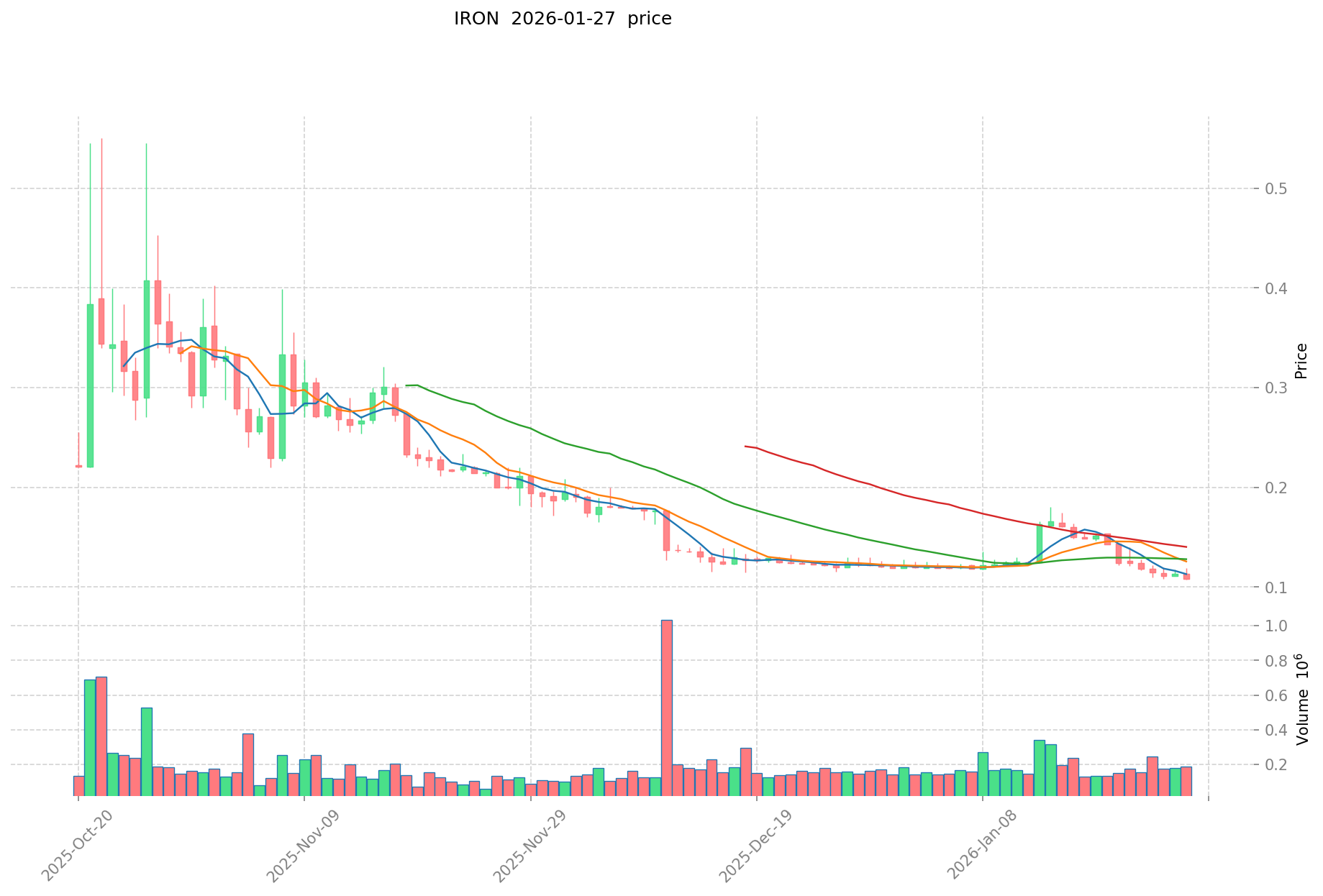
IRON is a cryptocurrency asset in the digital currency space. Since its launch, it has been developed as a decentralized, proof-of-work (PoW) based blockchain project focusing on privacy protection. As of January 27, 2026, Iron Fish has a market capitalization of approximately $7.56 million, with a circulating supply of around 69.97 million tokens, and the current price is maintained at approximately $0.108. With its positioning as a privacy-focused blockchain network, Iron Fish has gradually become a subject of discussion among investors when considering "Is Iron Fish (IRON) a good investment?" This article will comprehensively analyze the investment value, historical trends, future price predictions, and investment risks of Iron Fish, providing reference for investors.
Iron Fish is designed to support strong privacy guarantees for every transaction while maintaining censorship resistance and public accessibility. The project operates on a proof-of-work consensus mechanism, with a circulating supply ratio of approximately 99.99% of its total supply. Over the past year, the token has experienced notable price fluctuations, with the market observing various performance patterns across different time periods. Understanding these dynamics is essential for evaluating the token's potential in the evolving cryptocurrency landscape.
I. Iron Fish (IRON) Price History and Current Investment Value
- April 2023: IRON reached a notable price level of $17 during its early trading period → Early investors experienced significant price appreciation during the initial launch phase
- March 2025: The token dropped to its lowest recorded level of $0.078841 → Price declined substantially from earlier levels, reflecting broader market volatility
- January 2026: IRON trades at approximately $0.108 → Price shows modest recovery from the lower range, though remains significantly below peak levels
Current IRON Investment Market Status (January 2026)
- IRON Current Price: $0.108
- 24-Hour Trading Volume: $19,758.36
- Market Capitalization: Approximately $7.56 million
- Circulating Supply: 69,971,641.875 IRON tokens (representing 99.99% of total supply)
- 24-Hour Price Change: -1.98%
- 7-Day Price Change: -17.32%
- 30-Day Price Change: -14.27%
- 1-Year Price Change: -72.76%
Click to view real-time IRON market price
The current market data suggests IRON is experiencing downward price pressure across multiple timeframes. The token is listed on 3 exchanges and maintains a relatively small market capitalization. Recent price trends indicate continued volatility, with notable declines across weekly, monthly, and annual periods. The high circulation ratio suggests minimal token lock-up, which may contribute to price flexibility but also potential selling pressure.
II. Core Factors Influencing Whether IRON is a Good Investment
Supply Mechanism and Scarcity (IRON investment scarcity)
- Unlimited maximum supply model → affects long-term price dynamics and investment considerations
- Current circulating supply represents approximately 99.99% of total supply (69,971,641.875 IRON out of 69,981,193.75 total supply)
- Near-complete circulation may reduce future supply-side pressure, though unlimited maximum supply presents considerations for scarcity-driven value appreciation
- Investment implication: The supply structure differs from fixed-cap cryptocurrencies, requiring investors to evaluate value drivers beyond scarcity alone
Institutional Investment and Mainstream Adoption (Institutional investment in IRON)
- Trading availability across 3 exchanges provides limited but functional market access
- Market capitalization of approximately $7.56 million positions IRON as a smaller-cap privacy-focused project
- Adoption dynamics remain primarily community-driven, with privacy features targeting users seeking transaction confidentiality
- Investment consideration: Limited exchange presence may impact liquidity and institutional accessibility compared to more widely listed assets
Macroeconomic Environment Impact on IRON Investment
- Privacy-focused cryptocurrencies face evolving regulatory landscapes that may influence investment attractiveness
- Market volatility indicators: 24-hour price fluctuation range between $0.1074 and $0.1124 demonstrates active trading dynamics
- One-year performance showing -72.76% change reflects broader market conditions and project-specific developments
- Investment context: Privacy coins may serve specific portfolio functions during periods of increased financial surveillance concerns
Technology and Ecosystem Development (Technology & Ecosystem for IRON investment)
- Proof-of-Work (PoW) consensus mechanism provides decentralized security model
- Privacy guarantees for every transaction represent core technical value proposition
- Censorship-resistant architecture designed for publicly accessible yet private blockchain operations
- Development activity: Active GitHub repository and whitepaper documentation indicate ongoing technical maintenance
- Investment perspective: Privacy technology differentiation provides niche market positioning, though ecosystem scale remains developing compared to larger blockchain platforms
III. IRON Future Investment Forecast and Price Outlook (Is Iron Fish(IRON) worth investing in 2026-2030)
Short-term IRON investment outlook (2026)
- Conservative forecast: $0.063 - $0.109
- Neutral forecast: $0.109 - $0.155
- Optimistic forecast: $0.155 - $0.165
Mid-term Iron Fish(IRON) investment forecast (2027-2028)
-
Market stage expectation: Iron Fish may experience moderate volatility as the project continues its development phase. Market sentiment remains cautious following the significant decline from historical highs, with technical indicators suggesting neutral to slightly oversold conditions.
-
Investment return forecast:
- 2027: $0.120 - $0.165
- 2028: $0.126 - $0.184
-
Key catalysts: Project development milestones, broader cryptocurrency market trends, regulatory developments affecting privacy-focused blockchain projects, and adoption rate of privacy-preserving transaction technologies.
Long-term investment outlook (Is IRON a good long-term investment?)
- Base scenario: $0.128 - $0.183 (assuming steady development and moderate market conditions through 2030)
- Optimistic scenario: $0.183 - $0.249 (assuming accelerated adoption of privacy features and favorable market environment)
- Risk scenario: $0.063 - $0.120 (under adverse market conditions or technical challenges)
Check IRON long-term investment and price forecast: Price Prediction
2026-01-27 to 2030 Long-term Outlook
- Base scenario: $0.128 - $0.183 (corresponding to steady progress and gradual mainstream application growth)
- Optimistic scenario: $0.183 - $0.307 (corresponding to large-scale adoption and favorable market environment)
- Transformative scenario: Above $0.307 (breakthrough developments in ecosystem and mainstream adoption)
- 2030-12-31 forecast high: $0.249 (based on optimistic development assumptions)
Disclaimer: The above price predictions are based on technical analysis, historical data patterns, and market trend assessments. Cryptocurrency markets are highly volatile and subject to numerous unpredictable factors including regulatory changes, market sentiment shifts, technological developments, and macroeconomic conditions. These forecasts should not be considered as investment advice or guarantees of future performance. Investors should conduct their own research and consider their risk tolerance before making any investment decisions.
| Year |
Predicted High Price |
Predicted Average Price |
Predicted Low Price |
Price Change |
| 2026 |
0.155064 |
0.1092 |
0.063336 |
1 |
| 2027 |
0.165165 |
0.132132 |
0.12024012 |
22 |
| 2028 |
0.18432414 |
0.1486485 |
0.126351225 |
37 |
| 2029 |
0.199783584 |
0.16648632 |
0.1448430984 |
54 |
| 2030 |
0.24906353472 |
0.183134952 |
0.1281944664 |
69 |
| 2031 |
0.3068609255712 |
0.21609924336 |
0.1966503114576 |
100 |
IV. Iron Fish Investment Strategy and Risk Management (How to invest in Iron Fish)
Investment Strategy (Iron Fish investment strategy)
Long-term Holding (HODL Iron Fish)
For conservative investors seeking exposure to privacy-focused blockchain infrastructure, a long-term holding strategy may be considered. This approach involves:
- Accumulating IRON tokens during market corrections
- Holding through price volatility cycles
- Focusing on the project's fundamental development rather than short-term price movements
This strategy suits investors who believe in the long-term value proposition of privacy-preserving blockchain technology and are willing to weather significant price fluctuations.
Active Trading
For experienced traders, active trading strategies based on technical analysis and swing trading may be employed:
- Utilizing technical indicators to identify entry and exit points
- Capitalizing on price volatility within defined ranges
- Implementing stop-loss orders to manage downside risk
Given IRON's price volatility, with 24-hour movements around 1-2% and weekly fluctuations exceeding 17%, swing trading opportunities may present themselves regularly.
Risk Management (Risk management for Iron Fish investment)
Asset Allocation Ratios
Conservative Investors:
- Allocate no more than 1-3% of crypto portfolio to IRON
- Prioritize established cryptocurrencies with larger market caps
- Focus on capital preservation over aggressive growth
Moderate Investors:
- Consider allocating 3-7% of crypto portfolio to privacy-focused projects like IRON
- Balance between growth potential and risk exposure
- Diversify across multiple blockchain categories
Aggressive/Professional Investors:
- May allocate 7-15% to smaller-cap privacy tokens
- Employ advanced risk management tools and hedging strategies
- Maintain higher risk tolerance for potential outsized returns
Risk Hedging Solutions
- Portfolio Diversification: Combine IRON with established cryptocurrencies, stablecoins, and traditional assets
- Hedging Instruments: Consider using derivatives or inverse positions during high-volatility periods
- Periodic Rebalancing: Adjust portfolio weights quarterly or when allocations deviate significantly from targets
Secure Storage
Cold Wallet Storage:
- Hardware wallets (such as Ledger or Trezor) for long-term holdings
- Paper wallets as backup storage method
- Store private keys offline in secure locations
Hot Wallet Usage:
- Keep only trading amounts on exchanges
- Use reputable software wallets with strong security features
- Enable two-factor authentication and withdrawal whitelist
Recommended Practices:
- Never store large amounts on exchanges long-term
- Maintain multiple backup copies of recovery phrases
- Store backups in geographically distributed secure locations
V. Iron Fish Investment Risks and Challenges (Risks of investing in Iron Fish)
Market Risks
High Volatility
IRON exhibits substantial price volatility:
- 24-hour price fluctuations ranging from $0.1074 to $0.1124
- Weekly price movements exceeding 17%
- One-year decline of approximately 72.76%
This volatility level significantly exceeds traditional financial assets and even surpasses many established cryptocurrencies, creating both opportunities and risks for investors.
Price Manipulation Concerns
With a relatively modest market capitalization of approximately $7.56 million and daily trading volume around $19,758, IRON faces potential risks:
- Lower liquidity may amplify price swings from large trades
- Trading concentrated on limited exchanges (3 platforms) may increase manipulation vulnerability
- Market depth limitations could result in significant slippage for larger orders
Regulatory Risks
Policy Uncertainty Across Jurisdictions
As a privacy-focused cryptocurrency, Iron Fish faces heightened regulatory scrutiny:
- Privacy coins increasingly subject to regulatory restrictions in various jurisdictions
- Potential delisting risks from exchanges complying with local regulations
- Evolving compliance requirements may impact project development and adoption
Compliance Challenges
- Anti-money laundering (AML) regulations may conflict with privacy features
- Know-your-customer (KYC) requirements from exchanges may limit accessibility
- Regulatory frameworks for privacy-preserving technologies remain undefined in many regions
Technical Risks
Network Security Vulnerabilities
As a Proof-of-Work blockchain, Iron Fish faces specific technical challenges:
- Potential 51% attack risks given the network's current size
- Security of cryptographic implementations for privacy features
- Smart contract vulnerabilities if applicable
Upgrade and Development Risks
- Protocol upgrades may introduce unforeseen bugs or vulnerabilities
- Backward compatibility issues during major updates
- Development team execution risk and community coordination challenges
Infrastructure Dependencies
- Reliance on mining community for network security
- Node operator participation critical for decentralization
- Integration risks with third-party services and exchanges
VI. Conclusion: Is Iron Fish a Good Investment?
Investment Value Summary
Iron Fish presents a mixed investment profile characterized by both potential opportunities and significant risks. As a privacy-focused blockchain project, IRON operates in a specialized niche with limited but dedicated demand. The project's emphasis on transaction privacy through cryptographic techniques positions it within a category that faces both technical innovation potential and regulatory headwinds.
The token's performance metrics reveal substantial challenges: a 72.76% decline over one year and a modest market capitalization of approximately $7.56 million indicate limited market adoption and significant downward price pressure. The nearly complete circulation rate (99.99%) eliminates concerns about future supply inflation but also removes potential scarcity-driven value appreciation.
Long-term investment potential remains uncertain, contingent upon:
- Broader adoption of privacy-preserving blockchain technology
- Favorable regulatory developments for privacy coins
- Successful technical development and network growth
- Increased liquidity and exchange listings
Short-term price volatility remains pronounced, with weekly fluctuations exceeding 17%, creating both trading opportunities and substantial downside risks.
Investor Recommendations
✅ Beginners (New to Cryptocurrency)
- Approach with caution: Privacy coins involve elevated complexity and risk
- Education first: Thoroughly understand privacy technology and associated risks before investing
- Limited allocation: If investing, limit exposure to less than 1% of total crypto portfolio
- Secure storage: Use reputable hardware wallets for any holdings
- Dollar-cost averaging: Consider small, regular purchases rather than lump-sum investments to mitigate timing risk
✅ Experienced Investors
- Strategic allocation: Consider 3-7% allocation within crypto portfolio if aligned with privacy technology thesis
- Active monitoring: Track regulatory developments affecting privacy coins
- Swing trading: Exploit volatility through technical analysis-based trading strategies
- Portfolio diversification: Balance IRON exposure with established cryptocurrencies and other asset classes
- Risk hedging: Implement stop-loss orders and consider hedging during high-volatility periods
✅ Institutional/Professional Investors
- Specialized exposure: May consider tactical allocation as part of privacy technology investment thesis
- Regulatory assessment: Conduct thorough legal review of privacy coin exposure across operating jurisdictions
- Liquidity management: Account for limited trading volume in position sizing decisions
- Strategic monitoring: Track network development, adoption metrics, and competitive landscape
- Advanced risk management: Employ sophisticated hedging strategies and dynamic position management
⚠️ Important Disclaimer
Cryptocurrency investments carry substantial risk, including potential total loss of capital. Privacy-focused digital assets face additional regulatory uncertainties and technical complexities. This analysis is provided for informational purposes only and does not constitute investment advice, financial guidance, or a recommendation to buy, sell, or hold any cryptocurrency. Investors should conduct independent research, assess their risk tolerance, and consult qualified financial advisors before making investment decisions. Past performance does not indicate future results, and the high volatility observed in IRON's price history may continue or intensify.
VII. FAQ
Q1: What makes Iron Fish (IRON) different from other privacy-focused cryptocurrencies?
Iron Fish distinguishes itself through its combination of full transaction privacy guarantees with censorship resistance and public accessibility, all built on a Proof-of-Work consensus mechanism. Unlike some privacy coins that offer optional privacy features, Iron Fish implements privacy protections for every transaction by default. The project operates with a nearly complete circulating supply (99.99% of total tokens), eliminating concerns about future dilution while maintaining decentralized security through PoW mining. However, investors should note that IRON's market capitalization of approximately $7.56 million and availability on only 3 exchanges indicate it remains a smaller-scale privacy project compared to more established alternatives, which may impact liquidity and institutional adoption potential.
Q2: How volatile is IRON compared to other cryptocurrencies, and what does this mean for investors?
IRON exhibits significant price volatility that exceeds many established cryptocurrencies. Recent data shows 24-hour fluctuations ranging from $0.1074 to $0.1124, weekly price movements exceeding 17%, and a one-year decline of approximately 72.76%. This high volatility creates both opportunities and risks: active traders may capitalize on frequent price swings, while long-term investors face substantial drawdown risks. The modest daily trading volume of approximately $19,758 and limited exchange presence suggest lower liquidity, which can amplify price movements from large trades. Conservative investors should allocate no more than 1-3% of their crypto portfolio to IRON, while even aggressive investors should carefully consider position sizing given these volatility characteristics.
Q3: What are the primary regulatory risks associated with investing in Iron Fish?
As a privacy-focused cryptocurrency, Iron Fish faces heightened regulatory scrutiny across multiple jurisdictions. Privacy coins increasingly encounter restrictions from regulators concerned about potential money laundering and illicit financial activities. Key risks include: potential delisting from exchanges complying with Anti-Money Laundering (AML) regulations, conflicts between privacy features and Know-Your-Customer (KYC) requirements, and evolving compliance frameworks for privacy-preserving technologies. These regulatory uncertainties remain undefined in many regions and could materially impact IRON's accessibility, trading venues, and long-term viability. Institutional investors particularly should conduct thorough legal reviews of privacy coin exposure across their operating jurisdictions before establishing positions.
Q4: Is Iron Fish suitable for long-term investment, or is it better for short-term trading?
Iron Fish presents characteristics suitable for both strategies, though each carries distinct risks. For long-term investment, conservative projections suggest potential prices ranging from $0.128 to $0.183 through 2030, with optimistic scenarios reaching $0.249, representing modest appreciation from current levels around $0.108. However, the 72.76% one-year decline and uncertain regulatory environment create substantial long-term risk. Short-term trading may better exploit IRON's high volatility, with weekly fluctuations exceeding 17% providing regular swing trading opportunities. Experienced traders employing technical analysis and strict risk management may find short-term approaches more aligned with the token's current market dynamics. Long-term holders must believe strongly in privacy technology adoption and possess high risk tolerance to weather potential continued volatility.
Q5: How should investors securely store Iron Fish tokens?
Proper storage of IRON tokens is critical for investment security. For long-term holdings, hardware wallets such as Ledger or Trezor provide the most secure cold storage solution, keeping private keys completely offline and protected from online threats. Paper wallets serve as an additional backup method. Investors should maintain multiple copies of recovery phrases stored in geographically distributed secure locations. For active trading, hot wallets may be used but should contain only amounts intended for immediate trading, with two-factor authentication and withdrawal whitelists enabled. Never store significant amounts on exchanges long-term, as exchange security breaches represent a major risk factor. The combination of cold storage for holdings and minimal hot wallet balances for trading provides optimal security for IRON investments.
Q6: What technical factors should investors monitor to assess Iron Fish's investment potential?
Key technical indicators for assessing IRON's investment trajectory include: network hash rate and mining difficulty trends, which reflect security and miner participation; development activity on GitHub repositories, indicating ongoing technical maintenance and innovation; transaction volume and active addresses on the blockchain, measuring real usage; and node count distribution, affecting decentralization. Additionally, investors should track any protocol upgrades or significant technical milestones, as these may impact network functionality and security. As a Proof-of-Work blockchain, mining community engagement remains critical—declining hash rates could indicate security vulnerabilities or reduced confidence. Privacy technology implementations require particular scrutiny for cryptographic soundness and potential vulnerabilities that could compromise the core value proposition.
Q7: How does Iron Fish's unlimited maximum supply affect its investment value proposition?
Unlike fixed-supply cryptocurrencies like Bitcoin, Iron Fish operates with an unlimited maximum supply model, fundamentally altering its value dynamics. While approximately 99.99% of the current total supply is already in circulation (69,971,641.875 IRON out of 69,981,193.75 total), the absence of a hard cap means future token issuance could continue indefinitely through mining rewards. This structure removes scarcity as a primary value driver, requiring investors to focus on utility, adoption, and demand growth rather than supply limitations. For investment purposes, this means IRON's long-term value appreciation depends more heavily on increasing real-world usage and network effects rather than programmatic supply restrictions. Investors accustomed to deflationary tokenomics should carefully reconsider their investment thesis when evaluating IRON, as traditional scarcity-driven value models may not apply.
Q8: What portfolio allocation strategy is appropriate for different investor types considering IRON?
Portfolio allocation for IRON should reflect investor experience and risk tolerance. Conservative investors new to cryptocurrency should limit IRON exposure to less than 1-3% of their crypto portfolio, prioritizing capital preservation and focusing on established assets. This minimal allocation acknowledges the educational value and diversification benefits of privacy coins while limiting downside exposure. Moderate investors with greater crypto experience may consider 3-7% allocation, balancing growth potential against volatility risks while diversifying across multiple blockchain categories. Aggressive or professional investors might allocate 7-15% to smaller-cap privacy tokens, employing advanced risk management tools and maintaining higher risk tolerance for potential outsized returns. Regardless of allocation, investors should implement periodic rebalancing—quarterly or when allocations deviate significantly from targets—to maintain intended risk exposures and capture gains during price appreciation periods.
* The information is not intended to be and does not constitute financial advice or any other recommendation of any sort offered or endorsed by Gate.