This comprehensive analysis examines Ithaca Protocol (ITHACA), a non-custodial, composable options protocol operating on Arbitrum with multi-chain expansion plans. The article evaluates ITHACA's investment merit through multiple dimensions including current market metrics (price $0.00313, market cap $201,102.50), institutional backing from Cumberland and Wintermute, and technological innovations in MEV-resistant derivatives markets. It addresses critical investment considerations including supply dynamics (6.43% circulating ratio), price performance analysis, market positioning within DeFi ecosystem, and strategic allocation frameworks for different investor profiles. The content provides detailed price scenarios through 2031, identifies key risks encompassing market volatility, regulatory uncertainty, and liquidity constraints, and delivers actionable investment guidance. Designed for traders and investors evaluating early-stage DeFi protocol exposure on Gate platform.
Introduction: Ithaca Protocol (ITHACA)'s Investment Position and Market Outlook
Ithaca Protocol (ITHACA) is a digital asset in the cryptocurrency space, having launched in December 2024. As of February 8, 2026, ITHACA maintains a market capitalization of approximately $201,102.50, with a circulating supply of around 64.25 million tokens and a current price hovering near $0.00313. Positioned as a non-custodial, composable options protocol, ITHACA operates on Arbitrum with planned expansion to Base and Solana networks. Backed by Cumberland and Wintermute, the protocol has established presence within the DeFi derivatives sector. With 1,236 holders and a fully diluted valuation of $3.13 million, ITHACA represents approximately 0.00012% of the total cryptocurrency market. The protocol's modular infrastructure enables the creation of options, structured products, and derivative markets across various underlying assets. This article provides a comprehensive analysis of ITHACA's investment characteristics, historical price movements, future price considerations, and associated risks to serve as a reference for market participants evaluating the asset.
I. Ithaca Protocol (ITHACA) Price History Review and Current Investment Value
- December 2024: Protocol launch and initial token listing → ITHACA commenced trading with notable early-stage volatility
- December 19, 2024: Token reached a significant price level during initial market discovery phase → ITHACA price experienced expansion before subsequent market correction
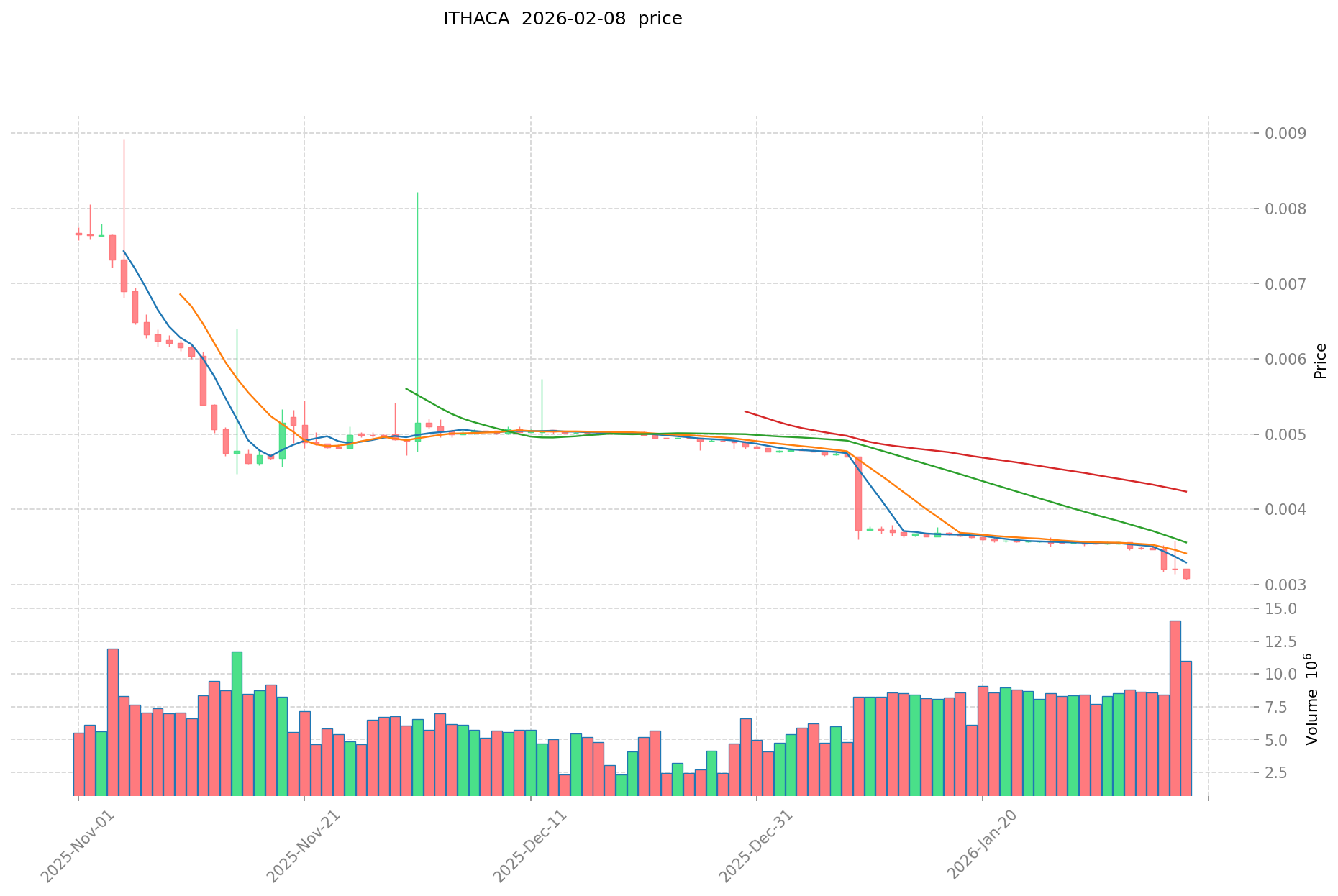
- Early 2026: Market adjustment cycle → Price declined from elevated levels toward lower valuation range
Current ITHACA Investment Market Status (February 2026)
- ITHACA current price: 0.00313 USD
- Market sentiment (Fear & Greed Index): Data unavailable in reference materials
- 24-hour trading volume: 31,087.69 USD
- Institutional investor holdings: Backed by Cumberland and Wintermute according to project documentation
Click to view real-time ITHACA market price
II. Core Factors Influencing Whether ITHACA is a Good Investment
Supply Mechanism and Scarcity (ITHACA Investment Scarcity)
- Maximum supply capped at 1,000,000,000 tokens, with current circulating supply of 64,250,000 tokens (6.43% of max supply) → significant supply concentration influences price dynamics and potential investment value
- Token economics demonstrate low circulation ratio, suggesting substantial unreleased supply that may affect future price movements
- Investment significance: the current low circulating supply ratio creates a supply-demand dynamic that could influence long-term investment considerations, though future token releases may impact scarcity dynamics
Institutional Investment and Mainstream Adoption (Institutional Investment in ITHACA)
- Institutional backing: protocol is supported by Cumberland and Wintermute, two recognized institutional participants in the crypto derivatives market
- Market position: Ithaca Protocol consistently ranks in the top three protocols on DeFiLlama within its category, indicating recognition within the decentralized finance ecosystem
- Ecosystem presence: the protocol operates across multiple blockchain networks including Arbitrum, with planned expansion to Base and Solana, suggesting broader infrastructure integration
Macroeconomic Environment's Impact on ITHACA Investment
- Market conditions: recent price performance shows -11.88% change over 7 days and -22.01% over 30 days, reflecting sensitivity to broader market conditions
- Trading activity: 24-hour trading volume of $31,087.69 indicates active market participation, though relatively modest compared to larger-cap assets
- Market capitalization: fully diluted valuation of $3,130,000 positions ITHACA as a smaller-cap asset, which typically exhibits higher volatility in response to macroeconomic shifts
Technology and Ecosystem Development (Technology & Ecosystem for ITHACA Investment)
- Non-custodial, composable options protocol: provides modular decentralized infrastructure for creating and market-making complete options, option strategies, and structured product markets on various underlying assets
- Auction-based algorithmic market clearing framework: designed to be MEV-resistant, allowing for efficient deployment of composable options and structured product markets
- Multi-chain strategy: protocol deployment on Arbitrum with planned expansion to Base and Solana networks → broadening ecosystem reach and potential user base
- AI integration: incorporation of Telegram and X AI agents for user interaction and public discourse, representing innovation in user engagement mechanisms
- DeFi applications: the protocol's focus on options and structured products provides infrastructure for advanced DeFi use cases, supporting the broader ecosystem development
III. ITHACA Future Investment Prediction and Price Outlook (Is Ithaca Protocol(ITHACA) worth investing in 2026-2031)
Short-term Investment Prediction (2026, short-term ITHACA investment outlook)
- Conservative Prediction: 0.002367 - 0.00269 USD
- Neutral Prediction: 0.00290 - 0.003156 USD
- Optimistic Prediction: 0.003156 - 0.00369252 USD
Mid-term Investment Outlook (2027-2028, mid-term Ithaca Protocol(ITHACA) investment forecast)
- Market Stage Expectation: The protocol may experience gradual price appreciation as the composable options infrastructure continues development. Trading activity on supported chains could influence price movement during this period.
- Investment Return Prediction:
- 2027: 0.002910621 - 0.003766686 USD
- 2028: 0.00269660475 - 0.00370333719 USD
- Key Catalysts: Expansion to additional blockchain networks, growth in decentralized options trading volume, and potential integration with structured product markets.
Long-term Investment Outlook (Is ITHACA a good long-term investment?)
- Baseline Scenario: 0.00266 - 0.00416 USD (assuming steady protocol development and moderate market adoption)
- Optimistic Scenario: 0.00405 - 0.00469 USD (assuming increased DeFi options market penetration and favorable ecosystem growth)
- Risk Scenario: 0.00236 - 0.00270 USD (under challenging market conditions or reduced protocol usage)
Click to view ITHACA long-term investment and price prediction: Price Prediction
2026-02-08 - 2031 Long-term Outlook
- Base Scenario: 0.00266 - 0.00418 USD (corresponding to steady progress and gradual mainstream application growth)
- Optimistic Scenario: 0.00405 - 0.00469 USD (corresponding to large-scale adoption and favorable market environment)
- Transformative Scenario: above 0.00469 USD (such as breakthrough ecosystem developments and mainstream popularization)
- 2031-12-31 Predicted High: 0.004691279229679 USD (based on optimistic development assumptions)
Disclaimer: Price predictions are based on historical data and market analysis. Cryptocurrency markets are highly volatile and unpredictable. These forecasts should not be considered as financial advice. Investors should conduct their own research and consider their risk tolerance before making investment decisions.
| Year |
Predicted High Price |
Predicted Average Price |
Predicted Low Price |
Price Change |
| 2026 |
0.00369252 |
0.003156 |
0.002367 |
0 |
| 2027 |
0.003766686 |
0.00342426 |
0.002910621 |
9 |
| 2028 |
0.00370333719 |
0.003595473 |
0.00269660475 |
14 |
| 2029 |
0.00470773257255 |
0.003649405095 |
0.00266406571935 |
16 |
| 2030 |
0.004429282963801 |
0.004178568833775 |
0.004053211768761 |
33 |
| 2031 |
0.004691279229679 |
0.004303925898788 |
0.003357062201054 |
37 |
IV. ITHACA Investment Strategy and Risk Management (How to invest in Options Protocol Tokens)
Investment Methodology (ITHACA investment strategy)
Long-term Holding (HODL ITHACA)
For conservative investors considering exposure to decentralized options protocols, a long-term holding approach may involve monitoring the project's development progress and ecosystem expansion. This strategy typically requires patience through market cycles and tolerance for significant price fluctuations.
Active Trading
Active trading strategies for ITHACA may incorporate technical analysis frameworks and swing trading approaches. Given the token's historical price movements, traders might focus on identifying support and resistance levels, though caution is advised due to limited liquidity as indicated by trading volume data.
Risk Management (Risk management for ITHACA investment)
Asset Allocation Ratios
- Conservative Investors: Consider limiting exposure to highly volatile assets like ITHACA to a small percentage of total portfolio (typically 1-3%)
- Aggressive Investors: May allocate a moderate portion (5-10%) while maintaining diversification across multiple crypto assets
- Professional Investors: Could employ larger allocations with sophisticated hedging mechanisms and continuous monitoring
Risk Hedging Solutions
A diversified approach might include combining ITHACA holdings with:
- Established cryptocurrencies with higher market capitalization
- Stablecoins for liquidity management
- Other DeFi protocol tokens to spread sector-specific risks
Secure Storage
- Cold Wallets: Hardware wallets compatible with BEP-20 tokens provide enhanced security for long-term storage
- Hot Wallets: May be used for smaller amounts intended for active trading, though security protocols should be strictly maintained
- Best Practices: Implementation of multi-signature solutions and regular security audits of storage methods
V. ITHACA Investment Risks and Challenges (Risks of investing in Options Protocol Tokens)
Market Risks
- High Volatility: ITHACA has demonstrated substantial price fluctuations, with 30-day changes exceeding 22% and year-to-date movements showing significant variation
- Price Manipulation Potential: With relatively limited trading volume and lower market capitalization, the token may be susceptible to price impact from large transactions
- Liquidity Concerns: Trading activity concentrated on limited exchanges may affect execution quality and slippage
Regulatory Risks
- Policy Uncertainty: Decentralized derivatives protocols face evolving regulatory frameworks across different jurisdictions
- Compliance Requirements: Future regulatory developments may impose additional operational constraints on options protocols
- Cross-border Considerations: Varying legal treatment of crypto derivatives across markets creates complexity for international investors
Technical Risks
- Smart Contract Vulnerabilities: As with any DeFi protocol, potential security weaknesses in smart contract code could pose risks to user funds
- Network Dependencies: Protocol performance relies on underlying blockchain infrastructure and its continued stability
- Integration Risks: The protocol's expansion plans across multiple chains (as mentioned in project descriptions) introduce additional technical complexity
- Market Adoption: Success depends on sustained user adoption and liquidity provision within the platform's markets
VI. Conclusion: Is Options Protocol Token a Good Investment?
Investment Value Summary
ITHACA represents exposure to the decentralized options trading sector, which addresses a specific niche within DeFi infrastructure. The protocol's focus on non-custodial, composable options markets presents potential utility value, though investors should note the project's relatively early stage as indicated by circulation ratio and market metrics.
Investor Recommendations
✅ Novice Investors: Consider beginning with educational resources on options protocols before investment; if proceeding, implement dollar-cost averaging strategies with amounts that represent only a small portion of disposable investment capital, and prioritize secure wallet storage solutions.
✅ Experienced Investors: May explore swing trading opportunities while maintaining diversified exposure across multiple DeFi sectors; position sizing should account for elevated volatility characteristics and limited liquidity profiles.
✅ Institutional Investors: Could evaluate strategic allocations as part of broader DeFi protocol exposure, implementing comprehensive risk management frameworks and continuous monitoring protocols.
⚠️ Disclaimer: Cryptocurrency investments carry substantial risks including potential total loss of capital. Market conditions can change rapidly, and past performance does not indicate future results. This content is provided for informational purposes only and does not constitute investment advice, financial guidance, or trading recommendations. Individuals should conduct independent research and consider consulting with qualified financial advisors before making investment decisions.
VII. FAQ
Q1: What is Ithaca Protocol (ITHACA) and what makes it unique in the DeFi space?
Ithaca Protocol is a non-custodial, composable options protocol operating primarily on Arbitrum with planned expansion to Base and Solana networks. The protocol distinguishes itself through its modular infrastructure that enables the creation of options, option strategies, and structured product markets across various underlying assets. Its auction-based algorithmic market clearing framework is designed to be MEV-resistant, providing efficient deployment mechanisms for composable options markets. Backed by institutional participants Cumberland and Wintermute, the protocol consistently ranks among the top three protocols in its category on DeFiLlama, indicating recognition within the decentralized finance ecosystem.
Q2: What is the current price and market status of ITHACA as of February 2026?
As of February 8, 2026, ITHACA trades at approximately $0.00313 USD with a market capitalization of $201,102.50. The token has a circulating supply of 64.25 million tokens out of a maximum supply of 1 billion (6.43% circulation ratio). The 24-hour trading volume stands at $31,087.69, indicating active but relatively modest market participation. The fully diluted valuation is $3.13 million, with 1,236 holders. Recent price performance shows -11.88% change over 7 days and -22.01% over 30 days, reflecting sensitivity to broader market conditions.
Q3: What are the price predictions for ITHACA from 2026 to 2031?
Short-term predictions for 2026 range from a conservative $0.002367-$0.00269 to an optimistic $0.003156-$0.00369. Mid-term forecasts suggest 2027 prices between $0.002910-$0.003766 and 2028 prices between $0.002696-$0.003703. Long-term outlook through 2031 presents a baseline scenario of $0.00266-$0.00416, an optimistic scenario of $0.00405-$0.00469, and a risk scenario of $0.00236-$0.00270. The predicted high for 2031 is approximately $0.00469. These predictions assume steady protocol development, gradual ecosystem expansion, and varying degrees of market adoption, though actual outcomes may differ significantly due to market volatility.
Q4: What are the main investment risks associated with ITHACA?
ITHACA presents multiple investment risks requiring careful consideration. Market risks include high volatility with price movements exceeding 22% over 30-day periods, potential price manipulation due to limited trading volume and lower market capitalization, and liquidity concerns from concentrated exchange activity. Technical risks encompass smart contract vulnerabilities inherent in DeFi protocols, dependencies on underlying blockchain infrastructure stability, and integration complexities from multi-chain expansion plans. Regulatory risks involve evolving policy frameworks for decentralized derivatives protocols, potential compliance requirements, and cross-border legal considerations. The token's low circulation ratio (6.43%) also suggests significant unreleased supply that may impact future price dynamics.
Q5: What investment strategies are recommended for different types of ITHACA investors?
Investment approaches vary by experience level and risk tolerance. Novice investors should begin with educational resources on options protocols, implement dollar-cost averaging with small portions of disposable capital (typically 1-3% of portfolio), and prioritize secure cold wallet storage solutions. Experienced investors may explore swing trading opportunities while maintaining diversified DeFi sector exposure, with allocations of 5-10% accounting for elevated volatility and limited liquidity. Institutional investors could evaluate strategic allocations as part of broader DeFi protocol exposure, implementing comprehensive risk management frameworks and continuous monitoring protocols. All investors should employ proper risk hedging through diversification, combining ITHACA with established cryptocurrencies, stablecoins, and other DeFi tokens.
Q6: How does ITHACA's supply mechanism affect its investment potential?
ITHACA's supply mechanism significantly influences its investment characteristics and scarcity dynamics. With a maximum supply capped at 1 billion tokens and only 64.25 million currently circulating (6.43%), the token demonstrates substantial supply concentration. This low circulation ratio creates a supply-demand dynamic that affects current price movements and potential investment value. However, the significant unreleased supply (93.57% remaining) presents a critical consideration for long-term investors, as future token releases may impact scarcity dynamics and price appreciation potential. Investors should monitor token unlock schedules and distribution plans to understand potential dilution effects on their holdings.
Q7: What technological developments and ecosystem expansion could impact ITHACA's future value?
Several technological and ecosystem factors may influence ITHACA's future valuation. The protocol's multi-chain expansion strategy from Arbitrum to Base and Solana networks could broaden user base and increase adoption. Integration of AI agents through Telegram and X platforms represents innovation in user engagement mechanisms. The protocol's MEV-resistant auction-based market clearing framework provides competitive advantages in efficient market operations. Growth catalysts include increased decentralized options trading volume, integration with structured product markets, and broader DeFi ecosystem adoption. The protocol's consistent ranking among top three in its DeFiLlama category suggests market recognition, though sustained development progress and user adoption remain critical for long-term value realization.
Q8: Is ITHACA suitable for long-term holding or active trading strategies?
Both long-term holding and active trading strategies present considerations for ITHACA investors, though each approach carries distinct characteristics. Long-term holding suits conservative investors willing to tolerate significant price fluctuations while monitoring protocol development and ecosystem expansion through market cycles. This approach requires patience and belief in the fundamental utility of decentralized options infrastructure. Active trading strategies may leverage technical analysis frameworks to identify support and resistance levels, though traders should exercise caution due to limited liquidity evidenced by trading volume data. The token's historical volatility creates both opportunities and risks for active traders. Ultimately, strategy selection should align with individual risk tolerance, investment timeframe, and ability to continuously monitor market conditions and protocol developments.
* The information is not intended to be and does not constitute financial advice or any other recommendation of any sort offered or endorsed by Gate.