This comprehensive analysis examines JOE, the governance token for Trader Joe decentralized exchange on the Avalanche network, currently trading at $0.05923 with a $23.9 million market cap. The article evaluates JOE's investment merit through multiple dimensions: historical price performance showing 82.58% annual decline, tokenomics featuring 403.57 million circulating tokens with 80.71% circulation rate, and ecosystem positioning within Avalanche DeFi infrastructure. Key sections address price scenarios ranging from $0.041-$0.151 through 2031, supply scarcity mechanisms, institutional adoption across 23 exchanges including Gate, and platform utility combining DEX services with leverage trading. The analysis presents three investment strategies—long-term holding for platform believers, active trading for technical traders, and diversified allocation for professional investors—accompanied by detailed risk management frameworks. Critical risk factors include high volatility, regulatory uncertainty, and technica
Introduction: JOE (JOE) Investment Position and Market Outlook
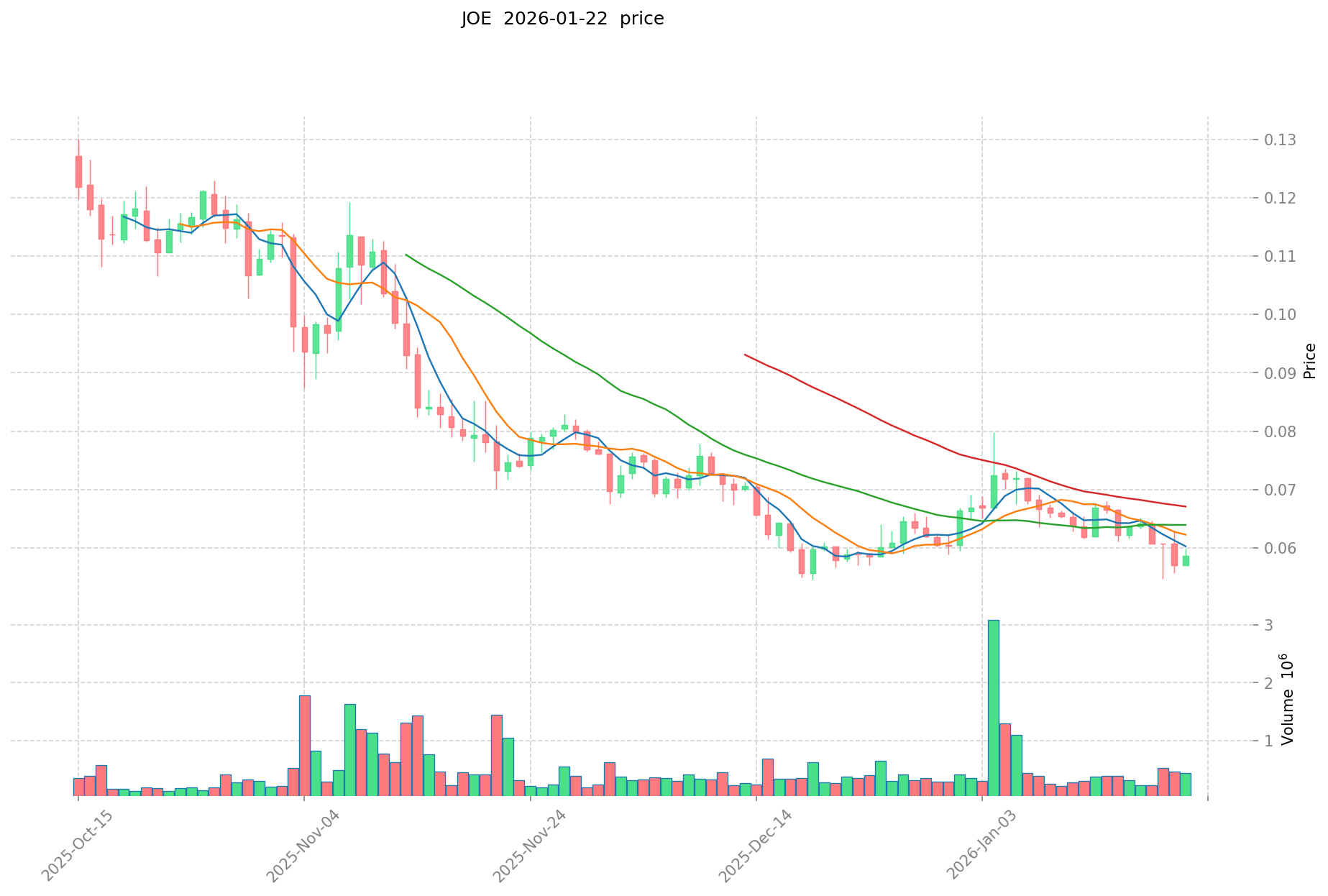
JOE is a significant asset in the cryptocurrency sector, serving as the governance token for Trader Joe, a one-stop decentralized trading platform operating on the Avalanche network. As of January 22, 2026, JOE maintains a market capitalization of approximately $23.90 million, with a circulating supply of around 403.57 million tokens and a current price of $0.05923. The platform combines DEX services with DeFi lending functionality, providing users with leverage trading capabilities. With approximately 149,960 token holders and availability across 23 exchanges, JOE has established a presence in the decentralized finance ecosystem. This article comprehensively analyzes JOE's investment value, historical trends, future price projections, and investment risks to provide reference information for investors considering the question "Is JOE (JOE) a good investment?"
I. JOE Price History Review and Investment Value Status
- 2021: JOE reached a price peak during the cryptocurrency market bull run in November 2021, with the token trading at higher levels during this period
- 2021-2026: The token experienced significant price fluctuations, reflecting broader market volatility in the decentralized finance sector
- Recent Performance: Over the past year, JOE has shown notable price movements, with varying performance across different time periods
Current JOE Investment Market Status (January 2026)
- JOE current price: $0.05923
- Market sentiment (Fear & Greed Index): Data not specified in available materials
- 24-hour trading volume: $24,247.66
- Institutional investor holdings: Data not specified in available materials
Click to view real-time JOE market price
II. Core Factors Affecting Whether JOE is a Good Investment (Is JOE(JOE) a Good Investment)
Supply Mechanism and Scarcity (JOE investment scarcity)
- Supply Structure → JOE has a maximum supply of 500,000,000 tokens, with approximately 403,574,272 tokens currently in circulation, representing a circulating ratio of about 80.71%. This relatively high circulation rate suggests that most tokens have already entered the market.
- Scarcity Characteristics → With the maximum supply capped, JOE's supply mechanism provides a certain degree of scarcity. The limited total supply may potentially create upward price pressure as demand increases, though market performance depends on multiple factors including adoption and ecosystem development.
- Investment Implication → The fixed supply ceiling establishes a foundational element for evaluating long-term investment potential, though scarcity alone does not guarantee value appreciation.
Institutional Investment and Mainstream Adoption (Institutional investment in JOE)
- Market Positioning → JOE serves as the governance token for Trader Joe, a decentralized trading platform on the Avalanche network. The token is listed on 23 exchanges, indicating a degree of market accessibility and liquidity.
- Holder Distribution → With approximately 149,960 holders, JOE demonstrates a distributed ownership structure, though specific institutional holding data is not provided in the available materials.
- Platform Integration → As a core component of the Trader Joe ecosystem, JOE's utility extends to governance participation and revenue sharing, which may influence its adoption within the DeFi sector.
Macroeconomic Environment's Impact on JOE Investment
- Market Volatility → JOE's price has experienced significant fluctuations, with historical data showing a price range from $0.0266 to $5.09. The token's 1-year performance shows a decrease of approximately 82.58%, reflecting sensitivity to broader market conditions.
- Liquidity Environment → Changes in monetary policy and interest rates may affect investor risk appetite for DeFi tokens like JOE. During periods of tighter liquidity, speculative assets may face increased pressure.
- Risk Sentiment → Macroeconomic uncertainty and shifts in market sentiment can significantly impact JOE's trading volume and price stability, as evidenced by its 24-hour trading volume of approximately $24,247.
Technology and Ecosystem Development (Technology & Ecosystem for JOE investment)
- Platform Foundation → Trader Joe operates as a one-stop decentralized trading platform on the Avalanche network, combining DEX services with DeFi lending to provide leverage trading functionality. This integrated approach aims to enhance user experience and platform utility.
- Ecosystem Position → The platform's positioning within the Avalanche ecosystem provides exposure to that network's technological developments and adoption trends. The platform's functionality may evolve alongside broader DeFi innovation.
- Application Scope → JOE's utility within the Trader Joe platform encompasses governance rights and revenue sharing mechanisms, which tie the token's value to platform performance and user activity levels.
III. JOE Future Investment Forecast and Price Outlook (Is JOE(JOE) worth investing in 2026-2031)
Short-term Investment Forecast (2026, short-term JOE investment outlook)
- Conservative estimate: $0.041433 - $0.05919
- Neutral estimate: $0.05919
- Optimistic estimate: $0.05919 - $0.0728037
Mid-term Investment Outlook (2027-2029, mid-term JOE(JOE) investment forecast)
-
Market phase expectation: The mid-term outlook suggests potential gradual recovery following the significant decline observed in 2025, with projected average prices showing modest growth from $0.06599685 in 2027 to $0.08539827 in 2029.
-
Investment return forecast:
- 2027: $0.0362982675 - $0.0745764405
- 2028: $0.0527149839375 - $0.1005099027075
- 2029: $0.0751504811013 - $0.104185894254075
-
Key catalysts: Market recovery momentum, potential developments in the Avalanche ecosystem, and broader DeFi sector performance trends.
Long-term Investment Outlook (Is JOE a good long-term investment?)
-
Base scenario: $0.060477349666271 - $0.109958817575038 (assuming steady development of the Trader Joe platform and stable market conditions through 2031)
-
Optimistic scenario: $0.094792084116412 - $0.150643580077802 (assuming enhanced adoption of decentralized trading platforms and favorable regulatory environment)
-
Risk scenario: $0.041433 - $0.060666933834504 (considering potential market downturns or increased competition in the DEX space)
Click to view JOE long-term investment and price forecast: Price Prediction
2026-01-22 to 2031 Long-term Outlook
-
Base scenario: $0.060477349666271 - $0.109958817575038 (corresponding to steady progress and gradual mainstream application growth)
-
Optimistic scenario: $0.094792084116412 - $0.150643580077802 (corresponding to large-scale adoption and favorable market conditions)
-
Transformative scenario: Above $0.150643580077802 (in case of breakthrough developments in ecosystem and mainstream adoption)
-
2031-12-31 projected high: $0.150643580077802 (based on optimistic development assumptions)
Disclaimer: These forecasts are based on historical data analysis and market trend projections. Cryptocurrency investments carry significant risks, and past performance does not guarantee future results. Investors should conduct thorough research and consider their risk tolerance before making investment decisions.
| Year |
Predicted High Price |
Predicted Average Price |
Predicted Low Price |
Price Change |
| 2026 |
0.0728037 |
0.05919 |
0.041433 |
0 |
| 2027 |
0.0745764405 |
0.06599685 |
0.0362982675 |
11 |
| 2028 |
0.1005099027075 |
0.07028664525 |
0.0527149839375 |
18 |
| 2029 |
0.104185894254075 |
0.08539827397875 |
0.0751504811013 |
44 |
| 2030 |
0.125125551033664 |
0.094792084116412 |
0.060666933834504 |
60 |
| 2031 |
0.150643580077802 |
0.109958817575038 |
0.060477349666271 |
85 |
IV. JOE Investment Strategy and Risk Management (How to invest in JOE)
Investment Methodology (JOE investment strategy)
-
Long-term Holding (HODL JOE): Suitable for conservative investors
Long-term holding strategy involves acquiring JOE tokens and maintaining positions over extended periods, regardless of short-term price fluctuations. This approach aligns with the platform's governance model, where token holders can participate in protocol decisions while potentially benefiting from trading fee distributions. Investors adopting this strategy should focus on the fundamental development of the Trader Joe platform on the Avalanche network and its competitive position in the decentralized exchange landscape.
-
Active Trading: Relies on technical analysis and swing trading
Active trading strategies involve analyzing price movements, volume patterns, and market trends to capture short-term opportunities. Given JOE's 24-hour trading volume of approximately $24,247 and price volatility reflected in its 24-hour range ($0.0571 - $0.05987), traders can identify entry and exit points based on technical indicators. This approach requires continuous market monitoring and understanding of both cryptocurrency market dynamics and Avalanche ecosystem developments.
Risk Management (Risk management for JOE investment)
-
Asset Allocation Ratio: Conservative / Aggressive / Professional investors
- Conservative investors: May allocate 1-3% of crypto portfolio to JOE, prioritizing capital preservation
- Aggressive investors: Could consider 5-10% allocation, accepting higher volatility for potential returns
- Professional investors: May implement dynamic allocation strategies based on market conditions and risk-adjusted metrics
-
Risk Hedging Solutions: Multi-asset portfolio + hedging instruments
Diversification across different blockchain ecosystems and asset classes can mitigate concentration risk. Investors might consider balancing JOE exposure with positions in major cryptocurrencies, stablecoins, or other DeFi tokens. Additionally, utilizing derivatives or implementing stop-loss orders can help manage downside risk during adverse market conditions.
-
Secure Storage: Hot and cold wallets + hardware wallet recommendations
For JOE tokens deployed on Avalanche C-Chain (contract address: 0x6e84a6216eA6dACC71eE8E6b0a5B7322EEbC0fDd), investors should employ appropriate storage solutions based on their trading frequency and security requirements. Hardware wallets provide enhanced security for long-term holdings, while reputable software wallets with strong security features may suit active traders. Always verify contract addresses through official channels before conducting transactions.
V. JOE Investment Risks and Challenges (Risks of investing in JOE)
-
Market Risk: High volatility, price manipulation
JOE exhibits significant price volatility, with a 7-day decline of 8.61% and 1-year decline of 82.58%. The token's price has ranged from a historical low of $0.02658814 to a peak of $5.09. This substantial volatility exposes investors to potential rapid value fluctuations. With a relatively modest 24-hour trading volume, the token may be susceptible to price impacts from large transactions or coordinated trading activities.
-
Regulatory Risk: Policy uncertainty across different jurisdictions
As a governance token for a decentralized exchange, JOE operates in an evolving regulatory landscape. Different jurisdictions maintain varying approaches to cryptocurrency regulation, with potential implications for platform operations, token classification, and user access. Regulatory developments affecting decentralized finance protocols or the Avalanche network could impact JOE's utility and value proposition.
-
Technical Risk: Network security vulnerabilities, upgrade failures
Technical risks include potential smart contract vulnerabilities, network congestion on the Avalanche C-Chain, or issues arising from protocol upgrades. While decentralized platforms undergo security audits, the complexity of DeFi protocols means risks cannot be entirely eliminated. Additionally, the platform's reliance on the Avalanche network means that any technical challenges affecting the underlying blockchain could impact JOE token functionality.
VI. Conclusion: Is JOE a Good Investment?
-
Investment Value Summary: JOE presents potential opportunities within the Avalanche DeFi ecosystem, though accompanied by substantial price volatility.
As the governance token for Trader Joe, a decentralized exchange on Avalanche, JOE offers holders participation rights in platform governance and exposure to trading fee revenue. With a circulating supply of approximately 403.57 million tokens (80.71% of maximum supply) and market capitalization around $23.9 million, the token maintains a presence in the competitive DEX landscape. However, the significant year-over-year price decline and market volatility underscore the inherent risks in this investment.
-
Investor Recommendations:
✅ Beginners: Dollar-cost averaging + secure wallet storage
New investors should consider systematic investment approaches, acquiring positions gradually rather than committing large amounts at once. Prioritize understanding the platform's functionality, the Avalanche ecosystem, and proper wallet security before investing.
✅ Experienced Investors: Swing trading + portfolio allocation
Seasoned traders can leverage technical analysis tools and market understanding to navigate JOE's price movements. Maintain appropriate position sizing within a diversified cryptocurrency portfolio to manage risk exposure.
✅ Institutional Investors: Strategic long-term allocation
Professional investors might evaluate JOE within the context of Avalanche ecosystem exposure and decentralized exchange sector positioning, implementing rigorous risk management frameworks and ongoing performance monitoring.
⚠️ Disclaimer: Cryptocurrency investment carries substantial risk. This content is provided for informational purposes only and does not constitute investment advice. Conduct thorough research and consider your financial situation before making investment decisions.
VII. FAQ
Q1: What is JOE and what makes it different from other DEX tokens?
JOE is the governance token for Trader Joe, a comprehensive decentralized trading platform built on the Avalanche network. Unlike traditional DEX tokens, JOE combines multiple functionalities including DEX services, DeFi lending, and leverage trading capabilities within a single platform. Token holders can participate in governance decisions and receive revenue sharing from trading fees. The platform's integration on Avalanche provides faster transaction speeds and lower costs compared to many Ethereum-based alternatives, while JOE's utility extends beyond simple trading to encompass protocol governance and platform development direction.
Q2: How volatile is JOE compared to other cryptocurrency investments?
JOE exhibits exceptionally high volatility, with historical price movements ranging from $0.02658814 to $5.09. Recent performance shows an 82.58% decline over one year and an 8.61% decrease over seven days, indicating significant short-term price instability. With a relatively modest 24-hour trading volume of approximately $24,247, the token may experience substantial price swings from individual transactions. This volatility level exceeds many established cryptocurrencies, making JOE suitable primarily for investors with high risk tolerance and experience managing volatile digital assets.
Q3: What are the main risks associated with investing in JOE?
The primary risks include market volatility with potential rapid value fluctuations, regulatory uncertainty affecting DeFi platforms across jurisdictions, and technical vulnerabilities in smart contracts or the Avalanche network. With an 82.58% year-over-year price decline, investors face substantial downside risk. The token's reliance on the Trader Joe platform's success and Avalanche ecosystem development creates concentration risk. Additionally, the relatively low trading volume may result in liquidity constraints during market stress, and potential security issues could impact both the platform and token value.
Q4: Is JOE suitable for long-term investment or short-term trading?
JOE can accommodate both strategies depending on investor profile and risk tolerance. Long-term holding suits those believing in Avalanche ecosystem growth and Trader Joe platform development, with potential benefits from governance participation and fee distribution. However, the significant price decline and market volatility suggest caution for extended holding periods. Short-term trading may capitalize on price fluctuations, though the modest trading volume requires careful execution. Conservative investors should limit exposure to 1-3% of portfolios, while experienced traders might allocate 5-10% with active risk management strategies.
Q5: What factors could drive JOE's price higher in the future?
Several catalysts could support price appreciation: expanded adoption of the Trader Joe platform increasing trading volume and fee revenue, broader Avalanche network growth enhancing ecosystem value, integration of innovative DeFi features attracting users, favorable regulatory developments for decentralized exchanges, and overall cryptocurrency market recovery. Price forecasts suggest potential gradual recovery with 2027 average prices around $0.066 and 2031 optimistic scenarios reaching $0.151. However, these projections depend on successful platform development, sustained user engagement, and favorable market conditions rather than guaranteed outcomes.
Q6: How should beginners approach investing in JOE?
Beginners should start with thorough research understanding Trader Joe's platform functionality, the Avalanche ecosystem, and DeFi fundamentals before investing. Implement dollar-cost averaging to acquire positions gradually rather than timing markets, reducing exposure to short-term volatility. Allocate only risk capital representing 1-3% of total cryptocurrency holdings. Secure tokens in reputable wallets, verifying the correct Avalanche C-Chain contract address (0x6e84a6216eA6dACC71eE8E6b0a5B7322EEbC0fDd). Monitor platform developments and market conditions regularly, but avoid emotional reactions to price movements. Most importantly, never invest amounts exceeding your loss tolerance.
Q7: What role does JOE play in the Avalanche ecosystem?
JOE functions as a key component within Avalanche's DeFi infrastructure, serving as the governance token for one of the network's prominent decentralized exchanges. The token provides holders with decision-making authority over protocol parameters, feature implementations, and platform treasury allocation. Through Trader Joe's one-stop platform combining trading, lending, and leverage services, JOE contributes to Avalanche's ecosystem liquidity and user activity. The platform's success and JOE's value are intrinsically linked to Avalanche's broader adoption, network performance, and competitive positioning against alternative blockchain platforms in the DeFi sector.
Q8: What is the realistic price outlook for JOE by 2031?
Price projections for 2031 suggest a range from $0.060477 (conservative scenario) to $0.150644 (optimistic scenario), representing potential increases of 2-154% from current levels around $0.059. The base case forecasts average prices reaching approximately $0.110 by 2031, assuming steady platform development and stable market conditions. However, these projections carry substantial uncertainty given cryptocurrency market volatility, competitive dynamics in the DEX sector, and Avalanche ecosystem evolution. Historical performance showing an 82.58% annual decline highlights significant downside risks. Investors should treat these forecasts as speculative references rather than guaranteed outcomes, conducting independent analysis before making investment decisions.
* The information is not intended to be and does not constitute financial advice or any other recommendation of any sort offered or endorsed by Gate.