This comprehensive analysis examines Just (JST), a governance token within TRON's decentralized finance ecosystem, to determine its investment merit. With a market cap of $402.34 million and 9.9 billion tokens fully circulated, JST enables users to generate USDJ stablecoin through collateralized lending. The article evaluates historical price performance, projects trading ranges from $0.0378 to $0.0838 through 2031, and identifies key catalysts including platform adoption and regulatory clarity. Risk factors encompassing market volatility, regulatory uncertainty, and technical vulnerabilities are thoroughly examined. Tailored investment strategies for beginners, experienced traders, and institutional investors are provided alongside comprehensive risk management recommendations. This resource serves investors seeking informed decision-making regarding JST's long-term potential within the DeFi landscape.
Introduction: Just (JST)'s Investment Position and Market Prospects
JST is a notable asset in the cryptocurrency sector, launched in April 2020 with a focus on decentralized finance infrastructure. As of January 2026, JST has achieved a market capitalization of approximately $402.34 million, with a circulating supply of 9.9 billion tokens and a current trading price around $0.04064. Positioned as part of a dual-token DeFi system built on the TRON ecosystem, JST has gradually become a focal point for investors examining "Is Just (JST) a good investment?" The token serves as a governance mechanism within a stablecoin lending platform where USDJ, a USD-pegged stablecoin, is generated through collateralized TRX deposits. With over 440,000 holders and availability on 30 exchanges, JST demonstrates measurable adoption within its operational framework. This article provides a comprehensive analysis of JST's investment characteristics, historical price movements, future price projections, and associated investment risks to serve as a reference for potential investors.
I. Just (JST) Price History Review and Investment Value Status
- 2020: JST launched and entered the decentralized finance sector → Early adopters experienced significant price volatility during the initial market introduction
- 2021: Token reached a notable price level in April → JST price showed substantial appreciation from its launch price of 0.002 USD
- 2025: Market stabilization phase → Price fluctuated within a range, with the token maintaining a presence in the DeFi lending ecosystem
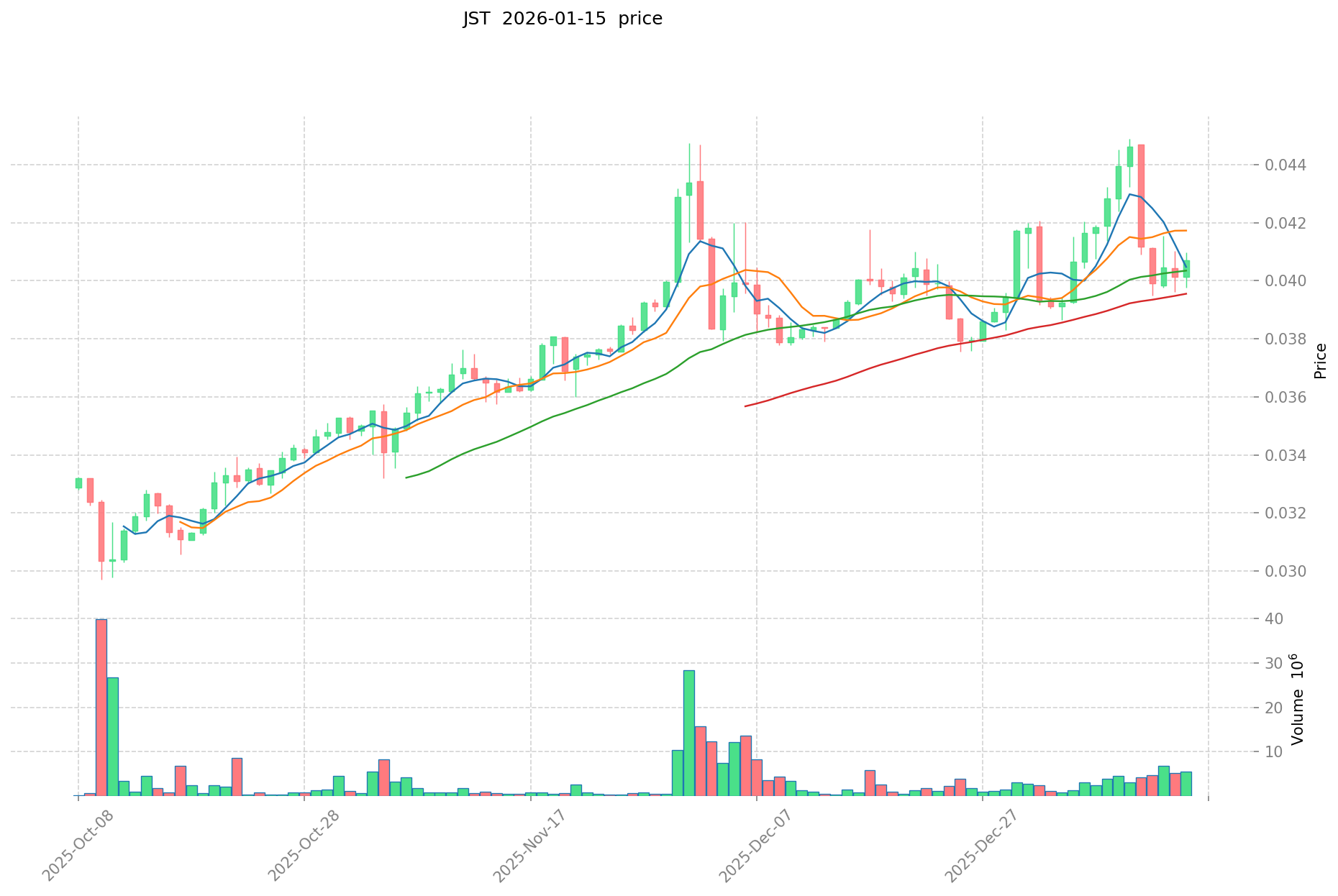
Current JST Investment Market Status (January 2026)
- JST current price: 0.04064 USD
- Market sentiment (Fear & Greed Index): Data not available in provided materials
- 24-hour trading volume: 221,435.03 USD
- Institutional investor holdings: 440,892 holders recorded on-chain
Click to view real-time JST market price
II. Core Factors Influencing Whether JST is a Good Investment
Supply Mechanism and Scarcity (JST Investment Scarcity)
- Fixed Supply Structure → Influences Price and Investment Value
- JST operates with a maximum supply of 9.9 billion tokens, with 100% currently in circulation. This fixed supply cap creates a deflationary structure that may support long-term value retention.
- Historical Context: JST has experienced significant price fluctuations since its launch, with the token trading at $0.04064 as of January 15, 2026. The token previously reached elevated price levels in April 2021.
- Investment Significance: The complete circulation of the maximum supply eliminates future dilution risks, which may serve as a foundation for long-term investment considerations.
Institutional Investment and Mainstream Adoption (Institutional Investment in JST)
- Holder Base and Market Presence
- JST currently has 440,892 holders, indicating a broad distribution across the user base.
- The token is listed on 30 exchanges, providing accessibility for various investor segments.
- Market Position: JST maintains a market capitalization of approximately $402.34 million, ranking #155 in the cryptocurrency market with a 0.011% market dominance.
Macroeconomic Environment Impact on JST Investment
- DeFi Market Dynamics and Stablecoin Demand
- As a dual-token system supporting USDJ (a USD-pegged stablecoin), JST's investment appeal may be influenced by broader demand for decentralized stablecoin mechanisms.
- Market Sentiment: Current market indicators reflect cautious investor sentiment, with 24-hour trading volume at approximately $221,435.
- Price Performance: JST has shown mixed performance across different timeframes, with a 1.72% increase over 24 hours, while experiencing a -5.02% decline over the past 7 days.
Technology and Ecosystem Development (Technology & Ecosystem for JST Investment)
- TRON Network Integration: JST operates on the TRON blockchain, leveraging its infrastructure for decentralized financial services. The platform's positioning within TRON's ecosystem may provide technical advantages in terms of transaction efficiency.
- CDP Lending Platform: The Collateralized Debt Position (CDP) platform allows users to generate USDJ by collateralizing TRX, creating utility for the JST token within the lending and borrowing framework.
- Governance and Transparency: JST holders can participate in community governance decisions, and all platform transactions are conducted on-chain, providing transparency for ecosystem operations.
- DeFi Application Scope: The platform aims to provide accessible and transparent financial services, with lending, collateralization, and governance mechanisms forming the core of its value proposition.
III. JST Future Investment Forecast and Price Outlook (Is Just(JST) worth investing in 2026-2031)
Short-term Investment Forecast (2026, short-term JST investment outlook)
Based on available market analysis, JST demonstrates varied price scenarios for the near term. Under a conservative scenario, the token may trade within a range of $0.0378 - $0.0406, reflecting cautious market sentiment and baseline growth assumptions. A neutral scenario suggests potential pricing between $0.0406 - $0.0484, indicating moderate adoption and steady ecosystem development. In an optimistic scenario, JST could reach levels of $0.0484 - $0.0609, contingent upon favorable market conditions and increased user engagement within the JUST DeFi ecosystem.
Mid-term Investment Outlook (2027-2029, mid-term Just(JST) investment forecast)
Market Stage Expectations: The mid-term period may witness gradual ecosystem maturation as JUST continues to develop its dual-token infrastructure (JST and USDJ) on the TRON blockchain. This phase could be characterized by enhanced platform utility and potential expansion of lending and stablecoin services.
Investment Return Projections:
- 2027: Price range of $0.0378 - $0.0610, representing potential year-over-year growth of approximately 9% based on neutral scenarios
- 2028: Price range of $0.0385 - $0.0607, with projections suggesting continued development momentum
- 2029: Price range of $0.0391 - $0.0630, reflecting potential cumulative growth of approximately 39% from 2026 baseline
Key Catalysts: Platform adoption rates, TRON ecosystem developments, DeFi sector trends, regulatory clarity regarding stablecoin protocols, and overall cryptocurrency market conditions may serve as primary factors influencing mid-term performance.
Long-term Investment Outlook (Is JST a good long-term investment?)
Baseline Scenario: $0.0381 - $0.0768 (assuming steady ecosystem growth, moderate user adoption, and stable competitive positioning within the DeFi lending sector through 2031)
Optimistic Scenario: $0.0607 - $0.0838 (contingent upon accelerated platform adoption, successful protocol upgrades, favorable regulatory developments, and strengthened market position within decentralized finance applications)
Risk Scenario: Below $0.0380 (under conditions of prolonged market downturn, significant competitive pressures, regulatory challenges, or fundamental shifts in DeFi market dynamics)
For detailed JST long-term investment analysis and price predictions: Price Prediction
2026-01-15 to 2031 Long-term Outlook
- Base Scenario: $0.0378 - $0.0768 (corresponding to steady progress and gradual mainstream application expansion)
- Optimistic Scenario: $0.0607 - $0.0838 (corresponding to large-scale adoption and favorable market environment)
- Transformative Scenario: Above $0.0838 (contingent upon breakthrough ecosystem developments and mainstream proliferation)
- 2031-12-31 Projected High: $0.0838 (based on optimistic development assumptions)
Disclaimer: The forecasts presented are derived from historical data analysis and market projections, which do not constitute investment advice. Cryptocurrency markets are inherently volatile and subject to numerous unpredictable factors. Actual results may differ materially from projections. Investors should conduct independent research and consider their risk tolerance before making investment decisions.
| Year |
Predicted High Price |
Predicted Average Price |
Predicted Low Price |
Price Change |
| 2026 |
0.0483854 |
0.04066 |
0.0378138 |
0 |
| 2027 |
0.060996099 |
0.0445227 |
0.037844295 |
9 |
| 2028 |
0.060673309425 |
0.0527593995 |
0.038514361635 |
29 |
| 2029 |
0.062955153453375 |
0.0567163544625 |
0.039134284579125 |
39 |
| 2030 |
0.083770055541112 |
0.059835753957937 |
0.046671888087191 |
47 |
| 2031 |
0.076829108081991 |
0.071802904749525 |
0.038055539517248 |
76 |
IV. JST Investment Strategy and Risk Management (How to invest in JST)
Investment Strategy (JST investment strategy)
Long-term Holding (HODL JST): Suitable for Conservative Investors
Long-term holding of JST may be appropriate for investors who believe in the fundamental value of decentralized finance systems and stablecoin mechanisms. This approach involves purchasing JST tokens and holding them through market cycles, focusing on the project's long-term development rather than short-term price movements. Investors adopting this strategy typically allocate a fixed portion of their portfolio to JST and maintain their position regardless of temporary market fluctuations.
Active Trading: Based on Technical Analysis and Swing Trading
Active traders may engage with JST through technical analysis and swing trading strategies. Given JST's 24-hour price change of 1.72% and recent volatility patterns (with a 7-day change of -5.020%), traders can potentially capitalize on short-term price movements. This approach requires monitoring price levels, such as the current 24-hour high of $0.04098 and low of $0.03976, along with technical indicators to identify entry and exit points.
Risk Management (Risk management for JST investment)
Asset Allocation Ratio: Conservative / Aggressive / Professional Investors
- Conservative Investors: May consider allocating 1-3% of their crypto portfolio to JST, focusing on established cryptocurrencies for the majority of holdings.
- Aggressive Investors: Could allocate 5-10% to JST as part of a diversified DeFi strategy, accepting higher volatility for potential returns.
- Professional Investors: May use JST as part of a sophisticated DeFi portfolio, potentially allocating 3-7% while implementing advanced hedging strategies.
Investors can manage JST exposure through portfolio diversification across different cryptocurrency categories and traditional assets. Risk mitigation may include setting stop-loss orders, using stablecoin allocations to preserve capital during downturns, and maintaining adequate liquidity reserves. Given JST's connection to the TRON ecosystem and its stablecoin USDJ, investors should consider correlations with TRX and other TRON-based assets.
Secure Storage: Hot and Cold Wallets + Hardware Wallet Recommendations
JST tokens, deployed on the TRON network (contract address: TCFLL5dx5ZJdKnWuesXxi1VPwjLVmWZZy9), require proper storage solutions:
- Hot Wallets: Suitable for active trading amounts, offering convenient access but higher security risks.
- Cold Wallets: Recommended for long-term holdings, providing offline storage with enhanced security.
- Hardware Wallets: Physical devices offering the highest security level for significant JST holdings, protecting against online threats while maintaining user control of private keys.
Investors should never store large amounts on exchange platforms and should verify contract addresses before transactions to avoid scams.
V. JST Investment Risks and Challenges (Risks of investing in JST)
Market Risks: High Volatility and Price Manipulation
JST exhibits significant price volatility, as evidenced by its historical price range from an all-time low of $0.00476275 (May 9, 2020) to an all-time high of $0.193254 (April 5, 2021). The current price of $0.04064 represents substantial distance from both extremes, indicating potential for significant price swings in either direction. The 24-hour trading volume of approximately $221,435 suggests moderate liquidity, which may expose the token to price manipulation risks in lower-volume periods. Investors should be aware that sudden price movements can occur due to market sentiment shifts or trading activities by large holders.
Regulatory Risks: Policy Uncertainty Across Different Countries
As a DeFi protocol offering stablecoin lending services, JST operates in a regulatory environment that continues to evolve globally. Different jurisdictions maintain varying approaches to decentralized finance platforms and stablecoin mechanisms. Regulatory developments concerning stablecoins, lending platforms, or the broader TRON ecosystem could impact JST's operations and token value. Investors should monitor regulatory changes in their respective countries and understand that sudden policy shifts could affect accessibility, liquidity, or the legal status of holding and trading JST tokens.
Technical Risks: Network Security Vulnerabilities and Upgrade Failures
JST's infrastructure relies on the TRON blockchain, creating dependency on the underlying network's security and performance. Potential technical risks include:
- Smart Contract Vulnerabilities: Bugs or exploits in JST's CDP lending platform could compromise user funds or system stability.
- Network Congestion: High activity on the TRON network may affect transaction speeds and costs.
- Protocol Upgrade Risks: Changes to JST's governance mechanisms or technical infrastructure could introduce unforeseen issues or require community consensus.
- Integration Dependencies: As part of the USDJ stablecoin system, technical issues with interconnected protocols could impact JST's functionality.
With approximately 440,892 holders, any technical incident could affect a substantial user base, potentially leading to loss of confidence or value.
VI. Conclusion: Is JST a Good Investment?
Investment Value Summary
JST presents a unique proposition within the decentralized finance landscape, operating as a governance token for a stablecoin lending system on the TRON network. The project's focus on providing transparent, on-chain financial services and its integration with the USDJ stablecoin mechanism may offer long-term potential for investors interested in DeFi protocols. However, the token experiences notable price volatility, as demonstrated by short-term fluctuations and the substantial gap between current prices and historical highs. With a market cap of approximately $402.36 million and full circulation of 9.9 billion tokens, JST maintains a mid-tier position in the cryptocurrency market.
Investor Recommendations
✅ Beginners: Consider dollar-cost averaging (DCA) strategies to build positions gradually while minimizing timing risks. Prioritize secure storage solutions, starting with reputable hot wallets for small amounts and transitioning to cold storage as holdings grow. Focus on understanding the TRON ecosystem and JST's role within the USDJ stablecoin system before committing significant capital.
✅ Experienced Investors: May engage in swing trading strategies to capitalize on JST's price movements while maintaining core long-term positions. Consider JST as part of a diversified DeFi portfolio, balancing exposure across multiple protocols and blockchains. Monitor governance proposals and protocol developments to make informed decisions about position adjustments.
✅ Institutional Investors: Could evaluate JST for strategic long-term allocation within DeFi exposure, conducting thorough due diligence on governance structures, protocol security, and ecosystem growth metrics. Consider JST's correlation with TRON ecosystem performance and stablecoin market dynamics when developing position-sizing strategies.
⚠️ Disclaimer: Cryptocurrency investments carry substantial risks, including potential loss of capital. This content provides informational analysis only and does not constitute investment advice. Investors should conduct independent research, assess their risk tolerance, and consider consulting financial professionals before making investment decisions. Past performance does not guarantee future results.
VII. FAQ
Q1: What is JST and how does it function within the TRON ecosystem?
JST (JUST) is a governance token that operates within a dual-token DeFi system built on the TRON blockchain, working alongside the USDJ stablecoin to facilitate decentralized lending and borrowing services.
JST was launched in April 2020 as part of the JUST platform, which enables users to generate USDJ (a USD-pegged stablecoin) by collateralizing TRX through a Collateralized Debt Position (CDP) mechanism. As a governance token, JST holders can participate in community decisions regarding protocol development and platform parameters. The token has a fixed maximum supply of 9.9 billion tokens, all of which are currently in circulation, creating a deflationary structure. With over 440,000 holders and availability on 30 exchanges, JST serves as both a governance mechanism and a core component of the TRON-based stablecoin lending infrastructure.
Q2: Is JST suitable for long-term investment in 2026?
JST may be considered for long-term investment by investors who believe in the fundamental value of decentralized finance systems and stablecoin mechanisms, though it carries substantial volatility risks.
Based on price projections, JST could potentially range from $0.0378 to $0.0768 by 2031 under baseline scenarios, with optimistic forecasts suggesting up to $0.0838. The token benefits from a fixed supply structure that eliminates future dilution risks and maintains a market capitalization of approximately $402.34 million as of January 2026. However, investors should consider that JST has experienced significant price fluctuations historically, trading between an all-time low of $0.00476275 (May 2020) and an all-time high of $0.193254 (April 2021). Long-term holding strategies may be appropriate for conservative investors who allocate 1-3% of their crypto portfolio to JST, focusing on the project's development rather than short-term price movements.
Q3: What are the primary risks associated with investing in JST?
The primary risks include high price volatility, regulatory uncertainty, and technical vulnerabilities within the protocol and underlying TRON network.
JST exhibits substantial price fluctuations, as evidenced by its historical trading range and current 24-hour trading volume of approximately $221,435, which suggests moderate liquidity that may expose the token to price manipulation during lower-volume periods. Regulatory risks stem from evolving global approaches to DeFi platforms and stablecoin mechanisms, where sudden policy shifts could affect accessibility and token value. Technical risks include potential smart contract vulnerabilities in the CDP lending platform, dependencies on TRON network security and performance, protocol upgrade complications, and integration risks with the USDJ stablecoin system. With approximately 440,892 holders, any technical incident could impact a substantial user base and potentially lead to loss of confidence or value.
Q4: How can investors implement effective risk management strategies for JST?
Investors should implement diversified asset allocation, utilize proper storage solutions, and employ risk mitigation tools appropriate to their investment profile.
Conservative investors may consider allocating 1-3% of their crypto portfolio to JST, while aggressive investors could allocate 5-10% as part of a diversified DeFi strategy. Risk hedging should include portfolio diversification across different cryptocurrency categories and traditional assets, setting stop-loss orders, maintaining stablecoin allocations for capital preservation, and keeping adequate liquidity reserves. For storage, active trading amounts can be held in hot wallets, but long-term holdings should be secured in cold wallets or hardware wallets, which offer the highest security level. Investors should never store large amounts on exchange platforms and must verify the TRON contract address (TCFLL5dx5ZJdKnWuesXxi1VPwjLVmWZZy9) before transactions to avoid scams.
Q5: What factors could influence JST's price performance in the near term?
Near-term price performance will likely be influenced by DeFi sector trends, TRON ecosystem developments, stablecoin market demand, and overall cryptocurrency market sentiment.
As of January 15, 2026, JST demonstrates mixed short-term performance with a 1.72% increase over 24 hours but a -5.02% decline over the past 7 days. The token's positioning within the TRON ecosystem and its connection to the USDJ stablecoin mechanism means that adoption rates of the CDP lending platform and broader demand for decentralized stablecoin services will serve as primary catalysts. Short-term price scenarios range from conservative projections of $0.0378 - $0.0406 to optimistic scenarios of $0.0484 - $0.0609, contingent upon favorable market conditions and increased user engagement. Investors should monitor platform utility developments, regulatory clarity regarding stablecoin protocols, and correlations with TRX and other TRON-based assets.
Q6: What makes JST different from other DeFi governance tokens?
JST distinguishes itself through its dual-token system architecture with USDJ, integration with the TRON blockchain for efficient transactions, and transparent on-chain lending operations.
Unlike standalone governance tokens, JST operates within a comprehensive stablecoin lending ecosystem where users can generate USDJ by collateralizing TRX through CDP mechanisms. This creates inherent utility beyond pure governance functions. The platform's deployment on TRON provides technical advantages in terms of transaction efficiency and cost compared to Ethereum-based alternatives. With 100% of the 9.9 billion maximum supply already in circulation, JST eliminates concerns about future token inflation that affect many DeFi projects. All platform transactions are conducted on-chain, providing transparency for ecosystem operations and allowing JST holders to participate directly in community governance decisions regarding protocol parameters and development directions.
Q7: Should beginners consider investing in JST, and what strategies are recommended?
Beginners may consider JST as part of a diversified cryptocurrency portfolio, but should start with small allocations and employ dollar-cost averaging (DCA) strategies to minimize timing risks.
New investors should prioritize understanding the TRON ecosystem and JST's role within the USDJ stablecoin system before committing significant capital. A recommended approach involves starting with 1-3% portfolio allocation and gradually building positions through DCA to smooth out price volatility. Beginners should focus on secure storage solutions, beginning with reputable hot wallets for small amounts and transitioning to cold storage as holdings grow. Given JST's current price of $0.04064 and accessibility on 30 exchanges, entry points remain relatively accessible. However, beginners must recognize that cryptocurrency investments carry substantial risks, including potential loss of capital, and should only invest amounts they can afford to lose while maintaining proper security practices and conducting independent research.
Q8: What are the long-term growth prospects for JST through 2031?
Long-term projections suggest JST could range from $0.0381 to $0.0838 by 2031, depending on ecosystem adoption, regulatory developments, and overall DeFi market dynamics.
Under baseline scenarios assuming steady ecosystem growth and moderate user adoption, JST may trade between $0.0381 and $0.0768 by 2031, representing potential cumulative growth of approximately 76% from the 2026 baseline. Optimistic scenarios, contingent upon accelerated platform adoption, successful protocol upgrades, and favorable regulatory developments, suggest prices could reach $0.0607 to $0.0838. Key catalysts include platform adoption rates within the JUST lending system, TRON ecosystem developments, regulatory clarity regarding stablecoin protocols, and strengthened market position within decentralized finance applications. However, risk scenarios below $0.0380 remain possible under conditions of prolonged market downturns, significant competitive pressures, or fundamental shifts in DeFi market dynamics. Investors should note that these projections are based on historical data analysis and do not constitute guarantees of future performance.
* The information is not intended to be and does not constitute financial advice or any other recommendation of any sort offered or endorsed by Gate.