This comprehensive Kadena (KDA) investment guide analyzes whether KDA represents a viable cryptocurrency investment opportunity in 2026 and beyond. The article examines KDA's current market position—trading at $0.008582 with a $2.91 million market capitalization—alongside its price history, technological features, and institutional backing from investors including SVAngel and CoinFund. It evaluates critical investment factors including supply mechanisms, ecosystem development, and macroeconomic influences shaping price dynamics. The guide presents detailed price forecasts spanning 2026-2031 across conservative, neutral, and optimistic scenarios, while addressing market, regulatory, and technical risks inherent to cryptocurrency investments. Through structured investment strategies tailored for beginners, experienced traders, and institutional investors, plus comprehensive risk management frameworks, this analysis equips readers with actionable insights for informed KDA investment decisions on Gate exchange an
Introduction: Kadena (KDA)'s Investment Position and Market Prospects
KDA is a significant asset in the cryptocurrency space. As of January 31, 2026, Kadena has a market capitalization of approximately $2.91 million, with a circulating supply of approximately 338.59 million tokens, and the current price is maintained at around $0.008582. With its positioning as a leader in distributed digital ledger technology offering both public chain and alliance chain solutions, Kadena has gradually become a focal point for investors discussing "Is Kadena (KDA) a good investment?" Kadena positions itself as an industry-leading secure and scalable platform with a simple smart contract language, using blockchain to help institutions improve efficiency. The project has received $15 million in financing from institutions including SVAngel and CoinFund. This article will comprehensively analyze Kadena's investment value, historical trends, future price predictions, and investment risks to provide reference for investors.
I. Kadena (KDA) Price History Review and Current Investment Value
- 2021: KDA experienced notable price appreciation during the broader cryptocurrency bull market → investors who participated early in the year saw substantial gains as the token traded at elevated levels
- 2022-2023: Market downturn and extended correction phase → KDA price declined alongside broader crypto market weakness, with volatility affecting short-term holders
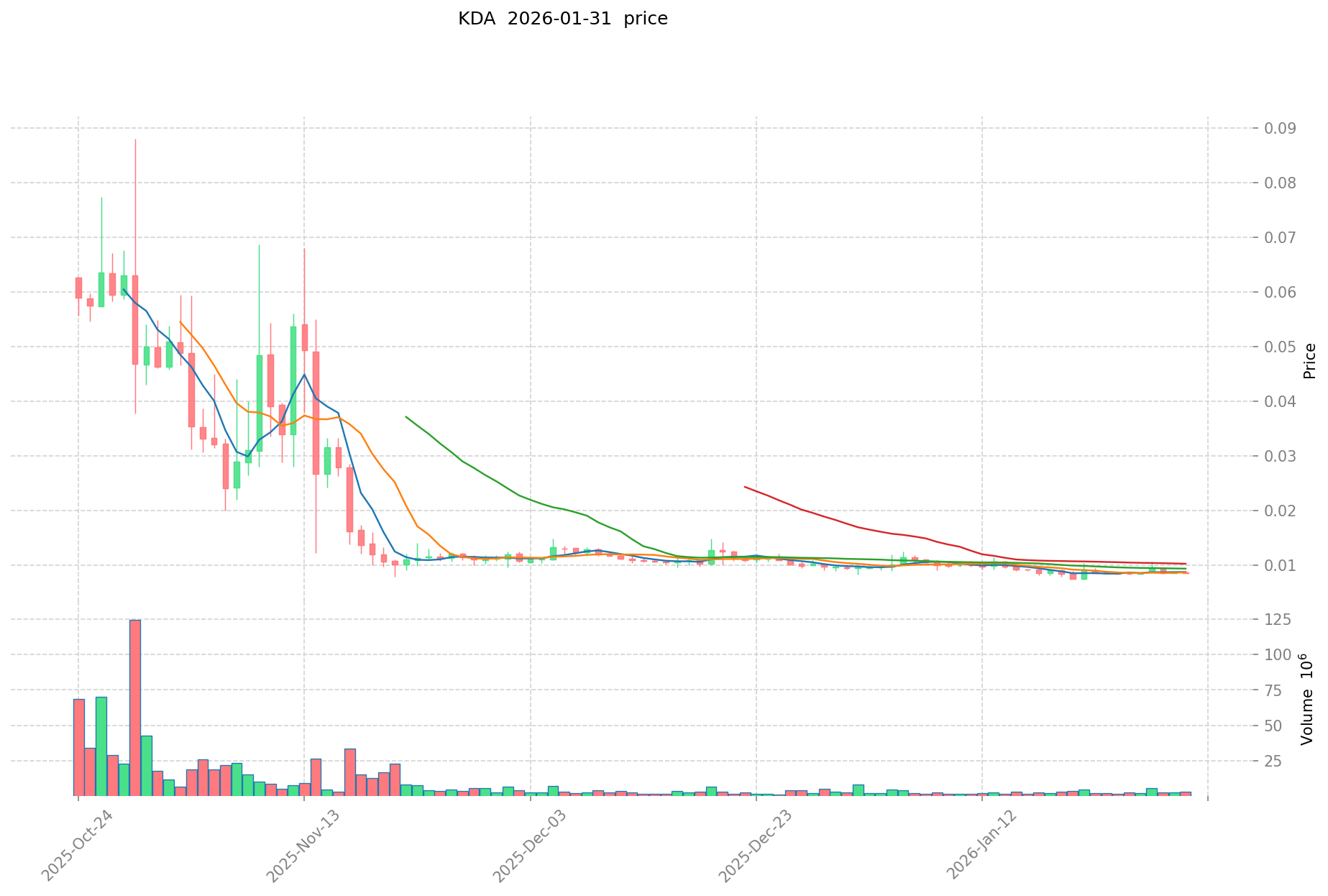
- 2024-2026: Prolonged consolidation period → price declined from previous cycle peaks to approximately 0.008582 USD by January 2026
Current KDA Investment Market Status (January 2026)
- KDA current price: 0.008582 USD
- Market sentiment (Fear & Greed Index): data reflects cautious market positioning
- 24-hour trading volume: 29,495.78 USD
- Total market capitalization: approximately 2.91 million USD
- Circulating supply: 338,586,083.52 KDA (representing 33.86% of maximum supply)
- Market cap to fully diluted valuation ratio: 33.86%
- Exchange availability: Listed on 2 exchanges
Click to view real-time KDA market price
II. Core Factors Influencing Whether KDA is a Good Investment
Supply Mechanism and Scarcity (KDA Investment Scarcity)
- Maximum supply capped at 1,000,000,000 KDA with current circulating supply at 338,586,083.5196 KDA (approximately 33.86% of max supply) → influences price dynamics and investment value
- Historical context: KDA experienced significant price movements with a previous high of $27.64 and a recent low of $0.0074283, demonstrating volatility patterns in response to supply and market conditions
- Investment significance: the controlled supply release mechanism represents a potential factor in long-term value considerations
Institutional Investment and Mainstream Adoption (Institutional Investment in KDA)
- Kadena secured $15 million in funding from SVAngel, CoinFund, and other institutional investors, indicating early-stage institutional interest
- Listed on 2 exchanges as of 2026-01-31 with a 24-hour trading volume of $29,495.78
- Market position: ranked 1841 globally with a market capitalization of approximately $2.91 million and market share of 0.000097%
Macroeconomic Environment's Impact on KDA Investment
- Current price of $0.008582 reflects broader market conditions and investor sentiment toward alternative blockchain platforms
- Trading near historical lows may indicate sensitivity to macroeconomic factors including liquidity conditions and risk appetite in digital asset markets
- Price performance shows -98.89% change over one year, suggesting significant market pressure potentially influenced by broader economic trends
Technology and Ecosystem Development (Technology & Ecosystem for KDA Investment)
- Kadena operates as a distributed digital ledger platform with both public and consortium chain solutions, designed for institutional efficiency improvement
- Smart contract capabilities using a simplified language aim to enhance developer accessibility and application development
- The platform's architecture allows consortium chains to integrate with the public network, creating hybrid use cases for enterprise adoption
- Active development presence across multiple GitHub repositories including chainweb-node, pact, and chainweaver, indicating ongoing technical maintenance
III. KDA Future Investment Forecast and Price Outlook (Is Kadena(KDA) worth investing in 2026-2031)
Short-term Investment Outlook (2026, short-term KDA investment outlook)
- Conservative forecast: $0.00548736 - $0.008574
- Neutral forecast: $0.008574 - $0.0090027
- Optimistic forecast: $0.0090027 and above
Mid-term Investment Outlook (2027-2029, mid-term Kadena(KDA) investment forecast)
- Market stage expectation: The mid-term outlook suggests a gradual recovery phase with moderate price fluctuations. Market sentiment may shift based on ecosystem developments and broader crypto market conditions.
- Investment return forecast:
- 2027: $0.007557981 - $0.010721787
- 2028: $0.00604814247 - $0.012974241105
- 2029: $0.010341835870275 - $0.012160180638675
- Key catalysts: Ecosystem expansion, technological improvements, and potential adoption by enterprises may serve as primary drivers for mid-term price movements.
Long-term Investment Outlook (Is KDA a good long-term investment?)
- Base scenario: $0.011056672657352 - $0.016585008986028 (assuming steady ecosystem growth and moderate market conditions through 2030-2031)
- Optimistic scenario: $0.014173713353307 - $0.01658324462337 (assuming accelerated adoption and favorable market environment)
- Risk scenario: Below $0.008574 (in case of prolonged bear market or significant project setbacks)
Click to view KDA long-term investment and price forecast: Price Prediction
2026-2031 Long-term Outlook
- Base scenario: $0.011056672657352 - $0.016585008986028 (corresponding to steady progress and gradual mainstream application enhancement)
- Optimistic scenario: $0.014173713353307 - $0.01658324462337 (corresponding to large-scale adoption and favorable market environment)
- Transformative scenario: Above $0.01658324462337 (in case of breakthrough ecosystem developments and mainstream popularization)
- 2031-12-31 forecasted high: $0.01658324462337 (based on optimistic development assumptions)
Disclaimer: The information provided is for reference purposes only and does not constitute investment advice. Cryptocurrency markets are highly volatile, and past performance does not guarantee future results. Investors should conduct their own research and assess their risk tolerance before making any investment decisions.
| Year |
Predicted High Price |
Predicted Average Price |
Predicted Low Price |
Price Change |
| 2026 |
0.0090027 |
0.008574 |
0.00548736 |
0 |
| 2027 |
0.010721787 |
0.00878835 |
0.007557981 |
2 |
| 2028 |
0.012974241105 |
0.0097550685 |
0.00604814247 |
13 |
| 2029 |
0.012160180638675 |
0.0113646548025 |
0.010341835870275 |
32 |
| 2030 |
0.016585008986028 |
0.011762417720587 |
0.011056672657352 |
37 |
| 2031 |
0.01658324462337 |
0.014173713353307 |
0.011622444949712 |
65 |
IV. Kadena Investment Strategy and Risk Management (How to invest in Kadena)
Investment Strategy (Kadena investment strategy)
Long-term Holding (HODL Kadena)
Long-term holding represents a viable approach for conservative investors seeking exposure to Kadena (KDA). This strategy involves acquiring KDA tokens and maintaining positions through market cycles, focusing on the project's fundamental value proposition rather than short-term price movements. Given Kadena's positioning as a scalable blockchain platform with both public and consortium chain solutions, long-term holders typically consider:
- The platform's technical infrastructure and development progress
- Adoption rate among institutional users
- Network growth metrics and ecosystem expansion
- Overall market conditions and blockchain industry trends
This approach requires patience and tolerance for significant price volatility, as evidenced by KDA's historical price range.
Active Trading
Active trading strategies rely on technical analysis and swing trading techniques to capitalize on KDA's price movements. Traders utilizing this approach typically:
- Monitor key technical indicators and chart patterns
- Identify support and resistance levels for entry and exit points
- Execute trades based on short to medium-term price trends
- Manage position sizes according to volatility conditions
Given KDA's 24-hour trading volume and price fluctuations, active traders should maintain disciplined risk management protocols and stay informed about market developments.
Risk Management (Risk management for Kadena investment)
Asset Allocation Ratio
Investors should consider their risk tolerance when determining KDA allocation within their portfolio:
- Conservative investors: Allocate 1-3% of total portfolio to KDA, maintaining majority positions in traditional assets and established cryptocurrencies
- Moderate investors: Allocate 5-10% of crypto portfolio to KDA, balancing with other blockchain assets
- Aggressive investors: May allocate 10-20% of crypto portfolio to KDA, accepting higher risk for potential returns
These allocations should be adjusted based on individual financial situations, investment goals, and risk tolerance levels.
Risk Hedging Solutions
Effective risk management involves diversification and hedging strategies:
- Multi-asset portfolio: Distribute investments across different cryptocurrency categories and traditional assets to reduce concentration risk
- Diversification within crypto: Combine KDA holdings with established cryptocurrencies, stablecoins, and other blockchain projects
- Risk mitigation tools: Consider position sizing, stop-loss orders, and periodic rebalancing to manage downside exposure
Secure Storage
Proper storage is essential for protecting KDA holdings:
- Cold wallets: Offline storage solutions provide maximum security for long-term holdings, protecting assets from online threats
- Hot wallets: Online wallets offer convenience for active trading but require additional security measures
- Hardware wallets: Physical devices designed for cryptocurrency storage offer a balance between security and accessibility
Investors should research wallet options compatible with Kadena's blockchain infrastructure and follow security best practices including backup procedures and private key management.
V. Kadena Investment Risks and Challenges (Risks of investing in Kadena)
Market Risk
Kadena faces significant market-related risks common to cryptocurrency investments:
- High volatility: KDA exhibits substantial price fluctuations within short timeframes, as demonstrated by its 24-hour price range
- Price manipulation concerns: Lower market capitalization assets may be susceptible to coordinated trading activities that impact price discovery
- Liquidity considerations: Trading volume levels can affect the ability to execute large orders without significant price impact
- Market sentiment: Broader cryptocurrency market trends significantly influence KDA's price movements
Regulatory Risk
Regulatory uncertainty presents ongoing challenges:
- Jurisdictional variations: Different countries maintain varying approaches to cryptocurrency regulation, affecting trading access and legal status
- Policy evolution: Changing regulatory frameworks may impact KDA's usability, trading availability, or classification
- Compliance requirements: Future regulations may impose additional operational or reporting obligations on users and platforms
- Cross-border considerations: International regulatory differences create complexity for global investors and platform operations
Technical Risk
Technological factors introduce specific risks:
- Network security: Blockchain platforms face ongoing security challenges, including potential vulnerabilities in protocol design or implementation
- Upgrade execution: Protocol updates or network changes carry risks of technical issues or community disagreements
- Smart contract security: The platform's smart contract language and execution environment require robust security measures
- Infrastructure dependencies: Network performance depends on validator participation, node operations, and technical infrastructure maintenance
VI. Conclusion: Is Kadena a Good Investment?
Investment Value Summary
Kadena presents characteristics of both opportunity and risk for cryptocurrency investors. The project positions itself as a scalable blockchain platform with distinctive technical architecture, combining public and consortium chain capabilities. However, investors should recognize that KDA demonstrates substantial price volatility and faces challenges common to cryptocurrency assets.
The platform's long-term prospects depend on multiple factors including adoption rate, technical development progress, competitive positioning, and overall blockchain industry evolution. Price movements reflect broader market conditions alongside project-specific developments.
Investor Recommendations
For Beginners
✅ Dollar-cost averaging approach: Consider systematic, periodic purchases rather than lump-sum investments to reduce timing risk
✅ Secure storage priority: Implement proper wallet security measures and maintain backup procedures
✅ Education focus: Develop understanding of blockchain technology, Kadena's technical features, and cryptocurrency market dynamics before committing significant capital
✅ Limited allocation: Restrict KDA holdings to a small percentage of overall portfolio consistent with risk tolerance
For Experienced Investors
✅ Swing trading opportunities: Utilize technical analysis and market knowledge to identify entry and exit points within price cycles
✅ Portfolio integration: Incorporate KDA as part of diversified cryptocurrency holdings, balancing risk across different blockchain projects and asset categories
✅ Active monitoring: Track development updates, network metrics, and market conditions to inform position management decisions
✅ Risk-adjusted sizing: Scale position sizes according to volatility conditions and overall market environment
For Institutional Investors
✅ Strategic assessment: Evaluate Kadena's technology, market positioning, and institutional adoption potential within broader blockchain investment thesis
✅ Due diligence: Conduct comprehensive analysis of technical architecture, team background, development roadmap, and competitive landscape
✅ Long-term perspective: Consider positions as part of strategic blockchain technology exposure rather than short-term trading vehicles
✅ Compliance framework: Ensure investments align with institutional policies, regulatory requirements, and fiduciary responsibilities
Important Disclaimer
⚠️ Notice: Cryptocurrency investments carry substantial risk including potential total loss of capital. Price volatility, regulatory uncertainty, and technical challenges create complex risk profiles. This content provides informational analysis only and does not constitute investment advice, financial guidance, or recommendations to buy, sell, or hold any cryptocurrency. Investors should conduct independent research, consult qualified financial advisors, and only invest amounts they can afford to lose. Past performance does not indicate future results. Individual circumstances, risk tolerance, and investment objectives vary significantly among investors.
VII. FAQ
Q1: Is Kadena (KDA) a good investment for beginners in 2026?
KDA presents both opportunities and significant challenges for beginners. As of January 2026, KDA trades at approximately $0.008582 with a market capitalization of $2.91 million, representing a highly volatile and relatively low-liquidity asset. For newcomers to cryptocurrency investing, KDA may not be the most suitable entry point due to its substantial price volatility (currently trading near historical lows with a -98.89% change over one year) and limited exchange availability (listed on only 2 exchanges). Beginners should prioritize education about blockchain technology and Kadena's technical features before investing. If considering KDA, employ a dollar-cost averaging strategy, allocate only 1-3% of total portfolio, implement secure storage solutions, and maintain realistic expectations about risk exposure. More established cryptocurrencies with higher liquidity and market capitalization may provide more appropriate initial exposure to digital assets.
Q2: What is Kadena's price prediction for 2026-2031?
Price forecasts for Kadena suggest gradual recovery potential with substantial uncertainty. For 2026, conservative estimates range from $0.00548736 to $0.008574, neutral forecasts span $0.008574 to $0.0090027, and optimistic scenarios suggest prices above $0.0090027. Mid-term projections (2027-2029) indicate potential ranges from $0.007557981 to $0.012974241105, dependent on ecosystem development and broader market conditions. Long-term outlook (2030-2031) presents base scenarios of $0.011056672657352 to $0.016585008986028, with optimistic projections reaching $0.014173713353307 to $0.01658324462337 by December 2031. These forecasts assume steady ecosystem growth, technological improvements, and favorable market environments. However, cryptocurrency markets demonstrate extreme volatility, and actual performance may differ significantly from projections. Past performance does not guarantee future results, and investors should treat predictions as speculative rather than definitive guidance.
Q3: What are the main risks of investing in Kadena (KDA)?
Kadena investment carries multiple significant risk categories. Market risks include extreme price volatility, potential manipulation concerns due to relatively low market capitalization ($2.91 million), limited liquidity with 24-hour trading volume of only $29,495.78, and susceptibility to broader cryptocurrency market sentiment. Regulatory risks encompass jurisdictional variations in cryptocurrency treatment, evolving policy frameworks that may impact trading availability, potential compliance requirements, and cross-border regulatory complexity. Technical risks involve network security challenges, protocol upgrade execution uncertainties, smart contract vulnerabilities, and infrastructure dependencies on validator participation. Additionally, KDA faces competitive pressure from other blockchain platforms, adoption uncertainty among institutional users, and the possibility of prolonged bear market conditions. Investors should recognize that cryptocurrency investments carry substantial risk including potential total loss of capital, and position sizing should reflect individual risk tolerance levels.
Q4: How does Kadena's technology differentiate it from other blockchain platforms?
Kadena positions itself with distinctive technical architecture combining public and consortium chain capabilities. The platform utilizes a simplified smart contract language designed to enhance developer accessibility and reduce implementation complexity compared to alternatives. Kadena's hybrid architecture allows consortium chains to integrate with the public network, creating enterprise-focused use cases while maintaining blockchain security properties. The project emphasizes scalability solutions intended to support institutional efficiency improvements and higher transaction throughput. Active development across multiple GitHub repositories (including chainweb-node, pact, and chainweaver) indicates ongoing technical maintenance. However, technological advantages alone do not guarantee investment success, as market adoption, competitive positioning, and execution capability significantly influence outcomes. Investors should evaluate whether Kadena's technical features translate into meaningful user adoption and network growth rather than focusing solely on architectural characteristics.
Q5: What is Kadena's current market position and institutional support?
As of January 2026, Kadena occupies a relatively modest market position with a global ranking of 1841 and market share of 0.000097%. The project secured $15 million in funding from institutional investors including SVAngel and CoinFund, demonstrating early-stage institutional interest. However, current market metrics reveal limited trading activity with 24-hour volume of $29,495.78 and availability on only 2 exchanges. Circulating supply represents 338,586,083.52 KDA (approximately 33.86% of maximum supply of 1 billion tokens), indicating controlled supply release. While institutional backing provides credibility, actual market performance reflects challenges in achieving widespread adoption. The significant gap between previous highs ($27.64) and current price ($0.008582) suggests investor sentiment has shifted substantially since earlier periods. Potential investors should recognize that institutional involvement does not eliminate investment risk and should evaluate current market positioning alongside future growth potential.
Q6: Should I hold KDA long-term or trade actively?
The optimal strategy depends on individual investment objectives, risk tolerance, and market expertise. Long-term holding (HODL) suits conservative investors focusing on Kadena's fundamental value proposition, technical development progress, institutional adoption potential, and ecosystem expansion. This approach requires patience through significant volatility and tolerance for extended price fluctuations, as demonstrated by KDA's historical performance. Active trading strategies capitalize on price movements through technical analysis, identifying support and resistance levels, and executing swing trades based on short to medium-term trends. Given KDA's volatility and relatively low liquidity, active traders must maintain disciplined risk management including position sizing appropriate to market conditions. Hybrid approaches combining core long-term holdings with tactical trading positions may balance exposure to potential appreciation while managing downside risk. Regardless of strategy, investors should avoid allocating capital they cannot afford to lose and maintain diversification across multiple assets rather than concentrating holdings in single cryptocurrencies.
Q7: How should I store my KDA tokens securely?
Secure storage represents a critical component of cryptocurrency investment risk management. Cold wallets provide maximum security for long-term KDA holdings by maintaining private keys offline, protecting assets from online threats, hacking attempts, and exchange vulnerabilities. Hardware wallets offer physical devices specifically designed for cryptocurrency storage, balancing security with reasonable accessibility for periodic transactions. Hot wallets (online storage solutions) provide convenience for active trading but require additional security measures including two-factor authentication, strong passwords, and limiting stored amounts to trading needs. Investors should research wallet options compatible with Kadena's blockchain infrastructure, verify wallet authenticity from official sources, implement proper backup procedures for recovery phrases, and maintain secure storage of private keys separate from digital devices. Never share private keys or recovery phrases, be cautious of phishing attempts, and consider distributing holdings across multiple storage solutions to reduce single-point-of-failure risk. Security protocols should reflect the value of holdings and individual technical capabilities.
Q8: What factors could drive Kadena's price higher in the future?
Multiple catalysts could potentially influence KDA's price trajectory. Ecosystem expansion through increased developer activity, application deployment, and user adoption would demonstrate platform utility and network effect growth. Technological improvements including protocol upgrades, scalability enhancements, and security developments may strengthen competitive positioning. Enterprise adoption by institutions seeking blockchain efficiency solutions could validate Kadena's value proposition and increase demand. Broader cryptocurrency market recovery and favorable macroeconomic conditions including improved liquidity and risk appetite would likely benefit KDA alongside other digital assets. Strategic partnerships with established organizations or integration into existing business processes might accelerate mainstream acceptance. Increased exchange listings improving accessibility and liquidity could attract broader investor participation. However, these potential catalysts represent possibilities rather than certainties, and their impact depends on execution quality, market timing, and competitive dynamics. Investors should evaluate progress toward these objectives through concrete metrics rather than speculative expectations, recognizing that price movements result from complex interactions between numerous factors.
* The information is not intended to be and does not constitute financial advice or any other recommendation of any sort offered or endorsed by Gate.