This comprehensive analysis examines whether KAITO represents a viable investment opportunity by evaluating the AI-powered InfoFi network token across multiple dimensions. Launched in February 2025, KAITO currently trades at $0.5488 with a market cap of $132.47 million across 42 exchanges, serving approximately 413,000 holders. The article analyzes KAITO's price history, demonstrating volatility from a $2.9232 high to $0.469 low, while examining core investment factors including supply mechanics, institutional adoption potential, and ecosystem development. Investment predictions for 2026-2030 range from $0.52-$0.78 (2026) to $0.85-$1.33 (2030) under various scenarios. The analysis covers diversified investment strategies for different investor profiles, risk management approaches including asset allocation and secure storage solutions, and significant risks spanning market volatility, regulatory uncertainty, and technical vulnerabilities. Comprehensive FAQ addresses common investor questions about KAITO's dif
Introduction: Kaito (KAITO) Investment Position and Market Prospects
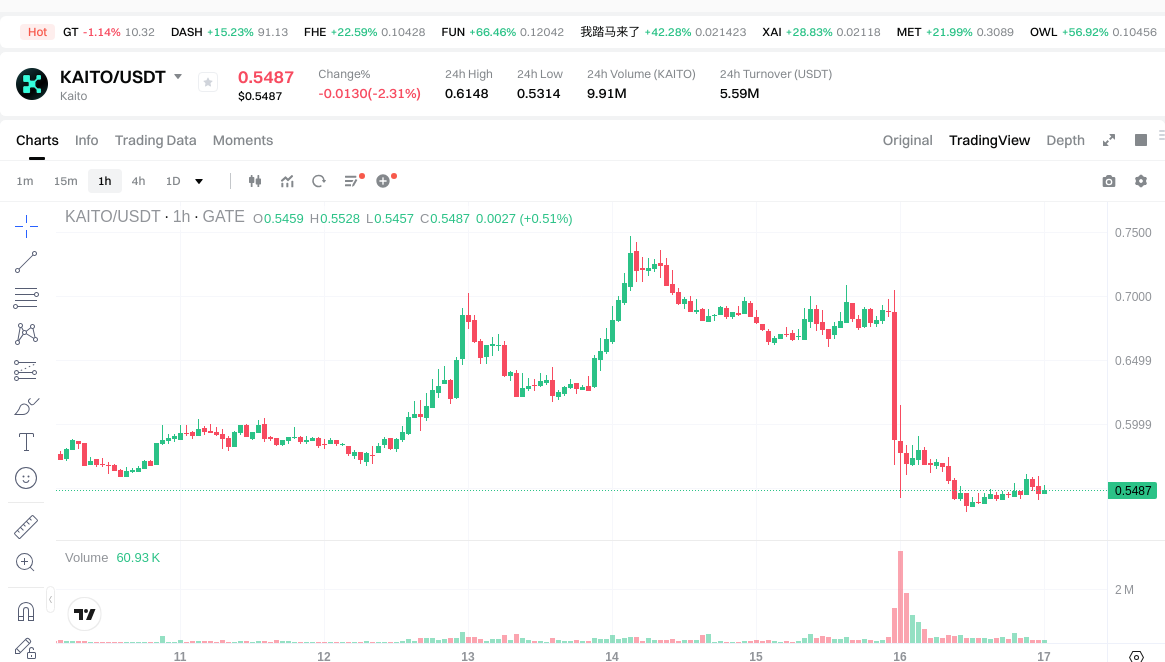
KAITO is an emerging digital asset in the cryptocurrency sector. Launched in 2025, it has positioned itself as an AI-powered InfoFi network token designed to facilitate efficient redistribution of attention and capital while rewarding network participants. As of January 17, 2026, KAITO holds a market ranking of 309 with a circulating market capitalization of approximately $132.47 million and a fully diluted valuation of $548.8 million. The token maintains a current price of $0.5488, with approximately 241.39 million tokens in circulation out of a maximum supply of 1 billion tokens. With a circulating supply ratio of 24.14% and a holder base of approximately 413,000 addresses, KAITO has established a presence across 42 exchanges. The token has experienced notable price volatility, recording a historical high of $2.9232 in February 2025 and a low of $0.469 in December 2025. Recent price movements show a 0.12% increase over 24 hours, a 7.56% decline over 7 days, and a 3.36% gain over 30 days. When investors consider "Is Kaito (KAITO) a good investment?", they examine its positioning within the AI and decentralized finance intersection. This article provides a comprehensive analysis of KAITO's investment characteristics, historical price patterns, future price outlook, and associated investment risks to assist investors in their evaluation process.
I. Kaito (KAITO) Price History Review and Investment Value Status
- 2025: Token launched on February 20, 2025 → Experienced significant volatility with price reaching $2.92 in late February before declining
- 2025: Market experienced turbulence in mid-year → KAITO price fluctuated from early-year levels to $0.47 range in December
- 2025-2026: Market cycle transition → Price movement from $2.92 range to approximately $0.55 level
Current KAITO Investment Market Status (January 2026)
- Current KAITO price: $0.5488 (as of January 17, 2026)
- 24-hour trading volume: $5,840,513.54
- Market capitalization: $132,474,222.28
- Circulating supply: 241,388,889 KAITO (24.14% of total supply)
- Fully diluted market cap: $548,800,000
- Recent price changes: +0.12% (24H), -7.56% (7D), +3.36% (30D)
- Number of holders: 413,000
- Listed on 42 exchanges
Click to view real-time KAITO market price
II. Core Factors Affecting Whether KAITO is a Good Investment
Supply Mechanism and Scarcity (KAITO Investment Scarcity)
- Total supply: 1,000,000,000 KAITO with a maximum supply cap of 1,000,000,000 tokens
- Current circulating supply: 241,388,889 tokens (24.14% of total supply)
- Market cap to fully diluted valuation ratio: 24.14%, indicating significant locked supply
- The controlled release of tokens may influence price dynamics as circulation increases over time
- Investment consideration: The relatively low circulation ratio suggests potential supply expansion, which investors should monitor when evaluating long-term scarcity dynamics
Institutional Investment and Mainstream Adoption (Institutional Investment in KAITO)
- Current holder count: approximately 413,000 addresses
- Trading availability: Listed on 42 exchanges, indicating growing market access
- The platform aims to integrate additional data sources, including social media platforms like X and TikTok, which may enhance utility
- Institutional support trends: The project is expected to pursue partnerships with crypto and traditional finance platforms, though specific institutional holdings data is not provided in available materials
- Mainstream adoption potential: KAITO's AI-powered InfoFi network design targets efficient attention and capital redistribution in the market
Macroeconomic Environment's Impact on KAITO Investment
- As a digital asset, KAITO's performance may be influenced by broader cryptocurrency market sentiment and macroeconomic conditions
- Market dynamics, investor sentiment, and trading volumes are noted as key factors affecting KAITO's price movement
- The relationship between general monetary policy changes and KAITO's specific investment appeal requires monitoring of overall crypto market trends
Technology and Ecosystem Development (Technology & Ecosystem for KAITO Investment)
- Core platform components:
- Kaito Pro: A search engine aggregating information from multiple sources and blockchains
- Kaito Yaps: Rewards users for sharing quality crypto content on supported social media platforms
- Kaito Connect: A network enabling users to create and share crypto information
- KAITO utility token functions: Enables holders to vote on governance proposals, pay for premium features, and rewards content contributors
- Planned ecosystem expansion: Integration of more data sources and social media platforms to broaden platform utility
- Technology focus: AI-powered information aggregation and blockchain-based incentive mechanisms designed to facilitate access to verified crypto news
- Long-term value consideration: The success of ecosystem expansion and user adoption of platform features may influence investment outcomes
III. KAITO Future Investment Predictions and Price Outlook (Is Kaito(KAITO) worth investing in 2026-2030)
Short-term Investment Prediction (2026, short-term KAITO investment outlook)
Based on available market data and technical analysis, KAITO's short-term price trajectory in 2026 presents varied scenarios:
- Conservative Prediction: $0.52 - $0.55
- Neutral Prediction: $0.55 - $0.67
- Optimistic Prediction: $0.67 - $0.78
Current price action indicates a 24-hour change of 0.12%, with the token trading at $0.5488. The circulating supply stands at 241.39 million tokens (24.14% of max supply), with a fully diluted market cap of approximately $548.8 million. Technical indicators suggest potential volatility within the $0.52-$0.78 range throughout 2026, influenced by overall crypto market conditions and platform adoption rates.
Mid-term Investment Outlook (2027-2028, mid-term Kaito(KAITO) investment forecast)
-
Market Stage Expectation: Consolidation and ecosystem development phase, with KAITO potentially experiencing price stabilization as the InfoFi network matures and attracts more participants. The period may witness increased integration with decentralized applications and enhanced utility within the Kaito AI ecosystem.
-
Investment Return Prediction:
- 2027: $0.56 - $0.75
- 2028: $0.67 - $0.83
-
Key Catalysts: Platform user growth, strategic partnerships within the Web3 space, expansion of AI-powered features, staking mechanism adoption, and broader market sentiment toward AI and information aggregation protocols. Additional factors include the development of community-driven initiatives and potential exchange listings.
Long-term Investment Outlook (Is Kaito a good long-term investment?)
- Baseline Scenario: $0.85 - $1.17 (assuming steady ecosystem growth, sustained user engagement, and moderate market conditions through 2030)
- Optimistic Scenario: $1.17 - $1.33 (contingent upon accelerated adoption of InfoFi networks, successful technological upgrades, favorable regulatory developments, and increased institutional interest in AI-driven crypto projects)
- Risk Scenario: $0.41 - $0.52 (under conditions of market downturns, competitive pressures from alternative information aggregation platforms, or slower-than-expected ecosystem development)
Click to view KAITO long-term investment and price prediction: Price Prediction
2026-01-17 to 2030 Long-term Outlook
- Base Case: $0.85 - $1.01 (corresponding to steady progress and gradual mainstream application growth)
- Optimistic Case: $1.01 - $1.33 (corresponding to large-scale adoption and favorable market environment)
- Transformative Case: Above $1.33 (contingent upon breakthrough ecosystem developments and mainstream penetration)
- 2030-12-31 Predicted High: $1.33 (based on optimistic development assumptions)
Disclaimer: These predictions are based on current market data, historical trends, and technical analysis. Cryptocurrency markets are highly volatile and subject to numerous external factors including regulatory changes, market sentiment shifts, and technological developments. Price predictions should not be considered as financial advice or guaranteed outcomes. Investors should conduct thorough research and assess their risk tolerance before making investment decisions. Past performance does not indicate future results, and actual prices may differ significantly from predictions.
| Year |
Predicted High Price |
Predicted Average Price |
Predicted Low Price |
Price Change |
| 2026 |
0.784498 |
0.5486 |
0.52117 |
0 |
| 2027 |
0.75320037 |
0.666549 |
0.55990116 |
21 |
| 2028 |
0.83055338145 |
0.709874685 |
0.67438095075 |
29 |
| 2029 |
0.93195898020225 |
0.770214033225 |
0.40821343760925 |
40 |
| 2030 |
1.165988514197666 |
0.851086506713625 |
0.485119308826766 |
55 |
| 2031 |
1.331269513801452 |
1.008537510455645 |
0.6252932564825 |
83 |
IV. Kaito Investment Strategy and Risk Management (How to invest in Kaito)
Investment Methodology (Kaito investment strategy)
Long-term Holding (HODL Kaito)
Long-term holding of Kaito may appeal to investors who believe in the fundamental value proposition of AI-powered InfoFi networks. This strategy involves acquiring Kaito tokens and maintaining positions through market fluctuations, based on the project's core mission to redistribute attention and capital more efficiently while rewarding network participants. This approach typically suits investors with a multi-year investment horizon who are willing to withstand significant price volatility.
Active Trading
Active trading strategies for Kaito involve technical analysis and swing trading approaches. Given the token's historical price range between $0.469 and $2.9232, traders may identify opportunities during price corrections and momentum shifts. The 24-hour trading volume of approximately $5.84 million provides sufficient liquidity for active position management. Technical traders often monitor price action across multiple timeframes, utilizing support and resistance levels derived from historical price data.
Risk Management (Risk management for Kaito investment)
Asset Allocation Proportions
- Conservative investors: May consider allocating 1-3% of their cryptocurrency portfolio to Kaito, maintaining significant exposure to established digital assets
- Aggressive investors: Could allocate 5-10% to Kaito, accepting higher risk for potential returns associated with emerging AI and InfoFi sectors
- Professional investors: May implement dynamic allocation strategies ranging from 3-15% based on market conditions, project developments, and portfolio correlation analysis
Risk Hedging Strategies
Diversified portfolio construction remains essential when investing in Kaito. Investors may consider combining Kaito exposure with:
- Established cryptocurrencies with lower correlation patterns
- Stablecoin positions to maintain purchasing power during market downturns
- Other AI-related digital assets to gain sector exposure while reducing single-project risk
Portfolio rebalancing at predetermined intervals helps maintain target allocation levels and captures profits during upward price movements.
Secure Storage Solutions
Cold Storage Options: Hardware wallets provide optimal security for long-term Kaito holdings. Since Kaito operates on the BASE network, investors should ensure their chosen hardware wallet supports BASE-compatible tokens.
Hot Wallet Considerations: For traders requiring frequent access, reputable software wallets with BASE network support offer convenience while maintaining reasonable security standards. However, hot wallets should only hold amounts allocated for active trading.
Multi-signature Solutions: For larger holdings, multi-signature wallet configurations add an additional security layer, requiring multiple approvals for transaction execution.
V. Kaito Investment Risks and Challenges (Risks of investing in Kaito)
Market Risks
High Volatility: Kaito has demonstrated significant price volatility, with the current price of $0.5488 representing an approximate 81% decline from its historical high of $2.9232 recorded in February 2025. The 7-day price change of -7.56% and 1-year change of -52.76% illustrate the substantial short-term and medium-term price fluctuations investors may encounter.
Liquidity Considerations: While Kaito maintains listings on 42 exchanges with a 24-hour trading volume of approximately $5.84 million, liquidity conditions may vary across different trading platforms. Lower liquidity environments can amplify price swings during periods of increased buying or selling pressure.
Market Capitalization Dynamics: With a circulating market capitalization of approximately $132.47 million and a market cap to fully diluted valuation ratio of 24.14%, Kaito represents a mid-sized cryptocurrency project. This positioning exposes the token to broader market sentiment shifts and sector-specific developments in AI and InfoFi categories.
Regulatory Risks
Jurisdictional Uncertainty: Cryptocurrency regulatory frameworks continue evolving across different jurisdictions. Changes in regulatory approaches toward AI-powered platforms, data handling, or token economics could impact Kaito's operational flexibility and market accessibility.
Compliance Requirements: As regulatory oversight of digital assets intensifies globally, projects like Kaito may face increasing compliance obligations. These requirements could affect token distribution mechanisms, platform features, or geographic availability.
Classification Challenges: The intersection of AI technology and tokenized incentive systems presents novel regulatory classification questions. Future regulatory determinations regarding similar projects could create precedents affecting Kaito's operational framework.
Technical Risks
Network Security: As a BASE network token, Kaito's security partially depends on the underlying blockchain infrastructure. While established networks generally maintain robust security practices, potential vulnerabilities in smart contracts or network protocols could pose risks to token holders.
Smart Contract Risks: The token's smart contract at address 0x98d0baa52b2d063e780de12f615f963fe8537553 on BASE represents a potential point of technical vulnerability. Smart contract bugs or exploits, though uncommon in audited projects, could affect token functionality or value.
Technology Integration Challenges: The successful implementation of AI-powered InfoFi networks requires complex technical integration. Delays in technological development, unexpected technical obstacles, or competitive technological advances could impact the project's value proposition.
Upgrade and Maintenance Risks: Future protocol upgrades or modifications to the Kaito ecosystem may introduce unforeseen technical complications or community disagreements, potentially affecting token value and network stability.
VI. Conclusion: Is Kaito a Good Investment?
Investment Value Summary
Kaito represents an emerging project at the intersection of artificial intelligence and information finance (InfoFi), addressing market efficiency in attention and capital allocation. The project maintains a presence across 42 exchanges with approximately 413,000 holders, indicating established market accessibility and community engagement. However, the significant price decline from historical highs and substantial volatility metrics suggest considerable short-term uncertainty.
The token's circulating supply of approximately 241.39 million out of a maximum supply of 1 billion tokens (24.14% circulation) indicates substantial future supply considerations. The current market capitalization of approximately $132.47 million positions Kaito within the mid-tier cryptocurrency category, offering potential growth opportunities while carrying proportionate risks.
Investor Recommendations
✅ Beginners:
- Consider dollar-cost averaging approaches to build positions gradually while managing entry price risk
- Prioritize secure storage solutions, utilizing hardware wallets for long-term holdings
- Limit initial allocation to small percentages of overall cryptocurrency exposure
- Focus on understanding the project's fundamental technology and use cases before investing
✅ Experienced Investors:
- Implement swing trading strategies during established price ranges, utilizing technical analysis frameworks
- Maintain diversified portfolio allocation, combining Kaito with lower-correlation assets
- Monitor project developments, partnership announcements, and technology milestones for tactical positioning adjustments
- Consider partial profit-taking strategies during upward price movements to manage risk
✅ Institutional Investors:
- Evaluate Kaito as a strategic allocation within AI and emerging technology cryptocurrency categories
- Implement comprehensive due diligence processes covering technical architecture, team capabilities, and competitive positioning
- Structure positions with appropriate risk management frameworks, including position limits and rebalancing protocols
- Monitor regulatory developments affecting AI-powered platforms and adjust exposure accordingly
⚠️ Important Notice: Cryptocurrency investments carry substantial risk, including the potential for complete capital loss. Kaito's price history demonstrates significant volatility, with declines exceeding 50% over various timeframes. This content provides informational perspectives and does not constitute investment advice, financial recommendations, or endorsements. Individuals should conduct independent research, assess personal risk tolerance, and consult qualified financial advisors before making investment decisions. Past performance does not indicate future results, and cryptocurrency markets remain highly unpredictable.
VII. FAQ
Q1: What is KAITO and what makes it different from other cryptocurrency projects?
KAITO is an AI-powered InfoFi (Information Finance) network token launched in February 2025, designed to facilitate efficient redistribution of attention and capital while rewarding network participants. Unlike traditional cryptocurrencies, KAITO combines artificial intelligence with decentralized finance to create an ecosystem that aggregates and distributes crypto information efficiently. The platform includes three core components: Kaito Pro (a multi-source search engine), Kaito Yaps (rewards users for sharing quality content), and Kaito Connect (a network for creating and sharing crypto information). This unique integration of AI technology with blockchain-based incentive mechanisms distinguishes KAITO from conventional tokens by focusing on information value and content quality verification.
Q2: Why has KAITO's price declined significantly from its all-time high?
KAITO's current price of $0.5488 represents approximately an 81% decline from its historical high of $2.9232 recorded in February 2025. This substantial price decrease reflects several factors: initial launch momentum followed by market correction, the broader cryptocurrency market volatility throughout 2025, and the typical price discovery phase common among newly launched tokens. The low circulating supply ratio of 24.14% at launch may have contributed to early price volatility, as limited supply combined with initial enthusiasm created an unsustainable price level. Additionally, as an emerging project in the AI and InfoFi sectors, KAITO experienced the typical cycle of speculative trading followed by consolidation as the market reassessed its fundamental value proposition.
Q3: Is KAITO suitable for long-term investment or short-term trading?
KAITO can serve both investment approaches, but each carries distinct considerations. For long-term investors (HODL strategy), KAITO offers exposure to the growing AI and InfoFi sectors, with predictions suggesting potential price ranges of $0.85-$1.33 by 2030 under optimistic scenarios. This approach suits investors willing to withstand significant volatility and believe in the project's fundamental ecosystem development. For short-term traders, KAITO's historical price range between $0.469 and $2.9232, combined with sufficient daily trading volume ($5.84 million), provides opportunities for active position management. However, the token's demonstrated volatility (7-day change: -7.56%) requires strong risk management practices. Conservative investors might allocate 1-3% of their portfolio to KAITO, while more aggressive traders could consider 5-10%, always maintaining diversified positions.
Q4: What are the main risks associated with investing in KAITO?
KAITO investment carries several significant risks that potential investors must consider. Market risks include high volatility (demonstrated by an 81% decline from historical highs), liquidity variations across different exchanges, and sensitivity to broader cryptocurrency market sentiment. Regulatory risks encompass evolving cryptocurrency frameworks, potential compliance requirements for AI-powered platforms, and classification uncertainties at the intersection of AI and token economics. Technical risks involve smart contract vulnerabilities (contract address: 0x98d0baa52b2d063e780de12f615f963fe8537553 on BASE), potential network security issues, and challenges in successfully implementing complex AI-powered InfoFi technology. Additionally, the low circulating supply ratio of 24.14% means substantial future token releases could create selling pressure. Investors should never allocate more capital than they can afford to lose entirely.
Q5: How can investors secure their KAITO tokens effectively?
Secure storage of KAITO tokens requires implementing appropriate solutions based on investment timeframes and holding amounts. For long-term holdings, cold storage through hardware wallets provides optimal security. Since KAITO operates on the BASE network, investors must ensure their chosen hardware wallet supports BASE-compatible tokens. Examples include Ledger or Trezor devices with BASE network compatibility. For active traders requiring frequent access, reputable software wallets with BASE network support offer convenience while maintaining reasonable security standards, though these hot wallets should only hold amounts allocated for active trading. For larger holdings, multi-signature wallet configurations add an additional security layer by requiring multiple approvals for transaction execution. Investors should never store significant amounts on exchange platforms for extended periods, as exchanges represent custodial solutions vulnerable to hacking or operational failures. Regular security audits of wallet software and maintaining updated firmware on hardware devices further enhance protection.
Q6: What factors could drive KAITO's price higher in the future?
Several catalysts could positively influence KAITO's future price trajectory. Platform user growth represents a primary driver, as increased adoption of Kaito Pro, Kaito Yaps, and Kaito Connect would demonstrate real-world utility and demand for the token. Strategic partnerships within the Web3 space and integration with additional data sources and social media platforms (planned expansions include X and TikTok) could significantly enhance platform functionality. Successful implementation and adoption of staking mechanisms would reduce circulating supply while rewarding long-term holders. Broader market sentiment toward AI and information aggregation protocols, especially if these sectors gain mainstream attention, could create positive spillover effects for KAITO. Additionally, new exchange listings beyond the current 42 platforms could improve liquidity and accessibility. Development of community-driven initiatives and successful technology upgrades would strengthen the ecosystem's fundamental value proposition, potentially attracting institutional interest in AI-driven crypto projects.
Q7: What price predictions exist for KAITO through 2030?
Based on technical analysis and current market conditions, KAITO price predictions vary across different scenarios and timeframes. For 2026, conservative predictions suggest a range of $0.52-$0.55, neutral predictions indicate $0.55-$0.67, and optimistic scenarios project $0.67-$0.78. Mid-term forecasts for 2027 estimate $0.56-$0.75, while 2028 projections range from $0.67-$0.83, assuming ecosystem development and maintained user engagement. Long-term outlook through 2030 presents three scenarios: a baseline case of $0.85-$1.17 (assuming steady growth and moderate market conditions), an optimistic scenario of $1.17-$1.33 (contingent upon accelerated InfoFi network adoption and favorable regulatory developments), and a risk scenario of $0.41-$0.52 (under market downturns or competitive pressures). The predicted high for 2030 stands at $1.33 under optimistic development assumptions. However, these predictions should not be considered financial advice or guaranteed outcomes, as cryptocurrency markets remain highly volatile and subject to numerous unpredictable external factors.
Q8: How does KAITO's tokenomics structure affect its investment potential?
KAITO's tokenomics structure significantly influences its investment characteristics and potential price dynamics. The token has a maximum supply cap of 1 billion tokens, with current circulating supply at approximately 241.39 million tokens (24.14% of total supply). This relatively low circulation ratio indicates substantial locked supply, which presents both opportunities and risks. The controlled release mechanism may support price stability by preventing sudden supply shocks, but future token unlocks could create selling pressure as circulation increases. The market cap to fully diluted valuation ratio of 24.14% suggests current market capitalization ($132.47 million) represents only about one-quarter of the potential fully diluted valuation ($548.8 million). The KAITO utility token serves multiple functions: enabling holders to vote on governance proposals, pay for premium platform features, and rewarding content contributors. This multi-functional design creates organic demand beyond speculative trading. However, investors should monitor the token release schedule and circulation growth rate, as increasing supply without proportionate demand growth could pressure prices downward over time.
* The information is not intended to be and does not constitute financial advice or any other recommendation of any sort offered or endorsed by Gate.