This comprehensive analysis examines whether KARRAT (KARRAT), a decentralized gaming infrastructure token, represents a viable investment opportunity. The article evaluates KARRAT's market fundamentals, including its $4.67 million market cap, 77.21% circulating supply, and presence on Gate and 4 other exchanges. It reviews historical price performance showing a 96.8% decline from all-time highs, analyzes key investment factors including tokenomics and ecosystem development, and presents price forecasts through 2031 ranging from conservative to optimistic scenarios. The guide addresses critical investment considerations for beginners through institutional investors, outlines proven risk management strategies and secure storage solutions for ERC-20 tokens, identifies market, regulatory, and technical risks, and provides actionable investment recommendations aligned with different investor profiles and risk tolerances.
Introduction: Karrat (KARRAT) Investment Position and Market Outlook
Karrat (KARRAT) is a decentralized gaming infrastructure layer token that has been operating in the crypto asset space since its launch in April 2024. As of January 29, 2026, KARRAT holds a market capitalization of approximately $4.67 million, with a circulating supply of 772.1 million tokens out of a maximum supply of 1 billion tokens. The current price stands at $0.006044, representing a market share of 0.00019% in the overall crypto market. Positioned as a protocol serving the gaming, entertainment, and AI sectors, KARRAT has garnered attention from 9,307 holders and is listed on 5 exchanges. The token operates on the Ethereum blockchain using the ERC-20 standard. With its focus on decentralized gaming infrastructure and community-driven governance through KARRATco (DAO), the project aims to provide solutions for gaming, real-time animation for streaming content, and AI innovations across retail, telecom, and education sectors. This article examines KARRAT's investment characteristics, historical price movements, future price scenarios, and associated risks to provide a reference framework for market participants considering exposure to this digital asset.
I. Karrat (KARRAT) Price History Review and Investment Value Status
- 2024: KARRAT experienced significant price fluctuations following its launch in April 2024, with the token trading at 0.75 during its initial offering period.
- 2024: Market performance showed notable volatility, with price movements reflecting broader market conditions and protocol adoption dynamics.
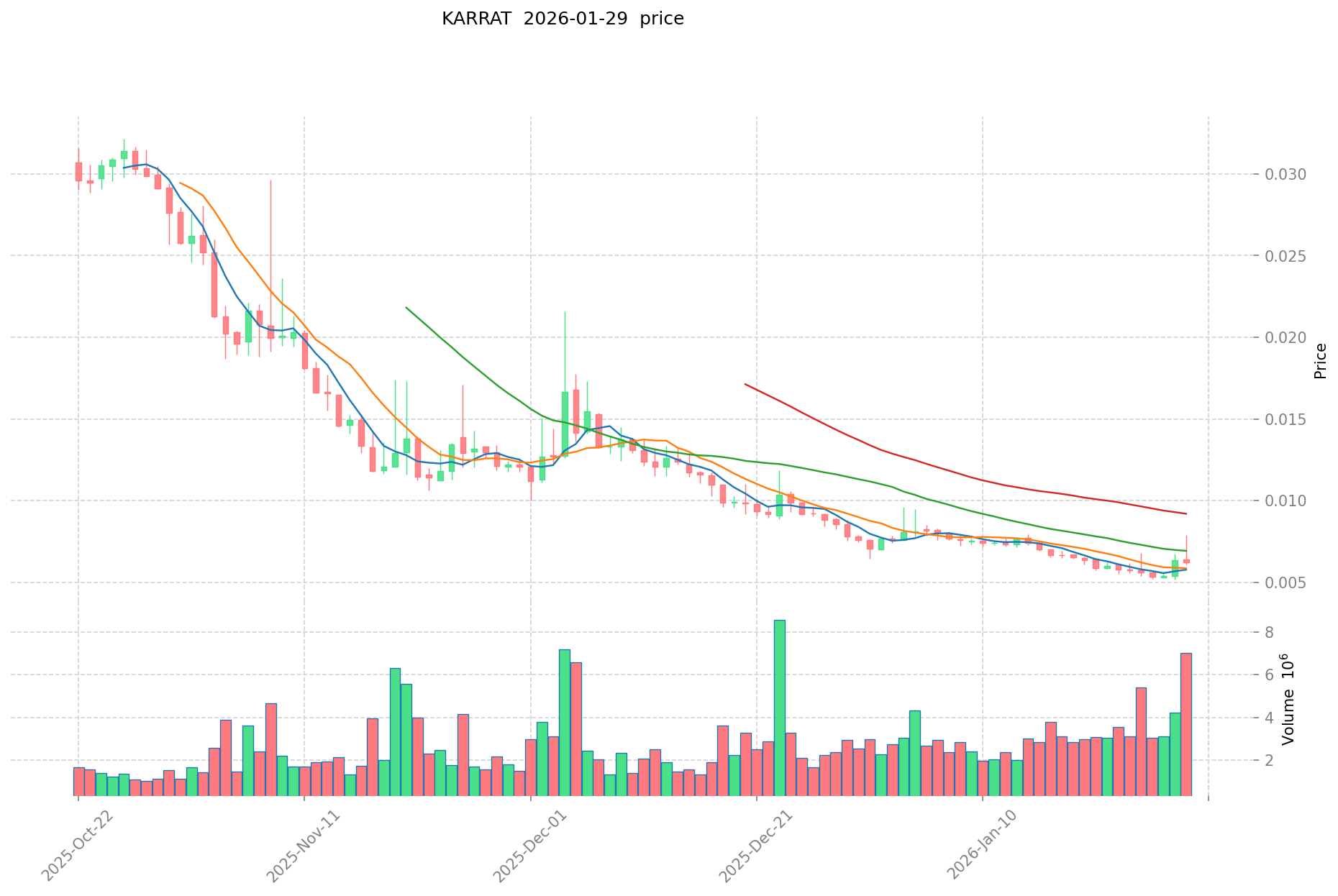
- 2026: The token has experienced considerable price adjustments, declining from higher levels to its current trading range of approximately 0.006044.
Current KARRAT Investment Market Status (January 2026)
- KARRAT current price: 0.006044
- 24-hour trading volume: 34,630.62
- Market capitalization: 4,666,563.26
- Circulating supply: 772,098,488 KARRAT (77.21% of total supply)
- Total supply: 1,000,000,000 KARRAT
- Market share: 0.00019%
- Holder count: 9,307 addresses
- Recent price changes: -12.6% (24H), +1.02% (7D), -20.48% (30D)
Click to view real-time KARRAT market price
II. Core Factors Affecting Whether KARRAT is a Good Investment
Supply Mechanism and Scarcity (KARRAT investment scarcity)
- Total Supply and Circulation → Impact on Price and Investment Value
- KARRAT has a maximum supply of 1,000,000,000 tokens, with current circulation of 772,098,488 tokens (77.21% of total supply)
- The fixed supply cap creates a potential scarcity effect that may influence long-term value dynamics
- Market Cap to Fully Diluted Valuation ratio stands at 77.21%, indicating significant portion already in circulation
- Historical Price Patterns: Supply dynamics and market conditions have contributed to notable price movements
- Price has experienced substantial fluctuation range, reflecting market response to various factors
- Current trading price of $0.006044 operates within established market parameters
- Investment Implications: Supply structure represents one consideration factor among multiple variables affecting investment decisions
Institutional Investment and Mainstream Adoption (Institutional investment in KARRAT)
- Holder Base Metrics: KARRAT currently has 9,307 token holders
- Exchange Accessibility: Listed on 5 exchanges, providing liquidity channels for participants
- Community and Governance: Supported by a decentralized community structure through KARRATco (DAO), enabling collective decision-making on protocol development
- Infrastructure Position: The protocol positions itself as a gaming infrastructure layer serving multiple industries including gaming, entertainment, and AI applications
Macroeconomic Environment Impact on KARRAT Investment
- Market Context: As of January 29, 2026, KARRAT maintains a market dominance of 0.00019%
- Price Performance Indicators:
- 1H change: +0.22%
- 24H change: -12.6%
- 7D change: +1.02%
- 30D change: -20.48%
- 1Y change: -96.8%
- External Environment: Broader cryptocurrency market conditions and regulatory developments may influence participation patterns and valuation dynamics
Technology and Ecosystem Development (Technology & Ecosystem for KARRAT investment)
- Protocol Infrastructure: KARRAT Protocol functions as a decentralized gaming infrastructure layer
- Application Scope:
- Gaming sector integration
- Entertainment applications through real-time animation for streaming content (UGC)
- AI innovation applications across retail, telecom, education sectors
- Technical Standard: Built on ERC-20 standard on Ethereum blockchain
- Ecosystem Tools: Protocol provides tools to support industry adoption and KARRAT Protocol integration
- Community-Driven Development: Future integration and advancement decisions determined through community governance mechanisms
III. KARRAT Future Investment Forecast and Price Outlook (Is Karrat(KARRAT) worth investing in 2026-2031)
Short-term Investment Forecast (2026, short-term KARRAT investment outlook)
- Conservative forecast: $0.0036 - $0.0060
- Neutral forecast: $0.0060 - $0.0070
- Optimistic forecast: $0.0070 - $0.0088
Mid-term Investment Outlook (2027-2029, mid-term Karrat(KARRAT) investment forecast)
- Market stage expectation: KARRAT may enter a gradual development phase as the gaming infrastructure layer and AI product integration advance, with price movements potentially influenced by protocol adoption rates and community governance decisions
- Investment return forecast:
- 2027: $0.0071 - $0.0087
- 2028: $0.0074 - $0.0094
- 2029: $0.0074 - $0.0092
- Key catalysts: Protocol adoption expansion in gaming and entertainment sectors, implementation of AI-driven innovations, and growth in user-generated content applications
Long-term Investment Outlook (Is KARRAT a good long-term investment?)
- Base scenario: $0.0059 - $0.0117 (assuming steady protocol development and maintained market position)
- Optimistic scenario: $0.0089 - $0.0117 (assuming accelerated adoption in gaming infrastructure and AI integration)
- Risk scenario: $0.0036 - $0.0071 (under challenging market conditions or delayed protocol implementation)
Click to view KARRAT long-term investment and price forecast: Price Prediction
2026-2031 Long-term Outlook
- Base scenario: $0.0059 - $0.0103 (corresponding to steady progress and gradual mainstream application enhancement)
- Optimistic scenario: $0.0089 - $0.0117 (corresponding to large-scale adoption and favorable market environment)
- Transformative scenario: Above $0.0117 (if ecosystem achieves breakthrough progress and mainstream popularization)
- 2031-12-31 forecast high: $0.0108 (based on optimistic development assumptions)
Disclaimer: The forecasts presented are based on historical data analysis and market trend projections. Cryptocurrency markets are highly volatile and subject to numerous unpredictable factors. These projections should not be considered as financial advice or guarantees of future performance. Investors should conduct thorough research and assess their risk tolerance before making investment decisions.
| Year |
Predicted High Price |
Predicted Average Price |
Predicted Low Price |
Price Change |
| 2026 |
0.0087551 |
0.006038 |
0.0036228 |
0 |
| 2027 |
0.0086539635 |
0.00739655 |
0.007100688 |
22 |
| 2028 |
0.0093895503975 |
0.00802525675 |
0.00738323621 |
32 |
| 2029 |
0.009229847788175 |
0.00870740357375 |
0.007401293037687 |
44 |
| 2030 |
0.011659213385251 |
0.008968625680962 |
0.005919292949435 |
48 |
| 2031 |
0.010829615509762 |
0.010313919533106 |
0.007116604477843 |
70 |
IV. KARRAT Investment Strategy and Risk Management (How to invest in KARRAT)
Investment Strategy (KARRAT investment strategy)
Long-term Holding (HODL KARRAT): This approach may be suitable for conservative investors who believe in the long-term vision of decentralized gaming infrastructure. Given KARRAT's focus on gaming, entertainment, and AI product integration, investors with conviction in the growth of blockchain-based gaming ecosystems might consider accumulating positions during market corrections. However, the token has experienced substantial volatility since its launch in April 2024, with prices declining significantly from its all-time high.
Active Trading: For traders employing technical analysis and swing trading strategies, KARRAT's price volatility presents potential opportunities. The token has shown price fluctuations across various timeframes, with recent data indicating a 1-hour gain of 0.22% and a 7-day increase of 1.02%, contrasted against a 24-hour decline of 12.6% and a 30-day drop of 20.48%. Active traders may seek to capitalize on these short-term price movements, though such strategies require continuous market monitoring and risk assessment.
Risk Management (Risk management for KARRAT investment)
Asset Allocation Ratios:
- Conservative investors: Consider limiting KARRAT exposure to a minimal percentage of overall portfolio (e.g., 1-3%)
- Moderate investors: May allocate a slightly higher percentage (3-7%) while maintaining diversification
- Experienced investors: Could consider larger allocations based on risk tolerance and market analysis
Risk Hedging Solutions: Investors might consider:
- Diversifying across multiple asset classes beyond gaming-focused tokens
- Maintaining stablecoin reserves for opportunistic accumulation during drawdowns
- Setting predetermined stop-loss levels to manage downside exposure
- Regularly rebalancing portfolio allocations based on market conditions
Secure Storage: Given KARRAT's ERC-20 token standard on Ethereum:
- Cold storage solutions: Hardware wallets supporting Ethereum-based tokens provide enhanced security for long-term holdings
- Hot wallets: Suitable for active traders requiring frequent access, though with increased security considerations
- Multi-signature wallets: For institutional or high-value holdings requiring additional security layers
V. KARRAT Investment Risks and Challenges (Risks of investing in KARRAT)
Market Risks: KARRAT has demonstrated substantial price volatility, with its current price representing a decline of approximately 96.8% from its all-time high of 1.678 reached in April 2024. The token's 24-hour trading volume and relatively limited exchange availability (listed on 5 exchanges) may contribute to liquidity constraints during periods of heightened market stress. The circulating supply of approximately 772 million tokens (77.21% of maximum supply) represents a significant portion of the total 1 billion token cap, though concentrated holdings could potentially impact price stability.
Regulatory Risks: As a gaming and AI-focused infrastructure project, KARRAT may face evolving regulatory frameworks across different jurisdictions. Gaming tokens and platforms have attracted increased regulatory scrutiny in various markets, and changes in legal interpretations regarding gaming-related cryptocurrencies could impact the project's operational scope and token utility. The decentralized nature of the protocol may present both advantages and challenges in navigating diverse regulatory environments.
Technical Risks: The KARRAT Protocol's integration of gaming, entertainment, and AI products introduces technical complexity that may present operational challenges. The protocol's reliance on real-time animation for user-generated content (UGC) and transformative AI innovations requires robust technical infrastructure. Network security considerations, smart contract vulnerabilities, and the successful execution of protocol upgrades represent ongoing technical risks that could affect token value and ecosystem functionality.
VI. Conclusion: Is KARRAT a Good Investment?
Investment Value Summary: KARRAT represents an exposure to the intersection of decentralized gaming infrastructure, entertainment, and AI applications. The protocol's focus on these emerging sectors positions it within potentially growing market segments. However, the token has experienced substantial price volatility and a significant decline from its launch price of 0.75 and all-time high. The project's success depends on the adoption of its gaming infrastructure solutions, effective community governance through the DAO structure, and the successful integration of AI-driven products across retail, telecom, and education sectors.
Investor Recommendations:
✅ Beginners: Consider dollar-cost averaging with minimal position sizes, prioritize secure wallet storage using hardware solutions compatible with ERC-20 tokens, and maintain realistic expectations regarding volatility.
✅ Experienced Investors: May explore swing trading opportunities based on technical analysis, maintain diversified positions across multiple gaming and infrastructure tokens, and actively monitor protocol developments and partnership announcements.
✅ Institutional Investors: Could consider strategic allocations as part of broader gaming and AI infrastructure exposure, conduct thorough due diligence on tokenomics and governance structures, and assess long-term viability within evolving regulatory frameworks.
⚠️ Disclaimer: Cryptocurrency investments carry substantial risk due to price volatility and market uncertainty. This content is provided for informational purposes only and does not constitute investment advice. Investors should conduct independent research and consider their financial situation before making investment decisions.
VII. FAQ
Q1: What is KARRAT and what makes it different from other gaming tokens?
KARRAT is a decentralized gaming infrastructure layer token operating on the Ethereum blockchain (ERC-20 standard) that serves gaming, entertainment, and AI sectors. Unlike many gaming tokens that focus solely on in-game economies, KARRAT positions itself as protocol-level infrastructure supporting real-time animation for user-generated content (UGC), AI innovations across retail, telecom, and education sectors, and community-driven governance through KARRATco (DAO). The protocol aims to provide foundational tools for gaming ecosystem development rather than being limited to a single game application.
Q2: How has KARRAT's price performed since its launch?
KARRAT has experienced significant price volatility since its April 2024 launch. The token initially traded at 0.75 during its offering period and reached an all-time high of 1.678 in April 2024. However, as of January 29, 2026, the current price stands at $0.006044, representing approximately a 96.8% decline from its peak. Recent performance shows mixed short-term movements: +0.22% (1H), -12.6% (24H), +1.02% (7D), -20.48% (30D), indicating continued volatility characteristic of emerging gaming infrastructure tokens.
Q3: What is KARRAT's tokenomics structure?
KARRAT has a maximum supply cap of 1,000,000,000 tokens, with a current circulating supply of 772,098,488 tokens (77.21% of total supply). This relatively high circulation rate means that most tokens are already in market circulation. The token maintains a market capitalization of approximately $4.67 million as of January 2026, with a market share of 0.00019% in the overall cryptocurrency market. The token is held by 9,307 addresses and is available on 5 exchanges, which may present liquidity considerations for larger positions.
Q4: What are the main risks associated with investing in KARRAT?
KARRAT carries several significant risk factors: (1) Market Risk - substantial historical volatility and a 96.8% decline from all-time high; (2) Liquidity Risk - relatively limited exchange availability (5 exchanges) and modest trading volume of $34,630.62 (24H) may impact execution of larger orders; (3) Technical Risk - complexity of integrating gaming, entertainment, and AI applications requires robust infrastructure and successful protocol execution; (4) Regulatory Risk - gaming tokens face evolving regulatory frameworks across jurisdictions; (5) Adoption Risk - the protocol's value depends on successful implementation and adoption of its gaming infrastructure solutions.
Q5: What price predictions exist for KARRAT through 2031?
Price forecasts for KARRAT vary based on different scenarios. For 2026, conservative estimates range from $0.0036-$0.0060, neutral forecasts suggest $0.0060-$0.0070, and optimistic projections indicate $0.0070-$0.0088. Mid-term forecasts show gradual growth potential: 2027 ($0.0071-$0.0087), 2028 ($0.0074-$0.0094), and 2029 ($0.0074-$0.0092). Long-term 2031 projections suggest a potential high of $0.0108 under optimistic development scenarios. However, these forecasts are based on historical analysis and assume favorable protocol adoption, and actual results may vary significantly due to market volatility and unpredictable factors.
Q6: How should different investor types approach KARRAT investment?
Investment strategies should align with experience level: Beginners should consider dollar-cost averaging with minimal position sizes (1-3% of portfolio), prioritize secure hardware wallet storage for ERC-20 tokens, and maintain realistic expectations about volatility. Experienced Investors may explore swing trading opportunities based on technical analysis, maintain diversification across gaming infrastructure tokens, and actively monitor protocol developments. Institutional Investors could consider strategic allocations as part of broader gaming and AI infrastructure exposure, conduct thorough due diligence on tokenomics and governance structures, and assess long-term viability within evolving regulatory frameworks. All investors should implement appropriate risk management strategies including stop-loss levels and regular portfolio rebalancing.
Q7: What factors could drive KARRAT's future value?
Several catalysts could influence KARRAT's value trajectory: (1) Protocol adoption expansion in gaming and entertainment sectors; (2) Successful implementation of AI-driven innovations across retail, telecom, and education industries; (3) Growth in user-generated content (UGC) applications utilizing real-time animation capabilities; (4) Effective community governance decisions through the DAO structure that enhance protocol utility; (5) Strategic partnerships and integrations within the gaming infrastructure ecosystem; (6) Broader cryptocurrency market conditions and institutional adoption trends. However, the materialization and timing of these factors remain uncertain, and negative developments in any area could adversely impact token value.
Q8: Where can investors purchase and store KARRAT tokens?
KARRAT is currently listed on 5 cryptocurrency exchanges, providing multiple access points for acquisition. As an ERC-20 token on the Ethereum blockchain, investors have several storage options: Hardware wallets (such as Ledger or Trezor) offer the highest security for long-term holdings by keeping private keys offline; Hot wallets (software wallets supporting Ethereum) provide convenient access for active traders but carry increased security considerations; Multi-signature wallets add additional security layers suitable for institutional or high-value holdings. Investors should research exchange reputation, compare trading fees, and prioritize security measures including two-factor authentication and secure backup of recovery phrases before making purchasing decisions.
* The information is not intended to be and does not constitute financial advice or any other recommendation of any sort offered or endorsed by Gate.