This comprehensive analysis examines whether Kaspa (KAS) represents a viable investment opportunity in 2024-2031. The article evaluates Kaspa's innovative GHOSTDAG protocol and blockDAG architecture, reviewing historical price performance, current market metrics (trading at $0.04859 with $1.30 billion market cap), and technical framework positioning. It provides detailed price predictions across multiple scenarios—conservative to optimistic—while addressing critical investment factors including supply mechanisms, macroeconomic conditions, and ecosystem development. The guide offers actionable investment strategies tailored to different investor profiles, from conservative dollar-cost averaging approaches to active trading methodologies. Comprehensive risk management frameworks address market volatility, regulatory uncertainties, and technical considerations specific to proof-of-work protocols. Ideal for investors evaluating Layer-1 blockchain exposure, this analysis balances Kaspa's technological differentiat
Introduction: Kaspa (KAS) Investment Position and Market Outlook
Kaspa (KAS) represents a notable presence in the cryptocurrency sector as a proof-of-work digital asset implementing the GHOSTDAG protocol. As of January 14, 2026, Kaspa holds a market capitalization of approximately $1.30 billion with a circulating supply of 26.78 billion tokens, trading at around $0.04859. The project distinguishes itself through its block DAG architecture, which allows parallel block creation and coexistence within consensus mechanisms. With a current market share of 0.038% and availability on 32 exchanges, Kaspa has attracted attention from over 541,000 holders. This article examines Kaspa's technical framework, historical price movements, potential future trajectories, and associated considerations for those evaluating its position in the Layer-1 blockchain landscape.
I. Kaspa (KAS) Historical Price Review and Current Investment Status
- 2022: KAS recorded its historical low price at $0.00017105 on May 26, 2022, during the broader cryptocurrency market downturn.
- 2024: On August 1, 2024, KAS reached a notable price level of $0.207411, representing a substantial appreciation from its earlier lows.
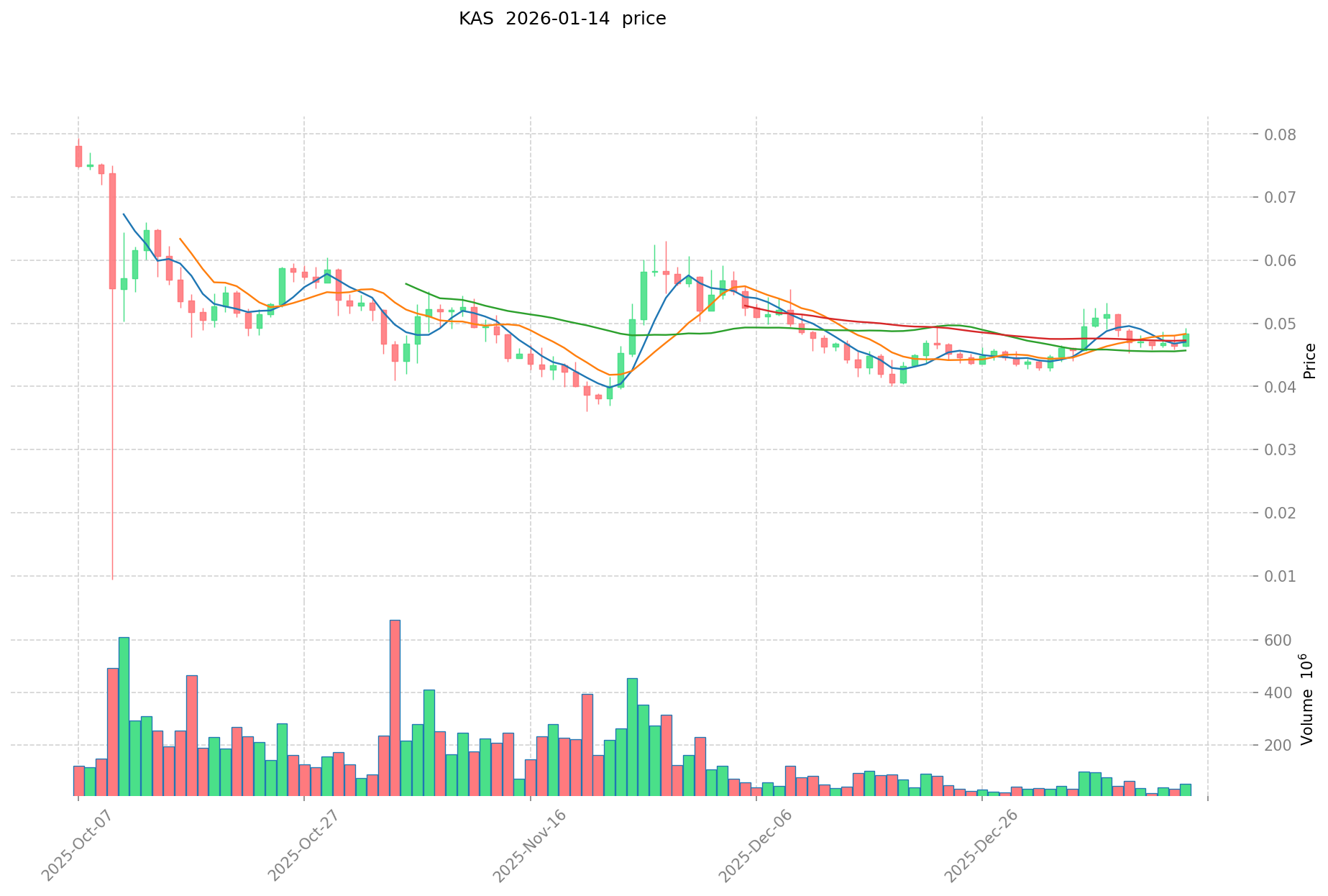
- 2025-2026: As of January 14, 2026, KAS is trading at $0.04859, reflecting a price adjustment from previous peaks.
Current KAS Investment Market Status (January 2026)
- KAS current price: $0.04859
- 24-hour price change: +4.48%
- 24-hour trading volume: approximately $2.5 million
- Market capitalization: $1.3 billion
- Circulating supply: 26.78 billion KAS (93.29% of max supply)
- Total supply: 27.11 billion KAS
- Max supply: 28.70 billion KAS
- Market cap to fully diluted valuation ratio: 93.29%
- Number of holders: 541,003
- Exchange listings: 32 exchanges
Click to view real-time KAS market price
Recent Price Trends
- 1-hour change: -0.76%
- 7-day change: -5.68%
- 30-day change: +9.51%
- 1-year change: -58.62%
- 24-hour price range: $0.04637 - $0.04927
Mining Infrastructure Development
Binance Pool introduced a zero-fee KAS mining service, providing cost-efficient mining opportunities for KAS miners during the promotional period.
II. Core Factors Affecting Whether KAS is a Good Investment
Supply Mechanism and Scarcity (KAS Investment Scarcity)
- Limited Maximum Supply: Kaspa has a maximum supply of approximately 28.7 billion KAS tokens, with current circulating supply at 26.78 billion tokens (93.29% of max supply). This fixed supply cap creates a scarcity mechanism that may support long-term value appreciation.
- Annual Halving Mechanism: Kaspa implements a unique yearly halving schedule that reduces block rewards over time. This mechanism progressively decreases new token issuance, potentially creating supply pressure that could influence price dynamics.
- Investment Significance: The combination of capped supply and systematic reduction in new token creation establishes a deflationary framework. Historical observations in cryptocurrency markets suggest that controlled supply mechanisms can contribute to long-term investment value, though market conditions and adoption rates remain critical variables.
Macroeconomic Environment Impact on KAS Investment
- Market Cycle Positioning: As of November 2025, Kaspa's price experienced correction to approximately $0.052, reflecting broader cryptocurrency market conditions. The cyclical nature of crypto markets, particularly correlation with Bitcoin's market movements, affects KAS investment outlook.
- Bitcoin Halving Influence: Kaspa's price trajectory shows sensitivity to Bitcoin's halving events and subsequent market cycles. The cumulative effect of both Bitcoin's market leadership and Kaspa's own halving schedule may create favorable conditions during bullish market phases.
- Market Volatility Considerations: Recent price volatility demonstrates the importance of risk assessment in KAS investment decisions. While the token showed gains at certain periods in 2025, overall returns remained subdued compared to previous performance levels, indicating the impact of prevailing market conditions.
Technology and Ecosystem Development (Technology & Ecosystem for KAS Investment)
- BlockDAG Architecture: Kaspa utilizes the GHOSTDAG protocol, implementing a blockDAG structure rather than traditional blockchain. This design allows parallel block creation to coexist and be ordered in consensus, potentially offering technical advantages in transaction processing.
- Layer-1 Scalability: As a Layer-1 blockchain project, Kaspa focuses on addressing challenges such as transaction speed, costs, and network congestion. The high-throughput blockDAG architecture represents a distinct technical approach within the cryptocurrency ecosystem.
- Developer Activity: The project maintains active development efforts, with ongoing technical improvements aimed at enhancing network performance. Strong developer engagement may contribute to long-term ecosystem growth and application expansion.
- Adoption Potential: Growing awareness of distributed ledger technologies across various industries creates environmental conditions that may benefit projects with innovative technical designs. Kaspa's potential to attract users and developers could influence its market presence and investment value over extended timeframes.
III. KAS Future Investment Predictions and Price Outlook (Is Kaspa(KAS) worth investing in 2026-2031)
Short-term Investment Prediction (2026, short-term KAS investment outlook)
Based on current market conditions and technical analysis, Kaspa (KAS) presents multiple scenario projections for 2026:
- Conservative prediction: $0.026 - $0.035
- Neutral prediction: $0.038 - $0.050
- Optimistic prediction: $0.055 - $0.068
The short-term outlook reflects market consolidation following recent price corrections. KAS currently trades at $0.04859, representing a recovery from recent lows while remaining substantially below its historical peak of $0.207411 recorded in August 2024. The 24-hour trading volume of approximately $2.5 million indicates moderate market activity, suggesting sustained investor interest despite broader market volatility.
Mid-term Investment Outlook (2027-2028, mid-term Kaspa(KAS) investment forecast)
-
Market stage expectation: During the 2027-2028 period, KAS may enter a gradual recovery phase as the cryptocurrency market matures and institutional participation potentially increases. The project's unique GHOSTDAG protocol and BlockDAG architecture could attract growing attention as scalability solutions gain prominence.
-
Investment return prediction:
- 2027: $0.049 - $0.061
- 2028: $0.052 - $0.064
-
Key catalysts: Technical developments in DAG technology, potential expansion of the Kaspa ecosystem, broader adoption of Layer-1 solutions, and macroeconomic factors affecting cryptocurrency markets could serve as primary drivers during this period.
Long-term Investment Outlook (Is KAS a good long-term investment?)
- Baseline scenario: $0.044 - $0.086 (assuming steady project development and moderate market conditions)
- Optimistic scenario: $0.062 - $0.099 (contingent upon significant ecosystem expansion and favorable market sentiment)
- Risk scenario: $0.026 - $0.048 (considering potential market downturns or competitive pressures)
Click to view KAS long-term investment and price prediction: Price Prediction
2026-2031 Long-term Outlook
- Base scenario: $0.045 - $0.080 (corresponding to stable progress and steady mainstream application growth)
- Optimistic scenario: $0.062 - $0.099 (corresponding to large-scale adoption and favorable market conditions)
- Transformative scenario: Above $0.10 (contingent upon breakthrough ecosystem developments and mainstream adoption)
- 2031-12-31 predicted high: $0.099 (based on optimistic development assumptions)
The circulating supply currently stands at approximately 26.78 billion KAS tokens, representing 93.29% of the maximum supply of 28.70 billion tokens. This relatively high circulation ratio suggests limited future supply pressure. However, investors should note that the token distribution shows moderate concentration, with the top five addresses holding approximately 16.95% of total supply.
Market sentiment indicators currently reflect cautious positioning, as evidenced by recent price volatility. The 7-day performance shows a decline of 5.68%, while the 30-day period demonstrates a gain of 9.51%, indicating mixed short-term momentum. Year-over-year performance reveals a significant correction of 58.62%, suggesting the asset is trading well below previous cyclical peaks.
Disclaimer: The predictions presented are analytical projections based on current market data, historical trends, and technical analysis. Cryptocurrency investments carry substantial risk, and actual prices may vary significantly from forecasts. These projections do not constitute investment advice, and investors should conduct thorough research and consider their risk tolerance before making investment decisions.
| Year |
Predicted High Price |
Predicted Average Price |
Predicted Low Price |
Price Change |
| 2026 |
0.067816 |
0.04844 |
0.0261576 |
0 |
| 2027 |
0.0610344 |
0.058128 |
0.0494088 |
19 |
| 2028 |
0.063751884 |
0.0595812 |
0.052431456 |
22 |
| 2029 |
0.0863331588 |
0.061666542 |
0.04378324482 |
26 |
| 2030 |
0.085839826464 |
0.0739998504 |
0.045139908744 |
52 |
| 2031 |
0.09910059965568 |
0.079919838432 |
0.04875110144352 |
64 |
IV. Kaspa Investment Strategy and Risk Management (How to invest in Kaspa)
Investment Methodology (Kaspa investment strategy)
Long-term Holding (HODL Kaspa)
Long-term holding represents a viable approach for conservative investors seeking exposure to Kaspa's underlying technological framework. This strategy involves acquiring KAS tokens and maintaining positions through market cycles, predicated on the assumption that the GHOSTDAG protocol and Layer-1 scalability features may drive sustained adoption over extended timeframes.
Investors employing this methodology typically focus on:
- Dollar-cost averaging to mitigate timing risk
- Periodic portfolio rebalancing based on predetermined thresholds
- Monitoring network development milestones and protocol upgrades
Active Trading
Active trading strategies for Kaspa involve leveraging technical analysis frameworks and swing trading techniques to capitalize on price movements. Given the asset's historical volatility—with recorded highs of $0.207411 (August 2024) and lows of $0.00017105 (May 2022)—traders may identify potential opportunities through:
- Chart pattern recognition and momentum indicators
- Volume analysis to assess market participation levels
- Correlation studies with broader cryptocurrency market trends
Traders should note that KAS exhibited a 24-hour volatility range of $0.04637-$0.04927 as of January 14, 2026, which may present intraday trading opportunities while simultaneously introducing execution risk.
Risk Management (Risk management for Kaspa investment)
Asset Allocation Ratios
Conservative Investors: 1-3% portfolio allocation to Kaspa, prioritizing capital preservation while maintaining limited exposure to cryptocurrency sector.
Moderate Investors: 5-10% allocation, balancing growth potential against portfolio stability through diversified holdings across multiple asset classes.
Aggressive Investors: 15-25% allocation, accepting elevated volatility in exchange for potential asymmetric returns, while maintaining sufficient liquidity reserves.
Risk Hedging Approaches
Multi-asset portfolio construction can help mitigate concentration risk:
- Diversification across Layer-1 protocols with distinct consensus mechanisms
- Inclusion of stablecoin positions to provide liquidity during market dislocations
- Consideration of derivatives instruments where available and appropriate for risk profile
Secure Storage Solutions
Cold Storage Options: Hardware wallets supporting Kaspa provide offline key management, reducing exposure to online security threats. Investors should verify wallet compatibility with KAS before transferring assets.
Hot Wallet Considerations: For active traders, exchange-based or software wallets offer convenience but introduce custodial risk. Users should implement two-factor authentication and withdrawal whitelisting where supported.
Best Practices:
- Maintain backup seed phrases in geographically distributed secure locations
- Test wallet recovery procedures with small amounts before substantial transfers
- Regularly update wallet software to incorporate security patches
V. Kaspa Investment Risks and Challenges (Risks of investing in Kaspa)
Market Risk
Price Volatility: Kaspa has demonstrated significant price fluctuations, with a one-year decline of 58.62% as of January 14, 2026. Such volatility patterns suggest investors should maintain appropriate risk tolerance levels and avoid over-leveraged positions.
Liquidity Considerations: With a 24-hour trading volume of approximately $2.50 million and listings on 32 exchanges, KAS maintains moderate liquidity. However, during periods of market stress, order book depth may deteriorate, potentially resulting in wider bid-ask spreads and slippage on larger transactions.
Market Capitalization Dynamics: At a circulating market capitalization of approximately $1.30 billion (ranking 71st), Kaspa occupies a mid-tier position within the cryptocurrency ecosystem. This positioning may result in asymmetric volatility relative to larger-cap assets during both bull and bear market cycles.
Regulatory Risk
Jurisdictional Uncertainty: Cryptocurrency regulatory frameworks continue evolving across global jurisdictions. Policy developments regarding proof-of-work consensus mechanisms, classification of digital assets, and reporting requirements may impact Kaspa's accessibility and valuation.
Compliance Considerations: Investors should monitor:
- Tax reporting obligations for cryptocurrency transactions in their respective jurisdictions
- Potential restrictions on proof-of-work protocols due to energy consumption concerns
- Exchange listing and delisting decisions influenced by regulatory compliance requirements
Technical Risk
Protocol Security: While the GHOSTDAG protocol represents a novel approach to consensus mechanism design, the relative complexity of blockDAG architecture introduces unique attack surface considerations. Network security depends on continued miner participation and protocol maintenance.
Network Upgrade Risk: Protocol modifications and network upgrades carry execution risk, including potential consensus failures, chain splits, or unintended functionality changes. Investors should monitor development activity and community governance processes.
Infrastructure Dependencies: The functionality of Kaspa's blockDAG architecture relies on sustained network operation, node infrastructure, and mining ecosystem health. Disruptions to these components could impact transaction processing and network stability.
VI. Conclusion: Is Kaspa a Good Investment?
Investment Value Summary
Kaspa presents a cryptocurrency asset characterized by innovative blockDAG architecture and GHOSTDAG consensus protocol, distinguishing it from traditional blockchain implementations. The project's focus on scalability and transaction throughput addresses known limitations in proof-of-work systems.
However, investment consideration requires acknowledging:
- Significant price volatility, with observed declines of 58.62% over the past year
- Market capitalization of approximately $1.30 billion, indicating mid-tier positioning
- Circulating supply of 26.78 billion KAS (93.29% of maximum supply), limiting future inflation impact
- Trading availability across 32 exchanges, providing moderate market access
Investor Recommendations
✅ New Investors:
- Implement dollar-cost averaging strategies to mitigate timing risk
- Utilize hardware wallet solutions for secure asset custody
- Limit initial allocation to 1-3% of total portfolio value
- Conduct thorough due diligence on GHOSTDAG protocol mechanics before investment
✅ Experienced Investors:
- Consider swing trading approaches leveraging technical analysis frameworks
- Maintain diversified cryptocurrency portfolio including multiple Layer-1 protocols
- Monitor on-chain metrics including hashrate, transaction volume, and network growth indicators
- Establish predetermined exit criteria based on risk tolerance and investment objectives
✅ Institutional Investors:
- Evaluate strategic allocation within broader digital asset portfolio context
- Assess custody solutions meeting institutional security and compliance requirements
- Consider correlation dynamics with traditional proof-of-work assets
- Monitor regulatory developments impacting proof-of-work consensus mechanisms
⚠️ Disclosure: Cryptocurrency investments involve substantial risk, including potential loss of principal. Market volatility, regulatory uncertainty, and technological risks may result in adverse investment outcomes. This analysis provides informational content only and does not constitute financial advice, investment recommendation, or solicitation. Investors should conduct independent research and consult qualified financial advisors before making investment decisions.
VII. FAQ
Q1: What makes Kaspa's technology different from traditional blockchain projects?
Kaspa implements the GHOSTDAG protocol with a blockDAG (Directed Acyclic Graph) architecture rather than a traditional linear blockchain. This fundamental design allows parallel block creation to coexist and be ordered in consensus, potentially offering advantages in transaction processing speed and scalability. Unlike conventional proof-of-work blockchains that discard competing blocks, Kaspa's structure incorporates them into the consensus mechanism, which may result in higher throughput and more efficient network utilization.
Q2: Is Kaspa suitable for long-term investment in 2026?
Kaspa presents characteristics that may appeal to certain long-term investors, including a fixed maximum supply of 28.70 billion tokens (with 93.29% already in circulation), an annual halving mechanism that progressively reduces new token issuance, and innovative Layer-1 technology. However, investors should note the significant price volatility, with a 58.62% decline over the past year. Long-term suitability depends on individual risk tolerance, portfolio diversification strategy, and belief in the project's technological differentiation. Conservative investors might consider allocating 1-3% of their portfolio, while more aggressive investors could consider 15-25%, always maintaining appropriate risk management practices.
Q3: What are the main risks associated with investing in Kaspa?
The primary risks include substantial price volatility (demonstrated by the historical range from $0.00017105 to $0.207411), moderate liquidity with approximately $2.50 million in 24-hour trading volume, regulatory uncertainty affecting proof-of-work cryptocurrencies, and technical risks inherent in novel blockDAG architecture. Additionally, Kaspa's mid-tier market capitalization of $1.30 billion may result in asymmetric volatility during market cycles. Investors should implement proper risk management strategies, including diversification, secure storage solutions, and position sizing appropriate to their risk tolerance.
Q4: How does Kaspa's supply mechanism affect its investment potential?
Kaspa's supply mechanism features three key elements: a maximum supply cap of 28.70 billion tokens, current circulating supply at 26.78 billion (93.29% of max supply), and an annual halving schedule that systematically reduces block rewards. This creates a deflationary framework with limited future supply pressure, as only 6.71% of maximum supply remains to be issued. The combination of controlled supply and decreasing issuance rate establishes scarcity mechanics that, historically in cryptocurrency markets, have contributed to long-term value appreciation, though market conditions and adoption rates remain critical variables.
Q5: What investment strategies are recommended for Kaspa?
Investment strategies vary by investor profile: Conservative investors may employ dollar-cost averaging with 1-3% portfolio allocation and cold storage solutions. Moderate investors might consider 5-10% allocation with periodic rebalancing based on network development milestones. Aggressive traders could utilize technical analysis frameworks for swing trading opportunities, leveraging Kaspa's historical volatility while maintaining 15-25% allocation. All investors should implement proper security measures including hardware wallet storage, two-factor authentication, and diversification across multiple Layer-1 protocols to mitigate concentration risk.
Q6: How does Kaspa's price performance compare to market expectations?
As of January 14, 2026, Kaspa trades at $0.04859, significantly below its August 2024 peak of $0.207411, representing a substantial correction. Short-term predictions suggest a range of $0.026-$0.068 for 2026, depending on market conditions. Mid-term forecasts (2027-2028) anticipate gradual recovery to $0.049-$0.064, while long-term projections (2031) reach up to $0.099 under optimistic scenarios. However, these predictions remain subject to considerable uncertainty given cryptocurrency market volatility, technological developments, and macroeconomic factors. The 30-day price gain of 9.51% contrasts with the one-year decline of 58.62%, indicating mixed momentum and the importance of managing expectations.
Q7: What factors could drive Kaspa's future price appreciation?
Potential catalysts include: increased adoption of the GHOSTDAG protocol and blockDAG technology, expansion of the Kaspa ecosystem with new applications and developer activity, broader institutional acceptance of Layer-1 scalability solutions, Bitcoin halving cycles and associated cryptocurrency market momentum, and successful network upgrades enhancing functionality. Additionally, the systematic reduction in token issuance through annual halving events creates supply pressure that may support price appreciation. However, actual outcomes depend on execution of development roadmap, competitive positioning against other Layer-1 projects, regulatory environment evolution, and overall cryptocurrency market conditions.
Q8: Where can investors securely purchase and store Kaspa?
Kaspa is available on 32 exchanges, providing multiple purchasing options with varying liquidity levels. For secure storage, investors should consider: hardware wallets supporting KAS for offline key management (reducing exposure to online security threats), software wallets for active trading with two-factor authentication enabled, or exchange-based custody for short-term holdings (acknowledging custodial risk). Best practices include maintaining backup seed phrases in geographically distributed secure locations, testing wallet recovery procedures with small amounts before substantial transfers, verifying wallet compatibility with Kaspa before asset transfer, and regularly updating wallet software to incorporate security patches. Investors should avoid keeping large amounts on exchanges long-term due to counterparty risk.
* The information is not intended to be and does not constitute financial advice or any other recommendation of any sort offered or endorsed by Gate.