This comprehensive analysis examines whether KernelDAO (KERNEL) represents a viable investment opportunity in 2024-2031. The article evaluates KERNEL's market position, current valuation at $0.07447 USD with $12.09 million market cap, and historical performance since its April 2025 launch. It analyzes core investment factors including the token's restaking infrastructure across Ethereum and BNB Chain, $2+ billion total value locked across 10 chains, and partnerships with 50+ DeFi protocols. The analysis provides detailed price forecasts ranging from conservative to optimistic scenarios through 2031, alongside practical investment strategies for different investor profiles and comprehensive risk management frameworks. Key sections address market volatility, regulatory uncertainty, technical vulnerabilities, and asset allocation recommendations. Suitable for investors evaluating KERNEL's restaking ecosystem exposure and seeking actionable investment guidance on Gate exchange.
Introduction: KernelDao (KERNEL) Investment Position and Market Prospects
KERNEL is an important asset in the cryptocurrency field. As of January 2026, KERNEL maintains a market capitalization of approximately 12.09 million USD, with a circulating supply of around 162.32 million tokens, and the current price stands at approximately 0.07447 USD. The token ranks 1112 in the overall cryptocurrency market, with a market dominance of 0.0023%. With its positioning in the restaking ecosystem across Ethereum and BNB Chain, featuring products spanning restaking and automated vault strategies, KERNEL has gradually become a focal point when investors discuss "Is KernelDao (KERNEL) a good investment?" The project reports over 2 billion USD in TVL locked across 10 chains, with partnerships involving over 50 DeFi platforms and more than 30 projects building within the Kernel ecosystem. This article will comprehensively analyze KERNEL's investment value, historical trends, future price predictions, and investment risks to provide reference for investors.
I. KERNEL Token Price History Review and Current Investment Value
- 2025 Q2: Token launched in April 2025, initially trading around $0.50 → Early investors experienced significant volatility in the nascent market phase
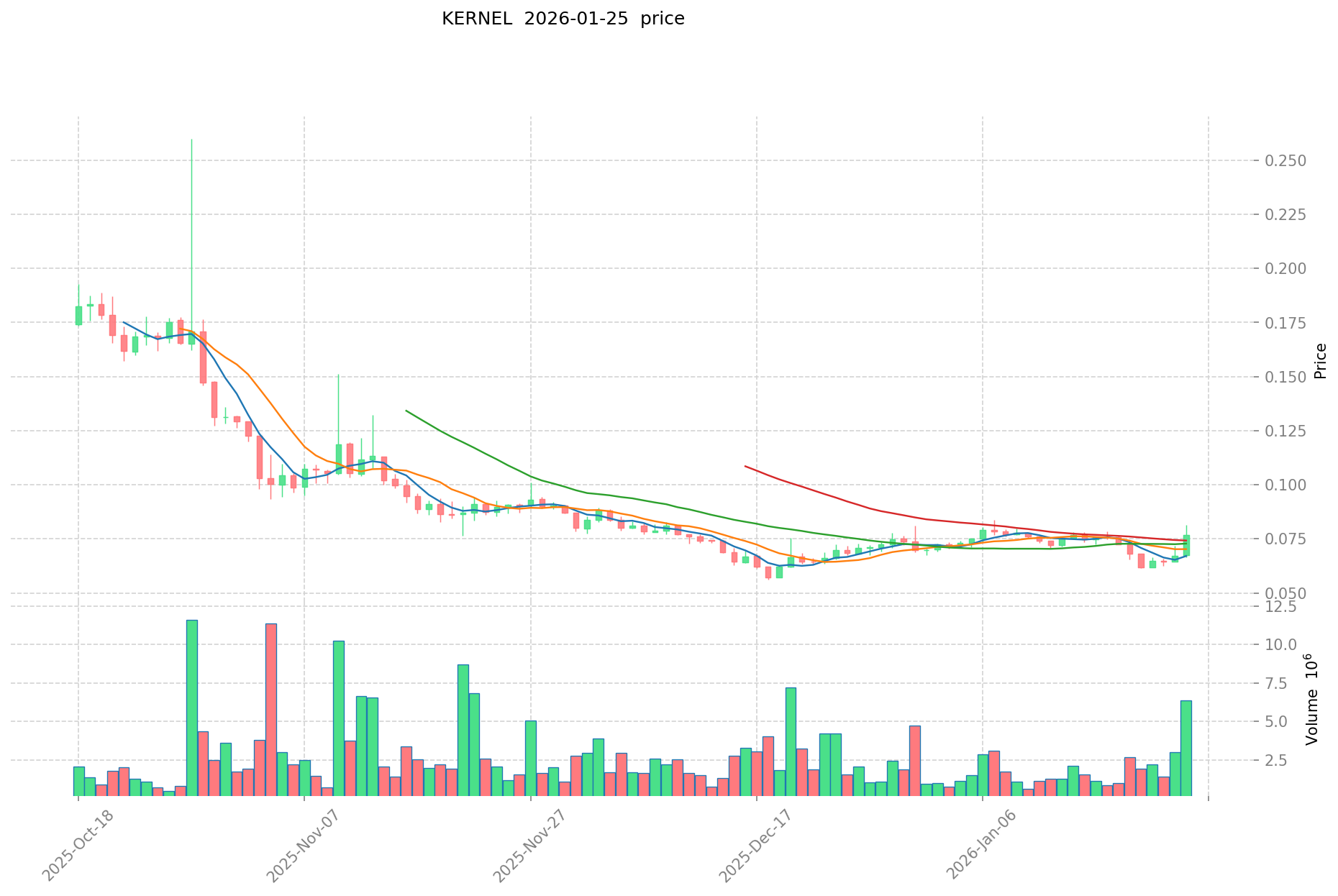
- 2025 Q4: Market correction phase → KERNEL price declined from higher levels to approximately $0.056 during the December period
- 2026 Q1: Recovery momentum observed → Price recovered to approximately $0.074 range, showing a moderate upward trend of about 7% over the 30-day period
Current KERNEL Investment Market Status (January 2026)
- KERNEL current price: $0.07447
- 24-hour trading volume: $465,994.40
- Circulating supply: 162,317,496 KERNEL (16.23% of total supply)
- Market capitalization: approximately $12.09 million
- Fully diluted valuation: $74.47 million
- Token holders: 13,192 addresses
- Listed on 32 cryptocurrency exchanges
Click to view real-time KERNEL market price
II. Core Factors Affecting Whether KERNEL is a Good Investment (Is KernelDAO(KERNEL) a Good Investment)
Supply Mechanism and Scarcity (KERNEL investment scarcity)
- Maximum supply capped at 1,000,000,000 KERNEL tokens → influences price dynamics and investment value
- Current circulating supply represents approximately 16.23% of total supply → potential for future supply expansion
- Investment significance: supply structure and release schedule are key considerations for long-term investment positioning
Institutional Investment and Mainstream Adoption (Institutional investment in KERNEL)
- Ecosystem partnerships: Over 50 DeFi partners and 30+ projects building within the Kernel ecosystem → enhances network effects and adoption potential
- Total Value Locked (TVL) exceeds 2 billion across 10 blockchain networks → indicates substantial institutional and user participation
- Multi-chain presence on Ethereum and BNB Chain → expands market reach and accessibility for diverse investor bases
Macroeconomic Environment's Impact on KERNEL Investment
- Broader cryptocurrency market conditions influence KERNEL's investment attractiveness, particularly given its 0.0023% market share
- Restaking sector growth trends may affect demand for KERNEL ecosystem services
- Market volatility considerations: 24-hour price fluctuation range of 0.07299 to 0.08441 reflects active trading dynamics
Technology and Ecosystem Development (Technology & Ecosystem for KERNEL investment)
- Restaking infrastructure: Enables shared security model for ETH, BTC, and BNB assets → creates utility-driven value proposition
- Automated vault strategies: Smart contract systems facilitate secure asset management and efficient reward distribution → supports user engagement
- Cross-chain integration across 10 blockchain networks → diversifies technological foundation and reduces single-chain dependency risks
- DeFi ecosystem participation through 50+ partnerships → expands use cases and potential revenue streams for the protocol
III. KERNEL Future Investment Forecast and Price Outlook (Is KernelDao(KERNEL) worth investing in 2026-2031)
Short-term Investment Forecast (2026, short-term KERNEL investment outlook)
- Conservative forecast: $0.0393 - $0.0745
- Neutral forecast: $0.0745 - $0.0850
- Optimistic forecast: $0.0850 - $0.0957
Mid-term Investment Outlook (2027-2029, mid-term KernelDao(KERNEL) investment forecast)
-
Market stage expectation: The restaking ecosystem may experience gradual growth as DeFi partnerships expand and integration across multiple chains deepens. The project's focus on shared security and automated vault strategies could attract increased participation from institutional and retail investors seeking yield optimization solutions.
-
Investment return forecast:
- 2027: $0.0543 - $0.0934
- 2028: $0.0749 - $0.1186
- 2029: $0.0904 - $0.1381
-
Key catalysts: Expansion of TVL across supported chains, strategic partnerships with additional DeFi protocols, technical upgrades to smart contract systems, broader adoption of restaking mechanisms in the Ethereum and BNB Chain ecosystems, and potential integration with emerging Layer 2 solutions.
Long-term Investment Outlook (Is KERNEL a good long-term investment?)
- Baseline scenario: $0.0835 - $0.1549 (assumes steady ecosystem development and moderate market conditions)
- Optimistic scenario: $0.1379 - $0.1903 (assumes accelerated adoption of restaking solutions and favorable regulatory environment)
- Risk scenario: Below $0.0560 (potential scenarios include intensified competition, security vulnerabilities, or adverse market downturns)
Click to view KERNEL long-term investment and price prediction: Price Prediction
2026-01-25 - 2031 Long-term Outlook
- Baseline scenario: $0.0835 - $0.1549 (corresponds to steady progress and gradual mainstream application growth)
- Optimistic scenario: $0.1379 - $0.1903 (corresponds to large-scale adoption and favorable market environment)
- Transformative scenario: Above $0.1903 (if the ecosystem achieves breakthrough developments and mainstream adoption)
- 2031-12-31 predicted high: $0.1903 (based on optimistic development assumptions)
Disclaimer: This analysis is for informational purposes only and does not constitute investment advice. Cryptocurrency markets are highly volatile and past performance does not guarantee future results. Investors should conduct their own research and consider their risk tolerance before making investment decisions.
| Year |
Predicted High Price |
Predicted Average Price |
Predicted Low Price |
Price Change |
| 2026 |
0.0956535 |
0.07415 |
0.0392995 |
0 |
| 2027 |
0.093391925 |
0.08490175 |
0.05433712 |
14 |
| 2028 |
0.118565293875 |
0.0891468375 |
0.0748833435 |
20 |
| 2029 |
0.138128567364375 |
0.1038560656875 |
0.090354777148125 |
39 |
| 2030 |
0.1548701651532 |
0.120992316525937 |
0.083484698402896 |
62 |
| 2031 |
0.190345112358604 |
0.137931240839568 |
0.092413931362511 |
85 |
IV. KERNEL Investment Strategy and Risk Management (How to invest in KernelDAO)
Investment Strategy (KERNEL investment strategy)
Long-term Holding (HODL KERNEL): Suitable for Conservative Investors
For investors seeking steady exposure to the restaking ecosystem, a long-term holding strategy may be considered. KernelDAO operates across Ethereum and BNB Chain with products spanning restaking and automated vault strategies. With a circulating supply of 162,317,496 KERNEL tokens (16.23% of total supply) and a market capitalization of approximately $12.09 million as of January 25, 2026, the token has experienced significant price fluctuations since its launch in April 2025.
The platform reports over $2 billion in Total Value Locked (TVL) across 10 chains, with partnerships involving 50+ DeFi protocols and 30+ projects building within its ecosystem. Long-term investors may focus on the development of the restaking infrastructure and adoption metrics rather than short-term price movements.
Active Trading: Technical Analysis and Swing Operations
Active traders may leverage technical analysis to navigate KERNEL's price volatility. The token has shown considerable price swings, ranging from a historical low of $0.05612 (December 18, 2025) to a historical high of $0.4998 (April 14, 2025). As of January 25, 2026, KERNEL trades at $0.07447, representing a 79.75% decline from its all-time high over the past year.
Recent price performance indicates:
- 1-hour change: -1.79%
- 24-hour change: -2.44%
- 7-day change: -0.55%
- 30-day change: +7.01%
The 24-hour trading range of $0.07299 to $0.08441 demonstrates intraday volatility that may present opportunities for swing traders. Daily trading volume stands at approximately $466,000, which traders should consider when assessing liquidity and execution capabilities.
Risk Management (Risk management for KERNEL investment)
Asset Allocation Ratios: Conservative / Aggressive / Professional Investors
- Conservative Investors: May consider limiting KERNEL allocation to 1-3% of crypto portfolio, given the token's early-stage nature and significant price volatility.
- Aggressive Investors: Could allocate 5-10% of crypto holdings, acknowledging the potential upside from ecosystem growth while accepting elevated risk.
- Professional Investors: May employ dynamic allocation strategies based on technical indicators, ecosystem metrics (TVL growth, partnership developments), and market conditions, potentially ranging from 3-15% depending on risk tolerance and conviction.
Risk Hedging Solutions: Multi-asset Portfolio + Risk Management Tools
Investors should consider diversification across:
- Multiple blockchain ecosystems (not concentrating solely in Ethereum/BNB Chain projects)
- Different crypto asset categories (Layer 1s, DeFi protocols, stablecoins)
- Traditional hedging instruments where available
Given KERNEL's correlation with broader DeFi and restaking trends, portfolio construction should account for systemic risks affecting the entire sector.
Secure Storage: Hot/Cold Wallets + Hardware Wallet Recommendations
KERNEL is an ERC-20 token deployed on Ethereum (contract address: 0x3f80b1c54ae920be41a77f8b902259d48cf24ccf). Storage options include:
- Cold Storage: Hardware wallets supporting ERC-20 tokens for long-term holdings
- Hot Wallets: MetaMask, Trust Wallet, or other Ethereum-compatible wallets for active trading
- Exchange Custody: Available on 32 exchanges, though long-term storage on exchanges carries counterparty risk
Investors should verify contract addresses through official channels (https://etherscan.io/token/0x3f80b1c54ae920be41a77f8b902259d48cf24ccf) before any transactions to avoid phishing schemes.
V. KERNEL Investment Risks and Challenges (Risks of investing in KernelDAO)
Market Risk: High Volatility and Price Dynamics
KERNEL exhibits substantial price volatility characteristic of emerging DeFi tokens. The 85.11% decline from all-time high to all-time low within an eight-month period demonstrates significant downside risk. With a current market capitalization of $12.09 million and fully diluted valuation of $74.47 million, the token represents a relatively small-cap asset with associated liquidity constraints.
The token's 24-hour trading volume of approximately $466,000 suggests moderate liquidity that may impact large orders. Market capitalization represents only 0.0023% of the total crypto market, indicating limited market depth and potential susceptibility to volatility during broader market movements.
Regulatory Risk: Policy Uncertainty Across Jurisdictions
As a restaking protocol operating across multiple chains, KernelDAO may face regulatory scrutiny related to:
- Classification of staking and restaking activities under securities laws
- Cross-chain operations and compliance requirements across different jurisdictions
- Evolving DeFi regulations in major markets including the United States, European Union, and Asia
The regulatory landscape for restaking protocols remains in development, and future policy changes could impact the protocol's operations, token utility, or market access.
Technical Risk: Network Security and Protocol Vulnerabilities
KernelDAO's infrastructure involves complex smart contract systems for asset management and reward distribution across 10 chains. Potential technical risks include:
- Smart contract vulnerabilities that could affect locked assets (reported $2+ billion TVL)
- Cross-chain bridge security risks when operating across multiple blockchain networks
- Protocol upgrade risks and potential governance challenges
- Dependency on underlying blockchain security (Ethereum and BNB Chain)
With 13,192 token holders, the protocol has a relatively concentrated user base, which may indicate early-stage adoption risks.
VI. Conclusion: Is KernelDAO a Good Investment?
Investment Value Summary
KERNEL represents exposure to the developing restaking ecosystem on Ethereum and BNB Chain, with infrastructure supporting over $2 billion in TVL across 10 chains. The token has experienced substantial price volatility, declining 79.75% from its April 2025 all-time high, while showing a 7.01% recovery over the past 30 days as of January 25, 2026.
The project's integration with 50+ DeFi partners and 30+ ecosystem projects suggests growing infrastructure adoption. However, with only 16.23% of tokens in circulation and significant price fluctuations, investors should carefully assess their risk tolerance before allocation.
Investor Recommendations
✅ Beginners: Consider dollar-cost averaging with small allocations (1-2% of crypto portfolio) and secure storage in hardware wallets supporting ERC-20 tokens. Prioritize understanding restaking mechanics and ecosystem developments before investing.
✅ Experienced Investors: May employ swing trading strategies leveraging technical analysis, given recent volatility patterns. Portfolio allocation of 3-7% could be considered with active risk management and stop-loss protocols.
✅ Institutional Investors: Strategic allocation may focus on ecosystem growth metrics (TVL trends, partnership developments, cross-chain expansion) rather than short-term price movements. Due diligence should include smart contract audits, team credentials, and regulatory compliance assessment.
⚠️ Disclaimer: Cryptocurrency investments carry substantial risk, including potential loss of principal. This analysis is provided for informational purposes only and does not constitute financial, investment, or legal advice. Investors should conduct independent research and consult qualified financial advisors before making investment decisions. Past performance does not guarantee future results.
VII. FAQ
Q1: What is the current market status of KERNEL and is it a good entry point for investment?
As of January 25, 2026, KERNEL trades at $0.07447 with a market capitalization of approximately $12.09 million. The token has declined 79.75% from its April 2025 all-time high of $0.4998 but has shown a 7.01% recovery over the past 30 days. With only 16.23% of total supply in circulation (162,317,496 tokens) and $466,000 in daily trading volume, KERNEL remains a relatively small-cap asset with moderate liquidity. Conservative investors may consider gradual accumulation through dollar-cost averaging, allocating 1-3% of crypto portfolio, while recognizing the substantial volatility risk inherent in early-stage DeFi tokens.
Q2: What are the key technological advantages that distinguish KERNEL's investment proposition?
KERNEL operates a restaking infrastructure across Ethereum and BNB Chain, enabling shared security models for ETH, BTC, and BNB assets. The platform reports over $2 billion in Total Value Locked (TVL) across 10 blockchain networks, with automated vault strategies facilitating secure asset management through smart contract systems. The project's integration with 50+ DeFi protocols and 30+ ecosystem projects demonstrates growing adoption. However, investors should recognize that these technological capabilities also introduce technical risks, including smart contract vulnerabilities, cross-chain bridge security concerns, and dependencies on underlying blockchain security.
Q3: What price range can investors expect for KERNEL in 2026-2031?
Short-term forecasts for 2026 range from a conservative $0.0393-$0.0745 to an optimistic $0.0850-$0.0957. Mid-term projections show potential growth: 2027 ($0.0543-$0.0934), 2028 ($0.0749-$0.1186), and 2029 ($0.0904-$0.1381). Long-term outlook for 2031 suggests a baseline scenario of $0.0835-$0.1549, with an optimistic scenario reaching $0.1379-$0.1903. These projections assume steady ecosystem development, expanded TVL across supported chains, and favorable market conditions. However, cryptocurrency markets remain highly volatile, and actual prices may vary significantly from these forecasts based on adoption rates, regulatory developments, and competitive landscape changes.
Q4: What are the primary risks associated with investing in KERNEL?
KERNEL investment carries three major risk categories: (I) Market Risk - substantial price volatility demonstrated by the 85.11% decline from all-time high to all-time low, limited market depth with $12.09 million market cap representing only 0.0023% of total crypto market, and liquidity constraints with $466,000 daily trading volume; (II) Regulatory Risk - uncertain classification of restaking activities under securities laws, evolving cross-chain compliance requirements, and developing DeFi regulations across major jurisdictions; (III) Technical Risk - smart contract vulnerabilities affecting the reported $2+ billion TVL, cross-chain bridge security concerns, and protocol upgrade challenges affecting 13,192 token holders.
Q5: How should different investor types approach KERNEL allocation?
Conservative investors should limit KERNEL to 1-3% of crypto portfolio, utilizing hardware wallets for secure ERC-20 token storage and focusing on long-term ecosystem development rather than short-term price movements. Aggressive investors may allocate 5-10% of holdings, employing swing trading strategies based on technical analysis of the $0.07299-$0.08441 daily range and recent volatility patterns. Professional investors could implement dynamic allocation strategies (3-15% range) based on ecosystem metrics including TVL growth, partnership developments across the 50+ DeFi protocols, and cross-chain expansion progress. All investor types should verify the official contract address (0x3f80b1c54ae920be41a77f8b902259d48cf24ccf) through Etherscan and diversify across multiple blockchain ecosystems to mitigate concentration risk.
Q6: What factors could drive KERNEL's price appreciation in the coming years?
Key catalysts for potential price growth include: expansion of TVL beyond the current $2+ billion across additional blockchain networks, strategic partnerships with major DeFi protocols beyond the existing 50+ collaborations, technical upgrades to smart contract systems enhancing security and efficiency, broader adoption of restaking mechanisms within Ethereum and BNB Chain ecosystems, and integration with emerging Layer 2 solutions. The project's current circulating supply of 16.23% suggests significant future supply expansion potential, which investors should monitor. Market conditions in the broader restaking sector and DeFi landscape will also influence price dynamics, as KERNEL's 0.0023% market dominance indicates sensitivity to category-wide trends.
Q7: Is KERNEL suitable as a long-term hold, and what metrics should investors monitor?
KERNEL may be considered for long-term holding by investors seeking exposure to the restaking ecosystem, provided they accept the elevated risk profile of an early-stage protocol. Key monitoring metrics include: TVL growth across the 10 supported chains, expansion of the 13,192 token holder base indicating adoption trends, partnership announcements beyond current 50+ DeFi collaborations, smart contract audit results and security developments, token unlock schedules affecting the 83.77% of supply not yet in circulation, and regulatory developments impacting restaking protocols. Investors should track quarterly updates on ecosystem projects (currently 30+) building within the Kernel infrastructure and assess whether the fully diluted valuation of $74.47 million reflects fair value relative to comparable protocols. Long-term holders should employ secure storage solutions and maintain diversification across different crypto asset categories.
* The information is not intended to be and does not constitute financial advice or any other recommendation of any sort offered or endorsed by Gate.