This comprehensive guide evaluates whether Klever (KLV) represents a viable investment opportunity in the cryptocurrency market as of January 2026. Trading at $0.001565 with a $14.13 million market capitalization, KLV addresses security and user experience challenges in the crypto space. The article examines historical price trends, current market status, and core investment factors including supply mechanics, institutional adoption, and technology development. Short-term price forecasts range from $0.00132 to $0.00200, with long-term scenarios reaching $0.00316 by 2031 under optimistic conditions. However, investors must carefully consider significant risks including extreme volatility (38.3% annual decline), limited liquidity across 4 exchanges, and competitive pressures. The analysis recommends conservative position sizing (1-3% of crypto portfolio for beginners) and disciplined risk management strategies to navigate this speculative asset class.
Introduction: Klever (KLV) Investment Position and Market Outlook
KLV represents a notable asset in the cryptocurrency sector, having been launched in 2020 with a focus on addressing security and user experience challenges within the crypto space. As of January 25, 2026, Klever maintains a market capitalization of approximately $14.13 million, with a circulating supply of around 9.03 billion tokens and a current trading price near $0.001565. Positioned as a cryptocurrency platform that serves as a bridge between traditional currency and the crypto world through simple and secure transaction methods, KLV has attracted attention from participants evaluating "Is Klever (KLV) a good investment?" This article examines KLV's investment characteristics, historical price movements, future price considerations, and associated risks to provide reference material for market observers.
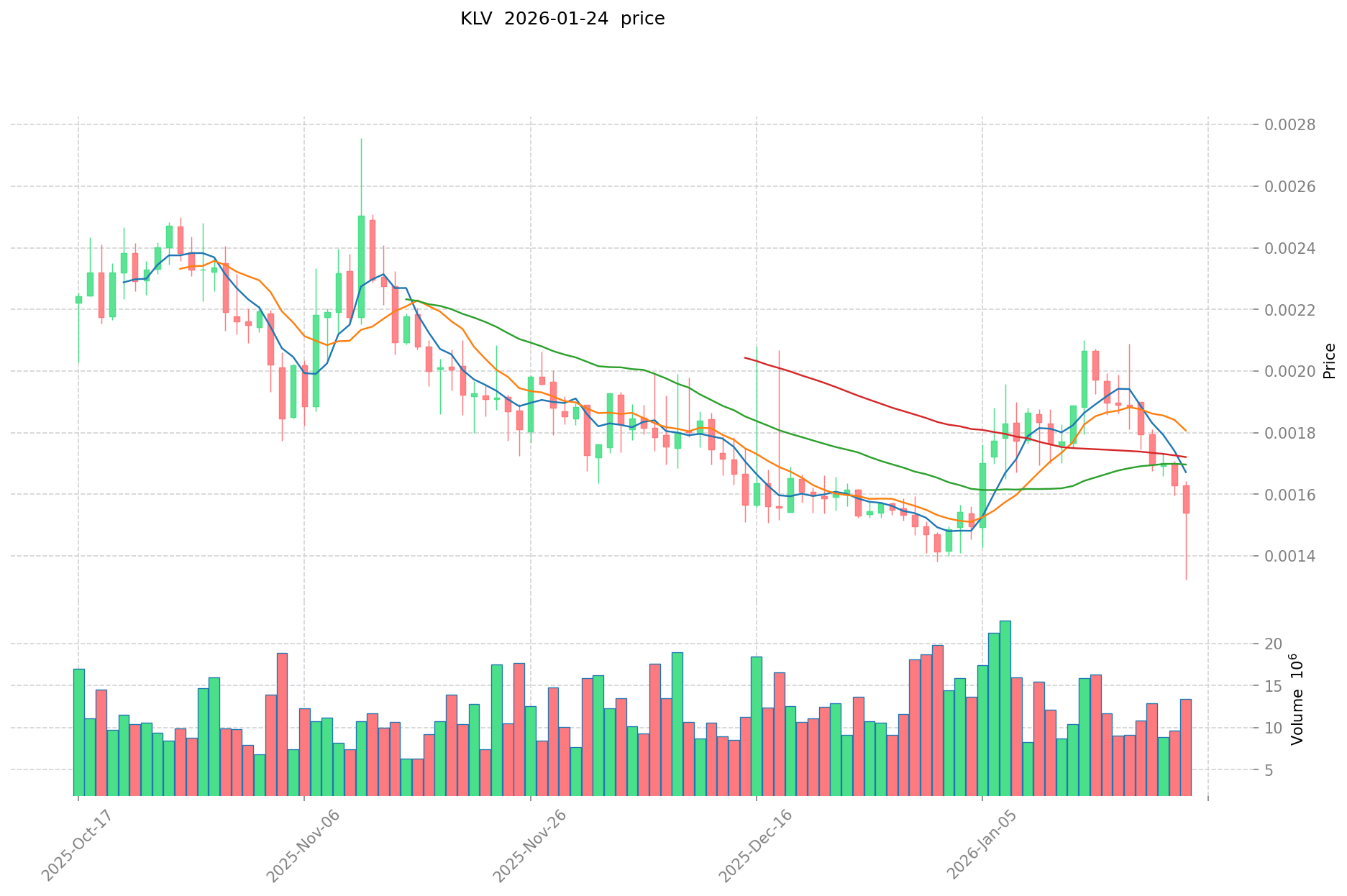
I. KLV Price History Review and Current Investment Value
- 2021: Price activity during early market phase → KLV reached 0.166705 on March 11, 2021
- 2026: Recent market fluctuation → KLV traded at 0.00141215 on January 2, 2026
- Market cycle observation → Price movement from higher levels to lower ranges over the multi-year period
Current KLV Investment Market Status (January 2026)
- KLV current price: 0.001565 USD
- 24-hour trading volume: 20,837.34 USD
- Market capitalization: 14,126,623.52 USD
- Circulating supply: 9,026,596,500.11 KLV
- Market dominance: 0.00044%
Click to view real-time KLV market price
II. Core Factors Affecting Whether KLV is a Good Investment (Is Klever(KLV) a Good Investment)
Supply Mechanism and Scarcity (KLV investment scarcity)
- Maximum supply capped at 10,000,000,000 KLV with current circulating supply of approximately 9,026,596,500 tokens → influences price dynamics and investment value
- The circulating supply represents approximately 90.27% of the maximum supply, indicating a relatively high circulation ratio
- Investment significance: the defined supply cap provides a framework for evaluating potential scarcity characteristics
Institutional Investment and Mainstream Adoption (Institutional investment in KLV)
- The token has a holder base of approximately 176,842 addresses
- Current trading availability across 4 exchanges may indicate the level of market accessibility
- Market capitalization to fully diluted valuation ratio stands at 90.27%, reflecting the relationship between current and potential market value
Macroeconomic Environment's Impact on KLV Investment
- Monetary policy shifts and interest rate adjustments may influence the attractiveness of cryptocurrency investments including KLV
- Market volatility indicators: 24-hour price fluctuation range between $0.001323 and $0.00163
- Broader economic uncertainty factors could affect investor sentiment toward digital asset allocations
Technology and Ecosystem Development (Technology & Ecosystem for KLV investment)
- Klever platform aims to address security and user experience challenges in the cryptocurrency space
- The platform positions itself as a bridge connecting traditional currency systems with the crypto ecosystem through simplified transaction processes
- Fee-sharing mechanism provides potential utility value through swap transaction rebates
III. KLV Future Investment Forecast and Price Outlook (Is Klever(KLV) worth investing in 2026-2031)
Short-term Investment Forecast (2026, short-term KLV investment outlook)
- Conservative forecast: $0.00132 - $0.00157
- Neutral forecast: $0.00157 - $0.00188
- Optimistic forecast: $0.00188 - $0.00200
Mid-term Investment Outlook (2027-2029, mid-term Klever(KLV) investment forecast)
-
Market stage expectation: During 2027-2029, KLV may experience gradual recovery phases, with potential price fluctuations influenced by broader cryptocurrency market sentiment and platform development progress.
-
Investment return forecast:
- 2027: $0.00131 - $0.00223
- 2028: $0.00164 - $0.00204
- 2029: $0.00124 - $0.00251
-
Key catalysts: Platform user experience improvements, security enhancements, expansion of cryptocurrency transaction functionalities, and potential partnerships within the crypto ecosystem.
Long-term Investment Outlook (Is KLV a good long-term investment?)
- Base scenario: $0.00194 - $0.00232 (assuming steady platform development and moderate market conditions)
- Optimistic scenario: $0.00229 - $0.00316 (assuming increased adoption, favorable regulatory environment, and successful ecosystem expansion)
- Risk scenario: $0.00124 - $0.00164 (considering potential market downturns or competitive pressures)
View KLV long-term investment and price forecast: Price Prediction
2026-01-25 - 2031 Long-term Outlook
- Base scenario: $0.00194 - $0.00232 USD (corresponding to stable progress and gradual mainstream application improvement)
- Optimistic scenario: $0.00229 - $0.00316 USD (corresponding to large-scale adoption and favorable market environment)
- Transformative scenario: Above $0.00316 USD (such as breakthrough ecosystem progress and mainstream popularization)
- 2031-12-31 forecast high: $0.00316 USD (based on optimistic development assumptions)
Disclaimer: This forecast is for informational purposes only and should not be considered as financial advice. Cryptocurrency investments carry significant risks, and past performance does not guarantee future results. Investors should conduct their own research and consult with financial professionals before making investment decisions.
| Year |
Predicted High Price |
Predicted Average Price |
Predicted Low Price |
Price Change |
| 2026 |
0.0018828 |
0.001569 |
0.00131796 |
0 |
| 2027 |
0.002226411 |
0.0017259 |
0.001311684 |
10 |
| 2028 |
0.002035440165 |
0.0019761555 |
0.001640209065 |
26 |
| 2029 |
0.002507247290625 |
0.0020057978325 |
0.00124359465615 |
28 |
| 2030 |
0.002324218238409 |
0.002256522561562 |
0.001940609402943 |
44 |
| 2031 |
0.00316071115198 |
0.002290370399985 |
0.001397125943991 |
46 |
IV. Klever Investment Strategy and Risk Management (How to invest in Klever)
Investment Methodology (Klever investment strategy)
Investors considering Klever (KLV) may adopt different approaches based on their risk tolerance and investment objectives:
-
Long-term holding (HODL Klever): This strategy suits conservative investors who believe in the platform's long-term value proposition as a bridge between traditional currency and cryptocurrency ecosystems. Given the current market capitalization of approximately $14.13 million and a circulating supply of 9.03 billion tokens (representing 90.27% of the maximum supply of 10 billion), investors should evaluate the token's utility within the Klever ecosystem for security and user experience improvements.
-
Active trading: This approach relies on technical analysis and swing trading opportunities. With a 24-hour trading volume of approximately $20,837 and recent price movements showing volatility (1-hour: -1.07%, 24-hour: -2.12%, 7-day: -18.19%), traders may identify short-term entry and exit points. However, the relatively limited exchange availability (listed on 4 exchanges) may affect liquidity considerations.
Risk Management (Risk management for Klever investment)
Asset allocation ratios:
- Conservative investors: Consider limiting Klever exposure to 1-3% of total crypto portfolio
- Moderate investors: May allocate 3-7% depending on conviction in the platform's development
- Experienced investors: Could dedicate 7-15% while actively monitoring project developments
Risk hedging approaches:
- Diversified portfolio construction: Combine Klever with established cryptocurrencies and other altcoins to reduce single-asset concentration risk
- Position sizing: Avoid overconcentration given the token's market ranking (1037) and relatively modest market capitalization
- Regular rebalancing: Adjust positions based on portfolio performance and market conditions
Secure storage solutions:
- Cold wallets: Hardware wallets provide enhanced security for long-term holdings
- Hot wallets: Suitable for smaller amounts needed for trading or platform interaction
- Multi-signature wallets: Consider for larger holdings to add additional security layers
- The Klever platform itself offers wallet solutions, though investors should evaluate security features and consider diversifying storage methods
V. Klever Investment Risks and Challenges (Risks of investing in Klever)
Market risks
-
Price volatility: Klever has experienced significant price fluctuations, with a 7-day decline of 18.19% and a 1-year decline of 38.3%. The token's current price of $0.001565 represents substantial distance from its historical peak of $0.166705 (recorded on March 11, 2021), indicating considerable downside movement from prior levels.
-
Liquidity considerations: With trading occurring on 4 exchanges and a 24-hour trading volume of approximately $20,837, investors may face potential liquidity constraints during periods of market stress or when executing larger orders.
-
Market capitalization: The relatively modest total market cap of approximately $14.13 million and market dominance of 0.00044% suggests exposure to heightened volatility compared to larger-capitalization digital assets.
Regulatory risks
-
Jurisdictional uncertainty: Cryptocurrency platforms face evolving regulatory frameworks across different countries, which may impact Klever's operations, token utility, or accessibility in certain markets.
-
Compliance requirements: Changes in regulatory standards for cryptocurrency platforms, security protocols, and user data protection may require operational adjustments that could affect the token's value proposition.
Technical risks
-
Platform security: As Klever positions itself as addressing encryption security issues, any security vulnerabilities or breaches could significantly impact user confidence and token value.
-
Network dependencies: The token contract exists on the Tron network (contract address: TVj7RNVHy6thbM7BWdSe9G6gXwKhjhdNZS), creating dependency on the underlying blockchain's performance, security, and continued operation.
-
Development execution: The platform's ability to deliver on its stated goals of improving user experience and security in the cryptocurrency space remains subject to successful technical implementation and adoption.
-
Competition: The cryptocurrency platform space includes numerous competitors, and Klever's ability to maintain differentiation and attract users represents an ongoing challenge.
VI. Conclusion: Is Klever a Good Investment?
Investment value summary
Klever presents a mixed investment profile. The platform addresses relevant pain points in the cryptocurrency space—security and user experience—which represent genuine market needs. However, the token's performance indicators suggest challenges: a substantial decline of 38.3% over the past year, recent downward price movement across multiple timeframes, and a modest market position (ranked 1037 with $14.13 million market capitalization).
The circulating supply represents 90.27% of the maximum supply, indicating limited additional token supply pressure. The holder count of 176,842 suggests some degree of community participation, though this should be evaluated in context of overall ecosystem activity and engagement.
Investor recommendations
✅ Beginners:
- Consider starting with small position sizes through dollar-cost averaging to mitigate timing risk
- Prioritize secure storage solutions and thoroughly research wallet security practices
- Allocate only funds you can afford to lose entirely given the asset's volatility profile
✅ Experienced investors:
- Evaluate Klever within a diversified cryptocurrency portfolio context
- Consider technical analysis for potential trading opportunities given recent price movements
- Monitor platform development milestones, adoption metrics, and ecosystem growth indicators
- Maintain disciplined position sizing relative to overall portfolio
✅ Institutional investors:
- Assess Klever's role within broader blockchain infrastructure and platform themes
- Evaluate liquidity constraints relative to position sizing requirements
- Consider platform fundamentals, competitive positioning, and technical roadmap execution
- Factor in the token's relatively modest market capitalization when determining allocation suitability
⚠️ Important notice: Cryptocurrency investments carry substantial risk, including the potential for complete loss of capital. Price volatility, regulatory uncertainty, and technical risks are inherent to digital asset markets. This analysis is for informational purposes only and does not constitute investment advice. Investors should conduct independent research and consider their financial situation, risk tolerance, and investment objectives before making any investment decisions.
VII. FAQ
Q1: Is Klever (KLV) a good investment in 2026?
Klever presents a speculative investment opportunity with significant risks and modest potential rewards. As of January 25, 2026, KLV trades at $0.001565 with a market capitalization of approximately $14.13 million, ranking 1037 in the cryptocurrency market. The token has experienced substantial declines, including a 38.3% drop over the past year and an 18.19% decline over the past week. While the platform addresses relevant pain points in cryptocurrency security and user experience, investors should carefully consider the token's limited liquidity (trading volume of $20,837), availability on only 4 exchanges, and distance from its historical peak of $0.166705. Conservative investors might allocate 1-3% of their crypto portfolio to KLV, while more experienced investors could consider 3-7% with active monitoring. The investment suitability depends heavily on individual risk tolerance, portfolio diversification, and long-term conviction in the platform's development roadmap.
Q2: What are the main risks of investing in Klever (KLV)?
The primary risks include extreme price volatility, limited liquidity, regulatory uncertainty, and technical execution challenges. Klever has demonstrated significant price fluctuations, with current levels representing a substantial decline from historical highs. The relatively low 24-hour trading volume of approximately $20,837 and listing on only 4 exchanges may create liquidity constraints during market stress. As a cryptocurrency platform, Klever faces evolving regulatory frameworks across jurisdictions that could impact operations or token utility. Technical risks include potential security vulnerabilities, dependency on the Tron network infrastructure, and competition from established platforms. The modest market capitalization of $14.13 million and market dominance of 0.00044% indicate exposure to heightened volatility compared to larger digital assets. Investors should implement proper risk management strategies including diversification, position sizing, and secure storage solutions to mitigate these risks.
Q3: What is the price prediction for Klever (KLV) through 2031?
Price forecasts for Klever show modest growth potential under various scenarios. For 2026, conservative estimates range from $0.00132 to $0.00157, neutral forecasts suggest $0.00157 to $0.00188, and optimistic projections reach $0.00188 to $0.00200. Mid-term projections (2027-2029) indicate potential ranges of $0.00131 to $0.00223 by 2027, $0.00164 to $0.00204 by 2028, and $0.00124 to $0.00251 by 2029. Long-term forecasts through 2031 suggest a base scenario of $0.00194 to $0.00232, an optimistic scenario of $0.00229 to $0.00316, and a risk scenario of $0.00124 to $0.00164. The 2031 predicted high reaches approximately $0.00316 under favorable development assumptions. These forecasts assume factors such as platform development progress, user adoption rates, broader cryptocurrency market conditions, and successful ecosystem expansion. However, cryptocurrency price predictions carry significant uncertainty, and actual outcomes may differ substantially from projections due to market volatility, regulatory changes, or unexpected developments.
Q4: How does Klever's circulating supply affect its investment value?
Klever's supply structure shows approximately 9.03 billion tokens in circulation out of a maximum supply capped at 10 billion, representing 90.27% of total supply. This high circulation ratio indicates limited additional token supply pressure, which differs from projects with large unvested token reserves that could create future selling pressure. The defined maximum supply cap provides a framework for evaluating scarcity characteristics, though scarcity alone does not guarantee value appreciation. With approximately 176,842 holder addresses, the token demonstrates some degree of distribution among market participants. The market capitalization to fully diluted valuation ratio of 90.27% suggests that current market valuation largely reflects the eventual total supply. However, investors should note that supply metrics represent only one component of investment analysis. Token utility within the Klever ecosystem, platform adoption rates, competitive positioning, and market demand dynamics all significantly influence investment value beyond supply considerations.
Q5: What investment strategies work best for Klever (KLV)?
Investment approaches for Klever vary based on individual risk tolerance and objectives. Long-term holding (HODL) suits conservative investors who believe in the platform's vision as a bridge between traditional currency and cryptocurrency ecosystems, focusing on multi-year development potential rather than short-term price movements. This strategy requires conviction in the project's fundamentals and tolerance for price volatility. Active trading approaches utilize technical analysis to identify short-term entry and exit points based on price momentum, support/resistance levels, and market trends. Given recent price movements showing volatility across multiple timeframes, traders may find swing trading opportunities, though limited liquidity on 4 exchanges requires careful order execution. Dollar-cost averaging allows investors to build positions gradually over time, mitigating timing risk and smoothing entry prices during volatile periods. Regardless of strategy, proper risk management remains essential: conservative investors should limit exposure to 1-3% of total crypto portfolio, moderate investors may allocate 3-7%, and experienced investors could dedicate 7-15% while actively monitoring developments. All strategies should incorporate secure storage solutions and regular portfolio rebalancing.
Q6: How does Klever compare to other cryptocurrency platforms?
Klever positions itself as addressing security and user experience challenges in the cryptocurrency space, serving as a bridge between traditional currency and crypto ecosystems through simplified transaction processes. However, the token's current market position suggests competitive challenges. With a market capitalization of approximately $14.13 million and ranking 1037, Klever operates in a space dominated by larger, more established platforms. The relatively modest 24-hour trading volume of $20,837 and availability on 4 exchanges indicates lower market liquidity compared to major competitors. The platform's fee-sharing mechanism through swap transaction rebates provides some utility differentiation, though execution and adoption remain critical factors. Klever's dependency on the Tron network creates different technical characteristics compared to platforms operating on Ethereum, Binance Smart Chain, or other blockchains. The holder base of 176,842 addresses suggests community participation, though engagement levels and active usage metrics would provide more complete competitive context. Investors evaluating Klever should assess its differentiation strategy, development progress, partnership ecosystem, and market adoption trajectory relative to established competitors and emerging alternatives.
Q7: What factors could drive Klever's price higher in the future?
Several catalysts could potentially influence Klever's price trajectory positively. Platform development milestones including security enhancements, user experience improvements, and expanded cryptocurrency transaction functionalities may attract increased adoption. Strategic partnerships within the crypto ecosystem could enhance utility and visibility, driving demand for KLV tokens. Broader cryptocurrency market sentiment improvements during bullish cycles historically benefit smaller-capitalization tokens disproportionately, though this also increases downside risk during bearish periods. Successful implementation of the fee-sharing mechanism and increased swap transaction volumes could enhance token utility value. Expansion of exchange listings beyond the current 4 platforms would improve liquidity and accessibility for potential investors. Favorable regulatory developments in key jurisdictions could reduce uncertainty and enable broader market participation. Technical innovations that successfully differentiate Klever from competitors in security or user experience could drive organic growth. However, these potential catalysts carry no guarantees, and investors should maintain realistic expectations given the token's current market position, competitive landscape, and execution requirements for meaningful price appreciation.
Q8: Should beginners invest in Klever (KLV)?
Beginners should approach Klever investment with significant caution due to high risk characteristics. The token's substantial volatility—including a 38.3% decline over the past year, 18.19% drop over the past week, and 99.06% decline from historical peak—demonstrates the potential for significant capital loss. The modest market capitalization of $14.13 million, ranking of 1037, and limited liquidity create challenges for inexperienced investors who may lack risk management frameworks. For beginners interested in exploring Klever despite these risks, several precautions are essential: start with very small position sizes representing funds you can afford to lose entirely, use dollar-cost averaging to mitigate timing risk, prioritize learning proper wallet security and storage practices before investing, never invest borrowed funds or money needed for essential expenses, and thoroughly research the platform's fundamentals, team, roadmap, and competitive positioning. Beginners should consider gaining experience with larger, more established cryptocurrencies before venturing into smaller-capitalization tokens like Klever. Educational resources, market research, and understanding cryptocurrency fundamentals should precede any investment decision. If proceeding with Klever investment, maintain position sizes at 1-3% of total crypto portfolio allocation and implement strict risk management discipline.
* The information is not intended to be and does not constitute financial advice or any other recommendation of any sort offered or endorsed by Gate.