This comprehensive analysis evaluates whether Konnect (KCT) represents a viable investment opportunity in the cryptocurrency market. The article examines KCT's price history, current market position at $0.0018 with $13.36 million market capitalization, and explores core investment factors including supply mechanisms, ecosystem development, and Web2-Web3 integration across travel, duty-free distribution, and K-pop sectors. Price forecasts project potential growth trajectories through 2031 under various scenarios, while detailed investment strategies address different investor profiles from beginners to institutional players. The analysis thoroughly evaluates market risks, regulatory uncertainties, and technical vulnerabilities inherent to early-stage tokens on the Polygon network. Recommendations emphasize risk management through diversification, dollar-cost averaging, and secure storage practices, with clear disclaimers about cryptocurrency volatility and the need for independent research before investment de
Introduction: Konnect (KCT)'s Investment Position and Market Outlook
KCT is an emerging asset in the cryptocurrency field. Since its launch in 2022, the project has been working to establish a travel token economy ecosystem by integrating web3 utilities with web2-based membership services. As of January 25, 2026, KCT's market capitalization stands at approximately $13.36 million, with a circulating supply of around 7.38 billion tokens. The current price is maintained at approximately $0.0018. With its positioning as a bridge connecting web 2.0's real-world infrastructure with web 3.0's potential, KCT has gradually become a focal point when investors discuss "Is Konnect (KCT) a good investment?" The project encompasses multiple categories including duty-free shop distribution, K-pop, medical services, tourism, and communication infrastructure. This article will comprehensively analyze KCT's investment value, historical trends, future price projections, and investment risks to provide reference for investors.
I. KCT Price Historical Review and Current Investment Value
- 2022: Token launched in May with an initial price of $0.0217
- 2023: Price reached a notable level of $0.04 in December 2023
- 2024: Market experienced significant volatility, with price declining to $0.000088 in December 2024
- 2025-2026: Price showed recovery momentum with notable upward movement
Current KCT Investment Market Status (January 2026)
- KCT current price: $0.0018119
- 24-hour trading volume: $485,308.83
- Market capitalization: $13,362,762.57
- Circulating supply: 7,375,000,040 KCT (73.75% of total supply)
- Market dominance: 0.00057%
- Price changes: +17.15% (24H), +21.47% (7D), +111.99% (30D), +422.36% (1Y)
Click to view real-time KCT market price
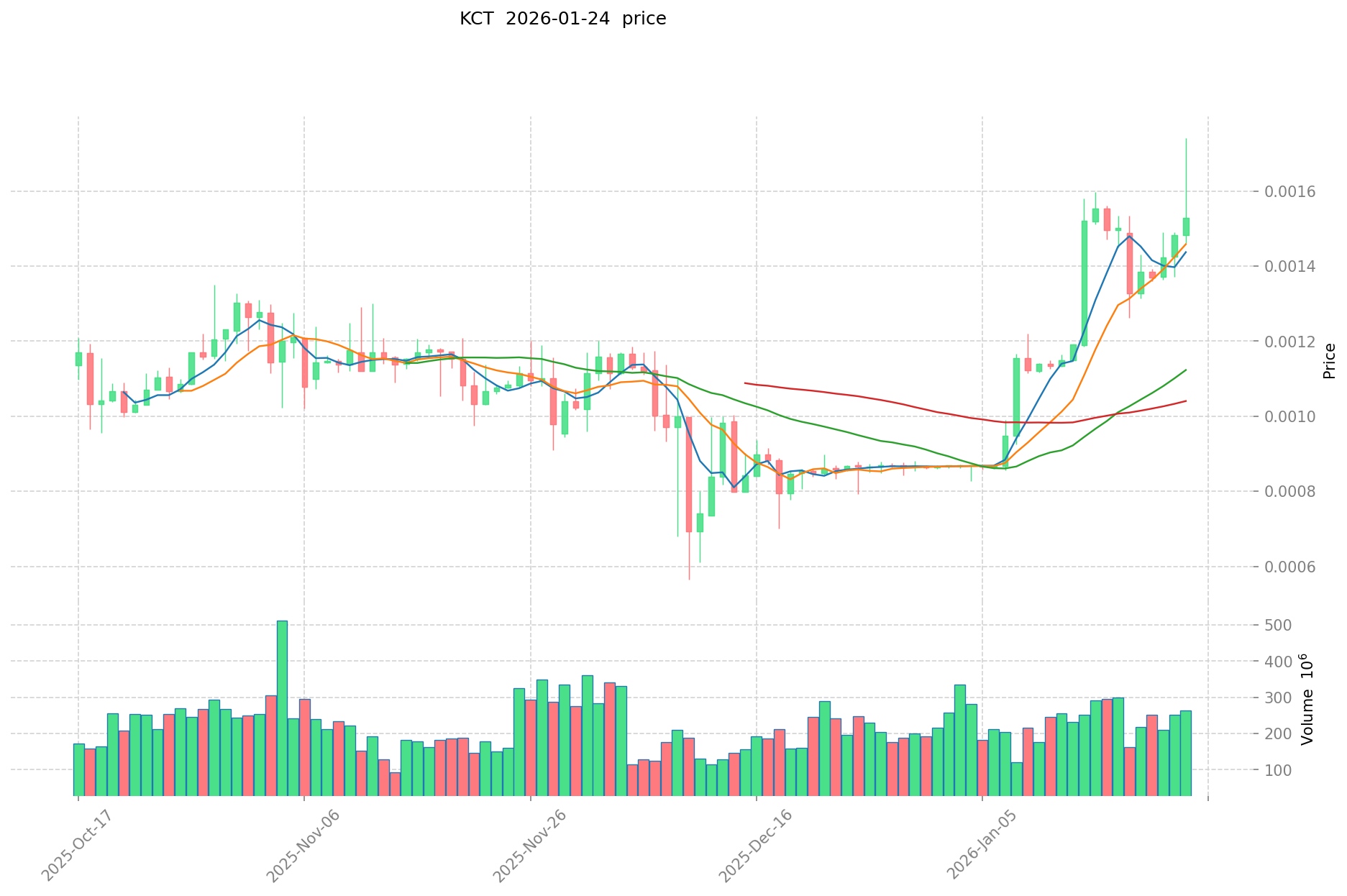
II. Core Factors Affecting Whether KCT is a Good Investment (Is Konnect(KCT) a Good Investment)
Supply Mechanism and Scarcity (KCT investment scarcity)
- Max supply of 10,000,000,000 KCT with current circulation of 7,375,000,040 tokens (73.75% circulating ratio) → impacts price and investment value
- Current supply dynamics show controlled token release with defined maximum cap
- Investment significance: Fixed supply mechanism provides potential long-term value support
Institutional Investment and Mainstream Adoption (Institutional investment in KCT)
- Limited exchange presence with trading available on 3 platforms
- Holder base remains relatively small with 15 recorded holders
- Project focuses on bridging Web2 and Web3 through membership utilities in duty-free distribution, K-pop, medical services, tourism, and communication infrastructure sectors
Macroeconomic Environment's Impact on KCT Investment
- Monetary policy and interest rate changes → alter investment attractiveness
- Inflation environment's hedging effect → positioning considerations
- Geopolitical uncertainties → influence demand patterns
Technology & Ecosystem Development (Technology & Ecosystem for KCT investment)
- Token operates on Polygon network using ERC-20 standard → provides scalability benefits
- Integration of Web3 utilities with Web2-based membership features → expands practical applications
- Ecosystem includes curated memberships, savings programs, DIY options, and Konnect NFTs → supports diverse use cases
- Travel token economy focus with real-world infrastructure integration → long-term value framework
III. KCT Future Investment Forecast and Price Outlook (Is Konnect(KCT) worth investing in 2026-2031)
Short-term Investment Forecast (2026, short-term KCT investment outlook)
- Conservative Forecast: $0.00121002 - $0.001806
- Neutral Forecast: $0.001806
- Optimistic Forecast: $0.001806 - $0.00265482
Mid-term Investment Outlook (2027-2029, mid-term Konnect(KCT) investment forecast)
- Market Stage Expectations: The project may experience gradual growth as it continues developing its web2-web3 integration platform for travel and membership utilities
- Investment Return Forecast:
- 2027: $0.001784328 - $0.0033010068 (potential 23% increase from 2026 average)
- 2028: $0.00165942504 - $0.003844334676 (potential 52% increase from 2026 average)
- 2029: $0.0021482639997 - $0.00485838166086 (potential 82% increase from 2026 average)
- Key Catalysts: Platform development progress, expansion of membership categories including duty-free distribution, K-pop, medical services, tourism, and communication infrastructure
Long-term Investment Outlook (Is KCT a good long-term investment?)
- Base Scenario: $0.003795982487469 - $0.00408170159943 (assuming steady ecosystem development and user adoption)
- Optimistic Scenario: $0.004593138809838 - $0.0055809105969 (assuming accelerated platform adoption and favorable market conditions)
- Risk Scenario: Below $0.001806 (under unfavorable market conditions or development setbacks)
View KCT long-term investment and price forecast: Price Prediction
2026-01-25 - 2031 Long-term Outlook
- Base Scenario: $0.003795982487469 - $0.00408170159943 (corresponding to steady progress and gradual mainstream application growth)
- Optimistic Scenario: $0.004593138809838 - $0.0055809105969 (corresponding to large-scale adoption and favorable market environment)
- Transformative Scenario: Above $0.0055809105969 (if ecosystem achieves breakthrough progress and mainstream adoption)
- 2031-12-31 Projected High: $0.0055809105969 (based on optimistic development assumptions)
Disclaimer: The above forecasts are based on historical data and market analysis models, and do not constitute investment advice. Cryptocurrency markets are highly volatile, and actual prices may differ significantly from predictions. Investors should conduct their own research and consider their risk tolerance before making investment decisions.
| Year |
Predicted High Price |
Predicted Average Price |
Predicted Low Price |
Price Change |
| 2026 |
0.00265482 |
0.001806 |
0.00121002 |
0 |
| 2027 |
0.0033010068 |
0.00223041 |
0.001784328 |
23 |
| 2028 |
0.003844334676 |
0.0027657084 |
0.00165942504 |
52 |
| 2029 |
0.00485838166086 |
0.003305021538 |
0.0021482639997 |
82 |
| 2030 |
0.00579601627119 |
0.00408170159943 |
0.003795982487469 |
125 |
| 2031 |
0.0055809105969 |
0.00493885893531 |
0.004593138809838 |
172 |
IV. Konnect (KCT) Investment Strategy and Risk Management (How to invest in travel token economy)
Investment Methodology (Konnect investment strategy)
-
Long-term Holding (HODL Konnect): Suitable for conservative investors
Long-term holding strategy involves acquiring KCT tokens and maintaining positions through market cycles. This approach may appeal to investors who believe in the project's vision of integrating web2 membership utilities with web3 infrastructure in the travel and tourism sector. Given the token's substantial price fluctuations observed in its history, patience and conviction in the underlying business model are essential for this strategy.
-
Active Trading: Relies on technical analysis and swing trading
Active traders can leverage KCT's price volatility for short-term gains. The token has demonstrated notable price movements, with 24-hour changes reaching double digits. Traders should monitor volume patterns, support and resistance levels, and utilize appropriate technical indicators. The token's trading availability on multiple exchanges provides liquidity for active trading strategies.
Risk Management (Risk management for Konnect investment)
-
Asset Allocation Ratios: Conservative / Aggressive / Professional investors
Conservative investors might consider allocating a small percentage (1-3%) of their crypto portfolio to KCT, treating it as a high-risk, speculative position. Aggressive investors comfortable with higher volatility may allocate 5-10% depending on their risk tolerance and conviction in the travel token economy thesis. Professional investors should conduct thorough due diligence on the project's partnerships, membership utilities, and adoption metrics before determining allocation sizes.
-
Risk Hedging Strategies: Multi-asset portfolio + hedging instruments
Diversification remains fundamental to managing KCT investment risks. Investors should combine KCT holdings with established cryptocurrencies, stablecoins, and potentially traditional assets to balance portfolio volatility. Setting predetermined exit points and employing stop-loss orders can help limit downside exposure. Position sizing should reflect individual risk tolerance and overall portfolio composition.
-
Secure Storage: Hot/cold wallets + hardware wallet recommendations
Given that KCT operates on the Polygon (MATIC) network using the ERC-20 standard, investors should utilize wallets compatible with Polygon infrastructure. For long-term holdings, hardware wallets supporting Polygon tokens offer enhanced security against online threats. For active traders requiring frequent access, reputable software wallets with strong security features may provide a balance between accessibility and protection. Always verify contract addresses before transactions and never share private keys.
V. Risks of Investing in Konnect (KCT) (Risks of investing in travel token economy)
-
Market Risks: High volatility, price manipulation potential
KCT has exhibited significant price volatility throughout its trading history. The token's relatively modest market capitalization and limited holder base may contribute to pronounced price swings. Lower liquidity can amplify both upward and downward price movements, and the token may be more susceptible to large-order impact compared to more established cryptocurrencies. Investors should be prepared for substantial short-term fluctuations.
-
Regulatory Risks: Policy uncertainty across different jurisdictions
The travel and tourism industry faces varying regulatory frameworks across different countries. As Konnect aims to bridge web2 membership services with web3 utilities, the project may encounter regulatory challenges related to both traditional travel services and cryptocurrency operations. Changes in cryptocurrency regulations, travel industry policies, or cross-border payment rules could impact the project's operational scope and token utility.
-
Technical Risks: Network security vulnerabilities, upgrade failures
As an ERC-20 token on the Polygon network, KCT inherits both the benefits and potential vulnerabilities of the underlying blockchain infrastructure. Smart contract risks, including undiscovered bugs or security flaws, could affect token functionality. The project's integration of web2 and web3 systems introduces additional technical complexity that may present implementation challenges. Network congestion or technical issues on the Polygon network could also impact transaction processing.
VI. Conclusion: Is Travel Token Economy a Good Investment?
-
Investment Value Summary: Konnect (KCT) presents a unique value proposition by attempting to integrate travel industry membership utilities with blockchain technology. The project addresses specific use cases including duty-free shopping, K-pop experiences, medical services, tourism, and communication infrastructure. However, the token has experienced considerable price volatility, and its relatively small market presence requires careful consideration.
-
Investor Recommendations:
✅ Beginners: Dollar-cost averaging + secure wallet storage
New investors should approach KCT with caution, allocating only funds they can afford to lose. Implementing a dollar-cost averaging strategy can help mitigate timing risk associated with the token's volatility. Prioritize security by learning proper wallet management and storage practices before acquiring tokens.
✅ Experienced Investors: Swing trading + portfolio diversification
Investors with cryptocurrency experience may explore tactical trading opportunities presented by KCT's price movements while maintaining appropriate portfolio diversification. Conduct thorough research on the project's development progress, partnership announcements, and utility expansion before making investment decisions.
✅ Institutional Investors: Strategic long-term allocation
Institutional participants should evaluate KCT within the broader context of blockchain adoption in the travel and tourism industry. Assess the project's competitive positioning, team execution capability, and scalability potential. Due diligence should include evaluation of the project's business model sustainability and token economics.
⚠️ Disclaimer: Cryptocurrency investments carry substantial risk. This content is provided for informational purposes only and does not constitute financial advice. Conduct independent research and consult with qualified financial professionals before making investment decisions.
VII. FAQ
Q1: What is Konnect (KCT) and what makes it different from other cryptocurrencies?
Konnect (KCT) is a travel token economy project that bridges Web2 membership services with Web3 utilities, operating on the Polygon network as an ERC-20 token. Unlike typical cryptocurrencies, KCT focuses specifically on the travel and tourism industry, offering practical applications including duty-free shopping distribution, K-pop experiences, medical services, tourism packages, and communication infrastructure. The project differentiates itself by integrating real-world business infrastructure with blockchain technology, providing curated memberships, savings programs, DIY options, and Konnect NFTs. With a maximum supply of 10 billion tokens and current circulation of approximately 7.38 billion tokens (73.75%), KCT aims to create tangible utility within established travel industry frameworks rather than operating solely as a speculative digital asset.
Q2: How has KCT's price performed historically and what is its current market position?
KCT has experienced significant volatility since its launch in May 2022 at $0.0217. The token reached a notable peak of $0.04 in December 2023 before declining substantially to $0.000088 in December 2024. As of January 25, 2026, KCT trades at approximately $0.0018, representing a remarkable recovery with gains of +17.15% in 24 hours, +111.99% over 30 days, and +422.36% year-over-year. The current market capitalization stands at $13.36 million with 24-hour trading volume of $485,308.83. Despite these recent positive trends, KCT maintains a modest market dominance of 0.00057% and trades on only three exchanges with a limited holder base of 15 recorded addresses, indicating it remains an early-stage project with substantial growth potential but also considerable risk exposure.
Q3: What are the price predictions for KCT from 2026 to 2031?
Price forecasts for KCT show progressive growth expectations under various scenarios. For 2026, conservative estimates range from $0.00121 to $0.00265, with a neutral forecast around $0.00180. Mid-term projections suggest potential increases of 23% by 2027 ($0.00178-$0.00330), 52% by 2028 ($0.00166-$0.00384), and 82% by 2029 ($0.00215-$0.00486) compared to 2026 average prices. Long-term forecasts for 2030-2031 project a base scenario range of $0.00380-$0.00408 and an optimistic scenario of $0.00459-$0.00558, representing potential increases of 125-172% from 2026 levels. These projections assume steady ecosystem development, expansion of membership categories, and favorable market conditions. However, investors should note that cryptocurrency markets are highly volatile, and actual prices may differ significantly from these model-based predictions based on technological progress, adoption rates, and broader market dynamics.
Q4: What investment strategies are suitable for different types of KCT investors?
Investment approaches for KCT should align with individual risk tolerance and experience levels. Beginners are advised to implement dollar-cost averaging strategies, allocating only 1-3% of their crypto portfolio to KCT while prioritizing secure wallet storage and fundamental education. This conservative approach helps mitigate timing risks associated with the token's volatility. Experienced investors may pursue active trading strategies, leveraging technical analysis and swing trading opportunities presented by KCT's price movements while maintaining 5-10% portfolio allocations depending on conviction levels. Professional and institutional investors should conduct comprehensive due diligence on partnership development, adoption metrics, and competitive positioning before determining strategic long-term allocations. Risk management essentials include diversification across multiple assets, predetermined exit points, stop-loss implementation, and secure storage using hardware wallets compatible with Polygon infrastructure for long-term holdings or reputable software wallets for active trading needs.
Q5: What are the main risks associated with investing in KCT?
KCT investment carries multiple risk categories that investors must carefully evaluate. Market risks include high volatility stemming from the token's relatively small market capitalization ($13.36 million), limited liquidity across only three trading platforms, and a small holder base of 15 addresses, making the token susceptible to significant price swings and potential manipulation. Regulatory risks arise from the project's dual exposure to both travel industry regulations and cryptocurrency policy frameworks across different jurisdictions, with potential impacts from changes in cross-border payment rules, tourism policies, or crypto-specific legislation. Technical risks encompass smart contract vulnerabilities inherent to ERC-20 tokens, potential security flaws in the integration between Web2 and Web3 systems, and dependency on Polygon network infrastructure stability. Additionally, the project's early stage of development, limited exchange presence, and relatively unknown status in the broader cryptocurrency market present execution and adoption risks that could affect long-term viability and token utility.
Q6: How does KCT's token economics and supply mechanism affect its investment potential?
KCT's token economics feature a fixed maximum supply of 10 billion tokens with current circulation of 7.38 billion tokens (73.75% circulating ratio), providing a defined scarcity framework that theoretically supports long-term value appreciation. This controlled supply mechanism contrasts with inflationary token models and offers investors transparency regarding future dilution potential. The remaining 26.25% of tokens yet to enter circulation represents a consideration for potential supply-side pressure, though the project appears to maintain measured release schedules. Operating on the Polygon network using the ERC-20 standard provides scalability benefits and lower transaction costs compared to Ethereum mainnet operations, enhancing practical utility for frequent transactions within the travel ecosystem. The token's integration with real-world membership utilities across duty-free distribution, K-pop, medical services, tourism, and communication infrastructure creates potential demand drivers beyond speculative trading. However, the current limited adoption indicated by low holder counts and modest trading volumes suggests that realizing this utility-based value proposition remains largely dependent on successful ecosystem development and user acquisition over the coming years.
* The information is not intended to be and does not constitute financial advice or any other recommendation of any sort offered or endorsed by Gate.