This comprehensive analysis evaluates Kryll (KRL), a utility token powering the Kryll.io automated trading platform, to determine its investment viability. Currently trading at $0.1801 with a $7.25 million market cap, KRL serves as operational fuel for drag-and-drop strategy creation. The article examines KRL's price history, supply mechanics (49.4M max supply, 81.44% circulation ratio), and platform adoption metrics including its August 2025 Revolut listing. Price forecasts range from $0.214-$0.408 by 2031 under base scenarios. Key value drivers include multi-chain expansion and new analytics tools planned for 2025. However, investors must weigh significant risks: extreme volatility (96% below all-time high), limited liquidity across 4 Gate exchanges, regulatory uncertainty, and platform dependency. The analysis provides strategic recommendations for conservative, aggressive, and institutional investors, emphasizing risk management and the token's specialized niche in trading automation.
Introduction: Kryll (KRL) Investment Position and Market Prospects
KRL is a notable digital asset in the cryptocurrency sector, launched in July 2018 as the native token of the Kryll.io platform. As of January 2026, KRL maintains a market capitalization of approximately $7.25 million, with a circulating supply of around 40.25 million tokens and a current price near $0.18. The token serves as the operational fuel for the Kryll.io automated trading strategy platform, which features a drag-and-drop visual editor enabling users to create trading strategies without coding skills. With its positioning as a utility token for algorithmic trading automation, KRL has garnered attention from investors exploring "Is Kryll (KRL) a good investment?" This article comprehensively analyzes KRL's investment characteristics, historical price movements, future price outlook, and associated risks to provide reference information for market participants.
I. Kryll (KRL) Price History Review and Current Investment Value Status
- 2018: Kryll (KRL) was launched with a publish price of $0.2, establishing the initial market valuation for the platform token
- 2020: During market volatility, KRL experienced significant price fluctuations, with the price dropping to lower levels in early April
- 2021: Amid the cryptocurrency bull market cycle in November, KRL price showed substantial upward movement, rising considerably from previous levels
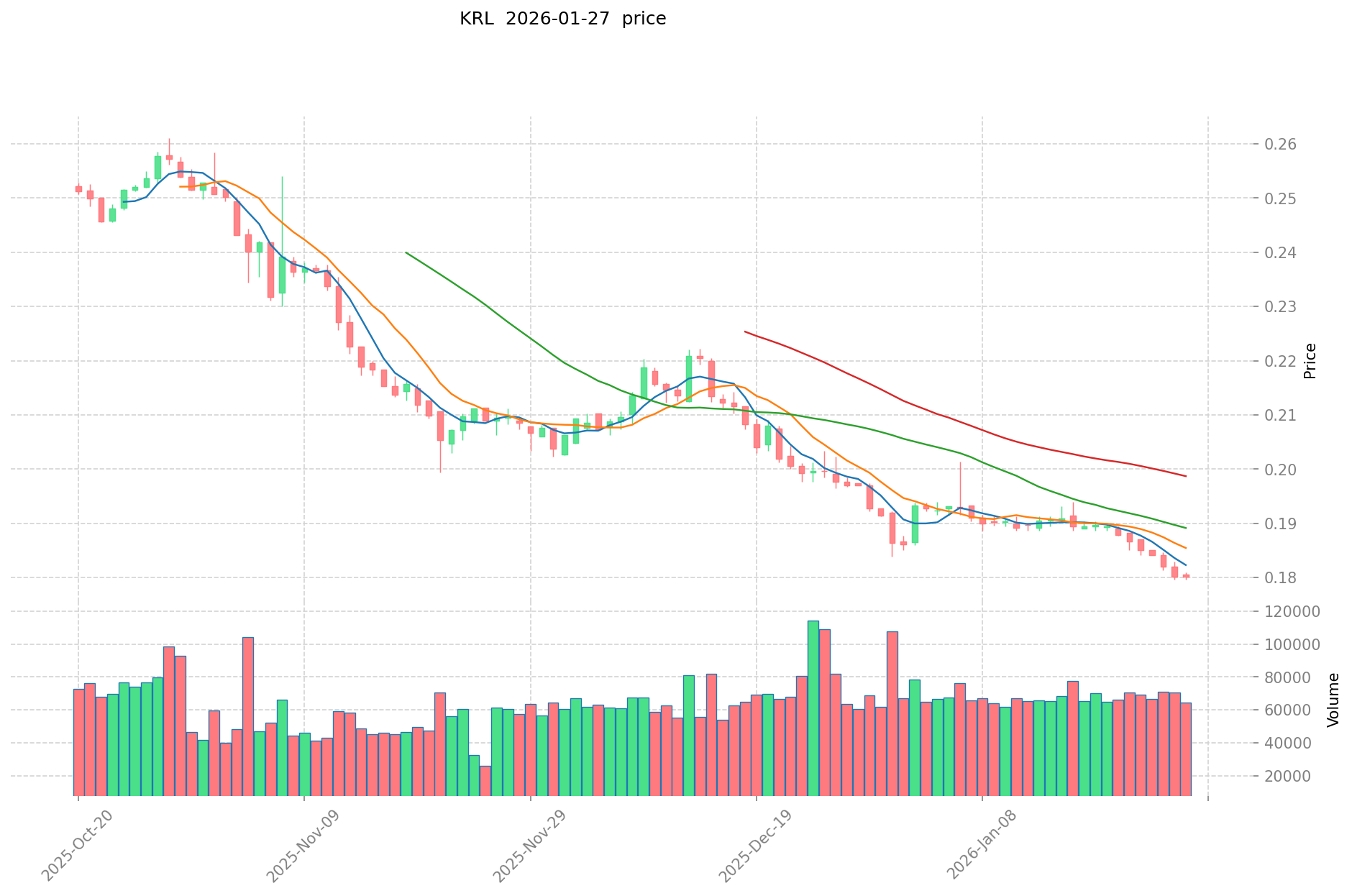
- 2026: Following multiple market cycles, KRL currently trades at $0.1801, reflecting notable price adjustments from earlier periods
Current KRL Investment Market Status (January 2026)
- KRL current price: $0.1801
- Market sentiment (Fear & Greed Index): Data not available in provided materials
- 24-hour trading volume: $11,620.60
- Institutional investor holdings: Data not available in provided materials
Click to view real-time KRL market price
II. Core Factors Influencing Whether KRL is a Good Investment (Is Kryll(KRL) a Good Investment)
Supply Mechanism and Scarcity (KRL investment scarcity)
- Supply Structure → Influences Price and Investment Value
- KRL has a maximum supply of 49,417,348 tokens, with a circulating supply of approximately 40,245,473 tokens, representing an 81.44% circulation ratio. This fixed supply cap creates a defined scarcity framework that may support long-term value considerations.
- The token operates as a utility asset on the Kryll.io platform, where KRL functions as "fuel" to execute automated trading strategies, linking its value proposition to platform usage and adoption.
- Investment Significance: The combination of fixed maximum supply and platform utility creates a scarcity model tied to functional demand rather than purely speculative dynamics.
Mainstream Adoption and Platform Expansion (Institutional investment in KRL)
- Exchange Listings and Accessibility: KRL is currently listed on 4 exchanges, including Gate.com, with an August 2025 listing on Revolut (55 million users) expanding its accessibility to retail investors through a mainstream financial platform.
- Platform Development: Kryll³'s 2025 roadmap includes multi-chain expansion and the launch of Harpoon, a tool designed to analyze top trader strategies, potentially increasing platform utility and KRL token demand.
- User Base: The token contract shows 14,232 holders, indicating a relatively concentrated ownership structure that may influence liquidity and price volatility characteristics.
Technology and Ecosystem Development (Technology & Ecosystem for KRL investment)
- Platform Innovation: Kryll.io provides a visual, drag-and-drop trading strategy editor enabling automated execution without coding requirements, supported by technical indicators including MACD, Ichimoku, and Bollinger Bands.
- Multi-Chain Strategy: The 2025 expansion plan includes multi-chain support beyond its current Ethereum-based infrastructure, potentially broadening the platform's addressable market and reducing dependency on a single blockchain ecosystem.
- X-Ray Launch: The introduction of new analytical tools in 2025 aims to enhance platform capabilities for tracking market participant strategies, which may drive increased platform engagement and corresponding KRL utility demand.
- Ecosystem Context: As a specialized auto-trading platform token, KRL's investment value correlates with the growth trajectory of algorithmic trading adoption in the cryptocurrency market and the platform's ability to maintain competitive advantages in strategy automation tools.
III. KRL Future Investment Forecast and Price Outlook (Is Kryll(KRL) Worth Investing in 2026-2031)
Short-term Investment Forecast (2026, Short-term KRL Investment Outlook)
- Conservative Forecast: $0.101 - $0.180
- Neutral Forecast: $0.180 - $0.210
- Optimistic Forecast: $0.210 - $0.236
Mid-term Investment Outlook (2027-2029, Mid-term Kryll(KRL) Investment Forecast)
-
Market Stage Expectation: During 2027-2029, KRL may experience gradual value appreciation as the platform continues to develop its trading automation features and expand its user base. Market conditions and adoption rates within the algorithmic trading sector could influence price trajectory.
-
Investment Return Forecast:
- 2027: $0.127 - $0.306
- 2028: $0.175 - $0.353
- 2029: $0.192 - $0.354
-
Key Catalysts: Platform feature enhancements, increased adoption of automated trading strategies, expansion of exchange integrations, and overall growth in the algorithmic trading market segment.
Long-term Investment Outlook (Is Kryll a Good Long-term Investment?)
- Base Scenario: $0.214 - $0.330 (assuming steady platform development and moderate market growth)
- Optimistic Scenario: $0.330 - $0.408 (assuming accelerated adoption, favorable market conditions, and successful feature implementation)
- Risk Scenario: Below $0.214 (under adverse market conditions or reduced platform traction)
For detailed KRL long-term investment analysis and price forecasts: Price Prediction
2026-2031 Long-term Outlook
- Base Scenario: $0.214 - $0.330 (corresponding to steady progress and gradual mainstream application growth)
- Optimistic Scenario: $0.330 - $0.408 (corresponding to large-scale adoption and favorable market environment)
- Transformative Scenario: Above $0.408 (contingent upon breakthrough ecosystem developments and mainstream adoption)
- 2031-12-31 Projected High: $0.408 (based on optimistic development assumptions)
Disclaimer: Price forecasts are based on historical data patterns and market analysis models. Cryptocurrency markets are highly volatile and subject to numerous unpredictable factors. These projections should not be construed as financial advice, and investors should conduct independent research and consider their risk tolerance before making investment decisions.
| Year |
Predicted High Price |
Predicted Average Price |
Predicted Low Price |
Price Change |
| 2026 |
0.236455 |
0.1805 |
0.10108 |
0 |
| 2027 |
0.306461925 |
0.2084775 |
0.127171275 |
15 |
| 2028 |
0.352733506125 |
0.2574697125 |
0.1750794045 |
42 |
| 2029 |
0.3539178668025 |
0.3051016093125 |
0.192214013866875 |
69 |
| 2030 |
0.339395030199225 |
0.3295097380575 |
0.2504274009237 |
82 |
| 2031 |
0.408031908636602 |
0.334452384128362 |
0.214049525842152 |
85 |
IV. Kryll (KRL) Investment Strategy and Risk Management (How to invest in Kryll)
Investment Strategy (Kryll investment strategy)
Long-term Holding (HODL Kryll)
Long-term holding represents a suitable approach for conservative investors who believe in the fundamental value proposition of the Kryll platform. This strategy involves acquiring KRL tokens and maintaining positions through market cycles, focusing on the platform's long-term adoption and utility growth rather than short-term price movements. Investors adopting this approach typically prioritize the strategic role of KRL as the fuel token powering automated trading strategies on the Kryll.io platform.
Active Trading
Active trading strategies for KRL rely on technical analysis and swing trading approaches. Given the token's 24-hour trading volume of approximately $11,620 and availability on 4 exchanges, traders can identify entry and exit points based on price movements. The recent price action shows fluctuations between $0.1796 and $0.181 within a 24-hour period, presenting opportunities for short-term traders. However, the relatively limited liquidity compared to major cryptocurrencies requires careful consideration of position sizing and execution strategy.
Risk Management (Risk management for Kryll investment)
Asset Allocation Ratios
Conservative Investors: Conservative portfolios might allocate 1-3% of crypto holdings to KRL, treating it as a speculative position within a diversified digital asset portfolio. This approach acknowledges the token's utility within the automated trading niche while maintaining prudent exposure limits.
Aggressive Investors: More aggressive investors comfortable with higher risk profiles might allocate 5-10% of their cryptocurrency portfolio to KRL, particularly if they actively utilize the Kryll.io platform for trading automation and see strategic value in holding the platform's native token.
Professional Investors: Institutional or professional investors may approach KRL as part of a thematic allocation to DeFi infrastructure and trading automation protocols, with position sizing determined by broader portfolio construction methodologies and risk tolerance parameters.
Risk Hedging Solutions
Implementing a multi-asset portfolio approach helps mitigate concentration risk associated with KRL investment. Investors can balance exposure by maintaining positions across different cryptocurrency categories, including major assets (Bitcoin, Ethereum), DeFi protocols, and utility tokens. Additionally, maintaining partial allocations to stablecoins provides liquidity buffers and downside protection during market volatility.
Secure Storage
Given that KRL operates on the Ethereum blockchain as an ERC-20 token (contract address: 0x464ebe77c293e473b48cfe96ddcf88fcf7bfdac0), investors should prioritize security through appropriate wallet solutions:
Cold Wallet Storage: For long-term holdings, hardware wallets such as Ledger or Trezor provide optimal security by keeping private keys offline and protected from online threats.
Hot Wallet Solutions: For active traders requiring frequent access, reputable software wallets with strong security features and multi-factor authentication offer a balance between accessibility and protection.
Wallet Recommendations: Hardware wallets remain the gold standard for significant KRL holdings, while MetaMask or other established Ethereum-compatible wallets serve active trading needs with appropriate security configurations.
V. Kryll (KRL) Investment Risks and Challenges (Risks of investing in Kryll)
Market Risk
High Volatility: KRL exhibits significant price volatility characteristic of mid-cap cryptocurrencies. The token's historical price range spans from $0.00474521 to $4.75, demonstrating extreme price swings. Recent performance shows a 63.44% decline over the past year, with the current price at $0.1801 representing approximately 96.2% below the all-time high recorded on November 7, 2021. Short-term fluctuations include a 4.91% decrease over 7 days and an 8.58% decline over 30 days.
Price Manipulation Concerns: With a relatively modest 24-hour trading volume of approximately $11,620 and availability on only 4 exchanges, KRL faces potential liquidity constraints that could make the token susceptible to price manipulation. The limited trading depth means that larger orders may experience slippage, and coordinated trading activity could disproportionately impact price discovery.
Regulatory Risk
Policy Uncertainty Across Jurisdictions: Cryptocurrency regulations vary substantially across different countries and continue evolving. Automated trading platforms like Kryll.io may face regulatory scrutiny in jurisdictions implementing stricter oversight of algorithmic trading systems, financial automation tools, or cryptocurrency services. Changes in regulatory frameworks could impact the platform's operational capabilities, user accessibility, or compliance requirements, potentially affecting KRL token utility and demand.
Classification Ambiguity: The regulatory classification of utility tokens like KRL remains subject to interpretation by different authorities. Shifts in how regulators categorize such tokens could impose additional compliance obligations on the platform or restrictions on token trading and usage.
Technical Risk
Network Security Vulnerabilities: As an ERC-20 token on the Ethereum blockchain, KRL inherits both the security benefits and potential risks associated with the Ethereum network. Smart contract vulnerabilities, either in the token contract itself or in the Kryll.io platform's integration mechanisms, could expose users to security risks. The token contract is publicly verifiable at 0x464ebe77c293e473b48cfe96ddcf88fcf7bfdac0 on Etherscan, allowing for community auditing, though this does not eliminate all potential technical risks.
Platform Dependency: KRL's value proposition is intrinsically tied to the Kryll.io platform's functionality and adoption. Technical issues affecting the platform's trading automation capabilities, user interface, or integration with supported exchanges could impact the token's utility and perceived value.
Upgrade and Development Risks: The evolution of the Kryll platform and any necessary protocol upgrades carry implementation risks. Technical complications during platform updates or feature deployments could temporarily or permanently affect service quality, potentially influencing token demand and market perception.
VI. Conclusion: Is Kryll a Good Investment?
Investment Value Summary
Kryll (KRL) represents a specialized investment opportunity within the cryptocurrency trading automation sector. With a market capitalization of approximately $7.25 million and a circulating supply of 40.24 million tokens (81.44% of maximum supply), KRL serves as the utility token powering the Kryll.io platform's drag-and-drop automated trading strategy builder. The token's value proposition centers on its role as "fuel" for executing trading strategies on the platform.
The investment thesis for KRL depends heavily on the continued adoption and utility of the Kryll.io platform. While the concept of accessible, code-free trading automation addresses a legitimate market need, the token has experienced substantial price contraction, currently trading approximately 96% below its historical peak. The limited exchange availability and modest trading volume present liquidity considerations that potential investors should carefully evaluate.
Investor Recommendations
✅ Beginners
Dollar-Cost Averaging: New investors interested in KRL should consider implementing a dollar-cost averaging strategy, making regular small purchases rather than large lump-sum investments. This approach helps mitigate timing risk in a volatile market.
Secure Wallet Storage: Given KRL's status as an ERC-20 token, beginners should prioritize learning proper wallet security practices. Setting up a hardware wallet or secure software wallet before acquiring KRL helps prevent loss through security breaches or user error.
Education First: New investors should thoroughly understand the Kryll.io platform's functionality and the token's specific utility before investing, as KRL's value is directly tied to platform usage rather than serving as a general-purpose cryptocurrency.
✅ Experienced Investors
Swing Trading Opportunities: Traders with technical analysis experience may identify opportunities in KRL's price movements, though the limited liquidity requires careful position management and realistic expectations regarding order execution.
Portfolio Diversification: Experienced investors might consider KRL as a small allocation within a diversified cryptocurrency portfolio, particularly if they have interest in or active use of trading automation tools. Position sizing should reflect the token's risk profile and liquidity constraints.
Platform Integration: Investors who actively use the Kryll.io platform for their own trading strategies may find strategic value in holding KRL tokens for operational purposes, creating natural demand alignment with their investment.
✅ Institutional Investors
Thematic Exposure: Institutional portfolios seeking exposure to cryptocurrency trading infrastructure and automation technologies might include KRL as part of a broader thematic allocation, though position sizes would likely remain modest given the token's market capitalization and liquidity profile.
Due Diligence Requirements: Institutional investment would require comprehensive due diligence on the Kryll.io platform's user base, trading volume, competitive positioning, and technical architecture to assess long-term viability and token utility sustainability.
⚠️ Important Notice
Cryptocurrency investments carry substantial risk, including the potential for complete loss of capital. KRL's historical price performance demonstrates extreme volatility, and the token's value depends heavily on continued adoption and utility of the Kryll.io platform. Market conditions, technological developments, regulatory changes, and competitive dynamics may significantly impact future performance in ways that cannot be predicted.
This analysis is provided for informational purposes only and does not constitute investment advice, financial guidance, or a recommendation to buy, sell, or hold KRL tokens. Potential investors should conduct independent research, assess their personal risk tolerance, and consider consulting with qualified financial advisors before making investment decisions. Past performance does not indicate future results, and the cryptocurrency market's inherent volatility requires careful consideration and risk management.
VII. FAQ
Q1: What is the minimum investment amount recommended for KRL tokens?
There is no fixed minimum investment amount for KRL, but conservative investors should consider starting with small allocations representing 1-3% of their cryptocurrency portfolio. Given KRL's relatively modest 24-hour trading volume of approximately $11,620 and availability on only 4 exchanges, beginners should employ dollar-cost averaging strategies with manageable amounts. The token's high volatility—currently trading 96.2% below its all-time high—suggests that investors should only commit funds they can afford to lose entirely. For practical purposes, starting with amounts that allow for multiple purchases over time helps mitigate timing risk while gaining exposure to this specialized trading automation token.
Q2: How does KRL's utility on the Kryll.io platform affect its investment value?
KRL's investment value is directly tied to its platform utility rather than functioning as a general-purpose cryptocurrency. The token serves as "fuel" to execute automated trading strategies on Kryll.io's drag-and-drop visual editor, meaning its demand correlates with platform adoption and usage frequency. Unlike speculative tokens, KRL's fundamental value proposition depends on whether traders actively utilize the platform's automated strategy execution features. With 14,232 token holders and recent expansion to Revolut's 55 million user base, the token's long-term investment thesis hinges on whether the Kryll.io platform can maintain competitive advantages in the trading automation market and convert platform usage into sustained KRL token demand.
Q3: What are the primary risks associated with investing in KRL?
KRL faces three critical risk categories that investors must consider. First, market risk manifests through extreme price volatility, with the token declining 63.44% over the past year and currently trading approximately 96% below its November 2021 peak. Limited liquidity across only 4 exchanges creates potential for price manipulation and order execution challenges. Second, regulatory risk emerges from evolving cryptocurrency regulations and uncertain classification of automated trading platforms across different jurisdictions. Third, technical risk stems from platform dependency—KRL's value proposition relies entirely on Kryll.io's continued functionality, security, and competitive positioning in the trading automation sector. Smart contract vulnerabilities, platform technical issues, or failed development initiatives could significantly impact token utility and market perception.
Q4: How does KRL compare to other DeFi and trading automation tokens?
KRL occupies a specialized niche within the trading automation sector, distinguished by its code-free, drag-and-drop strategy builder approach. With a market capitalization of approximately $7.25 million, KRL represents a micro-cap position compared to major DeFi protocols. The token's utility model—serving as operational fuel for strategy execution—differs from governance tokens or liquidity provision mechanisms common in other DeFi projects. KRL's competitive positioning depends on Kryll.io's ability to maintain user-friendly features while competing against both centralized exchange automation tools and alternative decentralized trading platforms. The 2025 roadmap's multi-chain expansion and Harpoon analytics tool aim to differentiate the platform, but investors should assess these developments against broader market competition and user acquisition trends in the trading automation space.
Q5: What technical indicators should investors monitor for KRL trading decisions?
For active KRL traders, several technical factors warrant monitoring beyond standard price indicators. First, track the 24-hour trading volume relative to the $11,620 baseline to identify liquidity changes that might affect order execution. Second, monitor the circulating supply ratio (currently 81.44%) for any token unlock events that could impact supply dynamics. Third, observe Ethereum network conditions since KRL operates as an ERC-20 token—gas fees and network congestion affect transaction costs for KRL transfers and trades. Fourth, follow the token holder count (14,232) for trends in ownership concentration or distribution. Finally, platform-specific metrics including Kryll.io user growth, strategy execution volume, and exchange integration announcements provide fundamental indicators of utility demand that complement technical price analysis for informed trading decisions.
Q6: Is KRL suitable for long-term holding or better for short-term trading?
The suitability of KRL for long-term holding versus short-term trading depends significantly on investor risk tolerance and platform conviction. Long-term holding appeals to investors who believe in Kryll.io's fundamental value proposition and are willing to weather substantial volatility while the platform develops its user base and feature set. The token's fixed maximum supply of 49.4 million creates a defined scarcity framework, and the 2025-2031 price forecasts suggest potential appreciation ranges from $0.214 to $0.408 under optimistic scenarios. However, the 96% decline from historical peaks illustrates the risk of prolonged holding periods. Short-term trading may suit experienced traders who can navigate the limited liquidity and technical analysis opportunities, though the modest trading volume requires careful position management. Ultimately, KRL's platform-dependent value proposition makes it more suitable for investors who either actively use Kryll.io services or maintain high conviction in trading automation adoption trends.
Q7: How do exchange listings and accessibility affect KRL's investment potential?
KRL's limited availability on only 4 exchanges significantly impacts its investment accessibility and liquidity profile. The August 2025 listing on Revolut, with its 55 million user base, represents a meaningful expansion of retail investor access to KRL tokens, potentially increasing demand from mainstream financial platform users. However, the absence of listings on major cryptocurrency exchanges limits institutional participation and reduces overall market depth. This restricted availability creates both risks and opportunities—lower liquidity increases volatility and price manipulation potential, but successful expansion to additional major exchanges could catalyze price appreciation through improved accessibility. Investors should monitor exchange listing announcements as potential catalysts, while acknowledging that the current limited availability constrains immediate liquidity and may affect order execution quality for larger positions.
Q8: What role does the 2025 roadmap play in KRL's investment thesis?
Kryll³'s 2025 roadmap serves as a critical component of the investment thesis, introducing three key development initiatives that could influence token utility and demand. The multi-chain expansion beyond Ethereum infrastructure aims to broaden the platform's addressable market and reduce single-blockchain dependency, potentially attracting users from alternative blockchain ecosystems. The Harpoon tool launch, designed to analyze top trader strategies, represents a value-added feature that could differentiate Kryll.io from competitors and increase platform engagement. The X-Ray analytical capabilities for tracking market participant strategies further enhance the platform's utility proposition. However, investors should recognize that roadmap execution carries implementation risks, and the success of these initiatives in driving user adoption and KRL demand remains uncertain. The investment case depends on whether these planned features translate into measurable growth in platform users, strategy execution volume, and corresponding KRL token usage.
* The information is not intended to be and does not constitute financial advice or any other recommendation of any sort offered or endorsed by Gate.