Kusama (KSM) serves as Polkadot's experimental blockchain network, currently trading at $7.43 with a market cap of $130.94 million as of January 2026. This comprehensive analysis examines KSM's investment characteristics, evaluating its role as a governance and staking asset within the ecosystem. The article reviews historical price volatility, with KSM experiencing a 77.47% decline over one year while showing recent stabilization. Investment forecasts across multiple timeframes project base-case prices ranging from $7.43-$15.85 through 2030, with optimistic scenarios reaching $18.25 by 2031. Key investment considerations include KSM's unlimited supply dynamics, institutional adoption on 33 exchanges, and technical risks from accelerated governance cycles. The analysis provides risk management strategies, including asset allocation recommendations for different investor profiles, secure storage solutions, and diversification approaches. Suitable for investors researching KSM's long-term potential within the P
Introduction: Kusama (KSM) Investment Position and Market Outlook
KSM is a significant asset in the cryptocurrency space, serving as the native token of Kusama network since its launch in December 2019. As of January 2026, Kusama holds a market capitalization of approximately $130.94 million with a circulating supply of 17.63 million tokens, trading at around $7.43. Positioned as an experimental network for Polkadot, Kusama enables real-environment testing and advancement of blockchain technology through its relay chain, parachains, and bridges infrastructure. With its governance mechanisms, staking functionalities, and cross-chain messaging capabilities, KSM has established itself as a functional token within the Polkadot ecosystem. Currently ranked 312th by market capitalization with a dominance of 0.0039%, Kusama maintains presence across 33 exchanges and serves approximately 266,873 holders. The token has experienced notable price volatility, with recent performance showing a 3.98% increase over 30 days, though facing a 77.47% decline over the one-year period. This article examines KSM's investment characteristics, historical price movements, future price considerations, and associated risks to provide reference information for those evaluating Kusama as part of their research.
I. KSM Price Historical Review and Investment Value Status
- 2020: KSM launched with an initial price around $1.5, followed by early growth momentum as the token gained exchange listings
- 2021: During the bull market phase, KSM experienced substantial appreciation, with the price climbing from approximately $2 in early 2020 to $7 by April-May 2020, reflecting early investor interest in the cryptocurrency market
- 2022-2023: Following the market downturn period, KSM price declined significantly from previous peak levels
Current KSM Investment Market Status (January 2026)
- KSM current price: $7.428
- 24-hour trading volume: $131,029.53
- Circulating supply: 17,628,018.44 KSM
- Market capitalization: $130,940,920.95
- Total supply: 17,628,018.44 KSM
- Exchange listings: 33 exchanges
- Token holders: 266,873
Click to view real-time KSM market price
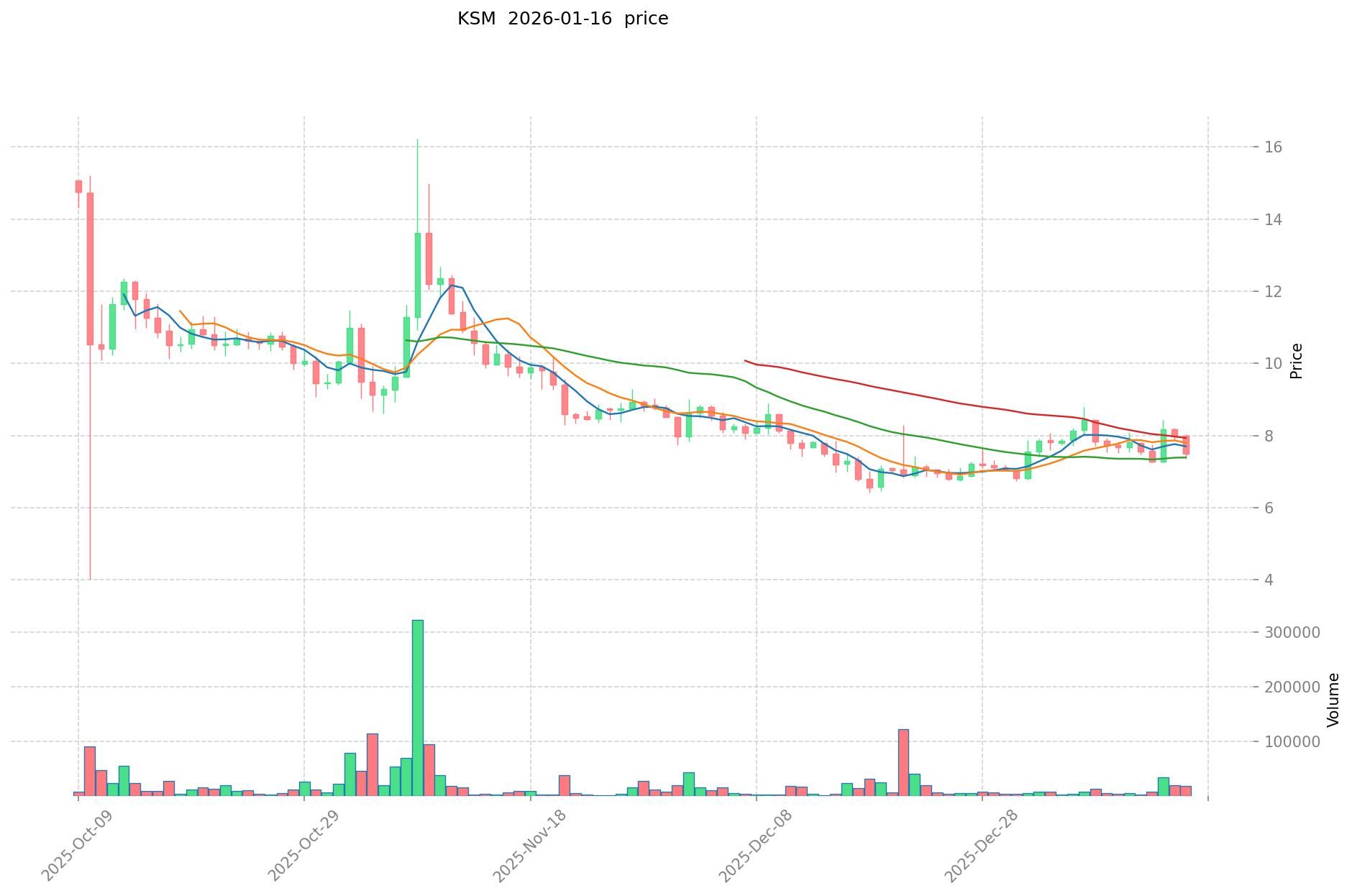
II. Core Factors Influencing Whether KSM is a Good Investment (Is Kusama(KSM) a Good Investment)
Supply Mechanism and Scarcity (KSM investment scarcity)
- Supply Dynamics → Impact on Price and Investment Value
- Kusama operates with a circulating supply of approximately 17.63 million KSM tokens as of January 2026, with no maximum supply cap (indicated as ∞). The token supply mechanism is influenced by staking requirements, parachain slot auctions, and governance activities, which can affect available circulating supply and potentially impact scarcity dynamics.
- Historical Patterns: KSM price experienced significant fluctuations, with notable price levels recorded in its trading history. The token's price movements have been influenced by supply dynamics related to staking participation and parachain auction activity.
- Investment Significance: The uncapped supply model differentiates KSM from fixed-supply assets, meaning scarcity dynamics are determined by token lock-up mechanisms (staking, governance, parachain bonding) rather than absolute supply limits. This creates a different risk-reward profile for long-term investment considerations.
Institutional Investment and Mainstream Adoption (Institutional investment in KSM)
- Market Position: As of January 2026, Kusama holds a market capitalization ranking of 312 with approximately 266,873 token holders, indicating a relatively established but niche user base compared to larger blockchain networks.
- Exchange Presence: KSM is listed on 33 exchanges, providing reasonable liquidity and accessibility for investors seeking exposure to the Kusama ecosystem.
- Ecosystem Role: Kusama serves as an experimental network for Polkadot, functioning as a testing ground for new features and upgrades before they are deployed on Polkadot. This positioning attracts developers and projects seeking faster governance and deployment cycles, which may influence its adoption trajectory.
Macroeconomic Environment's Impact on KSM Investment
- Market Sensitivity: KSM's price performance shows sensitivity to broader cryptocurrency market conditions, with a 77.47% decline over the one-year period ending January 2026, reflecting challenges in the wider digital asset environment.
- Risk Profile: As an experimental network with faster governance parameters (7-day voting period, 8-day implementation period), Kusama carries higher operational risk compared to more established networks, which may affect its appeal during periods of market uncertainty.
- Volatility Considerations: Short-term price movements show fluctuations of -2.04% (1H), -1.35% (24H), and -4.03% (7D) as of January 17, 2026, indicating ongoing price volatility that investors should consider in their risk assessment.
Technology and Ecosystem Development (Technology & Ecosystem for KSM investment)
- Technical Architecture: Kusama's infrastructure includes Relay Chain (main blockchain), Parachains (parallel blockchains maintained by collators), and Bridges (connections to external networks like Bitcoin and Ethereum), providing a multi-layered ecosystem for decentralized applications.
- Governance Innovation: The network features accelerated governance parameters compared to Polkadot, allowing for faster protocol evolution and experimentation, which may attract projects prioritizing rapid iteration.
- Token Utility: KSM serves multiple functions including network governance participation, staking for validator operations, parachain slot auction bonding, and cross-chain transaction fees. These utility functions create demand mechanisms beyond speculative trading.
- Ecosystem Applications: The parachain model enables various blockchain projects to connect to the Kusama relay chain, potentially expanding use cases across DeFi, governance, and interoperability applications, though the extent of ecosystem growth remains a key factor for long-term investment value.
III. KSM Future Investment Forecast and Price Outlook (Is Kusama(KSM) worth investing in 2026-2031)
Short-term Investment Forecast (2026, short-term KSM investment outlook)
- Conservative forecast: $6.54 - $7.43
- Neutral forecast: $7.43 - $8.77
- Optimistic forecast: $8.77 - $10.10
Mid-term Investment Outlook (2027-2029, mid-term Kusama(KSM) investment forecast)
-
Market stage expectation: KSM may experience gradual price appreciation as the network continues its role as Polkadot's experimental platform, with potential growth driven by parachain developments and governance evolution.
-
Investment return forecast:
- 2027: $4.73 - $12.63
- 2028: $5.99 - $13.69
- 2029: $7.93 - $17.44
-
Key catalysts: Network governance improvements, parachain ecosystem expansion, cross-chain bridge developments, and overall adoption trends within the Polkadot ecosystem.
Long-term Investment Outlook (Is KSM a good long-term investment?)
- Base scenario: $9.04 - $15.85 (assuming steady network development and moderate parachain growth through 2030)
- Optimistic scenario: $13.34 - $18.25 (assuming enhanced ecosystem adoption and favorable market conditions through 2031)
- Risk scenario: $4.73 - $7.93 (under conditions of reduced network activity or extended market downturns)
View KSM long-term investment and price forecast: Price Prediction
2026-2031 Long-term Outlook
- Base scenario: $7.43 - $15.85 (corresponding to steady progress and gradual mainstream application improvement)
- Optimistic scenario: $10.10 - $18.25 (corresponding to large-scale adoption and favorable market environment)
- Transformative scenario: Above $18.25 (in case of breakthrough ecosystem developments and mainstream popularization)
- 2031-12-31 forecast high: $18.25 (based on optimistic development assumptions)
Disclaimer: These forecasts are based on historical data patterns and market analysis models. Actual prices may vary significantly due to market volatility, regulatory changes, technological developments, and unforeseen events. This information is for reference purposes only and should not be considered as investment advice. Investors should conduct their own research and consult financial professionals before making investment decisions.
| Year |
Predicted High Price |
Predicted Average Price |
Predicted Low Price |
Price Change |
| 2026 |
10.1048 |
7.43 |
6.5384 |
0 |
| 2027 |
12.625056 |
8.7674 |
4.734396 |
18 |
| 2028 |
13.69117184 |
10.696228 |
5.98988768 |
43 |
| 2029 |
17.4369908856 |
12.19369992 |
7.925904948 |
64 |
| 2030 |
15.852419580996 |
14.8153454028 |
9.037360695708 |
99 |
| 2031 |
18.24732016535862 |
15.333882491898 |
13.34047776795126 |
106 |
IV. Kusama Investment Strategy and Risk Management (How to invest in Kusama)
Investment Methodology (Kusama investment strategy)
Long-term Holding (HODL Kusama): Suitable for conservative investors
Long-term holding of KSM may appeal to investors who believe in the sustained development of the Polkadot ecosystem. As Kusama serves as an experimental network for Polkadot, its technological evolution and ecosystem expansion could potentially support long-term value. This approach typically involves purchasing KSM tokens and holding them through market cycles, reducing the impact of short-term price fluctuations.
Active Trading: Relying on technical analysis and swing trading
Active traders may capitalize on KSM's price volatility through technical analysis and market timing. Given the token's historical price movements, with recent performance showing a -2.04% change in 1 hour, -1.35% in 24 hours, and -4.03% over 7 days, traders might identify entry and exit points based on price patterns. However, this strategy requires continuous market monitoring and technical expertise.
Risk Management (Risk management for Kusama investment)
Asset Allocation Ratio: Conservative / Aggressive / Professional investors
- Conservative investors: Consider allocating a smaller portion (typically less than 5%) of their cryptocurrency portfolio to KSM, given its volatility and experimental nature.
- Aggressive investors: May allocate a moderate position (5-15%) while maintaining diversification across other assets.
- Professional investors: Could incorporate larger positions with sophisticated hedging strategies and deeper technical understanding of the Kusama network.
Risk Hedging Solutions: Multi-asset portfolio + hedging tools
Investors should consider diversification across multiple blockchain networks and asset classes. Portfolio construction might include established cryptocurrencies alongside KSM to balance risk exposure. Some investors may explore derivative instruments or stablecoin positions to hedge against adverse price movements.
Secure Storage: Hot and cold wallets + hardware wallet recommendations
Secure storage is essential for KSM holders. Cold storage solutions, such as hardware wallets, provide enhanced security for long-term holdings by keeping private keys offline. Hot wallets may be suitable for smaller amounts used for active trading or staking activities. KSM holders should also consider multi-signature wallets for additional security layers, particularly for larger holdings.
V. Kusama Investment Risks and Challenges (Risks of investing in Kusama)
Market Risk: High volatility, price manipulation
KSM exhibits significant price volatility, as evidenced by its historical price range from $0.876572 to $621.71. The current market capitalization of approximately $130.94 million indicates a relatively smaller market compared to major cryptocurrencies, which may contribute to increased price volatility. With a 24-hour trading volume of $131,029.53, the token may experience liquidity constraints during periods of high market stress.
Regulatory Risk: Policy uncertainty across different jurisdictions
As a cryptocurrency designed for experimental purposes within the Polkadot ecosystem, Kusama may face varying regulatory treatment across jurisdictions. The evolving global regulatory landscape for cryptocurrencies introduces uncertainty regarding future compliance requirements, taxation policies, and operational restrictions. Investors should monitor regulatory developments in their respective jurisdictions and consider how policy changes might impact KSM's accessibility and utility.
Technical Risk: Network security vulnerabilities, upgrade failures
As an experimental network for Polkadot, Kusama implements new features and protocol changes more rapidly than its counterpart, with governance parameters designed for faster evolution (7-day voting period and 8-day implementation period). While this accelerated development cycle enables innovation, it also introduces potential technical risks. Network upgrades, parachain integrations, or bridge implementations could encounter unforeseen issues. The relay chain architecture and the network of validators securing the system require ongoing technical maintenance and security audits.
VI. Conclusion: Is Kusama a Good Investment?
Investment Value Summary: Kusama demonstrates potential for long-term growth within the Polkadot ecosystem, though it experiences considerable short-term price volatility.
Kusama's role as an experimental network for Polkadot positions it as a testing ground for innovative blockchain technologies. The network's infrastructure, including relay chains, parachains, and bridges, supports a diverse ecosystem of projects and use cases. The KSM token serves multiple functions including governance, staking, parachain bonding, and transaction fees, which may contribute to its utility and demand.
However, the significant price decline of approximately 77.47% over the past year and substantial volatility highlight the challenges and risks associated with KSM investment. The token's circulating supply of 17,628,018 KSM with an unlimited maximum supply introduces considerations regarding long-term tokenomics.
Investor Recommendations:
✅ Beginners: Dollar-cost averaging + secure wallet storage
New investors might consider systematic investment approaches combined with secure storage solutions to mitigate timing risk and protect their holdings.
✅ Experienced Investors: Swing trading + portfolio diversification
Investors with market experience may explore tactical trading strategies while maintaining diversified cryptocurrency portfolios that include KSM alongside other assets.
✅ Institutional Investors: Strategic long-term allocation
Institutional participants might evaluate KSM as part of a broader blockchain infrastructure investment thesis, particularly for those interested in the Polkadot ecosystem's development.
⚠️ Disclaimer: Cryptocurrency investment carries substantial risk. This content is for informational purposes only and does not constitute investment advice.
VII. FAQ
Q1: What is Kusama (KSM) and how does it differ from Polkadot?
Kusama is an experimental blockchain network that serves as a testing ground for Polkadot, launched in December 2019. While both networks share similar technical architectures including relay chains, parachains, and bridges, Kusama operates with accelerated governance parameters (7-day voting period and 8-day implementation period) compared to Polkadot's more conservative approach. This makes Kusama ideal for developers who prioritize rapid iteration and innovation testing before deploying on Polkadot's production network. The KSM token functions as the native asset for governance, staking, parachain slot auctions, and transaction fees within this experimental ecosystem.
Q2: Is Kusama a good long-term investment in 2026?
The long-term investment potential of Kusama depends on multiple factors and carries significant risk. While the network's role as Polkadot's experimental platform and its technological infrastructure provide potential growth opportunities, the token has experienced substantial volatility, including a 77.47% decline over the past year. Price forecasts suggest a range of $7.43-$15.85 under base scenarios through 2030, with optimistic projections reaching $18.25 by 2031. However, these projections assume continued ecosystem development and favorable market conditions. Conservative investors should consider allocating no more than 5% of their cryptocurrency portfolio to KSM, while maintaining diversification across other assets.
Q3: How can I safely store my KSM tokens?
Secure storage of KSM tokens requires a multi-layered approach. For long-term holdings, cold storage solutions such as hardware wallets provide optimal security by keeping private keys offline and protected from online threats. Hot wallets may be suitable for smaller amounts used in active trading or staking activities, offering convenience while accepting slightly higher risk. For substantial holdings, investors should consider implementing multi-signature wallet configurations that require multiple approvals for transactions, adding an additional security layer. Always ensure proper backup of recovery phrases and store them in secure, separate physical locations.
Q4: What are the main risks of investing in Kusama?
Kusama presents three primary risk categories. First, market risk includes high price volatility, as evidenced by the token's historical price range from $0.88 to $621.71, and relatively low liquidity with a 24-hour trading volume of approximately $131,000. Second, regulatory risk stems from uncertain policy frameworks across different jurisdictions affecting cryptocurrency operations and taxation. Third, technical risk arises from Kusama's experimental nature—its accelerated development cycle and rapid protocol changes introduce potential vulnerabilities in network upgrades, parachain integrations, and bridge implementations. The unlimited token supply model also creates different economic dynamics compared to fixed-supply cryptocurrencies.
Q5: How does KSM's token utility contribute to its investment value?
KSM serves multiple functional purposes within the Kusama network ecosystem. The token is required for network governance participation, allowing holders to vote on protocol upgrades and network parameters. It functions as a staking asset for validator operations, securing the network and generating potential rewards. KSM is used for bonding in parachain slot auctions, where projects lock tokens to secure blockchain connectivity. Additionally, it serves as the transaction fee currency across the network. These diverse utility mechanisms create demand beyond speculative trading, potentially supporting long-term value through actual network usage. However, the extent to which these utilities translate to price appreciation depends on ecosystem growth and adoption rates.
Q6: What investment strategy is most suitable for KSM?
The appropriate KSM investment strategy varies by investor profile and risk tolerance. Beginners should consider dollar-cost averaging, making regular small purchases over time to reduce timing risk, combined with secure cold wallet storage. Experienced investors might employ swing trading strategies, capitalizing on KSM's volatility through technical analysis while maintaining portfolio diversification across multiple cryptocurrencies. Institutional investors may approach KSM as a strategic long-term allocation within a broader blockchain infrastructure thesis, particularly if interested in the Polkadot ecosystem's development trajectory. Regardless of approach, risk management through proper position sizing and diversification remains essential given the token's high volatility.
Q7: What factors could drive KSM price appreciation in the future?
Several catalysts could potentially support KSM price growth through 2026-2031. Network governance improvements that enhance protocol efficiency and security may increase investor confidence. Expansion of the parachain ecosystem, with more projects launching on Kusama, could drive token demand through slot auctions and increased network activity. Development of cross-chain bridges connecting Kusama to major blockchains like Bitcoin and Ethereum might expand use cases and accessibility. Broader adoption within the Polkadot ecosystem could create spillover effects benefiting Kusama. Additionally, favorable macroeconomic conditions for cryptocurrencies and institutional recognition of Kusama's role as a blockchain innovation testbed could provide positive momentum. However, actual outcomes remain uncertain and dependent on execution of these developments.
Q8: How does Kusama's unlimited supply affect its investment proposition?
Unlike Bitcoin's fixed 21 million supply cap, Kusama operates with an unlimited maximum supply, currently with approximately 17.63 million KSM in circulation. This uncapped supply model creates different scarcity dynamics where token value depends on demand factors and lock-up mechanisms rather than absolute supply limits. Staking requirements, parachain slot auctions, and governance participation effectively reduce circulating supply by bonding tokens for specific network functions. The investment implication is that KSM's long-term value proposition relies more heavily on ecosystem utility growth and demand generation than on programmatic scarcity. This supply structure may appeal to investors who prioritize network functionality and adoption over deflationary tokenomics, but represents a different risk-reward profile compared to fixed-supply assets.
* The information is not intended to be and does not constitute financial advice or any other recommendation of any sort offered or endorsed by Gate.