This comprehensive analysis evaluates Lagrange (LA) as a zero-knowledge coprocessing protocol with market cap of $61.72 million trading at $0.3198. The article examines LA's investment value through four dimensions: price history showing volatility between $0.1647-$2.2, core technology enabling verifiable computations across blockchains, tokenomics with 19.3% circulation ratio, and market performance metrics. Detailed price forecasts range from $0.2816-$0.3584 for 2026 to $0.49-$0.66 by 2031 across varying scenarios. Investment strategies include long-term holding for conservative investors and active trading for experienced traders, with risk management covering asset allocation, diversification, and secure ERC-20 token storage on Gate. The analysis addresses market volatility, regulatory uncertainty, and technical risks while providing actionable recommendations for different investor profiles from beginners to institutions.
Introduction: Lagrange (LA) Investment Position and Market Prospects
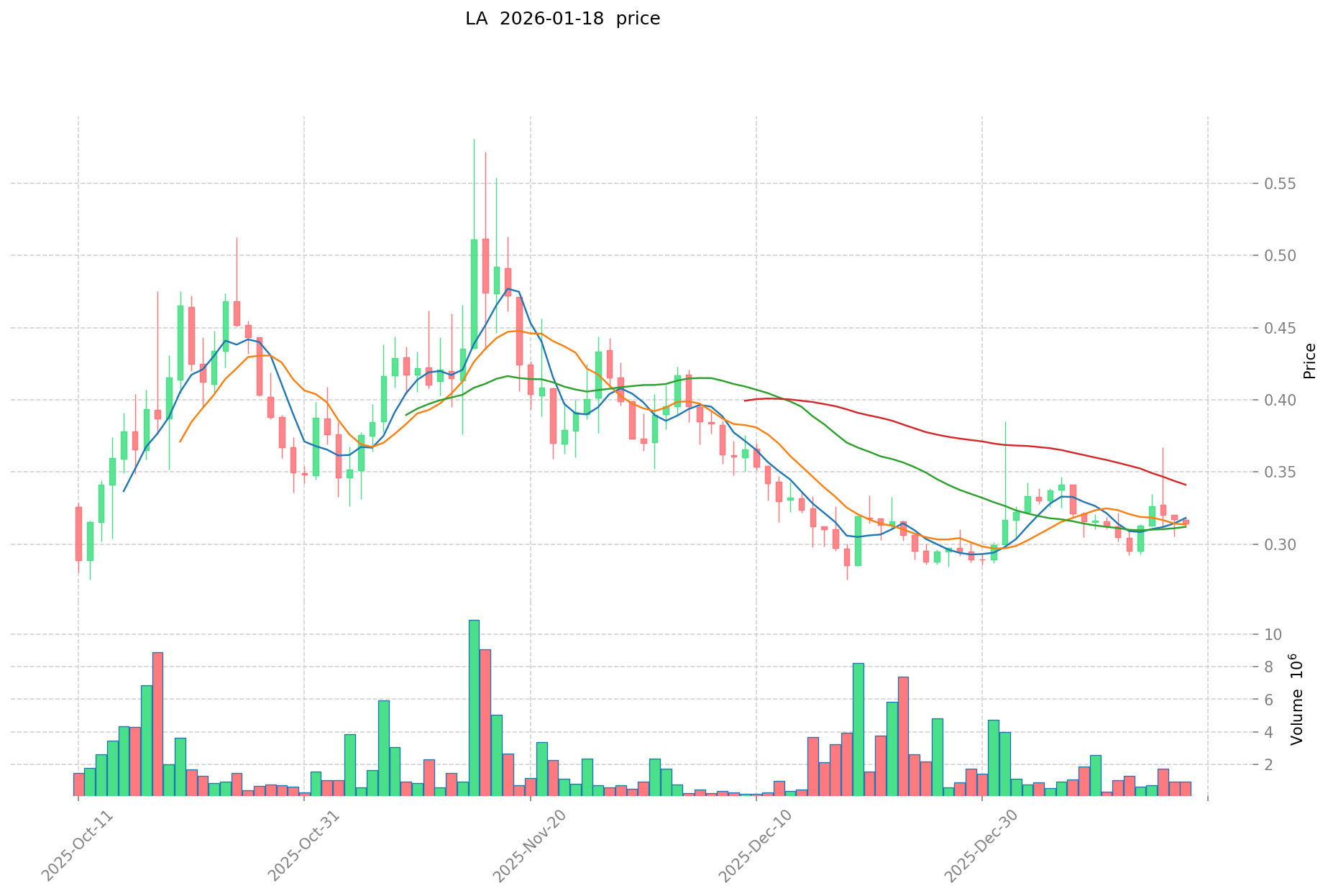
Lagrange (LA) represents a notable asset in the cryptocurrency sector, having been launched in 2025 with a focus on zero-knowledge coprocessing technology. As of January 19, 2026, LA maintains a market capitalization of approximately $61.72 million, with a circulating supply of 193 million tokens and a current price around $0.3198. The project positions itself as a Zero-Knowledge Coprocessing protocol designed to enable verifiable computations at big data scale across various blockchains. With its ranking at position 475 in the cryptocurrency market and trading on 28 exchanges, LA has garnered attention from investors examining "Is Lagrange (LA) a good investment?" This article provides a comprehensive analysis of LA's investment value, historical price movements, future price projections, and associated investment risks to serve as a reference for potential investors.
I. Lagrange (LA) Price History Review and Investment Value Status
- 2025: LA experienced notable volatility, with price fluctuations reflecting broader market dynamics
- September 2025: Price reached elevated levels around $2.2 during a market upswing
- October 2025: Market correction phase saw price movement toward lower support levels near $0.16
- Current period (January 2026): LA demonstrates recovery momentum with a 24-hour increase of 1.74%, trading at $0.3198
Current LA Investment Market Status (January 2026)
- LA Current Price: $0.3198
- 24-hour Trading Volume: $295,182.27
- Market Capitalization: $61.72 million
- Circulating Supply: 193 million tokens (19.3% of total supply)
- Recent Performance: +0.31% (1H), +1.74% (24H), +1.81% (7D), +5.12% (30D)
Click to view real-time LA market price
II. Core Factors Influencing Whether LA is a Good Investment
Supply Mechanism and Scarcity (LA Investment Scarcity)
- Total supply capped at 1,000,000,000 tokens with current circulating supply of 193,000,000 tokens (19.3% circulation ratio) → impacts price dynamics and investment value proposition
- Historical performance: LA has experienced notable price fluctuations, with previous trading ranges between $0.1647 and $2.2, demonstrating market responsiveness to supply dynamics
- Investment significance: The relatively low circulation ratio suggests potential supply expansion could influence future price action, making scarcity considerations relevant for long-term investment evaluation
Technology and Ecosystem Development (Technology & Ecosystem for LA Investment)
- Zero-Knowledge Coprocessing protocol: Enables verifiable computations at big data scale across multiple blockchains → enhances cross-chain interoperability capabilities
- Decentralized node network architecture: Executes off-chain computations and generates ZK proofs in hyper-parallel manner → unlocks efficiency and cost optimization for complex data operations
- Web3 infrastructure positioning: Protocol facilitates applications requiring complex computations over big data → supports growing demand for cross-chain solutions and zero-knowledge proof implementations
- Practical application scope: Technology enables innovations in cross-chain interoperability and data-intensive decentralized applications → provides foundational value proposition for ecosystem growth
- Recent price trends show mixed performance: 1-hour (+0.31%), 24-hour (+1.74%), 7-day (+1.81%), 30-day (+5.12%), while 1-year performance shows (-39.88%)
- Market capitalization stands at $61,721,400 with 24-hour trading volume of $295,182, indicating moderate liquidity levels
- Trading availability across 28 exchanges with 1,242 holders suggests growing but still developing market participation
- Price consolidation above 50-day Moving Average has been observed, indicating potential stabilization period following initial market activity
III. LA Future Investment Forecast and Price Outlook (Is Lagrange(LA) worth investing in 2026-2031)
Short-term Investment Outlook (2026, short-term LA investment outlook)
- Conservative estimate: $0.2816 - $0.32
- Neutral estimate: $0.32 - $0.3584
- Optimistic estimate: $0.32 - $0.3584
Mid-term Investment Outlook (2027-2029, mid-term Lagrange(LA) investment forecast)
- Market phase expectation: The token may experience gradual price appreciation as the protocol's zero-knowledge coprocessing capabilities attract more cross-chain applications and developer activity.
- Investment return forecast:
- 2027: $0.217088 - $0.478272
- 2028: $0.26976576 - $0.55588096
- 2029: $0.3954929536 - $0.5208931584
- Key catalysts: Adoption of ZK coprocessing technology across blockchain ecosystems, expansion of decentralized node network, and integration with major cross-chain protocols.
Long-term Investment Outlook (Is LA a good long-term investment?)
- Base scenario: $0.3762006144 - $0.616969007616 (assuming steady protocol development and moderate market adoption)
- Optimistic scenario: $0.49217072379904 - $0.65995619782144 (assuming accelerated adoption of zero-knowledge technology and favorable market conditions)
- Risk scenario: Below $0.2816 (in case of intense competition, technological challenges, or adverse market conditions)
For detailed LA long-term investment and price predictions, visit: Price Prediction
2026-01-19 to 2031 Long-term Outlook
- Base scenario: $0.3762006144 - $0.616969007616 (corresponding to steady progress and gradual mainstream application growth)
- Optimistic scenario: $0.49217072379904 - $0.65995619782144 (corresponding to large-scale adoption and favorable market environment)
- Transformative scenario: Above $0.65995619782144 (in case of breakthrough ecosystem developments and mainstream proliferation)
- 2031-12-31 projected high: $0.65995619782144 (based on optimistic development assumptions)
Disclaimer: The above predictions are based on historical data and market analysis models and do not constitute investment advice. Cryptocurrency markets are highly volatile, and actual prices may differ significantly from forecasts. Investors should conduct independent research and consider their risk tolerance before making any investment decisions.
| Year |
Predicted High Price |
Predicted Average Price |
Predicted Low Price |
Price Change |
| 2026 |
0.3584 |
0.32 |
0.2816 |
0 |
| 2027 |
0.478272 |
0.3392 |
0.217088 |
6 |
| 2028 |
0.55588096 |
0.408736 |
0.26976576 |
27 |
| 2029 |
0.5208931584 |
0.48230848 |
0.3954929536 |
50 |
| 2030 |
0.616969007616 |
0.5016008192 |
0.3762006144 |
56 |
| 2031 |
0.65995619782144 |
0.559284913408 |
0.49217072379904 |
74 |
IV. Lagrange (LA) Investment Strategy and Risk Management (How to invest in Zero-Knowledge Coprocessing Protocol)
Investment Methodology (Lagrange investment strategy)
Long-term Holding (HODL Lagrange): Suitable for Conservative Investors
For investors seeking stable exposure to zero-knowledge proof infrastructure, a long-term holding strategy may be considered. Lagrange's positioning in cross-chain interoperability and verifiable computation infrastructure suggests potential alignment with the broader development of blockchain scalability solutions. Long-term holders typically focus on the project's technological development milestones and ecosystem expansion rather than short-term price movements.
Active Trading: Relying on Technical Analysis and Swing Operations
Active traders may leverage Lagrange's price movements, which have shown notable fluctuations with a 24-hour change of 1.74% and a 7-day change of 1.81%. The token has demonstrated significant volatility range between its recorded low of $0.1647 and high of $2.2. Technical traders often utilize indicators such as support and resistance levels, with recent 24-hour range between $0.3089 and $0.3212 providing reference points for short-term trading strategies.
Risk Management (Risk management for Lagrange investment)
Asset Allocation Ratio: Conservative / Aggressive / Professional Investors
- Conservative Investors: May consider allocating 1-3% of their cryptocurrency portfolio to emerging infrastructure projects like Lagrange, maintaining majority holdings in established assets.
- Aggressive Investors: Could allocate 5-10% to zero-knowledge proof and coprocessing infrastructure tokens, accepting higher volatility for potential growth exposure.
- Professional Investors: May implement dynamic allocation strategies based on market conditions, technical developments, and broader sector trends in ZK technology adoption.
Risk Hedging Solutions: Multi-asset Portfolio + Hedging Tools
Diversification across different blockchain infrastructure categories can help mitigate concentration risk. Investors may consider balancing Lagrange holdings with other layer-1 protocols, scaling solutions, and established cryptocurrencies. Position sizing should account for Lagrange's relatively concentrated supply, with only 19.3% of tokens currently in circulation.
Secure Storage: Hot and Cold Wallets + Hardware Wallet Recommendations
LA tokens are deployed on the Ethereum network as ERC-20 tokens (contract address: 0x0fc2a55d5bd13033f1ee0cdd11f60f7efe66f467). For secure storage:
- Cold Storage: Hardware wallets supporting ERC-20 tokens (such as Ledger or Trezor) are recommended for long-term holdings.
- Hot Wallets: For active trading, reputable software wallets with ERC-20 support may be used, though only keeping necessary trading amounts in hot storage is advisable.
- Exchange Storage: While convenient for trading, keeping large amounts on exchanges carries counterparty risk.
V. Lagrange (LA) Investment Risks and Challenges (Risks of investing in Zero-Knowledge Coprocessing Protocol)
Market Risk: High Volatility and Price Dynamics
Lagrange has experienced substantial price fluctuations, with a year-to-date change of -39.88%, indicating significant volatility. The token's market capitalization of approximately $61.72 million and relatively limited circulating supply (193 million tokens out of 1 billion total supply) may contribute to price sensitivity. The 24-hour trading volume of approximately $295,182 suggests moderate liquidity, which may impact execution for larger trades.
Regulatory Risk: Policy Uncertainty Across Different Jurisdictions
As a zero-knowledge proof infrastructure protocol operating across multiple blockchains, Lagrange may face regulatory considerations related to:
- Cross-chain transaction compliance requirements in various jurisdictions
- Evolving regulations regarding cryptographic privacy technologies
- Potential classification and regulatory treatment of coprocessing network tokens
- Jurisdiction-specific requirements for decentralized computation networks
Investors should monitor regulatory developments in their respective regions and major cryptocurrency markets.
Technical Risk: Network Security Vulnerabilities and Upgrade Challenges
Zero-knowledge coprocessing protocols face several technical considerations:
- Smart Contract Risk: The ERC-20 token contract and associated protocols may contain undiscovered vulnerabilities.
- Network Dependency: As an off-chain computation protocol submitting proofs on-chain, Lagrange's functionality depends on the reliability of both its node network and underlying blockchains.
- Technology Evolution: The zero-knowledge proof space is rapidly evolving, with new proof systems and optimization techniques emerging regularly.
- Coordination Risk: The decentralized node network's coordination and proof generation mechanism represents a complex system with potential failure points.
VI. Conclusion: Is Zero-Knowledge Coprocessing Protocol a Good Investment?
Investment Value Summary: Lagrange represents exposure to zero-knowledge proof infrastructure and cross-chain computation, a developing sector within blockchain technology. The project's focus on verifiable off-chain computation addresses scalability challenges, though the token has experienced notable price volatility with a significant decline over the past year.
Investor Recommendations:
✅ Beginners: Consider dollar-cost averaging (DCA) strategies with secure wallet storage. Start with small allocations to understand the technology and market dynamics before increasing exposure.
✅ Experienced Investors: May implement swing trading strategies based on technical analysis while maintaining a core long-term position. Portfolio diversification across multiple infrastructure protocols can help manage sector-specific risks.
✅ Institutional Investors: Could evaluate strategic long-term allocation as part of broader blockchain infrastructure exposure, conducting thorough due diligence on technical development, team credentials, and competitive positioning.
⚠️ Important Notice: Cryptocurrency investments carry substantial risk, including the potential loss of principal. This content is provided for informational purposes only and does not constitute investment advice. Investors should conduct their own research and consult with qualified financial advisors before making investment decisions. Past performance does not indicate future results.
VII. FAQ
Q1: What is Lagrange (LA) and what makes it different from other blockchain projects?
Lagrange (LA) is a Zero-Knowledge Coprocessing protocol that enables verifiable computations at big data scale across various blockchains. Unlike traditional blockchain projects, Lagrange operates as a decentralized infrastructure layer that executes complex off-chain computations and generates ZK proofs in a hyper-parallel manner, then submits these proofs on-chain for verification. This approach addresses scalability challenges by offloading computational workloads while maintaining cryptographic verifiability, positioning LA as a cross-chain interoperability solution rather than a standalone blockchain network.
Q2: Is Lagrange (LA) a good investment for beginners in 2026?
For beginners, Lagrange presents both opportunities and challenges. While the project addresses important infrastructure needs in blockchain scalability and cross-chain computation, it carries significant volatility risk, having experienced a -39.88% year-to-date decline with price fluctuations between $0.1647 and $2.2. Beginners should consider dollar-cost averaging (DCA) strategies with allocations of 1-3% of their cryptocurrency portfolio, use secure cold storage wallets for token custody, and thoroughly research zero-knowledge proof technology before investing. The relatively low market capitalization ($61.72 million) and limited liquidity ($295,182 24-hour volume) may result in higher price sensitivity compared to established cryptocurrencies.
Q3: What are the price predictions for Lagrange (LA) through 2031?
Based on market analysis models, Lagrange's price projections show varying scenarios: For 2026, the expected range is $0.2816-$0.3584; by 2027, estimates range from $0.217088-$0.478272; and by 2031, projections range from $0.49217072 (base scenario) to $0.65995619 (optimistic scenario). These forecasts assume gradual adoption of ZK coprocessing technology, expansion of the decentralized node network, and integration with major cross-chain protocols. However, investors should note that cryptocurrency markets are highly volatile, and actual prices may differ significantly from these projections. The current price of $0.3198 suggests the token is trading within its expected 2026 range.
Q4: What are the main risks of investing in Lagrange (LA)?
Lagrange investment carries three primary risk categories: Market Risk includes high volatility (demonstrated by year-to-date decline of -39.88%), limited liquidity with moderate trading volume, and concentration risk due to only 19.3% token circulation; Regulatory Risk encompasses evolving regulations regarding cryptographic privacy technologies, cross-chain transaction compliance requirements, and uncertain classification of coprocessing network tokens across jurisdictions; Technical Risk involves potential smart contract vulnerabilities in the ERC-20 implementation, network dependency on both node operators and underlying blockchains, rapid technological evolution in zero-knowledge proof space creating competitive pressure, and coordination challenges within the decentralized computation network.
Q5: How should I store my Lagrange (LA) tokens securely?
Since LA operates as an ERC-20 token on Ethereum (contract address: 0x0fc2a55d5bd13033f1ee0cdd11f60f7efe66f467), secure storage follows standard ERC-20 best practices. For long-term holdings, hardware wallets supporting ERC-20 tokens such as Ledger or Trezor are recommended for cold storage, providing the highest security level. For active trading purposes, reputable software wallets with ERC-20 support may be used, though investors should maintain only necessary trading amounts in hot wallets. While keeping tokens on exchanges offers convenience, this approach carries counterparty risk and is not advisable for large holdings or long-term storage. Always verify contract addresses before transactions and enable all available security features including two-factor authentication.
Q6: What trading strategy is most suitable for Lagrange (LA)?
The appropriate strategy depends on investor profile: Long-term holders (HODL) should focus on the project's technological development milestones and ecosystem expansion rather than short-term price movements, suitable for conservative investors seeking exposure to zero-knowledge proof infrastructure; Active traders can leverage LA's notable volatility, with recent 24-hour range of $0.3089-$0.3212 providing reference points for technical analysis and swing operations, though this requires monitoring support/resistance levels and accepting higher risk; Balanced approach combines a core long-term position (60-70%) with a trading allocation (30-40%) to capture both potential long-term appreciation and short-term price movements, suitable for experienced investors who can manage portfolio rebalancing.
Q7: How does Lagrange's circulating supply affect its investment potential?
Lagrange's circulating supply of 193 million tokens represents only 19.3% of the total 1 billion token supply, creating several investment implications. This low circulation ratio suggests significant future supply expansion potential, which could create downward price pressure as additional tokens enter circulation through unlocking schedules or protocol distributions. However, the concentrated supply may also contribute to higher price volatility in the short term due to limited available tokens for trading. Investors should monitor token unlock schedules and distribution mechanisms, as gradual supply increases are common in emerging protocols. The current market capitalization of $61.72 million combined with this limited circulation means that relatively modest capital inflows or outflows can result in significant price movements, increasing both opportunity and risk for investors.
Q8: What are the key factors that could drive Lagrange (LA) price appreciation?
Several catalysts could positively impact LA's value: Technology adoption through increasing integration of ZK coprocessing capabilities by decentralized applications requiring complex computations over big data, particularly in DeFi, gaming, and data-intensive use cases; Ecosystem expansion via growth of the decentralized node network and partnerships with major cross-chain protocols, enhancing network effects; Market dynamics including broader adoption of zero-knowledge proof technologies across the blockchain industry, which could increase demand for specialized coprocessing infrastructure; Competitive positioning if Lagrange successfully differentiates its hyper-parallel proof generation mechanism from competing ZK solutions. However, these positive scenarios must be balanced against execution risks, competitive pressures from well-funded ZK projects, and overall cryptocurrency market conditions.
* The information is not intended to be and does not constitute financial advice or any other recommendation of any sort offered or endorsed by Gate.