Lava Network (LAVA) is a blockchain infrastructure protocol launched in July 2024 that coordinates traffic for AI agents, applications, and wallets across multiple networks. Currently trading at $0.08961 with a $39.19 million market cap, LAVA has generated over $3.5 million in protocol revenue from partnerships with NEAR, Starknet, Filecoin, and Axelar. This comprehensive analysis examines whether LAVA represents a sound investment by evaluating price history, token supply mechanics, technology fundamentals, and risk factors. The article provides price projections through 2031 ranging from conservative to optimistic scenarios, details investment strategies suitable for different investor profiles from new to institutional participants, and outlines essential risk management approaches. Investors should implement dollar-cost averaging strategies, maintain appropriate portfolio allocations (1-15% depending on risk tolerance), utilize secure hardware wallet storage, and understand that cryptocurrency investments
Introduction: Lava Network (LAVA) Investment Position and Market Prospects
Lava Network (LAVA) has emerged as a notable infrastructure protocol in the blockchain ecosystem since its launch in July 2024. The protocol coordinates traffic from AI agents, applications, and wallets across multiple blockchain networks by aggregating data providers and routing transactions based on speed and reliability metrics. As of January 20, 2026, LAVA maintains a market capitalization of approximately $39.19 million with a circulating supply of 437.33 million tokens, currently trading around $0.08961. The protocol has generated over $3.5 million in revenue, with blockchain networks including NEAR, Starknet, Filecoin, and Axelar contributing over $1 million in payments to LAVA stakers and providers. With its positioning as blockchain infrastructure that "owns the roads" connecting different networks, LAVA has attracted attention from observers evaluating "Is Lava Network (LAVA) a good investment?" This analysis examines LAVA's investment characteristics, historical price movements, future price projections, and associated risks to provide reference information for potential investors.
I. LAVA Token Price History Review and Current Investment Value Status
- July 2024: LAVA token launched at an initial price of $0.1, marking the beginning of its trading history
- December 2025: The token reached a notable price level of $0.26114 during market momentum
- January 2025: Market experienced a correction phase, with prices adjusting to lower levels from previous highs
Current LAVA Investment Market Status (January 2026)
- LAVA current price: $0.08961
- 24-hour trading volume: $335,170.76
- Circulating supply: 437,333,904 LAVA (43.73% of total supply)
- Market capitalization: $39,189,491.14
- Price movement: -0.87% (24H), +3.69% (7D), -43.11% (30D)
- 24-hour price range: $0.08914 - $0.09624
- Holder count: 4,266 addresses
- Listed on: 10 exchanges
Click to view real-time LAVA market price
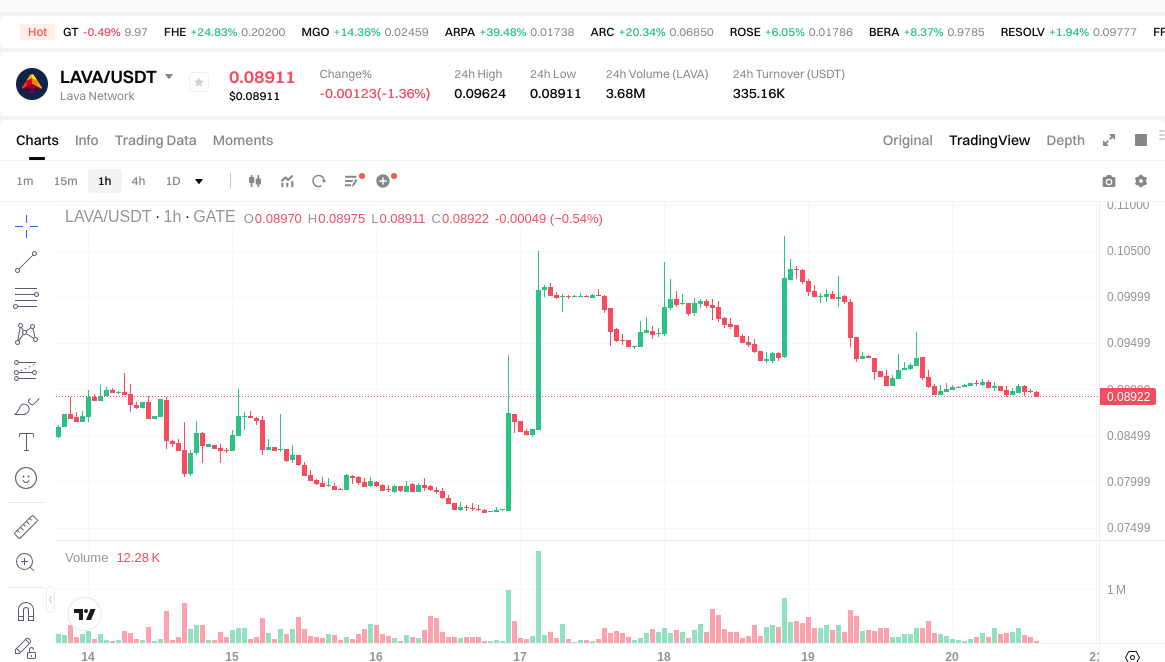
II. Core Factors Affecting Whether LAVA is a Good Investment (Is Lava Network(LAVA) a Good Investment)
Supply Mechanism and Scarcity (LAVA investment scarcity)
- Supply Structure → Impacts Price and Investment Value
- Total supply: 1,000,000,000 LAVA tokens with a maximum cap of 1,000,000,000 tokens
- Circulating supply: 437,333,904 LAVA (approximately 43.73% of total supply)
- Market cap to fully diluted valuation ratio stands at 43.73%, indicating significant locked supply
- Historical Context: LAVA experienced notable price fluctuations, with historical price movements between $0.008 (recorded in January 2025) and higher levels in December 2025
- Investment Implications: The limited circulating supply relative to total supply may create potential scarcity dynamics as the protocol expands its user base and service offerings
Institutional Investment and Mainstream Adoption (Institutional investment in LAVA)
- Revenue Generation: The protocol has secured over $3.5 million in revenue, demonstrating real-world utility and adoption
- Enterprise Integration: Major blockchain networks including NEAR, Starknet, Filecoin, and Axelar have paid LAVA stakers and providers over $1 million for ultra-reliable data services
- Holder Base: Current holder count of 4,266 addresses suggests growing community participation in the network
- Market Position: Trading on 10 exchanges with Gate.com listing, providing liquidity channels for institutional and retail participants
Macroeconomic Environment Impact on LAVA Investment
- Blockchain Infrastructure Positioning: As a protocol coordinating traffic for AI agents, applications, and wallets across multiple blockchains, LAVA operates within the growing blockchain infrastructure sector
- Market Correlation: Recent performance shows mixed trends with 30-day decline of 43.11% and 1-year decline of 41.22%, reflecting broader market conditions affecting infrastructure tokens
- Volatility Considerations: 24-hour price range between $0.08914 and $0.09624 indicates active trading dynamics influenced by market sentiment and macroeconomic factors
Technology and Ecosystem Development (Technology & Ecosystem for LAVA investment)
- Core Protocol Function: Lava aggregates data providers and routes transactions and queries based on provider speed and reliability, serving as critical infrastructure for blockchain networks
- Multi-Chain Support: The protocol coordinates traffic across multiple blockchain ecosystems, positioning itself as cross-chain infrastructure
- Revenue Model: Operating chains and applications pay LAVA stakers and providers for reliable service delivery, creating utility-driven token economics
- Application Scope: Serves AI agents, decentralized applications, and wallet services, expanding its addressable market within the evolving blockchain landscape
- Contract Deployment: LAVA token operates on Arbitrum (contract address: 0x11e969e9b3f89cb16d686a03cd8508c9fc0361af), leveraging Ethereum Layer 2 infrastructure
III. LAVA Future Investment Prediction and Price Outlook (Is Lava Network(LAVA) worth investing in 2026-2031)
Short-term Investment Prediction (2026, short-term LAVA investment outlook)
- Conservative prediction: $0.062454 - $0.08922
- Neutral prediction: $0.08922
- Optimistic prediction: $0.08922 - $0.1258002
Mid-term Investment Outlook (2027-2029, mid-term Lava Network(LAVA) investment forecast)
-
Market stage expectation: During this period, LAVA may experience gradual growth as the protocol continues to expand its data provider network and service reliability. The platform's coordination role for AI agents, applications, and wallets across blockchains could drive increased adoption.
-
Investment return prediction:
- 2027: $0.065581161 - $0.117186009
- 2028: $0.0674088327 - $0.149422912485
- 2029: $0.0994729674543 - $0.195019370403825
-
Key catalysts: Enhanced protocol revenue generation, expanded partnerships with major blockchain ecosystems, improved data provider aggregation efficiency, and growing demand for reliable blockchain infrastructure services.
Long-term Investment Outlook (Is LAVA a good long-term investment?)
- Base scenario: $0.11080765032475 - $0.167840999756607 (assuming steady protocol adoption and consistent revenue growth from stakers and providers)
- Optimistic scenario: $0.15051100915067 - $0.195019370403825 (assuming significant expansion in blockchain traffic coordination and broader ecosystem integration)
- Risk scenario: Below $0.08 (under adverse market conditions or increased competition in blockchain infrastructure services)
Click to view LAVA long-term investment and price prediction: Price Prediction
2026-01-20 - 2031 Long-term Outlook
- Base scenario: $0.11080765032475 - $0.167840999756607 (corresponding to steady progress and gradual mainstream application enhancement)
- Optimistic scenario: $0.15051100915067 - $0.195019370403825 (corresponding to large-scale adoption and favorable market environment)
- Transformational scenario: Above $0.195019370403825 (if the ecosystem achieves breakthrough progress and mainstream popularization)
- 2031-12-31 predicted high: $0.191860187488766 (based on optimistic development assumptions)
Disclaimer: These predictions are based on current market data and historical trends. Cryptocurrency investments carry substantial risk, and past performance does not guarantee future results. Investors should conduct thorough research and consider their risk tolerance before making investment decisions.
| Year |
Predicted High Price |
Predicted Average Price |
Predicted Low Price |
Price Change |
| 2026 |
0.1258002 |
0.08922 |
0.062454 |
0 |
| 2027 |
0.117186009 |
0.1075101 |
0.065581161 |
19 |
| 2028 |
0.149422912485 |
0.1123480545 |
0.0674088327 |
25 |
| 2029 |
0.195019370403825 |
0.1308854834925 |
0.0994729674543 |
46 |
| 2030 |
0.167840999756607 |
0.162952426948162 |
0.11080765032475 |
81 |
| 2031 |
0.191860187488766 |
0.165396713352384 |
0.15051100915067 |
84 |
IV. LAVA Investment Strategy and Risk Management (How to invest in Lava Network)
Investment Methodology (LAVA investment strategy)
Long-term Holding (HODL LAVA)
For conservative investors seeking exposure to blockchain infrastructure protocols, a long-term holding strategy may be considered. This approach involves:
- Dollar-Cost Averaging (DCA): Regularly purchasing LAVA tokens at predetermined intervals to mitigate the impact of price volatility
- Position Building: Gradual accumulation during market corrections or consolidation phases
- Holding Period: Maintaining positions through market cycles, typically 1-3 years or longer
This strategy suits investors who:
- Believe in the long-term development of blockchain data infrastructure
- Can tolerate short to medium-term price fluctuations
- Prefer passive management over active trading
Active Trading
For more experienced participants, active trading strategies may involve:
- Technical Analysis: Utilizing chart patterns, support/resistance levels, and momentum indicators to identify entry and exit points
- Swing Trading: Capitalizing on medium-term price movements (days to weeks) based on trend analysis
- Volume Analysis: Monitoring trading volume patterns, noting that LAVA's 24-hour trading volume stands at approximately $335,171
- Range Trading: Operating within established price ranges, with recent 24-hour boundaries between $0.08914 (low) and $0.09624 (high)
Risk Management (Risk management for LAVA investment)
Asset Allocation Ratios
Investors should calibrate their LAVA exposure according to their risk tolerance:
Conservative Investors:
- LAVA allocation: 1-3% of cryptocurrency portfolio
- Overall crypto allocation: 5-10% of total investment portfolio
- Focus on capital preservation with limited exposure to high-volatility assets
Moderate Investors:
- LAVA allocation: 3-8% of cryptocurrency portfolio
- Overall crypto allocation: 10-20% of total investment portfolio
- Balanced approach between growth potential and risk management
Aggressive Investors:
- LAVA allocation: 8-15% of cryptocurrency portfolio
- Overall crypto allocation: 20-40% of total investment portfolio
- Higher risk tolerance with focus on growth opportunities
Risk Hedging Solutions
Multi-Asset Portfolio Construction:
- Diversification across different blockchain categories (Layer 1, DeFi, infrastructure protocols)
- Combination with established cryptocurrencies to reduce portfolio volatility
- Geographic and sectoral diversification within the crypto ecosystem
Hedging Tools:
- Stablecoin reserves for opportunistic buying during market downturns
- Portfolio rebalancing strategies to maintain target allocation ratios
- Position sizing based on market capitalization and liquidity considerations
Secure Storage
Cold and Hot Wallet Management:
Hot Wallets (for active trading):
- Exchange wallets for frequent trading activities
- Mobile wallets for regular access
- Recommended allocation: 10-20% of LAVA holdings
Cold Wallets (for long-term storage):
- Hardware wallets for enhanced security
- Paper wallets or offline storage solutions
- Recommended allocation: 80-90% of LAVA holdings
Hardware Wallet Recommendations:
- Multi-signature capable devices supporting ERC-20 tokens
- Devices with secure element chips and firmware verification
- Regular security updates and reputable manufacturer support
Security Best Practices:
- Enable two-factor authentication (2FA) on all exchange accounts
- Maintain separate devices for cryptocurrency transactions
- Regularly backup wallet recovery phrases in secure, offline locations
- Verify contract addresses before transactions (LAVA contract: 0x11e969e9b3f89cb16d686a03cd8508c9fc0361af on Arbitrum)
V. LAVA Investment Risks and Challenges (Risks of investing in Lava Network)
Market Risks
High Volatility
LAVA exhibits substantial price volatility characteristic of mid-cap cryptocurrencies:
- Recent 30-day performance shows a decline of 43.11%, demonstrating significant price fluctuations
- One-year performance indicates a decrease of 41.22% from previous levels
- 24-hour price range from $0.08914 to $0.09624 represents approximately 8% intraday variation
- Market capitalization of approximately $39.19 million positions LAVA as a mid-cap asset with higher volatility compared to established cryptocurrencies
Investors should be prepared for:
- Rapid price movements in both directions
- Potential for significant drawdowns during market corrections
- Extended consolidation periods with limited price action
Price Manipulation Concerns
Mid-cap tokens with lower liquidity may face:
- Susceptibility to large orders impacting price discovery
- Lower trading volumes ($335,171 in 24-hour volume) potentially enabling concentrated market influence
- Limited order book depth affecting execution quality for larger positions
Regulatory Risks
Policy Uncertainty Across Jurisdictions
Cryptocurrency regulations vary significantly by geography:
United States:
- Evolving frameworks regarding token classifications and securities regulations
- State-level variations in cryptocurrency oversight
- Ongoing discussions regarding infrastructure provider compliance requirements
European Union:
- Implementation of Markets in Crypto-Assets (MiCA) regulation affecting operational requirements
- Changing standards for service providers and token issuers
Asia-Pacific Region:
- Diverse regulatory approaches ranging from supportive to restrictive
- Variations in licensing requirements for blockchain infrastructure providers
Global Considerations:
- Cross-border transaction regulations affecting protocol operations
- Tax treatment variations impacting investor returns
- Compliance requirements for decentralized infrastructure services
Technical Risks
Network Security Vulnerabilities
Potential technical challenges include:
- Smart Contract Risks: Vulnerabilities in protocol smart contracts deployed on Arbitrum (contract address: 0x11e969e9b3f89cb16d686a03cd8508c9fc0361af)
- Infrastructure Dependencies: Reliance on underlying blockchain networks for security and performance
- Oracle Risks: Potential issues with data provider coordination mechanisms
- Consensus Mechanism Vulnerabilities: Challenges related to validator coordination and network consensus
Protocol Upgrade Failures
Development and implementation risks:
- Potential bugs or exploits introduced during protocol updates
- Coordination challenges among network participants during upgrades
- Backward compatibility issues affecting user experience
- Migration risks when implementing new features or architecture changes
Additional Technical Considerations:
- Network congestion on the Arbitrum chain affecting transaction processing
- Interoperability challenges with supported blockchain networks
- Scalability limitations as adoption increases
- Dependency on third-party data providers for protocol functionality
VI. Conclusion: Is Lava Network a Good Investment?
Investment Value Summary
Lava Network (LAVA) represents an infrastructure protocol targeting blockchain data coordination across multiple networks. The project has reported revenue generation and partnerships with various blockchain platforms. However, the token has experienced considerable price volatility, with significant declines over recent months.
Long-term Perspective:
- The protocol addresses blockchain infrastructure needs related to data access and coordination
- Adoption by multiple blockchain networks indicates operational validation
- Market capitalization of approximately $39.19 million suggests mid-cap positioning with growth potential and elevated risk
- Circulating supply represents 43.73% of maximum supply, with remaining tokens potentially affecting future supply dynamics
Short-term Considerations:
- Recent 30-day decline of 43.11% reflects substantial price pressure
- Current price of $0.08961 significantly below all-time high of $0.26114 (December 2025)
- Limited trading volume of approximately $335,171 may impact liquidity for larger positions
Investor Recommendations
✅ New Investors
Suggested Approach:
- Implement dollar-cost averaging (DCA) strategy to mitigate timing risk
- Maintain LAVA allocation at 1-3% of cryptocurrency portfolio
- Prioritize secure storage using hardware wallets for long-term holdings
- Conduct thorough research on protocol fundamentals before investing
- Start with small positions to gain familiarity with token dynamics
Key Actions:
- Verify official contract address (0x11e969e9b3f89cb16d686a03cd8508c9fc0361af on Arbitrum) before transactions
- Enable all available security features on exchange and wallet accounts
- Monitor project developments through official channels
- Understand token economics including maximum supply of 1 billion tokens
✅ Experienced Investors
Strategic Considerations:
- Utilize technical analysis to identify optimal entry and exit points
- Implement swing trading strategies during periods of increased volatility
- Maintain diversified portfolio with LAVA as part of infrastructure protocol allocation
- Monitor on-chain metrics and protocol adoption indicators
- Consider risk-adjusted position sizing based on portfolio objectives
Advanced Strategies:
- Establish price targets and stop-loss levels based on technical and fundamental analysis
- Track developments in supported blockchain networks for potential catalysts
- Evaluate competitive positioning relative to other data infrastructure protocols
- Adjust allocation based on changing market conditions and protocol metrics
✅ Institutional Investors
Evaluation Framework:
- Conduct comprehensive due diligence on protocol architecture and security measures
- Assess long-term viability within blockchain infrastructure landscape
- Evaluate governance structure and token utility mechanisms
- Consider strategic allocation as part of broader blockchain infrastructure thesis
- Implement institutional-grade custody and security protocols
Risk Assessment:
- Analyze liquidity profile relative to institutional position sizes
- Evaluate counterparty and custodial risks
- Monitor regulatory developments affecting infrastructure protocols
- Establish clear investment thesis with defined metrics and exit criteria
⚠️ Important Disclaimer
Cryptocurrency investments carry substantial risk and may not be suitable for all investors. Digital assets are highly volatile and can experience rapid price fluctuations. This content is provided for informational purposes only and does not constitute investment advice, financial advice, trading advice, or any other type of recommendation. Investors should:
- Conduct independent research and due diligence
- Consult with qualified financial advisors before making investment decisions
- Only invest amounts they can afford to lose completely
- Understand that past performance does not indicate future results
- Be aware of the risks associated with cryptocurrency investments including total loss of capital
The information presented reflects market conditions and data as of January 20, 2026, and may change rapidly.
VII. FAQ
Q1: What is the current price of Lava Network (LAVA) and how has it performed historically?
As of January 20, 2026, LAVA trades at approximately $0.08961 with a market capitalization of $39.19 million. The token launched in July 2024 at $0.1, reached a peak of $0.26114 in December 2025, but has since experienced significant correction, declining 43.11% over the past 30 days and 41.22% over the past year. The 24-hour trading volume stands at approximately $335,171, with the price ranging between $0.08914 and $0.09624 during the last trading day.
Q2: What makes Lava Network valuable as blockchain infrastructure?
Lava Network functions as critical infrastructure that coordinates traffic from AI agents, applications, and wallets across multiple blockchain networks. The protocol aggregates data providers and routes transactions based on speed and reliability metrics, essentially "owning the roads" connecting different networks. The project has generated over $3.5 million in revenue, with major blockchain networks including NEAR, Starknet, Filecoin, and Axelar paying LAVA stakers and providers over $1 million for reliable data services, demonstrating real-world utility and adoption.
Q3: What is the token supply structure of LAVA?
LAVA has a maximum total supply of 1,000,000,000 tokens, with a current circulating supply of 437,333,904 tokens (approximately 43.73% of total supply). This means that over 56% of the total supply remains locked or unvested, which could potentially impact future price dynamics as tokens are gradually released into circulation. The token operates on Arbitrum with the contract address 0x11e969e9b3f89cb16d686a03cd8508c9fc0361af.
Q4: What are the predicted price ranges for LAVA through 2031?
Short-term predictions for 2026 range from $0.062454 to $0.1258002. Mid-term forecasts suggest gradual growth: 2027 ($0.065581161 - $0.117186009), 2028 ($0.0674088327 - $0.149422912485), and 2029 ($0.0994729674543 - $0.195019370403825). Long-term projections for 2030-2031 range from a base scenario of $0.11080765032475 to $0.167840999756607, with an optimistic scenario reaching $0.15051100915067 to $0.195019370403825. The 2031 predicted high stands at $0.191860187488766, though these projections carry substantial uncertainty.
Q5: What are the main risks associated with investing in LAVA?
LAVA faces multiple investment risks including: (1) High volatility, demonstrated by the recent 43.11% decline over 30 days and substantial price fluctuations, (2) Liquidity concerns, with relatively low 24-hour trading volume of $335,171 that may affect larger position executions, (3) Regulatory uncertainty across different jurisdictions affecting blockchain infrastructure providers, (4) Technical risks related to smart contract vulnerabilities and protocol upgrade failures, and (5) Market manipulation potential due to its mid-cap positioning. Investors should only allocate capital they can afford to lose completely.
Q6: How should different types of investors approach LAVA?
New investors should implement dollar-cost averaging (DCA) strategies, maintain LAVA allocation at 1-3% of their cryptocurrency portfolio, and prioritize secure hardware wallet storage. Experienced investors may utilize technical analysis for swing trading opportunities while maintaining LAVA as part of a diversified infrastructure protocol allocation (3-8% of crypto portfolio). Institutional investors should conduct comprehensive due diligence on protocol architecture, assess long-term viability within the blockchain infrastructure landscape, and implement institutional-grade custody solutions. All investor types should verify the official contract address and enable maximum security features.
Q7: What security measures should LAVA investors implement?
Investors should employ a multi-layered security approach: (1) Allocate 80-90% of LAVA holdings to cold storage using hardware wallets with secure element chips, (2) Keep only 10-20% in hot wallets for active trading, (3) Enable two-factor authentication (2FA) on all exchange accounts, (4) Verify the official contract address (0x11e969e9b3f89cb16d686a03cd8508c9fc0361af on Arbitrum) before executing any transactions, (5) Maintain separate devices for cryptocurrency transactions, and (6) Regularly backup wallet recovery phrases in secure, offline locations. Hardware wallets should support multi-signature capabilities and receive regular security updates.
Q8: What factors could drive LAVA's future price appreciation?
Potential positive catalysts include: (1) Enhanced protocol revenue generation from expanding data provider networks, (2) Increased partnerships with major blockchain ecosystems beyond current collaborators (NEAR, Starknet, Filecoin, Axelar), (3) Growing demand for reliable blockchain infrastructure services as AI agents and decentralized applications proliferate, (4) Improved data provider aggregation efficiency and routing capabilities, (5) Broader mainstream adoption of multi-chain coordination services, and (6) Favorable regulatory developments for blockchain infrastructure providers. However, these factors remain speculative and depend on market conditions and successful execution by the development team.
* The information is not intended to be and does not constitute financial advice or any other recommendation of any sort offered or endorsed by Gate.