This comprehensive analysis examines whether LayerZero (ZRO) represents a sound investment opportunity in 2024 and beyond. As of January 2026, ZRO trades at $1.613 with a $326.84 million market cap, positioned as a foundational omnichain interoperability protocol enabling lightweight cross-chain messaging across Ethereum and Arbitrum networks. The article evaluates ZRO's price history spanning from $0.859 lows to $7.557 December 2024 peaks, assesses core investment factors including supply mechanisms and institutional adoption, and projects future price scenarios ranging from $1.10-$2.10 by 2026 to $2.84-$4.03 by 2031. Key investment strategies address long-term holding and active trading approaches with differentiated risk management for conservative, aggressive, and professional investors. Critical risk factors include high volatility, regulatory uncertainties, and technical dependencies, while opportunities stem from growing cross-chain ecosystem adoption. The analysis concludes that LayerZero suits experi
Introduction: LayerZero (ZRO) Investment Position and Market Outlook
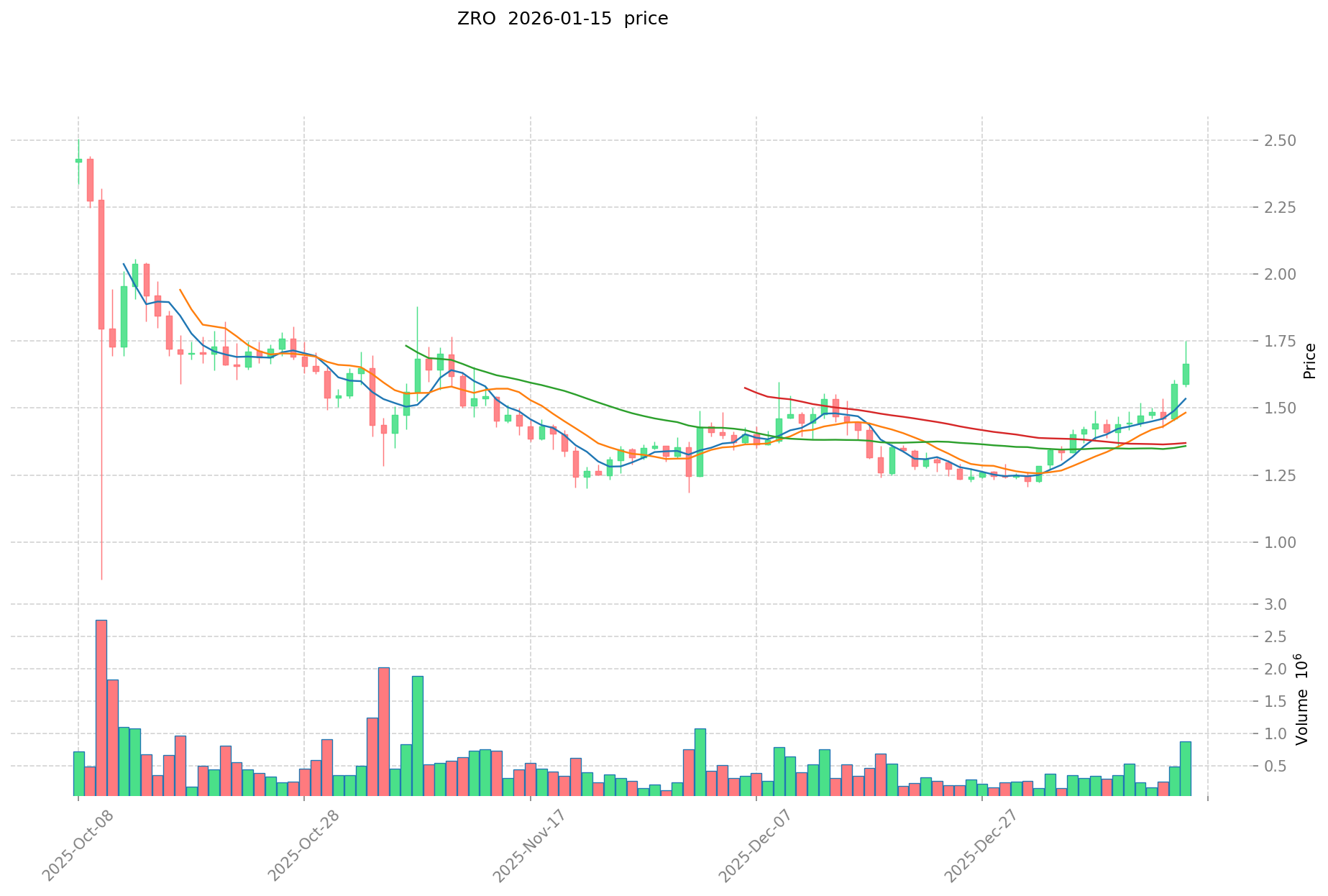
ZRO is a significant asset in the cryptocurrency space. Launched in 2024, it has made notable progress in the omnichain interoperability domain. As of January 15, 2026, LayerZero holds a market capitalization of approximately $326.84 million, with a circulating supply of around 202.63 million tokens, and a current price near $1.613. With its positioning as an interoperability protocol for lightweight cross-chain messaging, ZRO has gradually become a focal point when investors discuss "Is LayerZero (ZRO) a good investment?" This article provides a comprehensive analysis of ZRO's investment characteristics, historical price movements, future price projections, and associated risks to serve as a reference for investors.
I. ZRO Price History Review and Investment Value Status
- 2024: Token launched on June 20 at initial price of $4.41 → Price showed volatility throughout the year
- 2024: December peak reached → ZRO climbed to $7.557 before market correction
- 2025: Market adjustment phase → Price declined from December 2024 peak to $0.859 level by October 2025
Current ZRO Investment Market Status (January 2026)
- ZRO current price: $1.613
- Market sentiment (Fear & Greed Index): Data indicates cautious market positioning
- 24-hour trading volume: $1,498,670.54
- Market capitalization: $326.84 million with 20.26% of maximum supply in circulation
Click to view real-time ZRO market price
II. Core Factors Influencing Whether ZRO is a Good Investment
Supply Mechanism and Scarcity (ZRO investment scarcity)
- Max supply capped at 1,000,000,000 tokens → impacts price dynamics and investment value
- Current circulating supply represents approximately 20.26% of total supply, with 202,629,028 tokens in circulation
- Historical context: ZRO reached $7.557 in December 2024, while the fully diluted market cap stands at $1.613 billion, indicating potential for future price movements as more tokens enter circulation
- Investment significance: controlled supply release mechanism may support long-term value proposition
Institutional Investment and Mainstream Adoption (Institutional investment in ZRO)
- ZRO is listed on major exchanges including Gate.com, with trading availability across Ethereum and Arbitrum networks
- Token holders have grown to 22,504 participants, reflecting expanding community engagement
- The protocol's focus on omnichain interoperability positions it within the growing cross-chain infrastructure sector
- Adoption trends: LayerZero's lightweight message-passing technology serves as foundational infrastructure for blockchain interoperability applications
Macroeconomic Environment's Impact on ZRO Investment
- Market capitalization share of 0.047% indicates positioning as a mid-cap asset within the broader cryptocurrency market
- Trading volume of $1,498,670.54 over 24 hours suggests moderate liquidity conditions
- Recent performance shows 15.47% gain over 7 days and 14.57% increase over 30 days, though 1-year performance reflects -63.63% decline from previous levels
- Volatility considerations: 24-hour price range between $1.59 and $1.75 demonstrates typical crypto asset fluctuations
Technology and Ecosystem Development (Technology & Ecosystem for ZRO investment)
- Core technology: LayerZero implements an omnichain interoperability protocol designed for lightweight cross-chain message passing
- Technical features: provides authentic and guaranteed message delivery with configurable trustlessness through gas-efficient, non-upgradable smart contracts
- Multi-chain deployment: ZRO operates on Ethereum (ERC20) and Arbitrum networks, enabling broader ecosystem reach
- Infrastructure role: the protocol serves as foundational layer for cross-chain applications including DeFi protocols, NFT platforms, and decentralized applications requiring interoperability
- Documentation availability: technical whitepaper (V2.1.0) provides detailed specifications for developers and investors conducting due diligence
III. ZRO Future Investment Forecast and Price Outlook (Is LayerZero(ZRO) worth investing in 2026-2030)
Short-term Investment Outlook (2026, short-term ZRO investment outlook)
- Conservative Forecast: $1.10 - $1.45
- Neutral Forecast: $1.45 - $1.68
- Optimistic Forecast: $1.68 - $2.10
Mid-term Investment Outlook (2027-2028, mid-term LayerZero(ZRO) investment forecast)
- Market Phase Expectation: Based on market sentiment analysis, ZRO may experience moderate growth as the protocol continues expanding its cross-chain interoperability ecosystem across multiple blockchains.
- Investment Return Forecast:
- 2027: $1.04 - $2.14 (approximately 15% potential change from 2026 baseline)
- 2028: $1.94 - $2.92 (approximately 23% potential change from 2026 baseline)
- Key Catalysts: Cross-chain protocol adoption trends, expansion of supported blockchain networks, and development of omnichain decentralized applications may influence mid-term performance.
Long-term Investment Outlook (Is ZRO a good long-term investment?)
- Baseline Scenario: $2.05 - $2.84 by 2030 (assuming continued protocol development and steady ecosystem expansion)
- Optimistic Scenario: $2.84 - $4.03 by 2031 (assuming accelerated adoption of cross-chain solutions and broader market acceptance)
- Risk Scenario: Below $1.04 (under adverse market conditions or significant competitive pressure)
Click to view ZRO long-term investment and price forecast: Price Prediction
2026-01-15 to 2031 Long-term Outlook
- Base Scenario: $1.10 - $2.84 USD (corresponding to steady progress and mainstream application advancement)
- Optimistic Scenario: $2.84 - $4.03 USD (corresponding to large-scale adoption and favorable market environment)
- Transformative Scenario: Above $4.03 USD (if ecosystem achieves breakthrough developments and mainstream adoption)
- 2031-12-31 Forecast High: $4.03 USD (based on optimistic development assumptions)
Disclaimer: Cryptocurrency markets are highly volatile and unpredictable. Price forecasts are based on current market data, historical patterns, and various analytical models, but actual results may differ significantly. These projections should not be considered as investment advice or guarantees of future performance. Investors should conduct their own research and consider their risk tolerance before making any investment decisions.
| Year |
Predicted High Price |
Predicted Average Price |
Predicted Low Price |
Price Change |
| 2026 |
2.1021 |
1.617 |
1.09956 |
0 |
| 2027 |
2.1384825 |
1.85955 |
1.041348 |
15 |
| 2028 |
2.918563725 |
1.99901625 |
1.9390457625 |
23 |
| 2029 |
2.729256886125 |
2.4587899875 |
1.376922393 |
52 |
| 2030 |
3.086887889806875 |
2.5940234368125 |
2.049278515081875 |
60 |
| 2031 |
4.033447041899756 |
2.840455663309687 |
1.959914407683684 |
76 |
IV. LayerZero Investment Strategy and Risk Management (How to invest in omnichain interoperability)
Investment Methodology (ZRO investment strategy)
Long-term Holding (HODL ZRO)
For conservative investors seeking exposure to cross-chain infrastructure, long-term holding represents a foundational approach. This strategy aligns with the gradual development of omnichain technology adoption. Investors should consider the protocol's circulating supply of approximately 202.63 million ZRO tokens against a maximum supply of 1 billion, representing a circulation ratio of about 20.26%. This limited circulation suggests potential supply dynamics that may influence long-term value.
Dollar-cost averaging could serve as an effective accumulation method, particularly given the asset's historical volatility range between $0.859 and $7.557. Long-term holders should monitor the protocol's technical development milestones and cross-chain integration progress as fundamental indicators.
Active Trading
Active traders may leverage technical analysis and momentum strategies, considering ZRO's recent price movements showing a 15.47% gain over 7 days and 14.57% over 30 days as of January 15, 2026. The 24-hour trading range between $1.59 and $1.75 demonstrates intraday volatility that may present swing trading opportunities.
Key technical levels to monitor include the current price of $1.613, with the all-time low at $0.859 potentially serving as a significant support reference. Trading volume of approximately $1.5 million in 24 hours should be factored into liquidity assessments.
Risk Management (Risk management for ZRO investment)
Asset Allocation Ratios
Conservative Investors: Consider allocating 1-3% of crypto portfolio to infrastructure protocols like LayerZero, balancing exposure to cross-chain technology while maintaining predominant positions in established assets.
Aggressive Investors: May allocate 5-10% to emerging infrastructure protocols, accepting higher volatility for potential growth in the omnichain ecosystem.
Professional Investors: Could implement dynamic allocation strategies based on protocol adoption metrics, technical developments, and market cycles, potentially ranging from 3-15% depending on risk parameters.
Risk Hedging Strategies
Multi-asset portfolio construction should include:
- Core holdings in established cryptocurrencies to balance infrastructure exposure
- Diversification across different blockchain sectors beyond interoperability protocols
- Consideration of correlation patterns between ZRO and broader market movements
Given the asset's year-over-year decline of 63.63%, investors should implement position sizing that accounts for potential drawdowns and avoid overconcentration.
Secure Storage
Cold Wallet Solutions: For long-term holdings, hardware wallets supporting ERC-20 tokens are recommended, as ZRO operates on Ethereum and Arbitrum networks.
Hot Wallet Considerations: For active trading portions, utilize reputable exchange wallets with two-factor authentication and withdrawal whitelisting.
Multi-signature Options: Institutional or high-net-worth investors should evaluate multi-signature wallet solutions for enhanced security of significant positions.
V. LayerZero Investment Risks and Challenges (Risks of investing in omnichain interoperability)
Market Risks
High Volatility: The price range from $0.859 to $7.557 within the past year demonstrates substantial volatility. Short-term fluctuations can be significant, with 1-hour price changes showing 0.25% movements. This volatility may result in rapid portfolio value changes and requires psychological preparedness for price swings.
Price Discovery: With a market capitalization of approximately $326.8 million and fully diluted valuation of $1.613 billion, the asset maintains a market cap to FDV ratio of 20.26%, indicating substantial future supply yet to enter circulation. This dynamic may influence price discovery as token distribution progresses.
Market Depth: Trading volume relative to market capitalization should be monitored to assess liquidity conditions and potential slippage in larger transactions.
Regulatory Risks
Jurisdictional Uncertainty: Cross-chain protocols operate across multiple blockchain networks, potentially creating complex regulatory considerations in different jurisdictions. Evolving frameworks for interoperability protocols may impact operational parameters.
Compliance Evolution: As regulatory standards for blockchain infrastructure develop globally, protocols facilitating cross-chain transactions may face varying compliance requirements that could affect functionality or adoption rates.
Policy Shifts: Changes in cryptocurrency regulation across major markets could influence the broader ecosystem in which LayerZero operates, affecting market sentiment and adoption trajectories.
Technical Risks
Protocol Security: As an interoperability protocol designed for cross-chain message passing, LayerZero's architecture involves complex technical components. While implemented as non-upgradable smart contracts according to available information, the interaction between multiple blockchain networks introduces technical considerations.
Network Dependencies: The protocol's functionality depends on the operational status and security of connected blockchain networks. Issues on integrated chains could potentially affect protocol operations.
Technological Evolution: The competitive landscape of cross-chain solutions continues developing. Emergence of alternative interoperability approaches or technological shifts could influence long-term positioning.
VI. Conclusion: Is Omnichain Interoperability a Good Investment?
Investment Value Summary
LayerZero represents exposure to cross-chain infrastructure development, a sector addressing blockchain interoperability challenges. The protocol's position in the omnichain ecosystem, with a market capitalization of approximately $326.8 million and presence on major networks including Ethereum and Arbitrum, reflects established market recognition.
The asset has demonstrated considerable price volatility, with performance ranging from a 15.47% gain over 7 days to a 63.63% decline over one year as of January 15, 2026. This pattern suggests both growth potential and significant risk factors that investors should carefully evaluate.
Long-term investment potential relates to the broader adoption of cross-chain technology and LayerZero's role in enabling message passing across blockchain networks. However, short-term price movements may remain influenced by market sentiment, regulatory developments, and competitive dynamics.
Investor Recommendations
✅ Beginners: Consider starting with small position sizes through dollar-cost averaging strategies. Prioritize secure storage using hardware wallets supporting ERC-20 tokens. Focus on understanding the fundamentals of interoperability protocols before making investment decisions.
✅ Experienced Investors: May implement momentum-based strategies leveraging technical analysis, while maintaining disciplined position sizing. Portfolio allocation should reflect risk tolerance and consider diversification across different blockchain sectors. Monitor protocol development updates and cross-chain adoption metrics.
✅ Institutional Investors: Could evaluate strategic allocation to infrastructure protocols as part of broader blockchain ecosystem exposure. Consider longer-term holding periods aligned with technology adoption cycles, while implementing comprehensive risk management frameworks including position limits and rebalancing protocols.
⚠️ Disclaimer: Cryptocurrency investments carry substantial risk including potential loss of principal. Market volatility, regulatory uncertainty, and technical factors may significantly impact asset values. This analysis is provided for informational purposes only and does not constitute financial advice. Investors should conduct independent research and consult qualified financial advisors before making investment decisions.
VII. FAQ
Q1: Is LayerZero (ZRO) suitable for beginners starting their first cryptocurrency investment?
For absolute beginners, ZRO represents a higher-risk investment due to significant volatility and infrastructure-focused positioning. New investors should start with small allocations (1-3% of portfolio) using dollar-cost averaging to mitigate price fluctuation risks. The asset's 63.63% decline over one year and price range from $0.859 to $7.557 demonstrates substantial volatility that requires psychological preparation. Beginners must prioritize secure storage using hardware wallets supporting ERC-20 tokens and thoroughly understand cross-chain interoperability concepts before investing. Starting with established cryptocurrencies while gradually learning about infrastructure protocols may provide a more stable entry point.
Q2: What makes LayerZero different from other blockchain investment opportunities?
LayerZero focuses specifically on omnichain interoperability rather than being a standalone blockchain or DeFi application. Its core value proposition lies in enabling lightweight cross-chain message passing through non-upgradable smart contracts, positioning it as infrastructure for blockchain communication. With only 20.26% of maximum supply (202.63 million of 1 billion tokens) currently in circulation, the token economics differ from fully circulating assets. The protocol operates across multiple networks including Ethereum and Arbitrum, providing foundational technology for cross-chain applications. This infrastructure role means investment performance correlates with broader adoption of multi-chain ecosystems rather than individual protocol metrics alone.
Q3: How should investors approach ZRO's significant price decline from its December 2024 peak of $7.557?
The 78.66% decline from the December 2024 peak to the current $1.613 level reflects broader market corrections and requires careful risk assessment. Conservative investors might view current levels as potential accumulation points if fundamental protocol development remains on track, though further decline to the $0.859 low remains possible. Technical analysis suggests monitoring the $1.59-$1.75 trading range for support and resistance levels. Rather than attempting to time market bottoms, dollar-cost averaging over extended periods may reduce timing risk. Investors should evaluate whether LayerZero's cross-chain adoption progress justifies current valuation, recognizing that recovery to previous highs depends on both protocol development and favorable market conditions.
Q4: What are the main risks that could negatively impact LayerZero investment returns?
Three primary risk categories affect ZRO investment: market volatility demonstrated by price swings between $0.859 and $7.557; regulatory uncertainty surrounding cross-chain protocols operating across multiple jurisdictions; and technical risks inherent in complex interoperability infrastructure. The 79.74% circulation gap (only 20.26% of tokens currently circulating) presents supply inflation risk as more tokens enter markets. Competition from alternative interoperability solutions could reduce market share and adoption. Network dependencies mean security issues on connected blockchains may affect protocol operations. Additionally, the relatively modest 24-hour trading volume of $1.5 million versus $326.8 million market cap suggests liquidity constraints during large transactions.
Q5: What price targets are realistic for LayerZero by 2030?
Price projections for 2030 range from $2.05 to $2.84 in baseline scenarios assuming steady protocol development and ecosystem expansion, with optimistic scenarios reaching $2.84 to $4.03 if cross-chain adoption accelerates significantly. These forecasts assume continued growth in omnichain applications and favorable market conditions. However, adverse scenarios below $1.04 remain possible under competitive pressure or market downturns. Current price of $1.613 suggests potential upside of 75-150% over four years in optimistic cases, though investors should note that achieving $7.557 previous highs would require 368% appreciation. These projections carry substantial uncertainty and should not be interpreted as guaranteed returns, as cryptocurrency markets remain highly unpredictable.
Q6: How much of a portfolio should be allocated to LayerZero for optimal risk-reward balance?
Allocation recommendations vary by investor profile and risk tolerance. Conservative investors should consider 1-3% allocation within cryptocurrency portfolios, maintaining predominant positions in established assets while gaining exposure to cross-chain infrastructure. Aggressive investors comfortable with higher volatility may allocate 5-10%, accepting drawdown risks for potential growth in omnichain ecosystems. Professional investors might implement dynamic allocations ranging 3-15% based on protocol adoption metrics and market cycle positioning. Given ZRO's 63.63% year-over-year decline and infrastructure focus, position sizing should account for potential continued volatility. Diversification across blockchain sectors beyond interoperability protocols remains critical, as concentration in single infrastructure plays increases portfolio risk substantially.
Q7: What developments should investors monitor to evaluate LayerZero's investment prospects?
Key monitoring factors include protocol adoption metrics across supported blockchain networks, growth in holder count beyond current 22,504 participants, and expansion of cross-chain applications utilizing LayerZero infrastructure. Technical development milestones documented in protocol updates and whitepaper revisions signal ongoing innovation. Trading volume trends relative to market capitalization indicate changing liquidity conditions and market interest. Regulatory developments affecting cross-chain protocols across major jurisdictions may significantly impact operational parameters. Competitive positioning versus alternative interoperability solutions affects long-term market share potential. Supply distribution patterns as the remaining 79.74% of tokens enter circulation will influence price dynamics, making token release schedules important tracking metrics for informed investment decisions.
Q8: Should investors buy LayerZero now or wait for lower prices given recent market conditions?
Timing decisions depend on individual investment strategies and market outlooks. Current price of $1.613 sits 87.7% above the $0.859 all-time low but 78.66% below the $7.557 peak, suggesting neither extreme valuation. Recent positive momentum showing 15.47% gains over 7 days and 14.57% over 30 days may indicate emerging strength, though one-year performance remains negative 63.63%. Dollar-cost averaging strategies reduce timing risk by spreading purchases across market cycles rather than attempting single optimal entry points. Investors should evaluate whether LayerZero's fundamental protocol development and cross-chain adoption trajectory justify current valuation before committing capital. Waiting for confirmation of sustained uptrend or additional price weakness both represent valid approaches depending on risk tolerance and conviction levels regarding the omnichain interoperability thesis.
* The information is not intended to be and does not constitute financial advice or any other recommendation of any sort offered or endorsed by Gate.